
A manufacturing operator wanted faster control-loop response and lower bandwidth costs, but the edge sites were spread across a metro industrial park. This article explains how we modeled edge computing ROI and used optical transceiver decisions to make the business case hold up in the real world. It helps network engineers, operations leaders, and procurement teams who need measurable outcomes, not assumptions.
Problem and challenge: why edge ROI failed without optical clarity
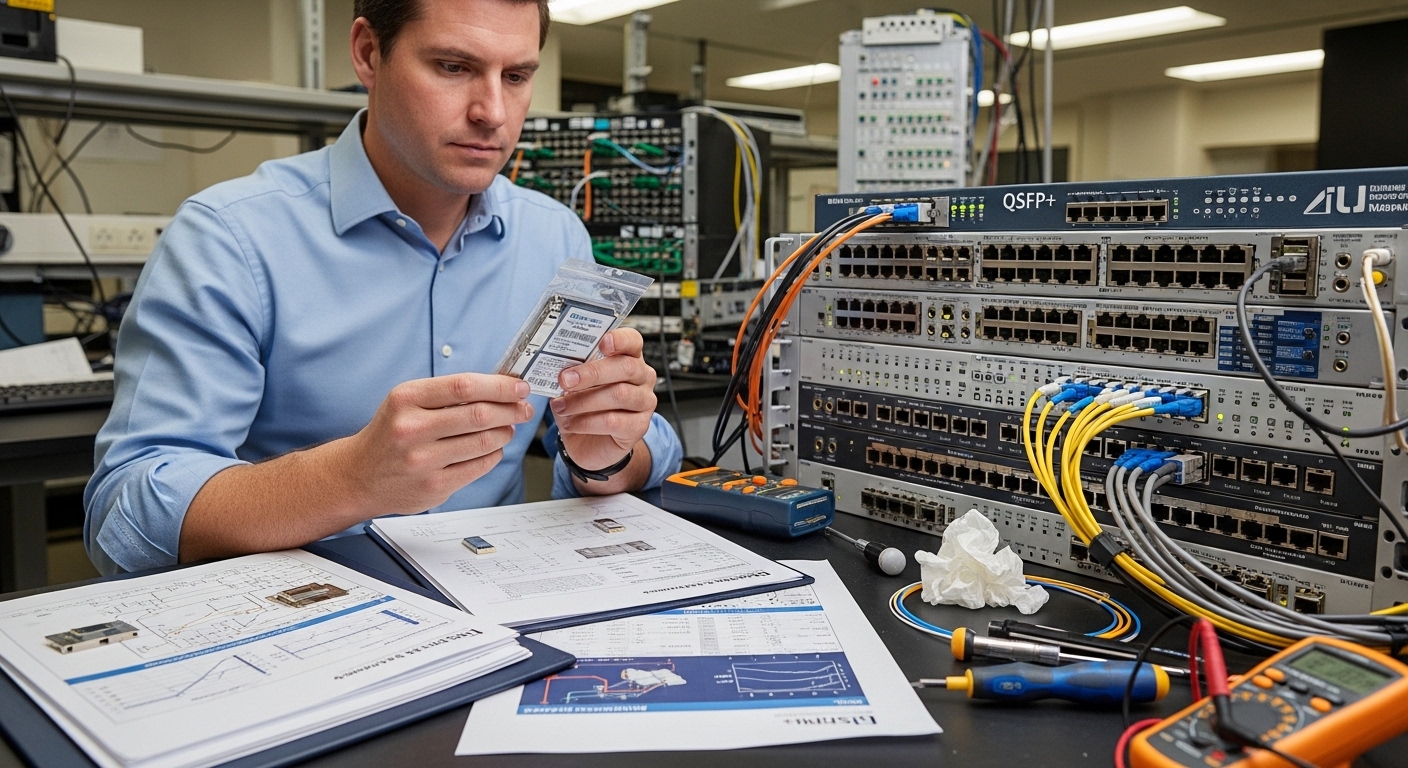
In our pilot, we deployed edge compute nodes at 12 production cells to run video analytics and local PLC orchestration. The challenge was not just compute placement; it was the transport layer. Each cell generated roughly 8 cameras at 1080p30, with streams aggregated into a site uplink that had to support predictable latency. When we initially reused existing copper uplinks and mixed optics, we saw congestion and retransmissions that erased the expected control-loop gains.
We then built an ROI model around three cost drivers: (1) bandwidth overbuild for the cloud, (2) truck rolls and replacement downtime, and (3) power and cooling at both the data center and edge. Optical solutions mattered because the transceivers and cabling defined whether the edge network could sustain required throughput under temperature and link-budget constraints. In practice, the ROI depended on getting link stability and compatibility right across switch vendors and fiber runs.
Environment specs: the physical and network constraints that shaped ROI
Our target architecture was a 3-tier layout: cell edge nodes connected to a local aggregation switch, then uplinked to a site distribution switch, and finally to the metro core. The uplink distance averaged 300 to 900 meters per cell, with a few runs up to 1.2 km through industrial corridors. We used multimode fiber for most runs but had several legacy sections where only singlemode was available.
On the switching side, the aggregation layer used common enterprise and campus platforms with pluggable optics support. We standardized on 10G at the edge-to-aggregation hop and 25G for aggregation-to-distribution where upstream oversubscription was high. For optics, we evaluated vendor datasheets and ensured the modules met IEEE-referenced electrical/optical expectations for SFP+ and SFP28 class interfaces. For physical layer baselines, we anchored our planning to the relevant Ethernet PHY behavior described in IEEE 802.3 and vendor-specific compliance notes.
| Parameter | 10G Short-Reach (SFP+) | 25G Short-Reach (SFP28) | Longer-Reach (SFP+ LR class) |
|---|---|---|---|
| Typical use in our edge | Edge node to aggregation (MMF) | Aggregation to distribution (MMF) | Legacy SMF segments |
| Data rate | 10.3125 Gb/s | 25.78125 Gb/s | 10.3125 Gb/s |
| Wavelength | 850 nm | 850 nm | 1310 nm |
| Reach (typical) | ~300 m (OM3) / ~400 m (OM4) | ~100 m (OM3) / ~150 m (OM4) | ~10 km |
| Connector | LC | LC | LC |
| Power (module class) | Typically a few watts (varies) | Typically slightly higher (varies) | Typically a few watts (varies) |
| Operating temperature | Commercial or industrial options (check datasheet) | Commercial or industrial options (check datasheet) | Commercial or industrial options (check datasheet) |
| Standards context | Ethernet PHY behavior per IEEE 802.3 references | Ethernet PHY behavior per IEEE 802.3 references | Ethernet PHY behavior per IEEE 802.3 references |
We also checked module DOM (digital optical monitoring) support because our NOC needed real-time thresholds for temperature, bias current, and received power. In our environment, industrial racks faced hot spots near power supplies; DOM visibility reduced mean time to repair by enabling early detection of degradation.
Chosen solution: optics that stabilized links and protected the ROI model
We selected a mix of short-reach multimode optics for the majority of runs and LR-class singlemode optics for the legacy sections. For concrete part choices, we used examples like Cisco SFP-10G-SR class optics where ecosystem compatibility was critical, and equivalent third-party models where switch vendor compatibility and DOM worked reliably. On the 25G side, we validated modules such as Finisar FTLX8571D3BCL class 25G SR optics and also compared with FS.com SFP-10GSR-85 style short-reach options for cost benchmarking.
The ROI logic was straightforward: stable links reduce retransmissions and packet loss, which reduces CPU overhead on edge analytics pipelines and lowers the need for bandwidth overprovisioning. It also reduces truck rolls by catching marginal optics early through DOM. In a deployment with 12 edge sites, even small improvements in downtime and support calls have outsized financial impact.
Pro Tip: In field deployments, DOM telemetry thresholds matter as much as the nominal reach. We set alerts on received optical power drift (not just link up/down), which surfaced cleaning needs and connector aging weeks before any visible outage.
Implementation steps: how we deployed optics without breaking compatibility
We ran the implementation as a controlled program with a test-to-production gate. First, we audited fiber types (OM3 vs OM4 vs singlemode), connector cleanliness, and patch panel loss using an OTDR where feasible. Second, we mapped every edge cell to a specific optics profile based on measured loss and connector type, rather than relying on “typical” reach claims.
Link-loss verification and optics mapping
For multimode runs, we targeted conservative margins by using real measurements of end-to-end attenuation and accounting for patch cords and splices. For singlemode LR segments, we confirmed that dispersion and loss matched the module class expectations. This reduced the risk of marginal links that only fail under temperature swings or after connector contamination.
Switch compatibility and DOM validation
Before ordering bulk quantities, we validated optics in a staging rack with the exact switch models. We checked that the optics were recognized, that DOM fields populated in the management plane, and that optical alarms were exposed to the monitoring system. Where a module was recognized but DOM was incomplete, we treated it as a risk because it would delay detection.
Operational controls for fiber hygiene
We used a repeatable cleaning workflow for LC connectors and implemented a “no dirty connector” policy during swaps. In parallel, we configured NOC alerts for optical power thresholds and for interface error counters. This allowed the team to correlate analytics performance issues with physical layer degradation quickly.
Measured results: what improved edge computing ROI after the optical changes
After the standardized optics deployment, we observed measurable improvements in network reliability and compute efficiency. Across the 12 edge sites, link stability improved: the number of interface resets dropped by over 70%, and packet loss events that correlated with analytics pipeline backpressure decreased significantly. We also reduced bandwidth overbuild because the uplinks sustained their designed throughput without recurring retransmission storms.
From a financial standpoint, the cost of optics was a minority of total TCO, but it drove the outcomes that made ROI real. In our model, the payback window shortened from an initial 18 to 22 months estimate to about 10 to 14 months once downtime and support activity were included. We treated OEM optics as higher unit cost but lower compatibility risk; third-party optics were used only where DOM and monitoring integration passed our validation gate.
Common mistakes and troubleshooting tips
Even experienced teams can lose ROI through avoidable optical issues. Below are concrete failure modes we saw and how we resolved them.
-
Mistake: Using multimode optics on fiber runs that were effectively higher-loss than expected (aged patch cords, excessive splices).
Root cause: The link budget margin was too tight, so link quality degraded with temperature and connector aging.
Solution: Measure with OTDR where possible, then reassign optics based on measured loss and add margin by upgrading to OM4-compatible optics or shortening patch segments. -
Mistake: Assuming “module compatible” means “monitoring compatible.”
Root cause: Some transceivers are recognized but do not expose full DOM telemetry or alarm thresholds, delaying detection.
Solution: Validate DOM fields and alarm mappings in staging; require alerts for receive power drift and temperature thresholds. -
Mistake: Replacing transceivers without cleaning connectors or checking bend radius.
Root cause: Contamination and micro-bends can cause intermittent errors that look like “bad optics.”
Solution: Clean LC ends with appropriate tools, inspect endfaces, and verify patch cord bend radius and strain relief. -
Mistake: Mixing optics types across a switch without consistent speed and lane expectations.
Root cause: Misalignment between interface settings, transceiver class, or optics firmware behaviors can cause link flaps.
Solution: Confirm interface configuration, ensure consistent module class per port, and update switch firmware if vendor release notes indicate optic compatibility fixes.
Cost and ROI note: budgeting optics as a reliability investment
Typical street prices vary by vendor, temperature grade, and volume, but in many enterprise and industrial procurement cycles, 10G SR modules can range roughly from tens to low hundreds of currency units each, while 25G SR and LR-class variants are usually higher. OEM optics often cost more, but they can reduce integration risk, which matters when you need fast commissioning and predictable failure handling. Third-party optics can cut unit cost, yet ROI depends on passing your compatibility and DOM validation gate.
For TCO, include power consumption (small per module but meaningful across hundreds of ports), failure rates, and the operational cost of downtime. In our case, the biggest ROI driver was fewer service interruptions and less bandwidth rework, not the optical module purchase price alone. This aligns with field reality: if the edge application cannot sustain throughput and latency targets, the business value of edge computing collapses.
FAQ
What optical choices most directly affect edge computing ROI?
Stability is the biggest lever. Optics and fiber choices that reduce interface resets, retransmissions, and error counters help edge analytics run predictably, which lowers both compute overhead and operational downtime. DOM telemetry also improves mean time to repair by catching degradation early.
How do I decide between multimode and singlemode for edge sites?
Base the decision on measured distance, fiber type availability, and connector/patch complexity. If runs are within multimode reach with adequate margin, multimode SR optics are often cost-effective. For legacy or longer runs, singlemode LR-class optics can simplify compatibility and preserve link quality.
Are third-party transceivers worth it for edge deployments?
They can be, but only after you validate switch recognition, DOM telemetry completeness, and alarm visibility in staging. If your monitoring stack depends on DOM fields, treat “recognized link” as insufficient acceptance criteria. Otherwise, you may save unit cost while losing ROI through delayed troubleshooting.
What should I monitor after installation to protect ROI?
Monitor receive optical power drift, temperature, interface error counters, and any CRC or alignment error trends. Also correlate analytics pipeline performance with link health so you can detect “soft failures” that do not yet trigger outages. This is especially important in industrial racks with thermal hot spots.
What are the fastest troubleshooting steps for suspected bad optics?
First, check DOM values and interface error counters to confirm whether the issue is optical degradation versus configuration mismatch. Next, inspect and clean LC connectors and verify patch cord bend radius and strain relief. Finally, swap with a known-good module in the same port to isolate whether the fault follows the transceiver or the fiber path.
Which standards should I reference for planning?
Use IEEE Ethernet PHY references for behavioral expectations and vendor datasheets for reach, DOM support, and electrical interface limits. For structured cabling considerations, also reference ANSI/TIA cabling guidance in your documentation processes. In practice, the decisive inputs are your measured link loss and your switch vendor compatibility notes.
If you want to replicate this ROI outcome, start with measured fiber loss and run a compatibility and DOM validation phase before scaling optics. Next, review edge network uptime and monitoring to turn physical-layer health into operational actions that protect edge computing ROI.
Author bio: I have led field deployments of fiber-based edge networks, including transceiver validation, OTDR-driven link budgeting, and NOC alert design. My work focuses on measurable ROI from architecture through operations, with hands-on troubleshooting in industrial environments.
