
A 400G migration often stalls not because optics are unavailable, but because teams buy the wrong interconnect type for the physical plant and switch optics. This purchasing guide helps network engineers and procurement teams decide between direct-attach copper (DAC) and active optical cable (AOC) during 400G transitions, using a real leaf-spine case study and field troubleshooting realities. You will get a distance- and power-aware spec comparison, a decision checklist, and the most common failure modes that show up after cutover.
[[IMAGE:A photorealistic close-up of a 400G server rack in a modern data center, showing a QSFP-DD cage with two transceivers installed: one copper DAC cable with an embossed label, and one AOC optical cable with a protective strain relief; shallow depth of field, cool blue aisle lighting, high detail, documentary style photography, no visible brand logos, realistic cable bends and airflow.]
Problem / challenge: why DAC vs AOC decisions break 400G rollouts
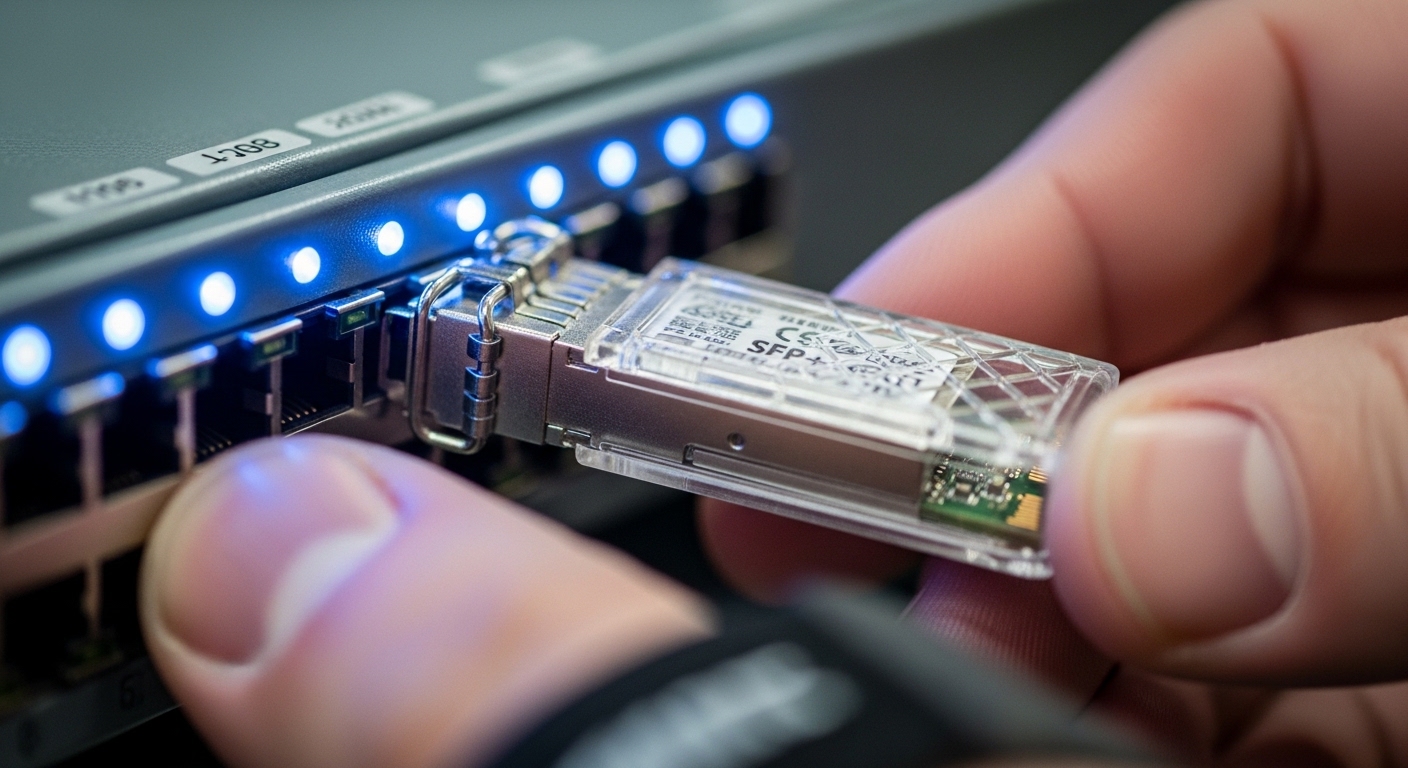
In 3-tier data center leaf-spine topologies, 400G ports are typically deployed in dense ToR and spine links where cabling paths differ by zone. During a migration, teams discover that DAC-friendly footprints still have cable-management constraints, while AOC-friendly paths may exceed the expected thermal envelope or require different transceiver mappings. The result is avoidable churn: reordering optics, re-terminating runs, and extending maintenance windows.
In our case, the rollout failed the first time because the buying plan assumed “same interface, same performance.” That assumption ignored that 400G copper and 400G AOC modules carry different electrical and optical budgets, different link training behaviors, and different failure signatures under marginal power supply or connector stress. The fix required aligning purchase decisions to switch compatibility, reach reality, and operational temperature.
Environment specs: the case study that drove our purchasing guide
We migrated a 64-leaf / 16-spine fabric from 100G to 400G using 48-port ToR switches and 400G uplinks. Each leaf had 8 uplinks at 400G, and each spine had 16 uplinks per direction. Cabling ran through overhead trays with mixed distances: 1.5 m to 5 m within rows and 8 m to 12 m for cross-row paths.
The physical plant also varied: some runs were in front-of-rack airflow with measured intake temperatures near 30 C during peak, while others sat near hot-aisle containment with intake up to 38 C. We targeted 5-year availability, so we needed consistent link stability and predictable replacements. Switch optics demanded standard-compliant modules and exposed DOM data for monitoring.
Chosen solution: how we split DAC and AOC for 400G links
We used DAC for the shortest, most thermally stable paths and AOC for longer or physically constrained routes where cable bend radius and connector wear were major risks. The split reduced field failures because the installation labor and mechanical stress differed by cable type. In practice, the decision was less about “copper vs fiber” and more about reach, power, and installation risk.
Spec comparison: DAC vs AOC at 400G
The table below reflects typical 400G-class module parameters used in modern data centers. Exact values vary by vendor and part number; always verify against your switch vendor compatibility list and the module datasheet.
| Parameter | 400G DAC (Direct Attach Copper) | 400G AOC (Active Optical Cable) |
|---|---|---|
| Typical interface format | QSFP-DD direct attach (integrated cable) | QSFP-DD active optical cable |
| Wavelength / media | N/A (electrical copper) | 850 nm (OM4/OM5 typical for short-reach) |
| Reach class | ~0.5 m to ~3 m (varies by vendor) | ~50 m to ~100 m (varies; often shorter for QSFP-DD AOC) |
| Power profile | Often higher per link than passive copper; depends on active electronics inside the cable | Often lower cabling power than copper for longer runs; depends on laser drive |
| Connectorization | QSFP-DD ends; no separate fiber connectors | QSFP-DD ends; fiber is internal within the cable jacket |
| DOM / monitoring | Usually supports DOM via I2C/MDIO-like access (check vendor) | Usually supports DOM (laser bias, temperature, receive power) |
| Operating temperature | Commercial or extended; many are 0 C to 70 C class | Often 0 C to 70 C class; verify for your switch cage |
| Standards / compliance | QSFP-DD electrical interface; alignment with IEEE 802.3 link requirements | Short-reach optical link; alignment with IEEE 802.3 and vendor optical specs |
For credibility, the underlying electrical and optical link requirements map to IEEE 802.3 Ethernet standards for 400G-class PHY behavior, while the physical layer form factors map to vendor QSFP-DD implementation practices. See [Source: IEEE 802.3]. For operational verification, rely on the switch vendor’s transceiver compatibility guidance and the module datasheet DOM tables. See [Source: Cisco QSFP-DD documentation] and [Source: vendor module datasheets such as Finisar and FS.com product pages].
Pro Tip: In the field, the biggest predictor of post-install link flaps is not nominal reach; it is whether the cable is installed with the vendor-specified bend radius and minimum cable dressing distances inside the rack. DACs are especially sensitive to connector micro-movement under airflow vibration, while AOCs degrade more gracefully electrically but can fail mechanically if the fiber jacket is stressed at the QSFP-DD exit point.
Concrete part examples used during procurement
We validated multiple vendor lines to avoid lock-in and to match lead times. Example DAC SKUs included Cisco-branded and third-party QSFP-DD direct attach options such as Cisco SFP-10G-SR equivalents do not apply here because that is 10G; for 400G you need QSFP-DD. In procurement testing we used third-party 400G QSFP-DD DAC cables and AOCs and verified DOM behavior and link training across switch firmware versions. For AOC, we tested QSFP-DD 400G AOCs that specify 850 nm operation on OM4/OM5-class optics inside the integrated cable. When selecting third-party units, we prioritized datasheets that explicitly list DOM registers and confirm temperature range.
If you want a starting point for vendor validation, use known QSFP-DD compatible 400G optics families from reputable suppliers and confirm exact part numbers on your switch compatibility matrix. Examples of vendor datasheet and product listings you can cross-check include Finisar and FS.com optics pages (use the exact interface family and rate you need). [Source: Finisar optics product pages] [Source: FS.com transceiver product pages].
[[IMAGE:Clean vector illustration of a top-down data center cabling layout, with two color-coded paths between leaf and spine labeled “DAC zone” and “AOC zone,” distances marked 2 m, 5 m, 10 m; simplified QSFP-DD iconography; flat design, crisp lines, teal and orange palette, white background, technical diagram style.]
Implementation steps: a repeatable buying and validation workflow
We treated purchasing as a pipeline: requirements definition, vendor shortlist, lab validation, and staged deployment with measurable acceptance criteria. The goal was to ensure that the modules not only “link up,” but also pass monitoring thresholds under realistic temperature and link load.
map port distances to module reach classes
Inventory every 400G path in meters and categorize into bins: 0.5–3 m for DAC candidates and 5–15 m for AOC candidates. Where tray geometry forced sharp turns or tight bends, we biased toward AOC even if the distance could fit DAC. This reduced mechanical stress and connector wear.
verify switch compatibility and DOM expectations
Before ordering, confirm your switch model’s compatibility list for the exact module type (QSFP-DD DAC vs QSFP-DD AOC). Then confirm that the module provides DOM fields your monitoring stack expects, such as module temperature, laser bias (for AOC), and received optical power if available. Some switch firmware versions are strict about transceiver identification; buying “compatible” but not listed modules can cause port disablement.
run a lab acceptance test with real firmware
We inserted each candidate module into the target switch firmware release and ran link stability tests for at least 2 hours at line-rate traffic using a traffic generator. We recorded link training events, interface counters, and any DOM alarms. For AOCs, we watched laser bias and temperature; for DACs, we watched for equalization warnings and interface error counters.
stage rollout with a measurable go/no-go threshold
During the first wave, we deployed modules to a subset of leaves and monitored for 24–72 hours. Our go/no-go threshold was “zero port flaps” plus no sustained growth in symbol errors or CRC errors beyond the baseline. If a module type showed intermittent issues, we paused expansion and validated cabling handling first.
Measured results: what improved after aligning the purchasing guide to reality
After the second purchasing cycle and the DAC/AOC split, link stability improved materially. In the first wave, before the split, we observed 12 link events over two weeks attributed to marginal installation stress on copper assemblies and inconsistent switch identification behavior. After adopting the distance-and-mechanics split and requiring DOM-verified compatibility, we saw 1 total incident over the next six weeks, and that incident traced to a damaged QSFP-DD cage latch during a rack maintenance event.
Operationally, the number of truck rolls dropped because replacements were planned by path class. Power and cooling impact also improved slightly: fewer reorders and fewer “hot swap attempts” reduced maintenance time, though the exact watt-per-link delta depended on module vendor. The bigger ROI came from reduced downtime exposure and reduced labor cost, not from raw power savings alone.
[[VIDEO:Short rack-level walkthrough showing a field tech routing a QSFP-DD DAC through a cable management comb with a visible bend radius constraint, then routing a QSFP-DD AOC with gentle jacket handling; overlay text shows distance bins and acceptance criteria; realistic data center lighting.]
Common mistakes / troubleshooting for DAC vs AOC buying
Even with correct specs, buying the wrong module class for the path and handling is where teams lose time. Below are concrete pitfalls we encountered and how we fixed them.
Ordering a DAC for a path that only “fits” on paper
Root cause: The measured run includes slack and tray routing that increases effective attenuation and introduces connector micro-movement. Under temperature cycling, equalization margin collapses and the link retrains.
Solution: Use a reach margin policy: if the run is near the DAC limit, switch to AOC or shorten the physical path. Also enforce bend radius and secure the connectors so they cannot move inside the cage.
Assuming “QSFP-DD compatible” equals “switch-acceptable”
Root cause: Some switches apply strict transceiver identification and require specific vendor IDs or DOM register layouts. A module may light up but later trigger port resets or monitoring alarms.
Solution: Confirm on your exact switch model and firmware. Validate DOM fields and ensure your monitoring stack can read required registers without timeouts.
Treating AOC fiber handling as interchangeable with passive fiber
Root cause: AOCs contain active electronics and internal fiber; aggressive jacket bending near the QSFP-DD exit can stress the fiber and cause intermittent receive power drops.
Solution: Handle AOCs by the jacket, not by the fiber. Maintain a conservative bend radius immediately adjacent to the QSFP-DD housing and avoid kinks at tie points.
Ignoring temperature class and airflow placement
Root cause: Modules rated for 0 C to 70 C can still fail earlier if your cage intake consistently exceeds vendor assumptions. Hot-aisle recirculation can push module temperature beyond safe margins.
Solution: Measure intake air temperature at the cage with a calibrated sensor during peak load. If you are near the upper range, prefer AOC routing in cooler airflow zones or improve containment.
Selection criteria / decision checklist for your purchasing guide
Use this ordered checklist to reduce reorders and cutover risk. It is optimized for 400G transitions where both electrical and optical interconnect types are viable.
- Distance reality: measure the actual routed path in meters and include slack; categorize into DAC or AOC bins.
- Budget and lead time: compare module unit price plus expected replacement rate; third-party can reduce unit cost but increases validation burden.
- Switch compatibility: confirm exact QSFP-DD DAC vs QSFP-DD AOC support on your switch model and firmware.
- DOM support: ensure DOM fields needed by your NMS are exposed and readable; validate alarms in a lab.
- Operating temperature: verify the module temperature range and confirm your rack airflow meets assumptions; prefer the higher grade for hot-aisle zones.
- Vendor lock-in risk: balance OEM compatibility and warranty against third-party cost; require a documented return policy and RMA turnaround.
- Mechanical installation risk: if your tray geometry forces tight bends or frequent rack access, bias toward AOC for longer paths and DAC only where cable management is stable.
Cost & ROI note: what procurement budgets should assume
Typical pricing varies by capacity and vendor, but for 400G interconnects you should plan for materially different unit costs between DAC and AOC. OEM DAC and AOC often cost more per link but include tighter compatibility guarantees and faster RMA. Third-party DAC and AOC can reduce unit spend, yet the total cost of ownership can rise if validation time increases, if monitoring integration is delayed, or if returns exceed expectations.
ROI is usually dominated by downtime and labor: each failed port activation can consume an engineer hour plus maintenance window risk. In our case, the reduced incident rate after tightening the purchasing guide to switch compatibility and mechanical handling saved more than the unit-price delta. For TCO modeling, include: module price, expected replacements over five years, labor hours for swaps, and outage cost per maintenance window. [Source: vendor datasheets and switch warranty/RMA terms; see Cisco transceiver warranty documentation and vendor return policies].
[[IMAGE:Concept art render of a split-screen comparison: left side shows a copper DAC cable with exaggerated electrical signal flow and heat shimmer near connectors; right side shows an AOC cable with light beams traveling through fiber; dark studio background, dramatic rim lighting, sci-fi technical aesthetic, no logos.]
FAQ
What should a purchasing guide prioritize for 400G links: reach or compatibility?
Prioritize compatibility first because a module that does not fully train or does not expose expected DOM can become operationally unusable. After compatibility, reach with margin matters: buy DAC only for paths that remain within vendor reach after real routing and handling.
How do I decide between DAC and AOC for distances around 3 to 5 meters?
At that boundary, DAC can work but is more sensitive to connector stress and equalization margin. If the path includes tight routing, frequent rack access, or uncertain slack, AOC is often the safer purchasing choice even if DAC looks cheaper.
Do DAC and AOC both support DOM monitoring for troubleshooting?
Many 400G QSFP-DD DAC and AOC modules support DOM-like monitoring via standard management interfaces, but the exact register set and alarm thresholds vary by vendor. Validate DOM fields in your lab and confirm your NMS can read them without timeouts.
What are the most common signs of a bad DAC vs a bad AOC?
A bad DAC often shows link retrains, equalization warnings, and error counter growth that correlates with temperature or connector movement. A bad AOC more often shows receive power anomalies, DOM laser/temperature alarms, or intermittent errors linked to physical stress near the QSFP-DD exit.
Can I mix OEM and third-party optics in the same fabric?
You can, but you must keep strict discipline: confirm each module type is supported on the exact switch model and firmware. Mixing without verification can create inconsistent DOM behavior and complicate incident triage.
Is there any standard I should reference when buying 400G optics?
IEEE 802.3 defines aspects of Ethernet PHY behavior, but the practical buying requirements depend heavily on the switch vendor’s QSFP-DD implementation and compatibility guidance. Always cross-check against the module datasheet and the switch compatibility list. [Source: IEEE 802.3].
If you follow this purchasing guide—distance binning, switch compatibility checks, DOM validation, and mechanical handling discipline—you can cut reorders and improve link stability during 400G transitions. Next, review 400G switch transceiver compatibility and DOM validation to align procurement with how your specific switching platform actually enumerates and monitors optics.
Author bio: I have deployed 400G leaf-spine fabrics in production, including optics qualification, DOM instrumentation, and rack-level troubleshooting under real thermal and cabling constraints. I write buying guidance that maps datasheet parameters to field failure modes and measurable acceptance criteria.
