If you are provisioning a WAN link for MPLS or Carrier Ethernet, the PE router transceiver you pick can quietly make or break link stability, timing, and supportability. This article helps network engineers and field techs choose the right optics for real distances, budgets, and switch compatibility. You will also get a troubleshooting checklist for the most common failure modes and a ranked comparison table at the end.
Top 7 PE router transceiver picks by WAN use case
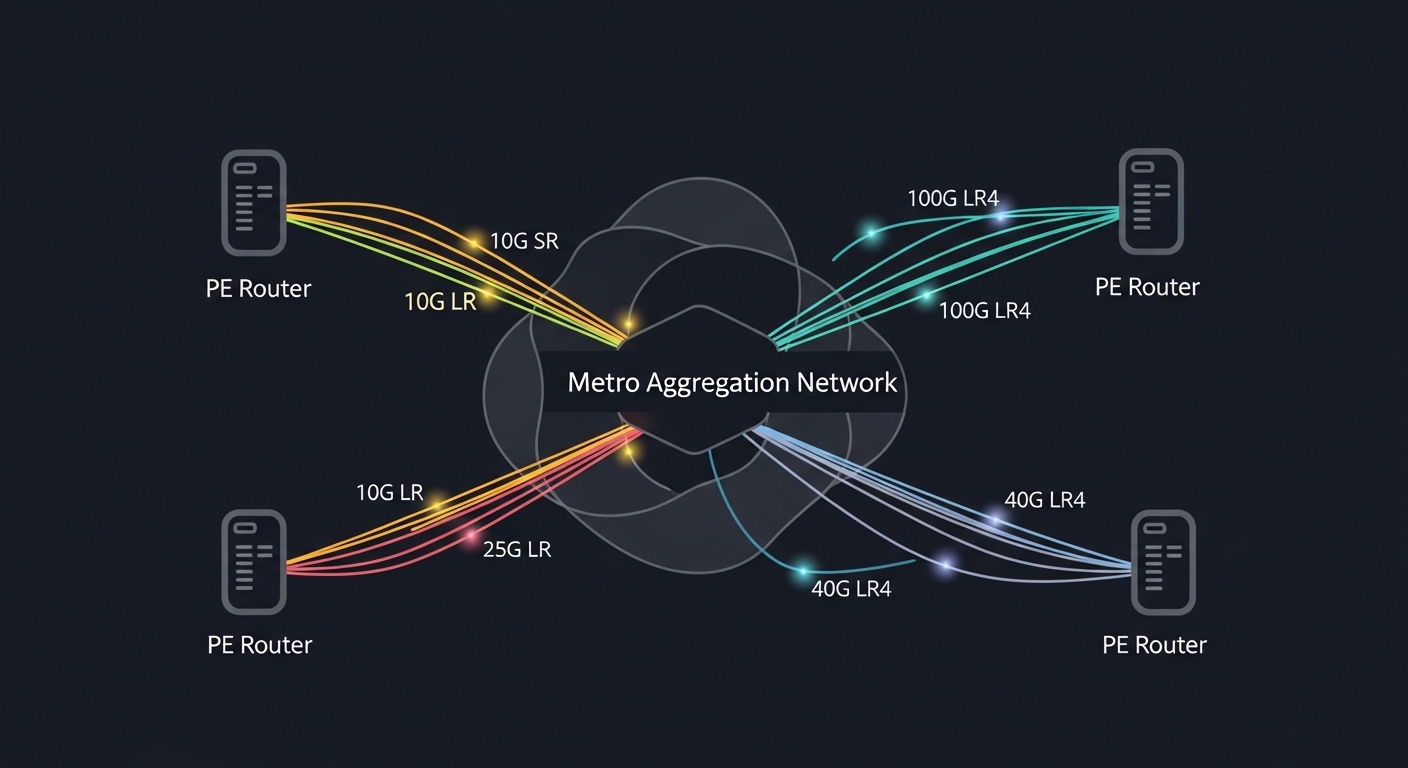
WAN optics are usually selected by modulation type, wavelength, connector style, and reach budget, not by “brand vibes.” For MPLS and Carrier Ethernet, you also need deterministic behavior under congestion, consistent optics diagnostics, and clean interoperability with your PE router and optics ecosystem.
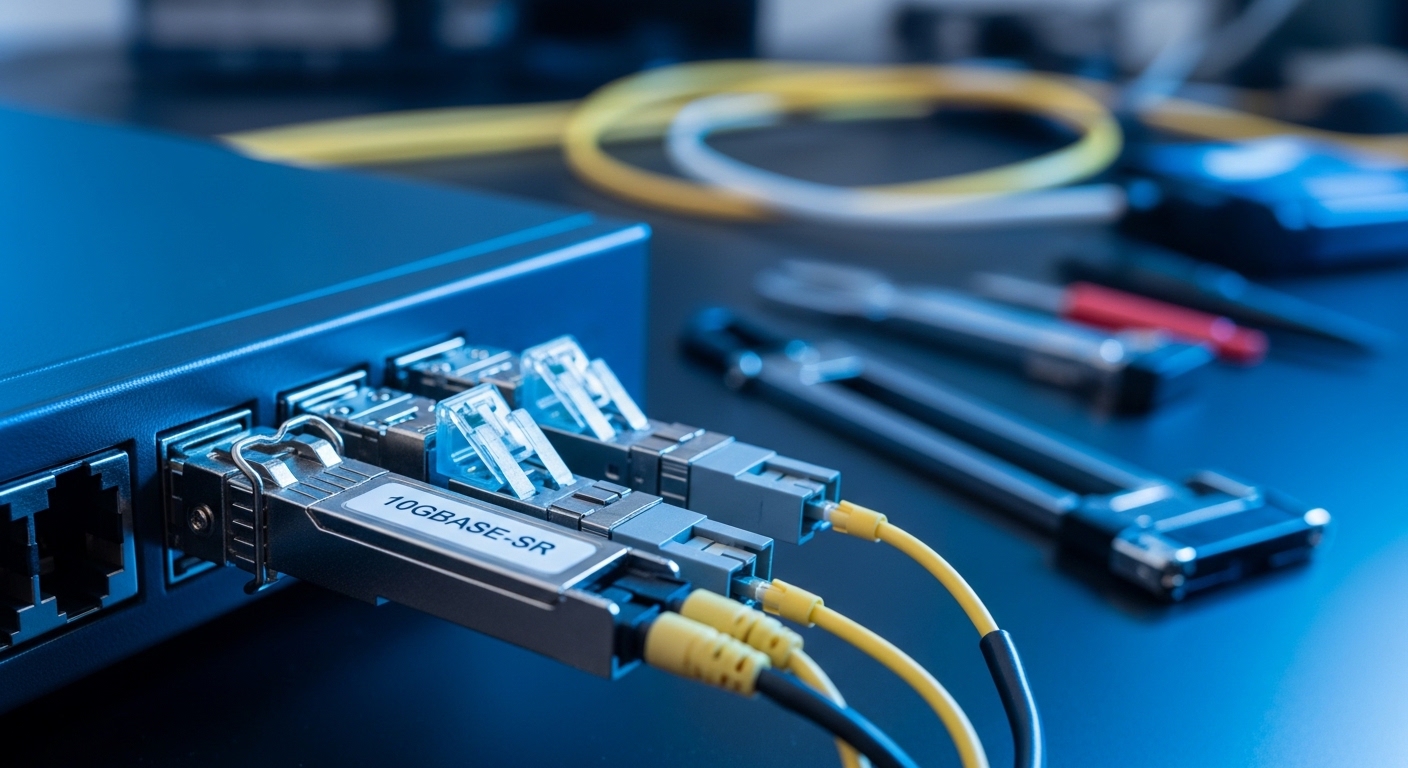
10GBASE-SR (850 nm) for short-reach PE-to-aggregation spans
When your PE router connects to an aggregation switch over patch panels and pre-terminated fiber, 10GBASE-SR is often the lowest-friction option. Typical optics target multimode fiber at 850 nm, using LC connectors and low power draw.
- Key specs: 10.3125 Gb/s, ~300 m typical over OM3, ~400 m over OM4 (exact reach depends on vendor budget)
- Best-fit scenario: Data center adjacent WAN handoff where patch cords plus a short run stay within the link budget
- Pros: Cheapest per port, widely supported, easy spare management
- Cons: Multimode limits distance; modal dispersion can bite if you exceed the vendor reach
10GBASE-LR (1310 nm) for metro WAN reach with single-mode fiber
10GBASE-LR is the classic “single-mode workhorse” when you need more distance between a PE site and metro aggregation. It uses 1310 nm and LC connectors, typically over OS2 single-mode fiber.
- Key specs: 10.3125 Gb/s, around 10 km typical (vendor reach varies)
- Best-fit scenario: MPLS core edge where PE routers connect to a metro PE hub across dark fiber
- Pros: Better reach than SR, strong ecosystem compatibility
- Cons: Requires single-mode plant; budget for cleaning and splice quality
25GBASE-LR / 25GBASE-ER for higher throughput on modern Carrier Ethernet
Carrier Ethernet upgrades often push you from 10G to 25G to reduce oversubscription. For WAN optics, 25GBASE-LR and 25GBASE-ER give you flexibility depending on whether you are on metro loops or longer regional routes.
- Key specs: 25.78125 Gb/s; LR typically ~10 km, ER typically ~40 km (vendor-dependent)
- Best-fit scenario: 25G uplinks from PE to provider edge aggregation when service demand grows
- Pros: Higher throughput per fiber pair, common in modern routers
- Cons: Higher optics cost; ensure your PE router supports the exact speed and optic type
40GBASE-LR4 for cost-effective scaling on single-mode links
For operators that want to scale capacity without immediately moving to 100G, 40GBASE-LR4 is a practical middle ground. It uses wavelength-division multiplexing over 1310 nm and typically LC connectors.
- Key specs: 40.0 Gb/s, typical ~10 km class reach
- Best-fit scenario: Carrier Ethernet handoff where you need more bandwidth but fiber plant is already committed
- Pros: Efficient use of fiber, good fit for regional metro
- Cons: More complex optics; cleanliness and connector quality become critical
100GBASE-LR4 and 100G coherent-adjacent tradeoffs for backbone-like PE links
When your PE router uplinks behave like mini-backbone links, 100GBASE-LR4 can reduce port count while staying within typical 100G transceiver ecosystems. In many deployments, LR4 is used when you cannot justify coherent optics but need 100G scale.
- Key specs: 103.125 Gb/s line rates (depending on implementation), typical ~10 km reach class
- Best-fit scenario: PE to aggregation over single-mode where you want fewer physical interfaces
- Pros: Big capacity jump with manageable complexity
- Cons: Budget sensitivity; compatibility and DOM handling matter a lot
Active optical cables (AOC) for short rack-to-rack WAN extensions
Sometimes your “WAN” is actually a cross-building or cross-aisle run inside a controlled facility. AOCs can be a faster path when fiber runs are short and you want to avoid splicing or patch panel churn.
- Key specs: Data rates vary (10G/25G/40G/100G), active reach typically from a few meters to tens of meters
- Best-fit scenario: PE router to adjacent aggregation in a hardened room with tight cabling constraints
- Pros: Quick installation, fewer connector variables
- Cons: Limited reach; higher replacement cost if damaged
Vendor-supported “long-tail” optics with DOM verification for strict operations
In carrier environments, the safest choice is often the one that your PE platform explicitly supports and that exposes reliable DOM diagnostics. Many operators standardize on specific vendor part numbers to reduce incident response time during MPLS traffic events.
- Key specs: Must support required digital diagnostics (temperature, bias current, received power, transmit power)
- Best-fit scenario: High-availability PE sites where you cannot tolerate optics-related flaps during maintenance
- Pros: Predictable support outcomes, faster troubleshooting
- Cons: Potentially higher unit cost and vendor lock-in
Technical specs that actually drive compatibility and reach
IEEE defines the optical behavior, but your PE router and optics vendor define the practical limits. Before you buy, confirm the transceiver form factor (SFP+, SFP28, QSFP28, CFP2/CFP4), wavelength, connector, and DOM support. Also verify that your fiber type matches the standard (multimode for SR; single-mode for LR/ER/LR4).
| Transceiver type | Data rate | Wavelength | Typical reach class | Fiber + connector | DOM | Operating temp (typ.) |
|---|---|---|---|---|---|---|
| 10GBASE-SR (SFP+) | 10.3125 Gb/s | 850 nm | ~300 m OM3 / ~400 m OM4 | MMF + LC | Required (standard) | Commercial / Industrial variants |
| 10GBASE-LR (SFP+) | 10.3125 Gb/s | 1310 nm | ~10 km class | SMF (OS2) + LC | Required (standard) | Commercial / Industrial variants |
| 25GBASE-LR / ER (SFP28) | 25.78125 Gb/s | 1310 nm (LR) / ~1550 nm (ER) | ~10 km (LR) / ~40 km (ER) | SMF (OS2) + LC | Required (standard) | Commercial / Industrial variants |
| 40GBASE-LR4 (QSFP+) | 40 Gb/s | 1310 nm (4 wavelengths) | ~10 km class | SMF (OS2) + LC | Required (standard) | Commercial / Industrial variants |
| 100GBASE-LR4 (QSFP28) | 103.125 Gb/s | 1310 nm (4 wavelengths) | ~10 km class | SMF (OS2) + LC (varies) | Required (standard) | Commercial / Industrial variants |
Standards and guidance: IEEE 802.3 defines Ethernet PHY behavior; transceiver electrical/diagnostics are aligned with SFF specifications and vendor implementations. For authority, see Source: IEEE 802.3 and vendor datasheets for exact reach and power budgets (for example, optics datasheets from Cisco/Fortinet/FS.com/Finisar style documentation).
Pro Tip: In the field, “it links up” is not the same as “it will stay up under MPLS churn.” Always validate received power and DOM thresholds after the first traffic burst, because some optics drift enough to pass link training at idle but degrade during sustained bursts.
Selection checklist for a PE router transceiver in MPLS and Carrier Ethernet
Engineers typically rank decisions in this order: operational reliability first, then cost, then convenience. If you follow this checklist, you reduce both downtime risk and rework when you discover the fiber plant type mismatch late.
- Distance vs link budget: measure fiber length, splice