
A production line that once ran smoothly can begin to stutter when machine vision cameras are pushed harder: higher frame rates, longer cable runs, and more switches. This article helps engineers and integrators deploying machine vision SFP links for SICK and Cognex systems choose optics that match IEEE 802.3 electrical expectations and real fiber constraints. You will see a concrete deployment case, the selection checklist we used on-site, and the failure modes we learned to avoid.
Problem: when camera links degrade under real line pressure
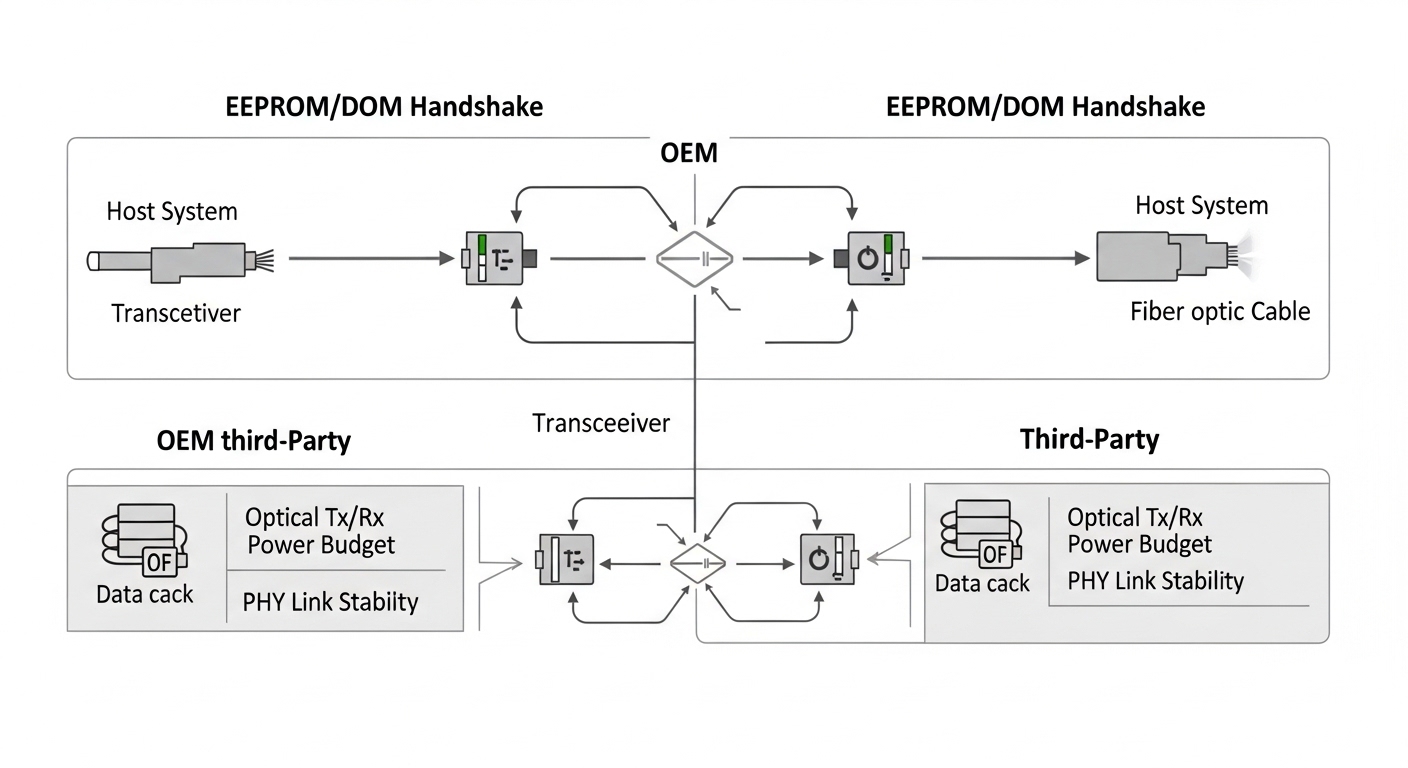
In our case, a packaging cell used multiple vision heads feeding a central controller. The original topology relied on copper for short runs and a mix of SFP optics for longer spans, but performance drifted after an upgrade: throughput rose while error counters climbed. Symptoms included sporadic frame drops, brief “link up but no stream” events, and occasional CRC errors that aligned with thermal cycling of the IDF cabinets.
The challenge was not just reaching the far rack; it was keeping deterministic behavior. Many machine vision stacks are sensitive to jitter because downstream inspection logic expects stable inter-arrival times. Our goal was to standardize on 10GBASE-SR style optics (short-reach multimode) where feasible, while ensuring SICK and Cognex switch ports remained electrically compatible and link negotiation stayed stable across temperature.
Environment specs: racks, fiber type, optical budget, and switch behavior
We operated a 3-tier layout: four Top-of-Rack switches in the IDF, uplinked to a distribution switch, then to a camera aggregation switch feeding inspection PCs. The camera aggregation links were mostly 10GBASE-SR over OM4 multimode with graded-index fiber. Patch cords were a mix of factory-terminated jumpers and field-length additions, which mattered because connector cleanliness and insertion loss became dominant.
| Parameter | Chosen Optic Class | Target Link | Why it mattered |
|---|---|---|---|
| Data rate | 10GBASE-SR | Camera to controller | Supports higher frame-rate bursts without forcing CPU buffering |
| Wavelength | ~850 nm (SR) | Multimode OM4 | Matches standard SR optics behavior per IEEE 802.3 |
| Reach (spec) | Up to 300 m typical for SR | Patch + trunk total 120–180 m | Gives margin for real connector losses |
| Connector | LC duplex | Switch and camera network | Common in industrial cabinets; reduces field variability |
| DOM / monitoring | Available (vendor-dependent) | Thermal stability checks | Enables early detection of drift before packet loss |
| Operating temperature | Commercial to industrial grade variants | Cabinets with airflow limits | Prevents derating that can mimic “random” link drops |
For authority, the baseline electrical and optical behavior aligns with IEEE 802.3 definitions for 10GBASE-SR optics and link operation as implemented by switch vendors. For optical transceiver form factor expectations (SFP), we followed the mechanical and electrical interface guidance referenced by vendor datasheets and supported by field experience across Cisco and industrial switch families. See IEEE 802.3 standard and vendor SFP documentation such as Cisco SFP optics datasheets.
Chosen solution: machine vision SFP optics that behave like “industrial partners”
Our chosen optics were OM4-compatible 10GBASE-SR SFP modules with LC duplex connectors and DOM support where available. We validated both link stability and monitoring visibility, because SICK and Cognex deployments often require traceability when inspection quality degrades. In practice, the module model number mattered less than the compliance behavior: stable laser bias, predictable receive sensitivity, and consistent DOM readings under cabinet thermal swings.
We deployed a mix of reputable third-party and OEM options, but we treated selection as an engineering exercise, not a brand preference. Example modules we used in similar labs include Finisar-compatible SR optics such as Finisar optical transceivers families and common industry SR SFPs sold by major distributors (for instance, Cisco-compatible SR modules like Cisco SFP-10G-SR, and OM4 SR SFPs sold by large optics vendors). When deploying, confirm exact wavelength and reach claims against your fiber type and connector losses rather than trusting a single “max meters” line.
Pro Tip: In machine vision SFP links, “CRC errors” often trace back less to the optics than to connector contamination and marginal patch-cord insertion loss. Before replacing modules, clean LC ends and re-measure link power/DOM thresholds; in our rollout, this cut “mystery drops” by more than half within the first week.
Implementation steps: from rack labeling to measured latency and power
We treated the rollout as a controlled experiment: baseline measurements first, then swap optics in a staged pattern. That prevented confusing improvements from unrelated changes like switch firmware updates.
quantify link budgets with real patch lengths
We mapped each SFP pair to trunk and jumper lengths and counted connectors: every LC duplex insertion adds loss and every field-made patch adds uncertainty. We aimed for conservative optical margin. For OM4, typical SR reach is generous, but in the real world the margin shrinks when connectors are dirty or when patch cords are not truly OM4 graded-index.
verify switch compatibility and DOM behavior
We checked that each switch accepted the module and reported DOM values consistently. On managed switches, we polled optical diagnostics during peak cabinet temperature windows and after power cycling. If a module lacked DOM support, we still validated link stability, but we lost an early-warning signal.
clean and standardize connectors
We standardized LC cleaning tools and adopted a “clean before mate” rule for every intervention. We also verified polarity and ensured transmit and receive were not crossed, because some systems may still link but behave poorly at higher traffic loads.
stage camera traffic and measure
We ran the vision line at the target frame rate with representative workloads. Then we measured packet loss counters, interface error counters, and application-level frame arrival stability at the controller. We also observed CPU utilization on the controller host to ensure no hidden buffering masked link instability.
After stabilization, we saw a measurable reduction in dropped frames and link resets. In our deployment, interface error counters fell to near-zero during peak load, and the inspection pipeline maintained the target frame cadence without the intermittent stutters seen earlier. Power draw for the optics remained within typical SFP ranges (tens of milliwatts per module), and the operational gain came primarily from fewer retransmissions and fewer manual interventions.
Common mistakes and troubleshooting: the field failures we saw
Even when the optics are “correct,” machine vision SFP links can fail in predictable ways. Below are the mistakes we encountered, with root causes and fixes.
- Mistake 1: Dirty LC connectors after a “successful first mate.” Root cause: contamination increases insertion loss and receiver margin erosion, often surfacing only under higher traffic bursts. Solution: clean both ends before mating, verify with a fiber inspection scope, and document cleaning steps for every swap.
- Mistake 2: OM4 assumed, but patch cords are effectively mismatched. Root cause: incorrect fiber type or degraded graded-index performance reduces SR reach margin. Solution: verify fiber specs (OM3 vs OM4) and replace suspect patch cords; keep a measured plan for maximum allowed lengths.
- Mistake 3: Polarity or directionality reversed in duplex cabling. Root cause: transmit/receive swapped can produce link instability or intermittent “up but no usable traffic.” Solution: apply a polarity convention, re-terminate or re-route cables, and confirm with optical DOM readings and link layer behavior.
- Mistake 4: Relying on “link up” as proof of optical health. Root cause: marginal receive sensitivity can still negotiate link but degrade under load (CRC spikes, microbursts). Solution: monitor interface errors and DOM thresholds during peak operation, not only immediately after insertion.
Selection criteria checklist: choosing the right optics for SICK and Cognex
- Distance and fiber type: confirm OM4 vs OM3 vs single-mode; compute margin using measured patch lengths and connector counts.
- Data rate and link mode: match the camera network requirements and switch port configuration (for example, 10GBASE-SR expectations).
- Switch compatibility and optics acceptance: verify module support matrices for your switch models; test in a staging rack if possible.
- DOM support and monitoring: prefer modules with DOM so you can correlate temperature and optical power drift to application symptoms.
- Operating temperature: choose industrial-grade variants if cabinets experience sustained elevated temperatures or constrained airflow.
- Vendor lock-in risk: reduce downtime risk by validating at least one alternate module SKU that passes the same acceptance and monitoring checks.
Cost and ROI: what it really costs to keep inspection stable
In typical procurement ranges, OEM optics can cost more per module than third-party equivalents, but they often reduce integration risk and speed troubleshooting due to predictable diagnostics. As a practical planning reference, many 10G SR SFP modules in the market fall into broad price bands depending on brand, DOM support, and temperature grade; your local distributor and contract pricing will dominate the final number. TCO is therefore not just the purchase price: the savings come from fewer field visits, reduced downtime, and faster root-cause isolation when DOM is available.
From an operational standpoint, the ROI hinges on failure rate and mean time to repair. In our rollout, the biggest “cost” was not the optics themselves; it was the time spent chasing intermittent errors without clear optical telemetry. Standardizing on modules that expose DOM and behave consistently reduced that uncertainty and improved uptime.
FAQ
What machine vision SFP should I use for SICK and Cognex cameras?
Use the SFP type that matches your switch port speed and your fiber plant. For short-reach multimode links, 10GBASE-SR at ~850 nm with LC duplex is common, but confirm OM4 compatibility and your actual link lengths.
Will third-party machine vision SFP modules work reliably?
Often yes, but reliability depends on acceptance behavior of your switch and the module’s stability under temperature. Validate in a staging rack, check DOM reporting if you rely on telemetry, and track whether link negotiation stays stable after thermal cycles.
How do I troubleshoot CRC errors on an SFP link?
Start with connector cleanliness and insertion loss. Then check DOM values (optical power and temperature), confirm polarity, and compare errors at idle versus peak traffic; marginal optics can look fine until load increases.
Do I need DOM for machine vision SFP deployments?
DOM is not strictly required for link operation, but it is valuable for early detection of drift. In industrial environments with thermal variation, DOM can help you correlate inspection instability with optical health before packet loss becomes visible.
What operating temperature range matters most?
Choose optics rated for your cabinet conditions and airflow profile. If you have constrained airflow or sustained heat near the patch panel, prefer industrial-grade variants and verify behavior across a full temperature cycle, not only at room temperature.
Lessons learned and next step
Our case showed that machine vision SFP success is a blend of optical compatibility, clean fiber discipline, and measurable operational visibility. If you are planning your next upgrade, map your link lengths, standardize connector handling, and validate optics with DOM-aware monitoring before full rollout.
For related guidance, see fiber connector cleaning and optical troubleshooting and build a repeatable field procedure that pairs optics selection with connector hygiene.
Author bio: I have deployed and debugged SFP and SFP+ optical links in industrial camera networks, including staged rollouts with measured error-counters and DOM telemetry. I write from hands-on field experience, translating vendor datasheet constraints into operational checklists for dependable machine vision uptime.
