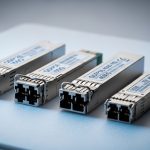
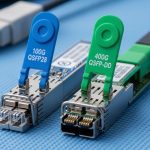
You are planning a high-throughput fabric upgrade and you want to avoid a costly optics mismatch that causes link flaps or silent performance loss. This article helps data center engineers compare an InfiniBand optical transceiver against common Ethernet optical modules, with practical selection criteria, a spec comparison, and field troubleshooting. It is aimed at teams running leaf-spine Ethernet alongside InfiniBand or migrating from one to the other.
What makes an InfiniBand optical transceiver different
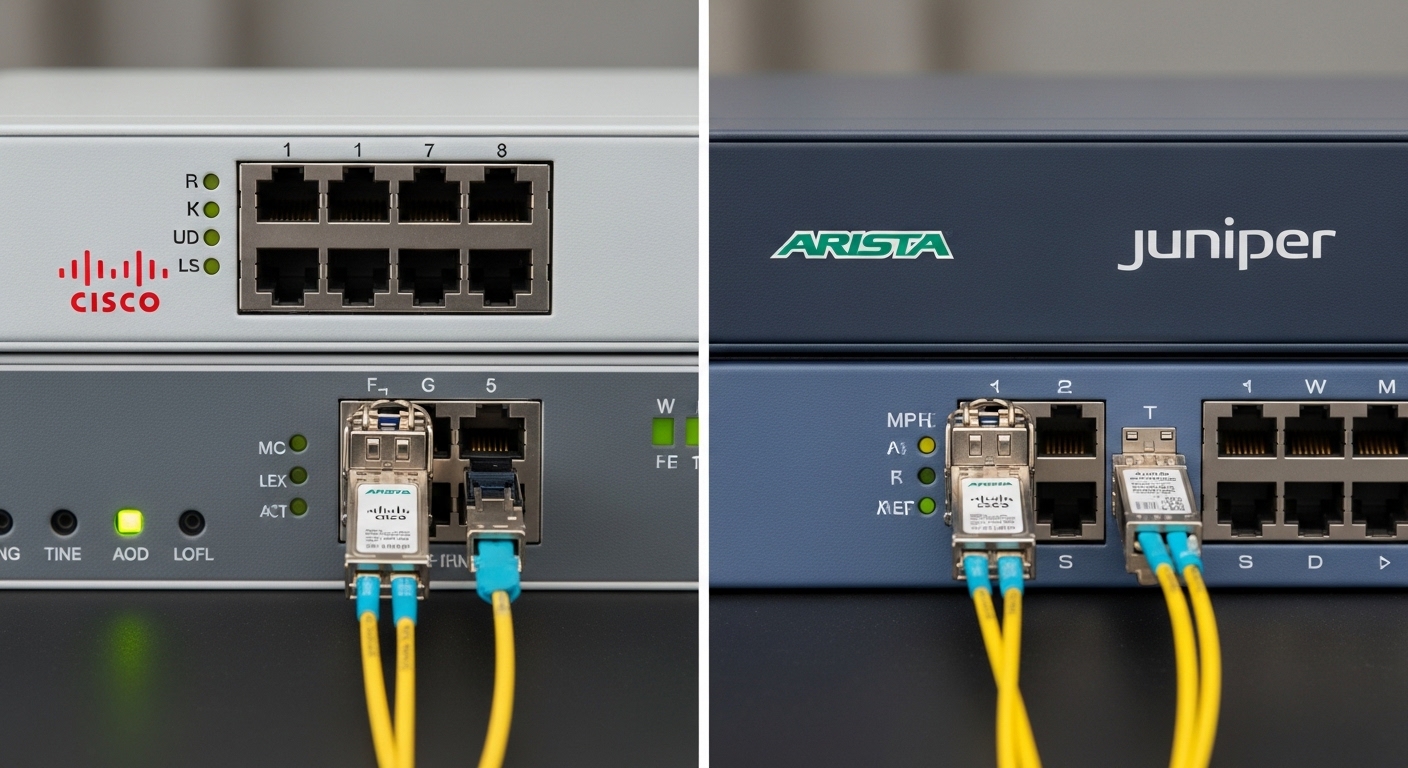
InfiniBand optics are designed around the InfiniBand physical and link layers, including specific lane behavior, receiver sensitivity targets, and management expectations. In production, the biggest operational difference is that InfiniBand fabrics often rely on deterministic link bring-up semantics and fabric-level diagnostics that assume the module matches the expected standard and vendor implementation. Ethernet optics, by contrast, are usually tuned to IEEE 802.3 PHY requirements and the switch vendor’s optics support matrix.
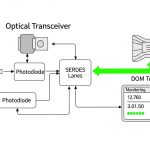
From a hardware standpoint, both families use similar form factors (QSFP, SFP, OSFP, and vendor-specific variants), but the electrical interface and firmware expectations can diverge. Many “compatible-looking” modules will still fail if they do not provide the correct host-facing electrical characteristics and DOM (Digital Optical Monitoring) behavior for the target switch or HCA.
Pro Tip: If you see the link light “on” but the fabric never comes up, do not assume fiber or dust is the culprit first. Many InfiniBand bring-up failures are caused by mismatched module profile expectations (including DOM telemetry mapping) between the transceiver and the target HCA or switch. Validate DOM readings and module identifier fields before swapping optics again.
InfiniBand vs Ethernet optics: a spec and compatibility reality check
Below is a representative comparison using common short-reach and long-reach classes. Exact values vary by vendor and part number, so always confirm against the module datasheet and the host device compatibility list.
| Category | InfiniBand optical transceiver (typical) | Ethernet optical transceiver (typical) |
|---|---|---|
| Primary use | InfiniBand fabric links (HCA to switch) | IEEE 802.3 links (switch to switch, server NIC) |
| Form factors | SFP+/QSFP+/QSFP28/OSFP variants depending on generation | SFP/SFP+/SFP28/QSFP+/QSFP28/OSFP variants by port speed |
| Center wavelengths | Common: 850 nm (SR), 1310/1550 nm (LR/ER) | Common: 850 nm (SR), 1310 nm (LR), 1550 nm (ZR) |
| Reach classes | SR typically tens of meters; LR often up to ~10 km class depending on coding | SR typically tens of meters; LR up to ~10 km; ZR farther depending on module |
| DOM / telemetry | DOM available; telemetry interpretation expected by InfiniBand stack | DOM available; telemetry interpretation expected by Ethernet switch/NIC |
| Management expectations | Fabric-level link bring-up and diagnostics may be stricter | Link may train under broader PHY compatibility, but optics still must be supported |
| Operational temperature | Commercial/industrial options; verify module grade for your rack environment | Commercial/industrial options; verify for your rack airflow and ambient limits |
For authority, see IEEE 802.3 for Ethernet PHY behavior and vendor datasheets for InfiniBand-specific electrical and optical parameters. Also check the transceiver standard alignment for your platform (for example, SFF specifications for form factor and DOM support). References: IEEE 802.3 and [Source: IEEE 802.3].
Choose by link speed and reach, not by “it fits the cage”
Engineers often start with SFP/QSFP form factor matching, then stop there. That is not enough for an InfiniBand optical transceiver decision. You must align port speed generation, lane count, coding scheme assumptions, and the optical class (SR vs LR) that your cable plant supports. If your facility uses OM4 or OM3 multimode, validate the module’s wavelength and transmitter launch conditions, not just the marketing reach.
On long-reach deployments over single-mode fiber, verify connector type (UPC vs APC), link budget, and whether the module is designed for the same dispersion tolerance required by your optics class. Even when the link comes up, marginal optical power can cause intermittent CRC-like errors translated into fabric-level retransmissions.
Selection criteria checklist for engineers deploying in mixed fabrics
When you compare InfiniBand optics against Ethernet optics in the same building, treat it like two different compatibility problems. Use this ordered checklist:
- Distance and fiber type: OM3/OM4 multimode vs OS2 single-mode; confirm connector cleanliness and endface geometry.
- Port speed generation: match the transceiver’s supported data rate and transceiver standard to the HCA or switch port.
- Switch or HCA compatibility list: vendor-qualified optics reduce the risk of unsupported DOM behavior and profile mismatches.
- DOM support and telemetry mapping: confirm that the host reads Tx bias, Tx power, Rx power, and temperature correctly.
- Operating temperature: validate commercial vs industrial grade against measured rack inlet temperatures.
- Vendor lock-in risk: evaluate OEM vs third-party; test one spare per type to reduce deployment downtime.
Common pitfalls and troubleshooting steps
In field work, most optics incidents are deterministic once you follow the right sequence. Here are common failure modes and how to fix them:
- Pitfall: “Link down” after swapping to an Ethernet optic in an InfiniBand slot
Root cause: Electrical profile and DOM expectations do not match the InfiniBand HCA or fabric switch.
Solution: Use optics from the InfiniBand-qualified list; verify module identifier fields and DOM readings during diagnostics. - Pitfall: Intermittent link flaps under load
Root cause: Marginal optical power due to dirty connectors, excessive insertion loss, or a mismatch between multimode launch conditions and your fiber plant.
Solution: Clean both ends with certified procedures; measure link optical power at the receiver; confirm patch panel loss and fiber grade. - Pitfall: “Module detected” but performance is degraded
Root cause: Wrong reach class or underestimated dispersion and power budget, leading to higher error rates and retransmissions.
Solution: Recalculate link budget including connector loss, splice loss, and safety margin; swap to the correct SR/LR class. - Pitfall: DOM shows values but alarms persist
Root cause: DOM telemetry interpretation mismatch or out-of-range thresholds configured on the host.
Solution: Compare host alarm thresholds with the module datasheet; consider a module with matching DOM implementation.
Cost and ROI: OEM vs third-party optics in practice
Price differences are real, but TCO depends on failure rates, compatibility testing time, and downtime exposure. OEM InfiniBand optical transceivers often cost more per module than third-party alternatives; in many deployments, a practical range is roughly $200 to $1,000 depending on speed, reach, and temperature grade. Third-party modules can be cheaper, but teams typically spend time validating DOM behavior, firmware interactions, and switch qualification.
ROI improves when you standardize on a small set of qualified part numbers and keep spares staged by site. If you operate multiple fabrics, the highest savings usually come from reducing truck rolls and accelerating mean time to repair by using optics that are already validated for your exact HCA and switch models.
FAQ
Can I use an Ethernet optical transceiver in an InfiniBand port?
Sometimes you can physically insert it, but it may not pass InfiniBand link bring-up due to electrical profile and DOM expectations. The safe approach is to use optics from the InfiniBand-qualified compatibility list for your HCA or switch model.
What fiber type matters most for short-reach InfiniBand optics?
For SR classes, multimode fiber type (OM3 vs OM4) and connector cleanliness usually dominate link reliability. Confirm the module’s wavelength and launch conditions and verify patch panel and splice losses.
How do I confirm DOM telemetry is correct?
During link diagnostics, compare reported Tx bias, Tx power, Rx power, and temperature against the module datasheet thresholds. If the host alarms do not align with the expected ranges, replace with a transceiver that matches the platform’s DOM implementation.
Do I need industrial temperature grade for data center racks?
Often commercial grade is fine, but it depends on measured inlet temperatures and airflow constraints. If your racks run hot during peak loads, industrial grade reduces risk of derating and early failures.
What is the fastest troubleshooting sequence when optics fail?
Start with host logs and DOM readings, then verify fiber polarity and connector cleanliness, then validate optical power budget. Avoid random swaps; keep one known-good spare per qualified part number.
Where can I find authoritative compatibility guidance?
Use your switch or HCA vendor’s optics compatibility matrix and the transceiver datasheet. For Ethernet baseline behavior, IEEE 802.3 is the relevant standards reference. IEEE 802.3 standard page [Source: IEEE 802.3].
If you are planning mixed InfiniBand and Ethernet deployments, treat optics selection as a platform compatibility problem rather than a form-factor problem. Next, review [[LINK:best practices for fiber