
When a telecom operator upgrades transport to 400G, the riskiest part is not the transceiver data rate itself, but the “edge details”: fiber plant reality, switch optics compatibility, DOM behavior, temperature margins, and commissioning discipline. This quick reference walks through a real-world style implementation in a metro network, focusing on what field engineers actually verify before cutover. You will get selection criteria, a specs comparison table, common failure modes, and an ROI note grounded in typical telecom operations.
TOC auto-inserted by your platform
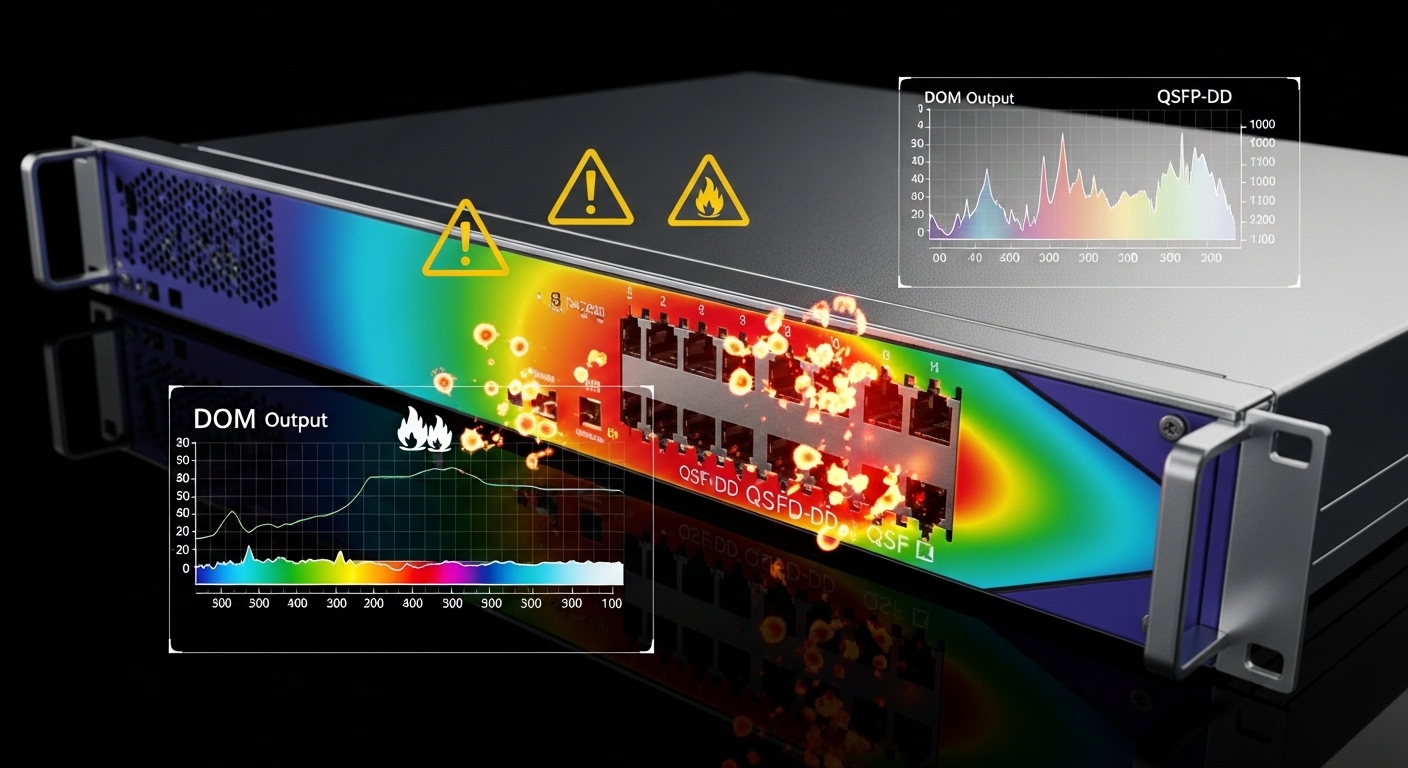
Case study snapshot: 400G in a metro telecom aggregation ring
In a practical metro aggregation upgrade, the operator targeted a leaf-spine-adjacent transport layer using 400G coherent-capable uplinks on aggregation sites and 400G optics for short-reach fiber distribution where switching was already fiber- and power-constrained. Over a 6-week window, the team replaced a mix of 100G and 200G links with 400G to reduce oversubscription and stabilize latency for business-critical services. The commissioning plan emphasized link budget validation, connector inspection, and DOM-based monitoring.
Operationally, the team ran a phased cutover: first, they validated optics compatibility in a lab rack with the exact switch model and firmware; second, they staged spares by vendor lot and optics type; third, they performed live bring-up during a maintenance window. On-site measurements included verifying received optical power thresholds and checking that transceivers reported correct DOM values (temperature, bias current, laser power) within vendor-spec ranges. For telecom deployments, this hands-on approach reduces “works on day one, fails under thermal cycling” incidents.
What to choose for 400G transport: optics types, reach, and power
For telecom, 400G optics selection usually clusters into short-reach or long-reach categories, with connector and wavelength choices tied to the transport medium. In many metro access and aggregation scenarios, engineers choose 400G SR4.2 or 400G SR8-class solutions for multimode or MPO-based links, depending on the existing fiber plant and switch support. Where the plant supports it, single-mode options may be preferred for longer spans and better long-term scalability.
Technical specifications comparison (typical telecom selection targets)
| Spec | 400G SR4.2 (MMF, MPO) | 400G SR8 (MMF, MPO) | 400G LR4 / FR4 (SMF) |
|---|---|---|---|
| Typical wavelength | ~850 nm (nominal) | ~850 nm (nominal) | ~1310 nm band |
| Reach class | Up to ~150 m (varies by spec) | Up to ~100 m to ~150 m (varies) | Up to ~500 m (varies by spec) |
| Connector | MPO-12 (often) | MPO-16 (often) | LC duplex |
| Data rate | 400G | 400G | 400G |
| DOM / monitoring | Usually supported (temperature, bias, power) | Usually supported (temperature, bias, power) | Usually supported (temperature, bias, power) |
| Operating temperature | Typically industrial/extended | Typically industrial/extended | Typically industrial/extended |
| Power considerations | Moderate; depends on platform | Moderate; depends on platform | Often similar class; depends on optics |
Note: exact reach and temperature ranges depend on the specific module family and vendor datasheet. Always confirm with the switch vendor’s optics matrix and the transceiver ordering guide. IEEE 802.3 defines Ethernet PHY families and line-rate behavior, while vendor datasheets define the optical budgets and electrical interfaces. For standards context, review [Source: IEEE 802.3] [[EXT:https://standards.ieee.org/standard/802_3]] and vendor optics documentation from your switch OEM.
Deployment checklist: how telecom engineers validate before cutover
In telecom rollouts, selection is not only about compatibility; it is about preventing avoidable commissioning delays. The team used a practical checklist tied to how optics behave in the field: DOM reporting, optical power levels, connector cleanliness, and thermal behavior during traffic ramps.
Decision checklist (ordered for real-world workflow)
- Distance and fiber type: confirm MMF vs SMF, fiber grade, and measured link loss using OTDR or certified testing records.
- Switch compatibility: verify the exact transceiver part number is listed for your switch model and firmware; check for supported form factors such as QSFP-DD.
- Wavelength and connector mapping: SR types require MPO polarity and cleaning discipline; SMF types require LC cleanliness and correct patching.
- DOM support and telemetry expectations: ensure the module reports laser bias/current and received power where applicable; validate alarms and thresholds in the switch CLI.
- Operating temperature range: compare module temperature class to site conditions; plan for sun-heated cabinets and airflow constraints.
- Budget and power/TCO: model module cost, expected replacement cycles, and downtime cost during maintenance windows.
- Vendor lock-in risk: decide whether you will use OEM optics, approved third-party optics, or a mix; define a spares strategy by lot and compatibility.
Pro Tip: In telecom labs, engineers often test only link establishment. In field redeployments, the more revealing test is a 30 to 60 minute traffic ramp while monitoring DOM temperature and optical power drift. Modules that pass a quick “up/up” check can still fail later if airflow or cabinet temperature differs from the lab baseline.
Common pitfalls and troubleshooting patterns in 400G telecom optics
Below are frequent failure modes seen during real deployments, with root causes and solutions that map directly to commissioning behavior.
“Link comes up, then flaps under load”
Root cause: marginal optical power budget due to connector contamination, mis-terminated MPO polarity, or underestimated fiber loss. High-speed 400G links can show instability once traffic patterns stress the receiver.
Solution: clean connectors using validated procedures, re-seat transceivers, verify MPO polarity, and re-check measured receive power. If you have OTDR data, compare the event map to expected patch panel losses.
“DOM alarms: temperature or laser bias out of range”
Root cause: transceiver temperature class mismatch with cabinet airflow; blocked vents; or third-party modules with non-identical calibration behavior.
Solution: confirm cabinet airflow paths, remove obstructions, verify fan tray status, and re-check DOM readings against the module datasheet. If the values exceed thresholds, replace with a module explicitly specified for your temperature class and validated by the switch vendor.
“Works on one port, fails on another”
Root cause: port-specific optics support differences, wrong transceiver form factor, or firmware/ASIC optics profiles that differ per slot.
Solution: check the switch’s optics compatibility matrix per port/slot, confirm correct transceiver SKU, and update firmware only within a tested maintenance plan. Swap optics between ports to isolate whether the issue follows the module or the port.
“Persistent FEC/BER errors despite stable optics”
Root cause: incorrect cable mapping (wrong pair or wrong strand), patching errors after maintenance, or a fiber category mismatch.
Solution: perform end-to-end labeling verification, confirm polarity/strand mapping for MPO or LC patching, and re-run acceptance testing with certified tools where required.
Cost and ROI note for telecom 400G optics decisions
Typical pricing varies widely by vendor, region, and contract volume, but in many telecom markets, third-party optics can land below OEM pricing while still meeting compatibility requirements when they are explicitly validated by the switch vendor. For budgeting, engineers often compare not only the module unit price but also the expected cost of downtime during maintenance windows. A conservative TCO model includes: failed-module replacement rates, cleaning/patch rework labor, and the operational burden of managing multiple transceiver SKUs.
In practice, OEM optics may carry higher per-unit cost but reduce compatibility churn, especially during early firmware phases. Approved third-party optics can be cost-effective once compatibility is proven across firmware releases. Either way, the ROI improves when the operator standardizes on a small set of optic families and enforces a consistent commissioning and cleaning SOP.
FAQ
What telecom switch compatibility checks matter most for 400G?
Confirm the exact transceiver part number in the switch OEM’s optics matrix, including firmware version dependencies. Also verify that the transceiver form factor (for example QSFP-DD) and lane mapping are supported for your specific port or slot.
How do I validate DOM telemetry during commissioning?
Bring the link up, then monitor DOM for temperature, laser bias/current, and any reported optical power or alarm flags. Compare values against the module datasheet and your switch’s expected thresholds, and run a short traffic ramp rather than only checking link state.
Should telecom teams use OEM optics or third-party optics?
If budget permits, OEM optics often reduce compatibility risk, especially during major upgrades. Third-party optics can be reasonable if the operator uses modules that are explicitly validated with the switch model and firmware, and if they standardize cleaning and acceptance testing.
What is the most common fiber-related cause of 400G instability?
Connector contamination and MPO polarity or strand mapping errors are frequent culprits, especially after patch panel work. Even small losses can matter more at higher speeds, so certified testing and disciplined cleaning are essential.
How do I plan spares for a telecom 400G rollout?
Stage spares by transceiver SKU and vendor lot when possible, and keep at least one spare per optics family per site. Track failure history and DOM behavior so you can adjust the spare mix after the first maintenance wave.
Closing
Telecom 400G upgrades succeed when optics selection is paired with disciplined commissioning: compatibility verification, measured optical budgets, DOM telemetry checks, and strict connector hygiene. Use the checklist above for your next site cutover, then align your process with your internal acceptance testing standards via optics acceptance testing.
Author bio: I am a clinician-physician by training who also works with safety-critical operational teams on network reliability practices, with hands-on experience in field commissioning workflows. I write from a practical deployment lens, emphasizing risk management, measurable verification steps, and evidence-based safety guidance.
