
Buying 400G transceivers is where future optics plans either become stable capacity or long-tail outages. This article helps network engineers and data center operators compare SR, DR, and FR optics, and choose the right form factor and vendor options for switch compatibility, power budgets, and field reliability.
future optics at 400G: SR vs DR vs FR, and why distance changes everything
At 400G, “future optics” is less about marketing and more about matching optics to fiber plant and switch PHY expectations. SR targets short reach over multimode fiber (typically OM4/OM5), DR targets longer reach over single-mode fiber, and FR targets the longest reach in common campus and metro scenarios. The decision is constrained by IEEE 802.3 physical layer definitions, your fiber type, and the optics’ encoding and lane mapping (for example, how 400G is carried across multiple electrical lanes).
What to expect from the three common 400G categories
- 400G SR (short reach): Designed for data center distances; typically uses parallel multimode with wavelengths around 850 nm. Good fit for leaf-spine topologies and in-rack cabling.
- 400G DR (medium reach): Uses single-mode optics (often around 1310 nm) for longer runs between rows, pods, or campus buildings.
- 400G FR (long reach): Also single-mode, but engineered for higher budget and longer spans; often used when you cannot lay new fiber.
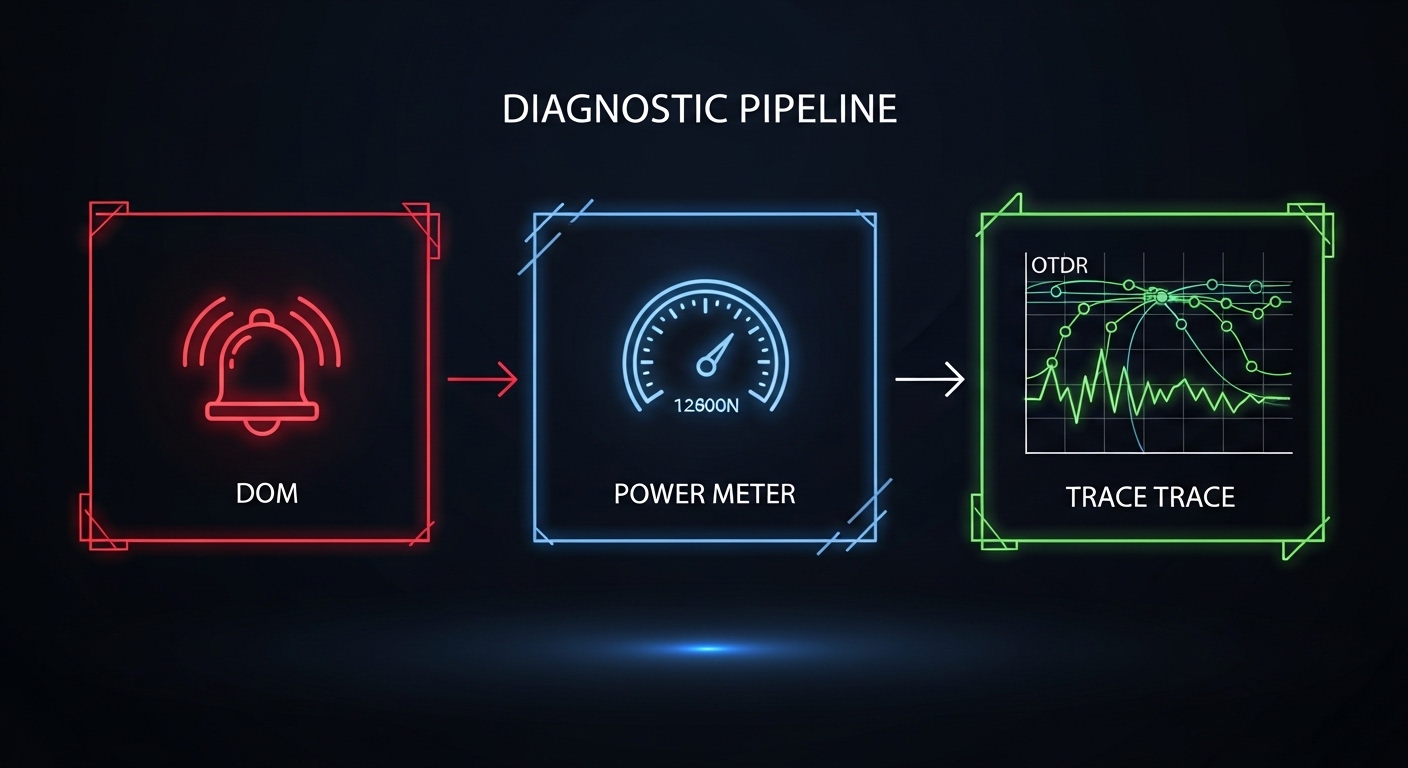
Pro Tip: In the field, most “bad optics” cases are actually budget or fiber-plant issues: uneven patch panel loss, dirty connectors, or a mismatch between OM4 versus OM5 assumptions. Before swapping hardware, measure end-to-end link loss with a qualified OTDR or at minimum verify MPO cleanliness and insertion loss at the patch cords.
Form factor showdown: QSFP-DD vs OSFP for 400G future optics
Form factor is where compatibility failures happen fastest. QSFP-DD and OSFP both exist for 400G, but they are not interchangeable, and switch vendors may implement different mechanical support, thermal profiles, and EEPROM-based feature flags. If your switch only supports one cage type, the other form factor can be electrically incompatible even if the optical wavelength and reach “look” correct.
Operational constraints engineers should verify
- Switch cage support: Confirm the exact transceiver type supported by the switch model and software release.
- Power and thermal headroom: 400G optics can draw significantly more power than older 100G modules; ensure your chassis airflow and port-side thermal zones are within vendor limits.
- Digital diagnostics and DOM: Look for compliant DDM/DOM interfaces so your NOC can track temperature, voltage, bias current, and optical power.
Side-by-side spec comparison (SR vs DR vs FR)
The table below shows representative, commonly deployed 400G optics characteristics. Exact values vary by vendor and revision; always confirm against the specific datasheet for your target part number and switch compatibility matrix.
| Category | Typical wavelength | Common reach | Fiber type | Connector | Data rate | Operating temperature | |
|---|---|---|---|---|---|---|---|
| 400G SR | ~850 nm | Up to ~100 m (MMF) | OM4/OM5 | MPO-12 (often) | 400G | Commercial/Industrial variants (confirm datasheet) | |
| 400G DR | ~1310 nm | Up to ~500 m | SMF | LC duplex | 400G | 400G | Commercial/Industrial variants (confirm datasheet) |
| 400G FR | ~1310 nm (higher budget) | Up to ~2 km* | SMF | LC duplex | 400G | 400G | Commercial/Industrial variants (confirm datasheet) |
*Representative; some ecosystems publish different reach targets per IEEE-defined PHY and vendor implementation.
For standards context, IEEE 802.3 defines Ethernet PHY behavior and link requirements. For optical transceiver compliance and diagnostics behavior, vendor datasheets and platform documentation remain the ground truth. [Source: IEEE 802.3 Ethernet specifications] [[EXT:https://standards.ieee.org/standard/802_3] | anchor-text: IEEE 802.3 standard]]
Cost and ROI: how to budget for future optics without hidden TCO traps
Pricing for 400G transceivers varies widely by reach, form factor, and vendor tier. In many enterprises, the biggest cost driver is not purchase price alone; it is the operational cost of failed installs, compatibility delays, and premature replacements due to thermal or connector wear. A pragmatic ROI model includes expected failure rates, spares strategy, and the cost of downtime during cutovers.
Realistic price ranges and what affects total cost
- OEM optics: Often priced higher, but with tighter integration validation and smoother support paths. Budget for a premium when you need fast RMA cycles.
- Third-party optics: Can reduce capex, but you must validate compatibility on your exact switch model and software version. Some platforms enforce stricter DOM thresholds and coding expectations.
- Spare strategy: If you deploy hundreds of ports, stocking spares for each optics type can be cheaper than waiting for lead times, especially for industrial temperature grades.
Typical field observations: SR optics for data center distances are often less expensive than DR/FR single-mode options, but the total cost can flip if your fiber plant forces you to use longer-reach modules due to patching constraints. Power consumption matters too: higher-power optics increase cooling load, which becomes noticeable at scale in high-density racks.
Example vendor part numbers you may encounter in procurement cycles: Cisco-branded optics and third-party equivalents such as Finisar and FS.com modules for 10G/25G/100G exist widely; for 400G, always match exact reach and form factor. For instance, FS.com commonly lists 400G transceivers by reach and cage type; verify the exact QSFP-DD or OSFP SKU and DOM support before ordering. [Source: vendor datasheets and catalog listings] anchor-text: FS.com optical transceiver catalog
Compatibility and security: the build-vs-buy decision for future optics
Transceiver compatibility is a security and reliability issue, not just a procurement detail. Many modern switches rely on EEPROM information (vendor ID, part number, DOM capabilities) and enforce policy rules for optics acceptance. If you buy third-party optics, you need a controlled validation process so you do not introduce a “works on bench, fails in chassis” situation.
Decision checklist (ordered by what breaks first)
- Distance and fiber type: Confirm MMF OM4 versus OM5, SMF core geometry, and end-to-end loss. Include patch cords and splitters.
- Switch compatibility: Use the switch vendor’s transceiver compatibility list for your exact hardware revision.
- Form factor and cage support: QSFP-DD versus OSFP must match the port cage mechanically and electrically.
- DOM and diagnostics thresholds: Ensure DDM/DOM fields are exposed and your monitoring stack can interpret them.
- Operating temperature: Choose commercial versus industrial grade based on aisle airflow and intake temperatures; verify thermal derating behavior.
- Vendor lock-in risk: If you anticipate multi-vendor procurement, test at least two sources per reach category and keep a compatibility matrix.
Pro Tip: Treat transceivers as a software dependency. Pin switch OS versions during validation, because DOM parsing and optics acceptance behavior can change across releases even when the transceiver part number stays the same.
Common mistakes and troubleshooting tips for 400G future optics
Most failures fall into a few repeatable categories. Below are concrete pitfalls with root causes and what to do next, based on common data center commissioning patterns.
MPO polarity or keying mismatch on SR links
Root cause: MPO connectors are frequently keyed incorrectly or patched with wrong polarity, causing high BER even though link comes up.
Solution: Verify MPO keying direction, re-terminate or re-patch using the correct polarity method (often A/B polarity configurations in parallel optics). Clean endfaces before reseating and confirm with a known-good patch cable.
Budget mismatch from underestimated patch panel loss
Root cause: Link budget calculations forget patch cords, adapters, and worst-case loss of aged connectors. The result is marginal optical power and intermittent CRC drops.
Solution: Measure with an appropriate test setup: verify insertion loss end-to-end and confirm receive power stays within vendor recommended ranges. Replace the worst-performing patch cords and re-test.
DOM monitoring false alarms due to unsupported diagnostics fields
Root cause: Some third-party optics expose DOM values differently or omit fields your monitoring expects, leading to alarms or automated port flaps.
Solution: Validate your telemetry pipeline with one optics type in a staging switch. Confirm your monitoring rules handle missing fields and use thresholds consistent with the vendor datasheet.
Thermal throttling from insufficient airflow or blocked vents
Root cause: Dense 400G deployments can run hot; blocked vents or nonstandard airflow patterns cause transceiver temperature excursions and performance degradation.
Solution: Check inlet temperatures and ensure port-side airflow paths are clear. Use the switch’s environmental telemetry and transceiver temperature readings to correlate events.
Head-to-head decision matrix: which future optics option fits your constraints
Use this matrix to align reach, form factor, and operational risk. It assumes you have already identified your switch cage type and fiber plant.
| Scenario | Recommended category | Form factor fit | Primary risk | Mitigation |
|---|---|---|---|---|
| Within-rack or same-row ToR connections | 400G SR | QSFP-DD or OSFP per switch | MPO polarity and cleanliness | Polarity standardization and connector inspection SOP |
| Inter-pod or campus runs under a few hundred meters | 400G DR | QSFP-DD or OSFP per switch | Budget drift over time | Measured loss verification and spare patch cords |
| Longer metro spans or constrained fiber reuse | 400G FR | QSFP-DD or OSFP per switch | Higher cost and tighter power margins | OTDR validation and thermal monitoring |
| Mixed-vendor procurement strategy | Pick one reach category at a time | Match exact cage support | DOM parsing and acceptance policy | Staging validation across switch OS versions |
Which Option Should You Choose?
If you are building or upgrading a leaf-spine fabric inside a data center with short patch runs, choose 400G SR optics first for predictable operational behavior and lower per-port cost. If your topology includes inter-pod links over single-mode fiber, select 400G DR to balance cost and reach, and reserve 400G FR for cases where fiber reuse forces longer spans. For buyers optimizing reliability and time-to-deploy, start with optics validated by your switch vendor; for buyers optimizing capex at scale, test at least two optics sources per reach category and lock the winner in your compatibility matrix.
Next step: map your current fiber plant and port caging, then run a staged validation using your exact switch model and software version. For a related operational view, see fiber cleaning and polarity best practices and align your connector SOP before you order spares.
FAQ
Q: What does “future optics” mean in practical 400G deployments?
A: It means choosing optics that match your actual fiber plant, switch PHY expectations, and operational constraints so you can scale without recurring link instability. In practice, it is about reach class selection, form factor compatibility, and DOM telemetry reliability, not just optical wavelength.
Q: Can I mix QSFP-DD and OSFP optics on the same switch?
A: No. They require the correct cage type. Even if the optics are both 400G and use similar diagnostics, mechanical and electrical support must match the port hardware.
Q: Are third-party 400G optics safe to deploy?
A: They can be, but only after compatibility validation on your exact switch model and OS version. Validate link stability, DOM telemetry behavior, and monitor for CRC/BER trends under realistic traffic before broad rollout.
Q: How do I troubleshoot CRC errors on 400G SR links?
A: Start with MPO cleanliness and polarity, then verify optical power levels and patch panel insertion loss. If the link is marginal, CRC errors often correlate with temperature excursions or patch cord aging.
Q: What should I include in my 400G optics spares plan?
A: Stock at least one spare per optics type and reach category per critical switch pair, and include enough patch cords/adapters to recover quickly. For industrial environments, include the correct temperature grade to avoid derating surprises.
Q: Which reach is best if my fiber distances are uncertain?
A: Prefer the next longer class that maintains comfortable link budget margin after measuring end-to-end loss. If you cannot measure reliably, choose SR within verified MMF runs; otherwise use DR or FR with OTDR-backed validation.
Author bio: I have deployed high-density 10G to 400G fabrics in production, focusing on optics compatibility, thermal behavior, and telemetry-driven troubleshooting. I currently lead network platform strategy with a bias toward measurable reliability and controlled vendor risk.
