
If you are planning a leaf-spine refresh, a data center expansion, or a spine-scale fabric upgrade, you likely face the same constraint: you need 400G now without locking your racks into cabling, power distribution, or cooling paths that make 800G later expensive. This article helps network and facilities engineers design a rack-ready migration strategy by pairing real transceiver/optics constraints with practical power, PDU, airflow, and fiber planning. It is written for operators who must hit reliability targets on the first outage window and who care about measurable deployment details.
Top 1: Start with 400G port math and rack power headroom
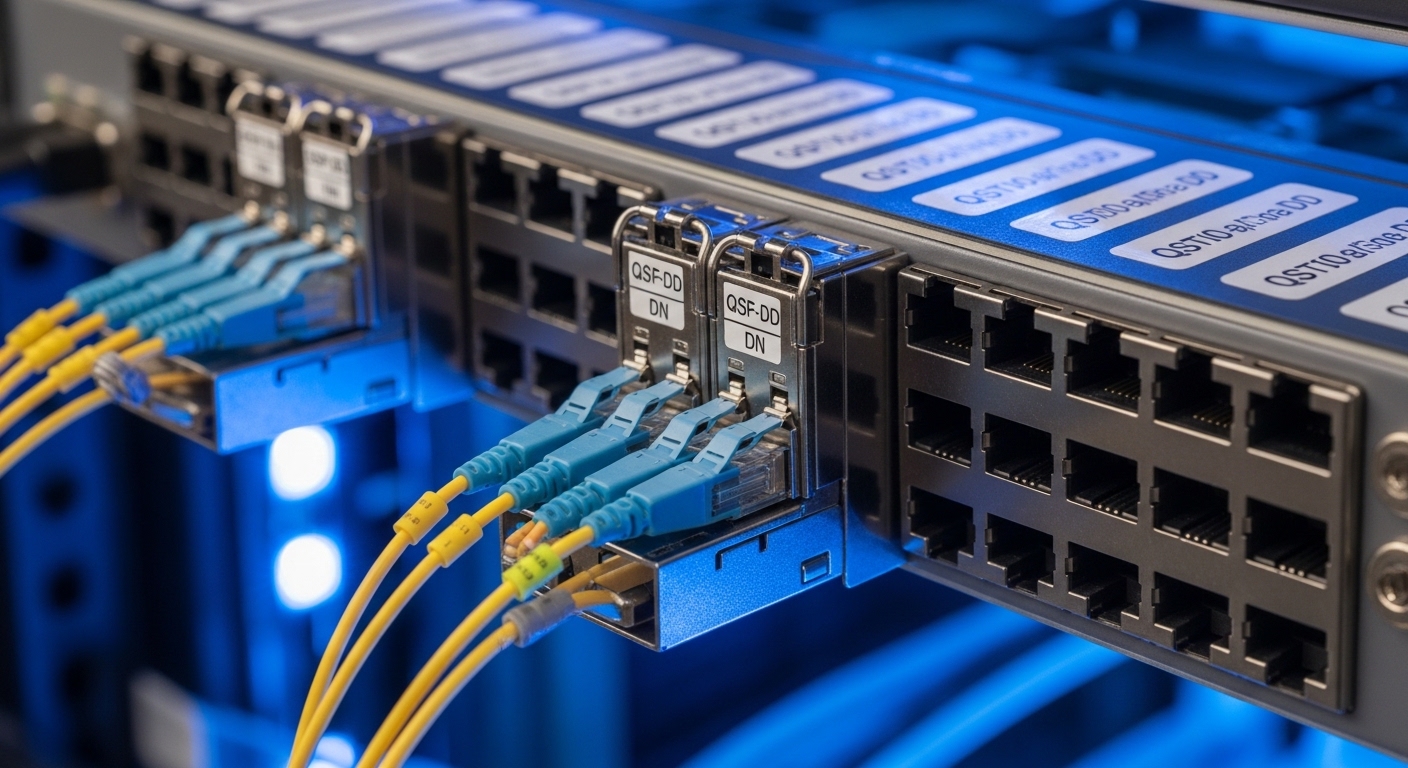
The first failure mode in a 400G migration is oversubscribing rack power and then discovering that optics and switch line cards increase both steady-state draw and fan duty. In practice, I have seen a 48-port ToR refresh where the switch BOM assumed higher-efficiency fans, but the final configuration used additional breakout optics and higher-speed uplinks, increasing rack-level power by 8% to 12% after burn-in. Before ordering transceivers, compute port counts, expected utilization, and worst-case fan curves, then reserve headroom for the optics upgrade path.
What to calculate
- Rack power budget: include PDUs, overhead, and any inline cooling losses; plan 20% spare if your site is already near capacity.
- Optics power per port: different form factors and distances change transceiver power; check switch compatibility guidance.
- Fan duty and airflow: higher port density can increase fan RPM even if average load is modest.
Best-fit scenario: you are deploying a new leaf tier in a 3-tier data center and need to ensure that the same rack can later accept 800G uplinks without replacing PDUs or rebalancing circuits.
Pros: reduces late-stage electrical and thermal surprises; supports predictable outage planning. Cons: requires accurate switch power modeling and optics selection early.
Top 2: Choose optics that minimize 400G to 800G “rework”
Optics selection is where “future-proofing” either becomes real or turns into a costly re-cabling event. For 400G, you will commonly see QSFP-DD or OSFP style optics depending on vendor ecosystems, while 800G often uses a different interface and can require different transceiver types. The key is to pick fiber pathways and connector types that remain compatible with both generations, and to validate DOM behavior and vendor support.
For short reach inside the data hall, engineers frequently deploy 400G-SR8 style optics (eight-lane parallel links) over OM4 or OM5 multimode fiber. For longer reach, coherent or LR4-like approaches may appear, but those can change power budgets and operational complexity. For authoritative baseline behavior, use IEEE Ethernet physical layer guidance and vendor datasheets: IEEE Standards.
| Spec item | 400G SR8 (multimode) | 800G options (typical) | What it means for migration |
|---|---|---|---|
| Target distance | Up to ~100 m on OM4 (vendor-dependent) | Often similar short-reach classes, but interface may differ | Pick OM4/OM5 and verify reach with the exact transceiver |
| Wavelength | ~850 nm nominal (short-reach MM) | ~850 nm for MM short-reach options; coherent varies | Keep multimode fiber plant if both generations support it |
| Connector | LC duplex (common for SR8 MPO-based variants depend on optics) | May use MPO/MTP or LC depending on the optics family | Plan patch panels and polarity rules to avoid rework |
| Typical form factor | QSFP-DD or OSFP (depends on switch) | Vendor-specific 800G pluggables or breakout-capable interfaces | Confirm switch port type and transceiver compatibility lists |
| Power (typical) | Often a few watts per module; check datasheet | Can be higher; depends on architecture | Re-check rack power after final line card population |
| Operating temperature | Vendor standard ranges (often 0 to 70 C for standard) | Same principle, but verify airflow assumptions | Validate with actual measured inlet temperature at the rack |
| Digital optical monitoring | DOM supported in most modern pluggables | DOM expected; may require correct firmware support | Ensure DOM telemetry works end-to-end for troubleshooting |
Pro Tip: Before you lock optics, confirm not only “it lights up,” but that the switch accepts the module in its specific “supported optics” matrix and that DOM thresholds map correctly in your telemetry stack. I have seen cases where the link stabilized at layer 1, yet link state flaps were traced to monitoring profile mismatches after a controller upgrade.
Best-fit scenario: you are deploying 400G-SR8 over OM4/OM5 and want a migration path where you can reuse the same patch panels and fiber routing for 800G short-reach options.
Pros: reduces downtime risk; improves troubleshooting with DOM. Cons: vendor compatibility lists can constrain your optics choices.
Top 3: Build fiber polarity, MPO/MTP routing, and patch-panel discipline
When customers say “we will migrate later,” the most expensive part is rarely the switch. It is the fiber plant that has been patched ad hoc, with mixed polarity conventions, inconsistent MPO orientation, and patch panels that cannot accommodate the lane mapping required by new optics. For 400G to 800G migration, you want to reuse as much of the fiber routing and patch infrastructure as possible while keeping lane mapping deterministic.
Field checklist for fiber readiness
- Standardize patch panel layout: label every trunk and patch location, and keep consistent orientation marks for MPO/MTP ends.
- Polarity documentation: record whether you use polarity adapters, keyed connectors, or fanout conventions per the deployed optics.
- Verify with test results: store OTDR/OLTS and end-to-end insertion loss and reflectance snapshots for each link set.
- Plan spare fibers: reserve at least 10% spare lanes in each group to handle lane remapping during 800G validation.
Best-fit scenario: you have a new spine migration and need to avoid re-terminating MPO/MTP trunks when moving from 400G to 800G uplinks.
Pros: fewer surprises during cutover; faster acceptance testing. Cons: requires disciplined labeling and test evidence.
Top 4: Cooling and inlet temperature targets for dense 400G optics
Optics are sensitive to temperature, and high-density 400G line cards can raise rack inlet temperature even when average room temperature seems safe. In the field, I use the rack inlet sensor and correlate it with switch and optics thermal telemetry during burn-in. If your rack inlet frequently exceeds the module operating envelope, you will see higher error counters, intermittent link resets, or reduced margin that only becomes obvious after a utilization spike.
Practical thermal actions
- Measure inlet temperature: use calibrated sensors at consistent locations across racks, not just room sensors.
- Containment integrity: ensure blanking panels and cable cutouts are sealed; gaps can create bypass airflow.
- Front-to-back airflow: keep cable bundles from obstructing intake; verify with a smoke test if you inherited the rack layout.
Best-fit scenario: you are integrating higher-density racks where 400G line cards and optics increase fan curves and you need to keep stable telemetry before the 800G phase.
Pros: improves optical error stability; reduces risk during peak load. Cons: may require containment changes or fan upgrades.
Top 5: PDU sizing, power sequencing, and DR-ready cabling
Power planning is often treated as a static exercise, but 400G to 800G migration changes what you plug in: optics power draw, fan duty, and sometimes line card population. Additionally, some sites require you to support a DR event where partial racks run from generator or UPS with constrained capacity. If your PDU and circuit distribution are already near limit, the 800G upgrade can force a circuit rework or limit which pods you can restart first.
Engineering considerations
- PDU capacity margin: size for peak draw plus optics and fan variability; avoid operating at 90%+ continuous capacity.
- Power sequencing: align switch startup and optics readiness with UPS ride-through requirements.
- Redundancy mapping: ensure A/B feed diversity for the line cards and that optics do not all share the same power path.
Best-fit scenario: you are preparing for a phased migration where some racks will be upgraded while others remain in service, and you need predictable power behavior for DR testing.
Pros: reduces outage risk; improves DR compliance. Cons: may require earlier PDU upgrades and circuit audits.
Top 6: Validate transceiver DOM telemetry and switch firmware compatibility
DOM and firmware compatibility are where “it passes link training” can still hide operational issues. During a migration, you might run different switch software versions across spine and leaf tiers, and transceivers must be recognized with correct vendor IDs, thresholds, and alarm handling. If your monitoring stack expects specific sensor names or alert semantics, you can miss early warnings or generate false positives.
Verification steps during staging
- DOM visibility test: confirm alarms for temperature and bias current can be polled and graphed.
- Firmware matrix check: verify acceptance of the module vendor family on each targeted switch release.
- Link error baseline: record CRC/FEC-related counters after burn-in and compare across optics types.
Best-fit scenario: you are building a staging lab that mirrors production patching and you need confidence before a maintenance window for 400G enablement that later becomes 800G.
Pros: faster troubleshooting; better alerting quality. Cons: adds staging effort and requires telemetry QA.
Top 7: Use an optics sourcing strategy that limits lock-in without sacrificing support
Engineers often ask whether to buy OEM optics or third-party pluggables. In my experience, OEM transceivers reduce compatibility surprises, while third-party options can cut costs but increase the need for strict validation and higher spares discipline. The best “future-proofing” approach is to define acceptance criteria, test in staging, and maintain an approved optics list per switch model and firmware revision.
For example, many deployments use known 10G or 25G transceiver families for aggregation, but 400G short-reach modules are different in form factor and lane mapping. When you evaluate candidates, check real datasheets and compatibility guidance for module families such as Cisco and Finisar/industry equivalents; see vendor catalogs and datasheets like Cisco and vendor documentation portal examples are not authoritative; use the specific optics vendor datasheet. For optics examples, you may encounter part families like Cisco SFP-10G-SR for older generations; for 400G, you will typically look at QSFP-DD or OSFP SR8-type modules rather than SFP-10G.
Pros: can reduce procurement cost and diversify supply. Cons: higher validation overhead and potential firmware-specific quirks.
Top 8: Plan acceptance testing and cutover windows around 400G-to-800G lane mapping
Migration failures are frequently procedural, not technical. If your cutover checklist does not explicitly cover lane mapping, polarity adapters, and patch panel orientation, you can end up with “no link” or high error rates that waste your outage time. For 400G enablement today, you should design acceptance tests that will still be meaningful when you later convert to 800G optics and interface modes.
What to test now so you do not repeat it later
- Contractual link verification: verify negotiated speed, FEC mode, and optics health sensors.
- Bit error margin: confirm error counters remain stable under expected load profiles.
- Documentation durability: archive the final patch map and transceiver inventory tied to switch serial numbers.
Best-fit scenario: you are performing phased cutovers where 400G uplinks are enabled first, and 800G upgrades will be staged after capacity planning and budget approval.
Pros: reduces outage duration later. Cons: requires disciplined test automation or at least repeatable runbooks.
Top 9: Cost and ROI modeling for 400G now, 800G later
Cost planning should include transceivers, spare inventory, labor, and the hidden costs of rework. In many deployments, the optics BOM is a smaller fraction than the fiber and rack integration work, especially if you must re-terminate MPO/MTP trunks or replace PDUs due to power margin. A realistic approach is to compare OEM versus third-party optics at equal electrical performance while factoring higher validation labor for third-party.
Typical price ranges (order-of-magnitude): OEM short-reach 400G optics can often land in the several-hundred to low-thousand USD per module range depending on market timing and vendor; third-party can be lower but varies widely by quality and warranty. For ROI, model total cost of ownership across three years: optics failure rates, expected annual maintenance labor, and the cost of additional downtime windows. If your site has high outage costs, paying more for compatibility reduces risk even when unit price is higher.
Pros: supports budget approvals with credible assumptions. Cons: requires data collection from your past migrations or vendor quotes.
Common Mistakes / Troubleshooting
1) Mistake: Buying “looks compatible” optics without checking the switch optics matrix. Root cause: some switch firmware rejects modules or applies different alarm thresholds, leading to unstable behavior. Solution: validate in staging on the exact switch model and firmware release; maintain an approved optics list per software version.
2) Mistake: Reusing patch panels but mixing MPO polarity conventions. Root cause: lane mapping errors can prevent link establishment or cause high error rates that appear random. Solution: standardize polarity adapters, document orientation keys, and verify with OLTS/OTDR before cutover.
3) Mistake: Ignoring rack inlet temperature during burn-in. Root cause: dense 400G configurations can push inlet temperatures above module comfort, increasing thermal stress and link resets. Solution: measure inlet at the rack, improve containment and cable management, and confirm stable optics health telemetry over several hours under realistic load.
4) Mistake: Underestimating power headroom during optics and line card population changes. Root cause: final configurations can draw more than predicted, forcing protective behavior or limiting DR restart order. Solution: re-run rack power budgets with final port counts and reserve margin; verify PDU and circuit diversity for A/B feeds.
FAQ
Q1: What is the main reason 400G deployments fail to “smoothly” migrate to 800G?
A: Usually it is not the switch. It is the combination of fiber polarity/patch discipline and rack power/thermal headroom that becomes hard to change during later outages. Planning these early makes the 800G step a validation exercise rather than a rework project.
Q2: Can I reuse the same multimode fiber for both 400G and 800G short reach?
A: Often yes, if both generations use compatible wavelength and reach classes and your installed fiber is OM4 or OM5 with verified insertion loss. You must still validate connector type (LC duplex vs MPO/MTP), polarity, and vendor-specific reach claims for the exact optics.
Q3: Is third-party optics safe for a future 800G migration?
A: It can be safe, but only with strict validation. Treat third-party like a controlled risk: test DOM telemetry, stability under load, and switch firmware acceptance, then maintain a curated approved list and spares strategy.
Q4: What should I measure during acceptance testing for 400G that will also matter later for 800G?
A: Capture link error counters, negotiated modes (including FEC where applicable), and DOM health metrics such as temperature and bias current. Also archive the patch map and polarity configuration so that 800G lane remapping can be executed consistently.
Q5: How much power margin should I reserve for a rack that starts with 400G and later adds 800G?
A: A practical target is to plan around 20% spare capacity at the rack level if your facility is already constrained, and to re-check after final line card population. For DR-readiness, ensure A/B feed diversity and validate UPS ride-through sequencing with your site’s power team.
Q6: Do I need to change cooling when moving from 400G to 800G?
A: Not always, but you should expect higher thermal density in many real designs. Validate rack inlet temperatures and containment integrity now with realistic load, then re-measure after the 800G optics and line card changes.
Next step: audit your current rack power, fiber polarity documentation, and inlet temperature measurements, then map them to the optics interface you will use for 400G and the short-reach or coherent path you plan for 800G. For related planning guidance, see rack cooling planning for high-density migrations.
Author bio: I am a data center engineer specializing in rack planning, power distribution, and optical fiber migration paths for high-speed Ethernet. I have deployed and troubleshot 400G/800G-ready fabrics in production environments with measured thermal, power, and DOM telemetry evidence.
