
Upgrading optical networks in a data center is rarely a straight “buy faster optics” decision. You have to align transceiver reach, switch compatibility, power draw, and fiber plant constraints with measurable business outcomes like reduced outages and lower per-bit cost. This article helps IT directors, architects, and field engineers build an ROI model that survives procurement scrutiny and operational reality.
Top 8 ROI levers for optical networks upgrades in data centers
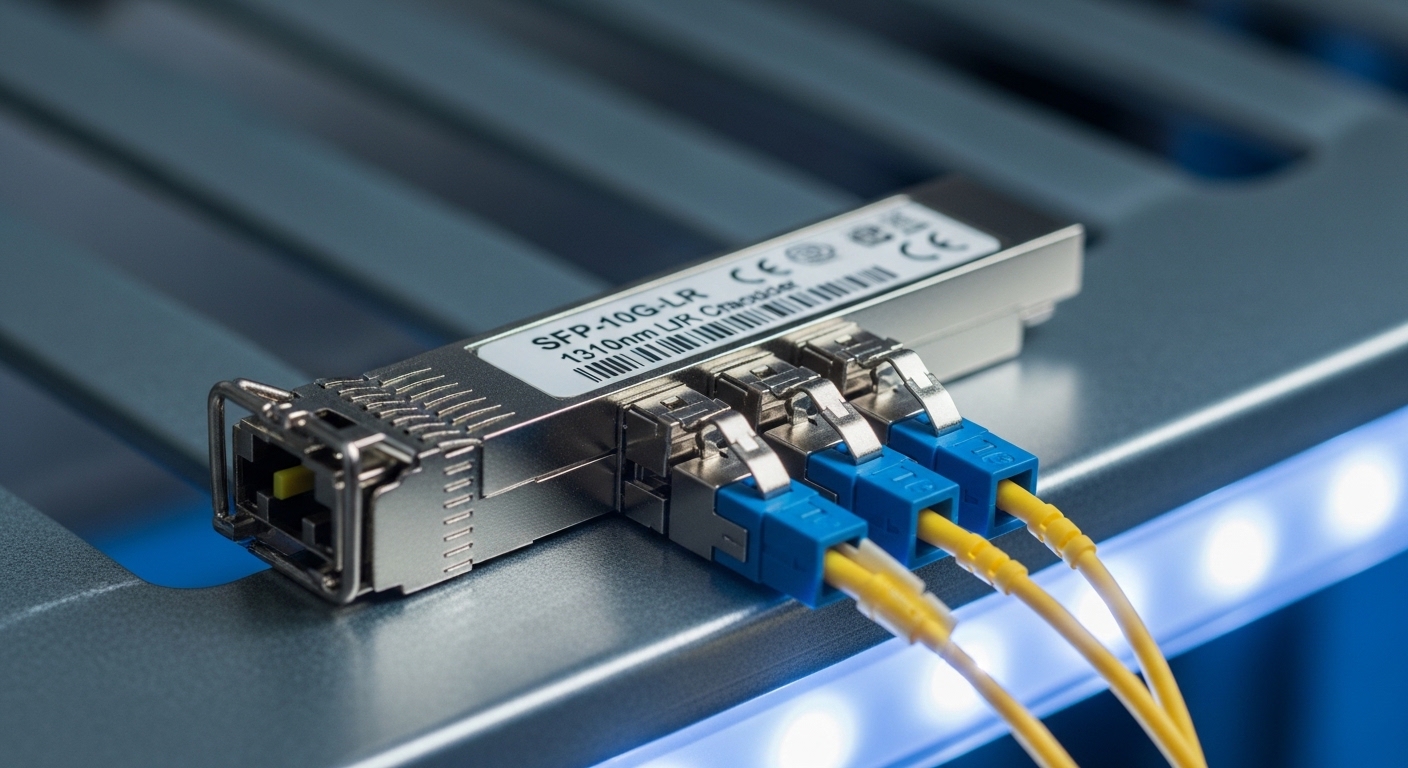
When finance asks for ROI, the technical story must be quantified: fewer link failures, lower power per port, reduced truck rolls, and better utilization of existing fiber. In practice, optical networks upgrades fail ROI targets when teams ignore DOM telemetry, oversubscribe transceiver budgets, or misread switch optics compatibility matrices. A robust decision process ties each hardware change to a measurable delta in TCO.
Item 1: Match reach to fiber reality to avoid stranded capacity
The most common ROI killer in optical networks is over-specifying reach and then discovering that the installed fiber plant does not support the assumed link margin. For example, migrating from 10G SR optics to 25G or 50G SR requires not only a wavelength match but also a link budget that accounts for connector loss, patch panel attenuation, and worst-case OM3/OM4 modal bandwidth limits. If you can validate your fiber plant with OTDR or at least documented attenuation and polarity records, you can keep capital spend inside the “use what you already paid for” envelope.
From an enterprise architecture governance lens, you also want a single source of truth for fiber type (OM3 vs OM4 vs OS2), length, and polarity. That prevents future teams from assuming “it worked once” and then deploying incompatible optics in a different rack row.
Best-fit scenario: A leaf-spine fabric where ToR-to-spine runs average 55 m on OM4, but some critical paths include 120 m due to cable management constraints. The ROI win comes from selecting SR optics that cover the true 95th percentile reach, not the marketing maximum.
- Pros: Prevents stranded spend on unused reach; reduces re-cabling risk.
- Cons: Requires measurement discipline (OTDR or validated records).
Item 2: Power per port and cooling impact, not just transceiver cost
In optical networks, the incremental cost of a higher-speed transceiver is only part of the TCO. Power draw affects total cost of ownership via power supply losses and data hall cooling. Field measurements often show that moving from older 10G optics to modern 25G/50G modules can reduce per-bit energy even if module wattage looks similar, because utilization rises and you need fewer ports for the same throughput.
Governance-wise, define an “optics power budget” per switch line card and verify it against your facility’s cooling model. If you are using liquid cooling or high-density air-cooled designs, the thermal headroom is limited and the ROI case must include throttling avoidance.
Best-fit scenario: A 48x25G ToR upgrade where each switch consumes less total watts for the same workload due to higher oversubscription efficiency. Your ROI is improved by reduced rack-level heat load and fewer spares for underused port types.
- Pros: Quantifiable energy savings; supports sustainability targets.
- Cons: Requires accurate utilization modeling and facility thermal assumptions.
Item 3: DOM telemetry for faster fault isolation and fewer outages
DOM (Digital Optical Monitoring) is often treated as “nice to have,” but it directly impacts ROI through mean time to repair (MTTR). Modern optics expose laser bias current, received power, and module temperature. With standardized monitoring, you can detect drift before a link goes down and automatically correlate optical events with switch syslog and interface counters.
To keep this enterprise-grade, enforce telemetry ingestion into your observability platform and set alert thresholds that match your BER expectations and vendor-recommended operating ranges. If you skip governance, teams may deploy modules that do not behave consistently with your monitoring pipelines.
Pro Tip: In optical networks, many “mystery flaps” are actually marginal receive power events caused by dirty connectors or slowly degrading fiber runs. DOM-based received power trends let you catch the degradation pattern days before the interface drops, which can cut MTTR from hours to minutes.
Best-fit scenario: A multi-tenant data hall where you have shared patch panels. DOM alerts trigger maintenance windows that include cleaning and reseating before BER crosses the vendor’s operational boundary.
- Pros: Faster troubleshooting; fewer truck rolls.
- Cons: Requires observability integration and consistent alert tuning.
Item 4: Switch compatibility and optics qualification to reduce “DOA” risk
ROI collapses when optics are rejected by the switch due to compatibility constraints. Many vendors publish optics compatibility lists per platform and per software release. Even if the transceiver conforms to IEEE 802.3 for electrical and optical characteristics, the switch may still enforce vendor-specific requirements for EEPROM coding, signal conditioning, or diagnostics behavior.
Operationally, you should maintain a tested optics catalog per switch model and software baseline. That prevents field teams from experimenting during critical upgrade windows.
Best-fit scenario: A migration from legacy ToR switches to a new platform family. The ROI improves when you pre-qualify optics models like Cisco-compatible SR modules and validate them in a staging rack with the exact firmware level before the production cutover.
- Pros: Lower deployment failure rate; shorter outage windows.
- Cons: Upfront qualification work; careful change management needed.
Item 5: OSFP and QSFP form factor strategy to protect future scaling
Optical networks upgrades are also about lifecycle planning. If you buy the wrong form factor now, you may strand ports or force expensive rework later. For example, QSFP28-based 25G deployments may be fine for a near-term refresh, but a roadmap that expects higher density may require QSFP56 or OSFP-style optics and line cards.
Architecturally, you want a “port abstraction” model: define which physical ports map to logical interfaces and how you will migrate those mappings without re-architecting the entire network. This governance reduces future migration cost and improves ROI by lowering the probability of disruptive re-cabling.
Best-fit scenario: A pod refresh where you standardize on 25G now but select chassis and spares that support a drop-in path to higher rates. You avoid buying a second wave of optics and reduce operational complexity.
- Pros: Protects capex; reduces future migration risk.
- Cons: Needs roadmap discipline and realistic traffic projections.
Item 6: BER and link margin engineering for predictable performance
Optical networks are not only about reach; they are about optical power budgets and bit error ratio (BER) margin. For 25G/50G SR links, you need to verify that your launch power, receive sensitivity, and system penalties (fiber, connectors, splices, and aging) maintain adequate margin. IEEE 802.3 defines the physical layer requirements, but real links depend on plant quality and operational conditions.
In governance terms, require link budget calculations for any design that exceeds a defined margin threshold. Also define acceptance tests that include optical power verification and interface error counter baselines.
Best-fit scenario: A 50G SR rollout across dense patch panels. ROI improves because you avoid silent performance degradation that would later cause congestion or retransmits in latency-sensitive workloads.
- Pros: Predictable performance; fewer “it works today” surprises.
- Cons: Requires engineering effort and documented standards.
Item 7: Choosing OEM vs third-party optics with a TCO model
Procurement often focuses on unit price, but optical networks ROI depends on failure rates, warranty terms, and the cost of operational friction. OEM optics typically integrate cleanly with platform compatibility lists, but third-party optics can be cost-effective when properly qualified. The ROI question becomes: what is the expected cost of failure multiplied by the cost of time and risk during deployments?
Field reality: third-party optics can be excellent if the vendor provides stable EEPROM coding, DOM behavior, and consistent firmware behavior. However, you must manage vendor lock-in risk by qualifying multiple sources for the same spec and by requiring consistent diagnostic outputs.
Best-fit scenario: A large-scale refresh of 10G SR optics to 25G SR. ROI improves when you standardize on a primary qualified vendor and keep a second qualified vendor for spares to reduce lead time shocks.
- Pros: Lower purchase cost; improved supply resilience.
- Cons: Requires qualification and stronger governance controls.
Item 8: Spares, lead times, and BOM governance to stabilize delivery
Optical networks upgrades are time-sensitive. If lead times are unpredictable, you may pay expediting fees or extend outage windows. ROI should include schedule risk: the cost of delayed cutovers, the cost of maintaining temporary capacity, and the cost of carrying extra inventory.
Governance best practice is a BOM policy: every optics part number must be tied to a qualified platform/software combination, and spares must be stocked with at least one alternative vendor where feasible. This reduces operational risk and improves availability metrics.
Best-fit scenario: A staggered rollout across multiple data halls. ROI improves when you stage spares and validate optical performance thresholds so you do not re-open maintenance windows for avoidable issues.
- Pros: Lower schedule variance; higher availability.
- Cons: Inventory planning overhead; qualification maintenance needed.
Optics selection: specs that actually drive optical networks ROI
ROI depends on selecting optics that satisfy IEEE physical layer requirements while matching your fiber plant and operational constraints. The most important specs for optical networks in a data center are data rate, wavelength, reach, power consumption, connector type, DOM support, and operating temperature range.
The table below compares representative short-reach module classes used in enterprise optical networks. Values vary by vendor and exact part number, so treat these as decision inputs rather than absolutes.
| Module class | Typical data rate | Wavelength | Target reach | Connector | DOM | Operating temp | Common use |
|---|---|---|---|---|---|---|---|
| 10G SR (SFP+) | 10.3125G | 850 nm | ~300 m OM3 / ~400 m OM4 | LC | Supported (typically) | 0 to 70 C (commercial) | Legacy upgrades, server access |
| 25G SR (SFP28) | 25.781G | 850 nm | ~100 m OM4 (typical) | LC | Supported (typically) | 0 to 70 C (commercial) | Leaf-spine scaling |
| 50G SR (QSFP28) | ~50G | 850 nm | ~100 m OM4 (typical) | LC | Supported (typically) | 0 to 70 C (commercial) | Higher density fabrics |
| 100G SR4 (QSFP28) | 100G aggregate | 850 nm | ~100 m OM4 (typical) | LC | Supported (typically) | 0 to 70 C (commercial) | Spine uplinks |
Engineering references: IEEE 802.3 defines Ethernet PHY requirements and electrical/optical interfaces for short-reach links. For module behavior, consult vendor datasheets for laser class, receiver sensitivity, and DOM register mappings. [Source: IEEE 802.3 Ethernet Physical Layer Specifications] [Source: Cisco SFP and QSFP Transceiver Documentation] [Source: Finisar/II-VI Transceiver Datasheets]
anchor-text: IEEE 802.3 physical layer standards
What to verify before purchase
- Reach vs worst-case link budget: include connectors, patch panels, splices, and aging.
- DOM telemetry consistency: verify received optical power units and alarm thresholds.
- Connector cleanliness and polarity: ensure LC polarity and MPO polarity handling match your patching standard.
- Operating temperature: confirm modules meet your rack inlet temperature profile.
- Switch qualification: verify the exact module part number is supported on your platform and software version.
Decision checklist: how engineers score optical networks ROI in procurement
To make upgrades defensible, score each candidate optics option with a consistent rubric. The goal is to prevent late-stage surprises and to connect technical requirements to measurable outcomes like reduced outage frequency and improved utilization.
- Distance and fiber type fit: OM3 vs OM4 vs OS2, plus measured attenuation and patch panel losses.
- Switch compatibility: confirm exact part number support for your switch model and software release.
- DOM and observability readiness: ensure alarms integrate with your monitoring stack and your runbooks.
- Power and thermal impact: compute per-port power and validate against rack and facility cooling constraints.
- Operating temperature and derating: confirm performance under inlet temperature extremes.
- Vendor lock-in risk: evaluate second-source availability and the stability of EEPROM coding and diagnostics.
- Warranty, RMA logistics, and mean time to replace: include shipping and spares strategy in TCO.
- Acceptance testing plan: define optical power checks, interface error baseline, and burn-in steps where needed.
Best-fit scenario: A program managing 3,000+ optics across multiple pods. ROI improves when the rubric is applied consistently and when exceptions require engineering sign-off with documented link budget evidence.
- Pros: Repeatable procurement decisions; fewer integration failures.
- Cons: Requires upfront standardization and data collection.
Common mistakes and troubleshooting tips for optical networks ROI
Even with good planning, optical networks upgrades can fail operationally. Below are frequent failure modes with root causes and corrective actions that field teams see during rollouts.
Mistaking “reach” marketing numbers for real link margin
Root cause: Installed fiber includes patch panel losses, dirty connectors, or unvalidated lengths, shrinking link margin below receiver sensitivity. Some teams only verify length, not attenuation and connector quality.
Solution: Use OTDR or validated attenuation records for each run, clean connectors using appropriate procedures, and verify received power via DOM after installation. Establish an acceptance threshold based on vendor-recommended minimum received power.
Deploying optics that are not fully qualified for the switch software baseline
Root cause: The switch may enforce optics coding or diagnostics behavior that changes across software releases. The module “inserts and links” but later triggers CRC errors or link resets under load.
Solution: Pre-qualify in staging with the exact firmware version. Lock the network change window so optics and switch software are upgraded together only when tested.
Ignoring DOM telemetry in monitoring and runbooks
Root cause: Teams alert on interface down events, not on optical power drift. By the time the interface drops, the operational cost is already incurred: repeated reconvergence, workload impact, and extended troubleshooting time.
Solution: Configure alerts on DOM received power and temperature, and include optical power trend dashboards in the on-call workflow. Update runbooks to include cleaning steps and DOM register checks.
Wrong polarity or MPO/LC patching mismatch
Root cause: In dense patch panels, polarity errors create low received power and intermittent links. This often shows up as “it works sometimes” behavior due to connector movement.
Solution: Enforce polarity labeling standards, use polarity testers, and verify patching before energizing. For MPO, follow the vendor’s recommended polarity scheme and validate with a light test.
- Pros: Fewer outages and faster resolution.
- Cons: Requires operational discipline and training.
Cost and ROI note: realistic ranges and TCO drivers
Pricing for optical networks optics varies by speed, vendor, and supply conditions. In many enterprise data centers, short-reach optics unit costs can range from roughly $50 to $200 per module for mature 10G classes, and often $150 to $400+ for 25G/50G/100G short-reach modules depending on qualification and channel pricing. OEM modules can carry a premium, but third-party optics can reduce capex when governance and qualification are strong.
For ROI, model TCO with at least three components: (1) capex per port times expected rollout count, (2) opex from power draw and cooling impacts, and (3) opex from failure and maintenance. If your historical optics-related MTTR is high or your outage cost is significant, the DOM and compatibility governance can dominate the ROI calculation.
Also include failure rate assumptions and RMA logistics. A slightly higher module price with better warranty terms can outperform cheaper optics if the replacement cycle and shipping time are lower.
Best-fit scenario: A data center with frequent maintenance windows and strict uptime requirements. ROI improves when governance reduces “link bring-up” failures and reduces the number of optics that must be replaced during ramp.
- Pros: ROI model can be justified to finance with measurable assumptions.
- Cons: Requires credible historical outage and maintenance data.
Summary ranking table: which ROI lever matters most
The table below provides a practical ranking view based on typical data center upgrade programs, weighted toward measurable operational outcomes.
| Rank | ROI lever | Primary metric improved | Typical impact | Effort level |
|---|---|---|---|---|
| 1 | Switch compatibility and qualification | Deployment failure rate, outage window | High reduction in rollbacks | Medium |
| 2 | DOM telemetry and runbook integration | MTTR, fault prediction | High improvement in operational readiness | Medium |
| 3 | Reach and fiber plant fit | Link stability, avoided re-cabling | High capex protection | Medium to High |
| 4 | BER/link margin engineering | BER stability, reduced retransmits | Medium to High performance predictability | Medium |
| 5 | Power and cooling impact | Energy cost, thermal headroom | Medium, compounding over time | Medium |
| 6 | OEM vs third-party TCO governance | Capex and warranty-driven opex | Medium with strong qualification | High |
| 7 | Spares and lead time stabilization | Availability and schedule risk | Medium, program-dependent | Medium |
| 8 | Form factor lifecycle planning | Future migration capex | Medium, longer horizon | Medium |
FAQ
How do optical networks upgrades affect ROI beyond transceiver price?
ROI is dominated by opex drivers: power draw, cooling impact, and operational cost of troubleshooting and outages. DOM telemetry and compatibility governance reduce MTTR and reduce the probability of failed deployments, which can be more valuable than the unit price difference.
What fiber plant checks should we require before buying short-reach optics?
At minimum, verify fiber type (OM3/OM4/OS2), run length distribution, connector/splice counts, and documented attenuation. For high-risk paths, use OTDR or equivalent measurement to validate end-to-end loss and polarity correctness before commissioning.
How strict should switch compatibility requirements be for optical networks?
Be strict for production cutovers. Even if the optics meet IEEE 802.3 electrical and optical specs, the switch can enforce EEPROM coding and diagnostics behavior that differs by platform and software baseline.
