
In modern 5G networks, the hardest part is rarely the radio link. It is the fronthaul and midhaul transport that must scale quickly while staying compatible across vendors and temperature ranges. This article helps network and field engineers choose modular optical transceivers that reduce change windows, simplify upgrades, and keep link budgets predictable. You will see concrete spec tradeoffs, selection criteria, and troubleshooting patterns from deployments in dense access and aggregation sites.
Why modular optics matter inside 5G networks
5G transport segments typically include fronthaul (often strict latency and timing), aggregation, and sometimes backhaul, each with different distance and power constraints. Modular optical transceivers let you swap optics without redesigning the host switch, because the electrical interface and management hooks are standardized. In practice, operators also use modular optics to stage upgrades: deploy today at 10G/25G, then migrate to 25G/100G depending on traffic growth and fiber availability. The key is to match the transceiver’s optical parameters, diagnostics, and connector type to the field realities of your site.
What “flexibility” actually means in the field
Field teams usually mean four specific outcomes. First, fast replacement during outages: a technician can pull an SFP/SFP28/QSFP module instead of reworking optics or cabling. Second, upgrade agility: change data rate while keeping the same transceiver footprint and switch port. Third, multi-vendor interoperability: rely on DOM support and standardized management so the host can read power, temperature, and alarms. Fourth, operational consistency: maintain predictable link budgets across cold-weather outdoor cabinets and hot indoor aggregation rooms.
Pro Tip: Before you standardize on any optics SKU for 5G networks, validate DOM alarm thresholds and your switch’s response to threshold changes during burn-in. In several real deployments, “compatible” modules passed link-up tests but later triggered nuisance alarms due to vendor-specific calibration, masking genuine fiber issues.
Core transceiver types for 5G fronthaul and aggregation
Most 5G sites rely on short-reach optics for intra-building links and longer-reach optics for campus or metro spans. Common module families include SFP, SFP28 (25G), and QSFP/QSFP28 (40G/100G), with optical interfaces like SR (multimode), LR/LR4 (single-mode), and ER/ER4 for extended reach. Your selection is driven by the fiber plant: multimode OM3/OM4 versus single-mode OS2, plus the connector and transceiver form factor supported by the switch.
Spec comparison engineers actually use
Below is a practical comparison for commonly deployed short-reach and reach-extending options. Always confirm the exact wavelength, reach, and interface spec against your switch vendor’s compatibility list and the module datasheet.
| Module family (examples) | Typical data rate | Optical type | Wavelength | Reach (typ.) | Connector | DOM | Operating temperature |
|---|---|---|---|---|---|---|---|
| SFP-10G SR (e.g., Cisco SFP-10G-SR, FS.com SFP-10GSR) | 10G | Multimode | 850 nm | Up to ~300 m on OM3 / ~400 m on OM4 | LC | Usually supported | 0 to 70 C (industrial variants exist) |
| SFP28-25G SR (e.g., Finisar FTLX8571D3BCL class) | 25G | Multimode | 850 nm | Up to ~100 m on OM3 / ~150 m on OM4 (varies by vendor) | LC | Usually supported | -20 to 70 C common |
| QSFP28-100G SR4 / LR4 (vendor-dependent) | 100G | Multimode or single-mode | ~850 nm (SR4) or ~1310 nm (LR4/ER4) | ~100 m (SR4 typical) / ~10 km (LR4 typical) | LC (SR4/LR4) | Usually supported | Commercial to industrial bins |
| QSFP-40G SR4 (legacy aggregation) | 40G | Multimode | 850 nm | ~100 m typical | LC | Often supported | 0 to 70 C typical |
These optical categories map to standard Ethernet transceiver expectations defined by IEEE 802.3 physical layer families and the module ecosystem managed through vendor datasheets. For protocol context, see IEEE 802.3 on physical layer definitions and link behavior. IEEE 802.3 Standard
DOM and diagnostics: the “flex” enabler
DOM (Digital Optical Monitoring) is what makes modular optics operationally flexible. It exposes transmit power, received power, temperature, and vendor-specific alarms, enabling proactive maintenance. In 5G networks, this matters because a failing connector, dirty ferrule, or micro-bend can degrade links gradually. A host switch that reads DOM can log thresholds and trigger maintenance workflows before the fronthaul drops.
Selection criteria checklist for 5G transport optics
The best modular optics decision is a structured engineering trade study, not a shopping list. Use this ordered checklist; it matches how field teams reduce rework and avoid “works on the bench” surprises in 5G networks.
- Distance and fiber type: confirm OM3/OM4 versus OS2, and measure installed attenuation and patch-panel loss.
- Switch port compatibility: verify the exact form factor and electrical interface support (SFP vs SFP28 vs QSFP28), plus vendor compatibility.
- Wavelength and reach category: SR for multimode, LR/LR4 for single-mode, ER/ER4 only when link budget demands it.
- Connector and polarity: LC versus MPO, and correct polarity handling for MPO-based optics.
- DOM support and management behavior: confirm DOM is functional in your host and that alarms integrate cleanly with your monitoring stack.
- Operating temperature and thermal design: outdoor cabinets and tower shelters can exceed commercial bins; select industrial-grade modules when needed.
- Vendor lock-in risk: evaluate third-party modules using documented compatibility lists and a test plan; keep spare strategy consistent.
- Power and cooling impact: ensure switch PSU and airflow meet module thermal limits under worst-case ambient conditions.
If you are standardizing across many sites, request vendor datasheets with DOM parameter details and run an acceptance test that includes DOM telemetry sampling and link stability under thermal cycling.
Deployment scenario: modular optics in a 5G leaf-spine edge
Consider a 3-tier data center and edge pattern used for 5G networks: 48-port ToR switches at the edge, aggregation pairs in a regional room, and a spine layer in the core. Suppose the operator must connect 12 radio units per edge pod to aggregation using 25G uplinks, totaling 24 x 25G links per pod. They initially deploy SFP28-25G SR modules over OM4 with LC connectors for up to ~150 m, since patch-panel loss is known and measured. As traffic grows, they later replace select edge uplinks with QSFP28-100G LR4 for longer runs across a campus corridor, keeping the host upgrade limited to specific port groups.
In this scenario, modular optics provide practical flexibility: technicians carry a small spare pool (one module family per reach class), and the monitoring system can track DOM trends. When a link shows gradual received-power decline, field staff clean the connector, re-seat the transceiver, and confirm the DOM “rx power” returns to normal range. This reduces mean time to repair because the transceiver is a defined replaceable unit with deterministic electrical and optical interfaces.
Common mistakes and troubleshooting patterns
Even experienced teams hit predictable failure modes when deploying modular transceivers for 5G networks. The following pitfalls come up repeatedly in acceptance tests and after go-live.
“Link-up passes, but performance degrades later”
Root cause: marginal link budget caused by excess patch loss, dirty connectors, or underestimated fiber attenuation; the link can still train but BER increases over time. Solution: measure end-to-end loss with an OTDR or calibrated light source/optical power meter, clean both ends, and verify DOM received power trend stability.
Wrong polarity or MPO handling
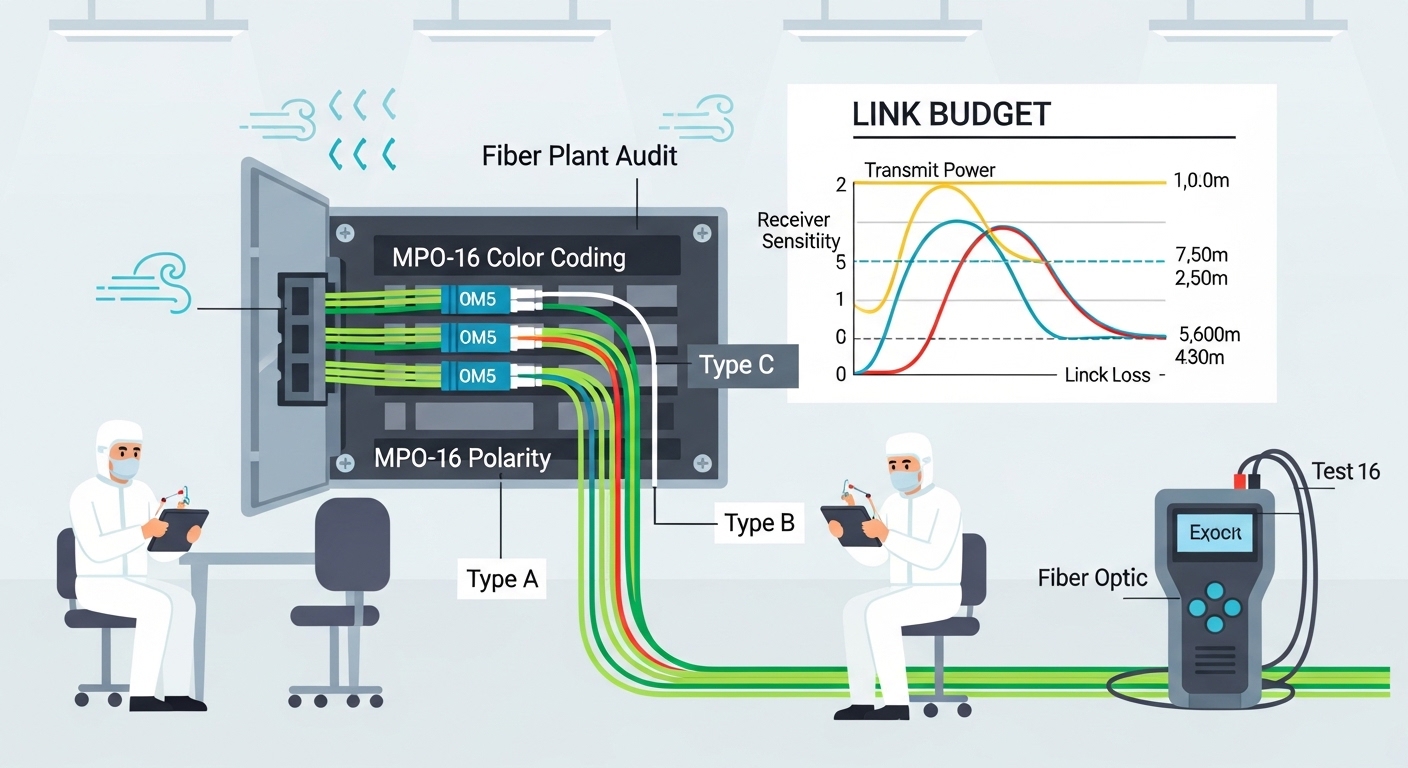
Root cause: MPO polarity mismatch on multi-fiber jumpers, leading to swapped lanes and intermittent errors. Solution: re-check polarity labels, confirm MPO keying orientation, and use the correct polarity method documented by the transceiver and cabling standard.
Temperature bin mismatch in outdoor or high-heat cabinets
Root cause: using commercial-grade modules where ambient excursions exceed the specified operating range, causing power drift or thermal shutdown. Solution: select industrial-grade modules with the appropriate temperature range, add airflow where feasible, and log DOM temperature during peak ambient.
DOM alarm thresholds create false escalation
Root cause: vendor-specific DOM calibration differences cause thresholds to trigger even when the link is within acceptable performance. Solution: baseline DOM values during stable operation, adjust monitoring thresholds, and correlate with error counters (PCS/FEC or equivalent) from the host.
Cost and ROI: balancing OEM and third-party optics
Pricing varies by data rate and reach class, but practical field ranges for new modules often look like this: 10G SR SFP modules can be relatively low-cost, while 25G SFP28 and 100G QSFP28 modules typically cost more per port due to higher-speed optics and testing. OEM optics frequently command a premium, yet they can reduce compatibility risk and simplify warranty workflows. Third-party optics may reduce upfront capex, but they can increase engineering time for compatibility testing and monitoring tuning, especially for DOM alarm behavior.
ROI improves when modular optics reduce downtime: a quick swap during a fronthaul outage can be worth far more than a small per-module price delta. For TCO, include failure rates observed in your own environment, cleaning consumables, spares logistics, and the labor cost of acceptance testing across multiple switch models. Also plan a lifecycle strategy: mix modules only when you have verified DOM and thermal behavior across the full operating envelope.
FAQ
What standards govern optics used in 5G networks?
At the Ethernet physical layer, optics behavior aligns with IEEE 802.3 physical layer specifications for link training, signaling, and optical classes. Operational details like DOM telemetry fields and alarm thresholds come from vendor datasheets and module standards used by the transceiver ecosystem. IEEE
Can I mix OEM and third-party transceivers in the same switch?
Often yes, but you must validate compatibility per switch model and confirm DOM telemetry works reliably. The most common issue is monitoring integration: “link-up” can succeed while alarms or thresholds behave differently. Run a staged rollout with a controlled acceptance test.
How do I choose between SR and LR for a 5G site?
Use SR for short intra-building or campus links over multimode fiber when the measured loss and connector penalties fit the reach spec. Use LR/LR4 on single-mode when you have longer distances or when the installed plant is OS2. Always base the decision on measured attenuation and patch-panel loss, not only the datasheet “typical reach.”
What should I monitor after installing modular optics?
Monitor DOM transmit power, received power, temperature, and any vendor alarms, then correlate with host error counters. A healthy link shows stable DOM trends and no recurring alarm bursts. If received power slowly declines, treat it as a likely contamination or connector wear indicator.
Why do some links drop only under high ambient temperature?
Thermal drift can change laser output power and receiver sensitivity margin, especially if the module is near its operating limit. The fix is selecting an industrial temperature bin, improving airflow, and verifying DOM temperature during peak conditions. Also inspect for airflow blockage behind the transceiver cages.
Where do engineers usually lose time during optical deployments?
Most delays come from assuming fiber reach without verifying patch loss, and from polarity mistakes on MPO jumpers. Another time sink is missing a switch compatibility check for the exact module family. A disciplined checklist and a small pilot deployment usually prevents major rework.
Modular optical transceivers make 5G networks more resilient by turning transport optics into replaceable, monitorable units. Next, align your transceiver selection with your switch compatibility and fiber measurements using optical-transceiver-compatibility-and-dom.
Author bio: I have worked hands-on with high-density Ethernet transport for radio access and aggregation, validating optics with DOM telemetry, link budgets, and field troubleshooting. I focus on measurable outcomes: stable BER, predictable thermal behavior, and reduced mean time to repair across mixed-vendor hardware.
