
Choosing the right optics for data center connectivity is no longer just a matter of “fiber versus copper.” In modern leaf-spine and AI cluster designs, engineers weigh signal integrity, thermals, switch compatibility, and total cost of ownership across thousands of links. This article compares Active Optical Cables (AOC) and Direct Attach Copper (DAC) with practical, field-ready guidance for architects, network engineers, and data center operations teams.
AOC vs DAC performance: reach, signal quality, and latency behavior
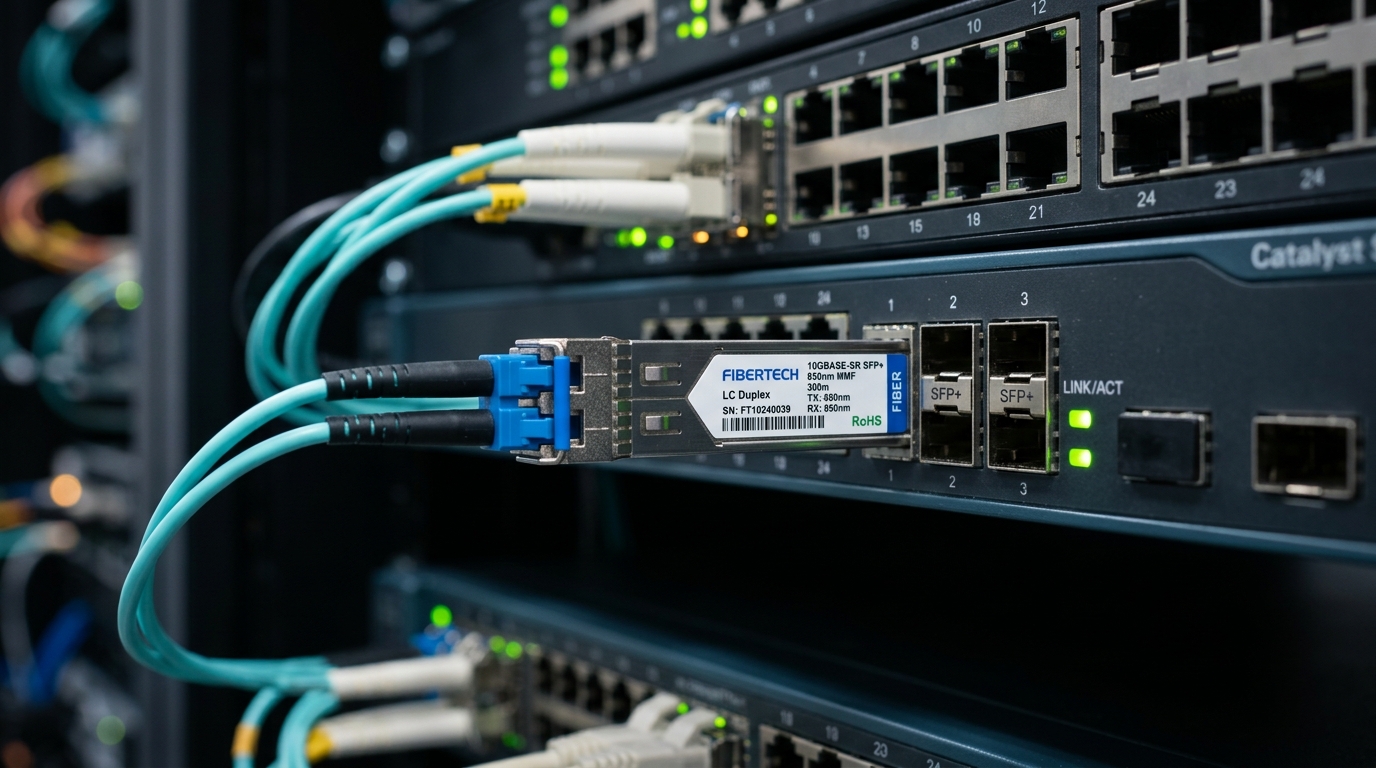
For short-reach top-of-rack and end-of-row links, DAC is often deployed because it is inexpensive and fast to install. For longer runs inside the same building, AOC typically becomes more attractive because it uses optical transceivers inside a pre-terminated cable assembly. In practice, both options can meet IEEE Ethernet requirements, but the limiting factor is usually the physical channel budget and the host port’s supported electrical or optical profiles.
What “performance” means in day-to-day operations
Engineers usually evaluate three things: supported data rate (for example 25G, 40G, 100G), maximum reach for the specific copper or fiber channel, and whether the link stays stable during temperature swings. DAC assemblies are electrical end-to-end; AOC assemblies convert electrical signals to optics near the connectors and then back at the far end. That conversion helps maintain signal quality over longer distances, but it introduces optical power and receive sensitivity constraints.
Technical specifications comparison table
The table below summarizes typical spec ranges seen in common 25G/100G deployments. Exact values vary by vendor and part number, so always verify against the datasheet and your switch vendor’s compatibility matrix.
| Category | Example form factor | Typical data rates | Wavelength / medium | Typical reach (1 link) | Connector type | Operating temperature | Typical power (per link) |
|---|---|---|---|---|---|---|---|
| AOC | Active optical cable (QSFP28 AOC, SFP28 AOC) | 25G to 400G (by generation) | 850 nm (SR class) or 1310 nm (LR class, rarer for AOC) | Up to 100 m class for many 25G/100G AOC SKUs | Integrated cable ends (no separate optics) | -5 C to 70 C (varies by vendor) | ~1.5 W to 4 W |
| DAC | Direct attach copper (SFP+ DAC, QSFP+ DAC, QSFP28 DAC) | 10G to 400G (by generation) | Electrical copper channel | ~1 m to 7 m typical for higher-speed DAC | Integrated cable ends (no separate optics) | 0 C to 70 C (varies by vendor) | ~0.5 W to 2 W |
From a compatibility standpoint, DAC generally depends on the switch’s supported electrical reach and channel equalization. AOC depends on whether the host port expects an optical interface profile and whether the AOC’s internal optics meet the host’s optical parameters.
Cost and ROI: how AOC vs DAC impacts TCO at scale
Upfront price is visible on the PO, but TCO comes from installation time, spares strategy, and the probability of link failures that require labor. DAC often wins on purchase cost for short reaches because it avoids optical components and uses a passive copper channel. AOC can be more expensive per port, yet it may reduce installation time by eliminating separate transceivers and fiber patching.
Realistic cost ranges and where they come from
Typical market pricing for enterprise and mid-market deployments varies by rate and vendor. As a planning baseline, short DAC assemblies (for example 25G or 100G within 3 m to 5 m) often land in the low tens of USD per link, while AOC assemblies for similar rates and higher reach can be in the mid tens to low hundreds of USD per link. In OEM ecosystems, pricing is often higher, but the advantage is fewer compatibility surprises.
Operational ROI considerations
Consider spares: DAC spares can be cheaper, but if you stock multiple lengths to match cable routing constraints, inventory grows quickly. AOC spares can reduce length fragmentation because you can use a single 30 m or 50 m class AOC for many routes. Also account for power and cooling: while both are relatively small per link, a 1000-port cluster can see measurable differences in aggregate wattage.
Pro Tip: In many leaf-spine designs, the “right” option is not the one with the best headline reach. It is the one that minimizes link rework. If your cabling plan already supports a single AOC length for multiple rows, you can cut change-order labor and reduce the number of intermediate patch points that cause intermittent loss-of-signal events.
Compatibility and standards: what your switch actually accepts
Both AOC and DAC must interoperate with your switch ASIC, PHY, and optics policy. IEEE Ethernet standards define electrical and optical behavior, but vendors implement port-level constraints, including supported breakout modes, channel equalization ranges, and whether third-party optics are allowed. For Ethernet interfaces, IEEE references include the relevant 10GBASE, 25GBASE, 40GBASE, and 100GBASE families depending on your rate. For optical behavior, consult the vendor datasheets for receiver sensitivity and compliance statements.
Standards and vendor documentation to reference
- IEEE 802.3 for Ethernet physical layer definitions and optical/electrical requirements: [[EXT:https://standards.ieee.org/standard/]] [Source: IEEE Standards Association]
- Switch vendor “optics compatibility” or “transceiver matrix” for supported part numbers and reach classes: [Source: Cisco, Juniper, Arista, and Broadcom-based vendor documentation]
- Optics vendor datasheets for DOM (Digital Optical Monitoring) and optical power budgets: [Source: manufacturer datasheets for AOC and DAC SKUs]
DOM and diagnostics: AOC tends to be easier to observe
Many AOC assemblies expose diagnostics similar to SFP/SFP28 or QSFP28 modules, including transmit bias, received power, and temperature. DAC can also provide diagnostics depending on generation, but in the field you will often see fewer optical telemetry fields because the link is electrical. If you rely on telemetry for proactive maintenance, confirm which diagnostics are implemented and whether they are surfaced through your switch management plane.
Use-case fit: where AOC beats DAC and where DAC still wins
AOC and DAC each have a “sweet spot” shaped by distance, cable management, and operational workflow. DAC is typically favored for very short rack-to-rack or top-of-rack to spine within a few meters. AOC is typically favored when you need longer reach but want the simplicity of a single pre-terminated cable assembly.
Concrete deployment scenario from the field
In a 3-tier data center leaf-spine topology with 48-port 10G or 25G ToR switches, a common pattern is leaf-to-spine links across the aisle. Suppose each leaf switch serves 20 racks and the average direct route to the spine is 18 m due to aisle depth and containment. If the switch supports 25G optical interfaces but your cabling team wants to avoid separate optics and patching, 25G AOC assemblies rated for up to 100 m class can be used to standardize on one or two lengths (for example 20 m and 30 m) across the site. By contrast, a 25G QSFP28 DAC solution may only cover 3 m to 7 m, forcing additional fiber runs and more patch panel complexity.
When DAC remains the rational choice
If your physical layout keeps runs under the DAC reach budget, DAC reduces optical budget variables. It also simplifies troubleshooting: a DAC link failure often presents as a straightforward “link down” event tied to connector seating, cable replacement, or host port equalization settings. For high-volume, short-reach deployments, that speed of diagnosis can outweigh the longer-term benefits of optical reach.
Selection criteria and decision checklist engineers use
When choosing between AOC and DAC for data center connectivity, engineers typically follow an ordered checklist that prevents late-stage surprises. Use this as a practical decision path during design review.
- Distance and channel budget: Confirm the exact run length, including slack loops and routing constraints. Compare against the AOC/DAC reach spec for your exact data rate.
- Switch compatibility: Verify the switch vendor’s optics matrix for supported third-party AOC/DAC part numbers, especially for newer generations.
- Data rate and interface type: Match the port speed (25G vs 100G) and connector form factor (SFP28, QSFP+, QSFP28, etc.).
- DOM and monitoring requirements: If you need telemetry for received power or link health, confirm which fields are supported and how the switch surfaces them.
- Operating temperature and airflow: Check the cable assembly temperature rating and your inlet-to-outlet airflow profile. Many failures correlate with high local heat near dense optics.
- Vendor lock-in risk: Evaluate whether you can standardize on multiple suppliers without triggering compatibility issues. OEM-only optics can raise replacement costs during outages.
- Spare strategy and lifecycle: Decide whether to stock multiple lengths (DAC) or fewer standardized lengths (AOC). Include expected failure rates and lead times.
Common mistakes and troubleshooting tips
Even when specs look correct on paper, real installations fail due to operational details. Below are frequent failure modes and how to fix them.
Link flaps after thermal changes
Root cause: The AOC or DAC is operating near the upper temperature threshold, or airflow is blocked by bundling. High local temperature can reduce transmitter power margin and increase bit errors.
Solution: Improve airflow clearance, re-route cable bundles away from hot exhaust paths, and verify the assembly’s operating temperature range. Then check switch interface error counters for CRC and symbol errors.
“No module detected” or “unsupported transceiver”
Root cause: The switch enforces a strict optics policy, or the AOC/DAC does not meet the host’s expected electrical/optical profile. This is common when mixing generations or using unverified third-party parts.
Solution: Confirm the exact transceiver interface type and speed (for example QSFP28 for 100G). Validate against the switch vendor compatibility matrix and update switch firmware if the vendor documents improved optics support.
Intermittent loss-of-signal due to connector stress
Root cause: Cable assemblies experience mechanical stress from tight bends or uneven connector seating. DAC assemblies are especially sensitive to connector alignment because they rely on stable electrical contact and controlled impedance.
Solution: Reseat both ends using proper connector handling, replace any cable that shows visible wear, and enforce bend radius guidance from the datasheet. Use cable management to remove tension rather than letting connectors absorb the load.
Misjudged reach because of patch panel complexity
Root cause: Designers underestimate total effective channel length, including patch leads, slack, and intermediate consolidation points. While AOC is typically rated end-to-end, additional optical conversions elsewhere can still impact budgets.
Solution: Measure the physical route and include realistic slack. For optical designs, validate the end-to-end loss budget and confirm that you are not mixing SR and LR class assumptions.
Decision matrix: AOC vs DAC for data center connectivity
Use the matrix to quickly map your situation to the likely best choice. Weights are directional, not absolute; always validate with the switch compatibility matrix and cable datasheet.
| Evaluation factor | DAC typical fit | AOC typical fit |
|---|---|---|
| Distance (short runs) | Strong (if within DAC reach) | Good (but sometimes overkill) |
| Distance (longer aisle routes) | Weak (reach-limited) | Strong (often higher reach) |
| Installation simplicity | Strong (pre-terminated) | Strong (pre-terminated) |
| Telemetry and diagnostics | Variable by vendor | Often better standardized |
| Power and cooling sensitivity | Often lower per link | Typically higher per link |
| Switch compatibility risk | Moderate to high (electrical profiles) | Moderate to high (optics policy) |
| Total cost at scale | Often lower for short reach | Competitive when it avoids extra patching |
Which option should you choose?
If you are building short-reach top-of-rack connectivity where most runs are under a few meters and your switch compatibility is well-proven, choose DAC for its simplicity and typically lower power. If your physical layout requires longer runs across aisles or you want to standardize on fewer cable lengths without patch panel complexity, choose AOC for improved reach margin and cleaner operational workflows.
For a practical starting point, validate your exact switch model and rate support, then test one or two candidate part numbers in a pilot rack before rolling out across the fleet. If you want a broader view of link budgets and optical classes that inform these choices, see how to plan fiber link budgets for the calculations and operational checks teams use during design review.
FAQ
Is AOC or DAC better for data center connectivity in a leaf-spine setup?
For leaf-spine, DAC is often best when the physical distance stays within the DAC reach budget. When you cross wider aisles or have constrained routing that forces longer paths, AOC usually provides more margin without switching to separate optics and fiber patching.
Do AOC cables support DOM diagnostics like standard optics?
Many AOC assemblies expose diagnostics similar to SFP or QSFP modules, but the exact fields and support vary by vendor and platform. Confirm the datasheet and test in a pilot rack, especially if you rely on telemetry for proactive maintenance.
Will third-party AOC or DAC work with major switch vendors?
Often yes, but it depends on the switch model, firmware, and the vendor’s optics policy. Always check the vendor compatibility matrix for the exact part numbers you plan to deploy, and plan a pilot test to reduce rollout risk.
What is the most common cause of link failures after installing DAC?
Mechanical stress and connector seating issues are frequent culprits, especially when cables are pulled tight or bent beyond recommended radius. A second common cause is using a DAC length that exceeds the channel equalization capability for the host port.
How should we plan spares for AOC vs DAC?
For DAC, you may need multiple lengths to match rack positions, increasing inventory diversity. For AOC, standardizing on one or two lengths for common routes can reduce spare SKUs, but ensure the chosen AOC class matches your reach and temperature requirements.
Do I need to worry about operating temperature for these cables?
Yes. Dense deployments can create hot spots near switch exhaust and cable bundles, and both AOC and DAC have temperature operating ranges. If you see CRC errors or link instability during heat waves, review airflow and compare local temperatures to the cable assembly rating.
Author bio: I work as a network and optics field consultant, deploying and validating AOC and DAC links in production data centers with measurable link error and power telemetry. I translate vendor specs and IEEE channel expectations into practical rollout checklists that reduce downtime and compatibility surprises.
