
5G rollouts and private LTE upgrades often fail not because fiber is missing, but because the wrong transceiver optics are deployed for the actual link budget, optics management, and switch compatibility. This article helps network engineers, field techs, and data center operators select optical solutions that stay stable as traffic grows from 10G to 25G, and eventually toward 50G and beyond. You will get practical selection criteria, a specs comparison table, and troubleshooting steps that map to how optics behave in the field.
Why 5G-ready optical solutions are a transceiver problem, not a fiber problem
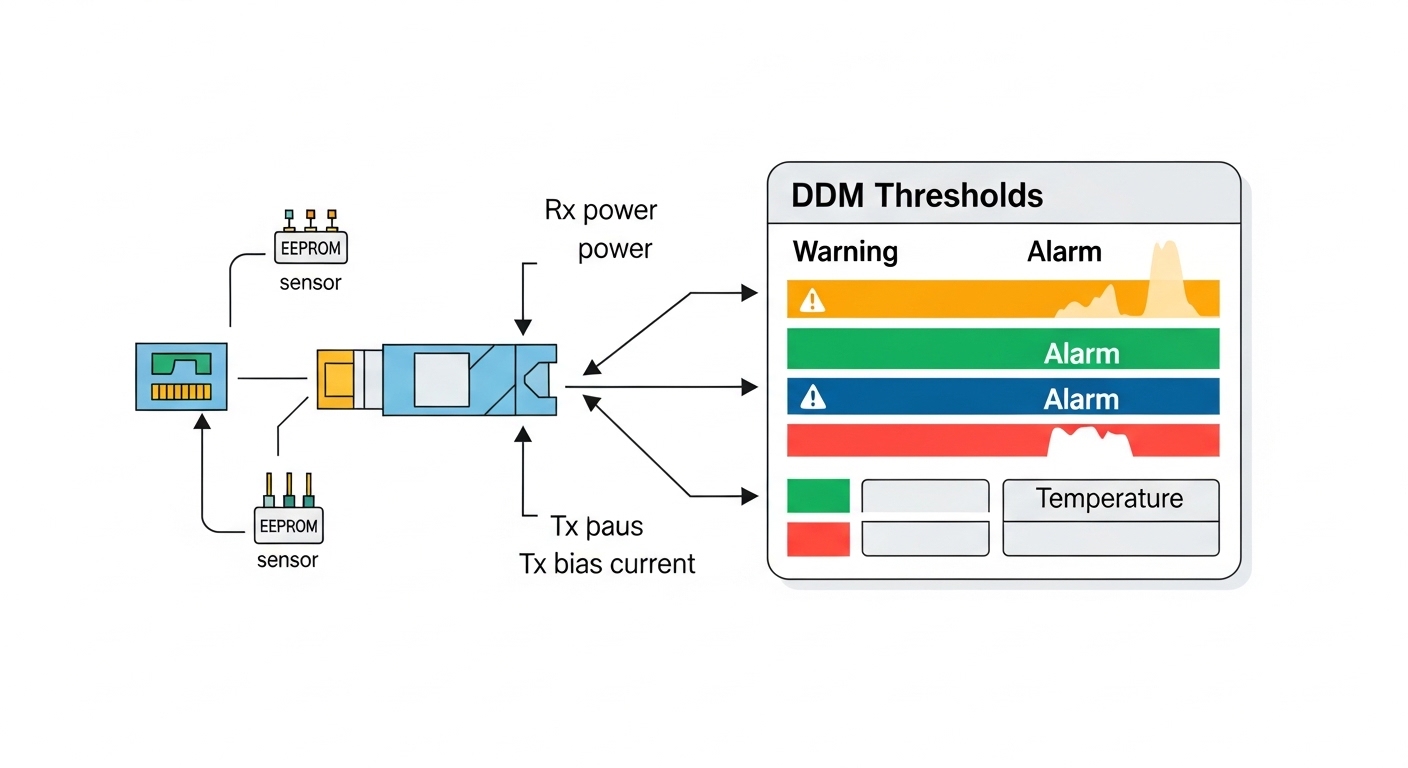
In a typical 5G transport design, you move baseband and fronthaul/backhaul traffic across managed Ethernet using SFP28, QSFP28, or higher-capacity pluggables, then aggregate at regional sites. The fiber plant may be proven, yet links still flap when transceivers exceed the platform’s electrical tolerance, when DOM readings are ignored, or when the optical budget is miscalculated for aging and connector loss. IEEE 802.3 defines the physical layer behaviors for Ethernet over fiber, including modulation and optical safety expectations, but it does not guarantee that every vendor’s optics will negotiate cleanly with every switch.
From a deployment workflow perspective, the most common failure pattern is “it worked on the bench, then failed in the cabinet.” The cabinet adds vibration, thermal cycling, and patch-panel connector variability; meanwhile, the transceiver may be specified for a different temperature range or a different reach class than your plan assumed. When you treat transceiver selection as an operational engineering task—budgeting optics, verifying DOM, and checking compatibility—you reduce repeat truck rolls and shorten acceptance testing.
What standards and vendor specs actually constrain
For Ethernet over fiber, the relevant baseline is IEEE 802.3 for optical interfaces (for example, 10GBASE-SR and 25GBASE-SR families). On the practical side, vendor datasheets specify wavelength, nominal reach, transmit power, receiver sensitivity, and DOM capability. If you are targeting multi-vendor interoperability, you also need to understand how your switch vendor validates optics compatibility (often via an optics compatibility matrix or internal qualification list).
Transceiver selection by 5G transport role: fronthaul, backhaul, and aggregation
Different 5G segments stress optics differently. Fronthaul tends to be more latency-sensitive and may use stricter power and dispersion assumptions; backhaul and aggregation focus more on reach margin, port density, and manageability. In operational terms, you should align the transceiver type with the link length class and the expected growth path in your network design.
Common 5G-ready optics families you will see in the field
- 10GBASE-SR (multimode, typically 850 nm): widely available, good for short-reach data center links.
- 25GBASE-SR (multimode, 850 nm): a common step for dense 5G aggregation and modern ToR/aggregation layers.
- 10G/25G LR or ER (single-mode, ~1310/1550 nm): used for longer reach across campuses and metro rings.
- Coherent long-haul optics (where applicable): for metro/regional transport with higher spectral efficiency, but with more complexity.
Specs comparison table for typical choices
The table below compares representative optics used in 5G transport planning. Real products vary by vendor, but these values reflect how engineers evaluate reach, power, and connector type.
| Optics Type | Wavelength | Typical Reach | Data Rate | Connector | DOM / Monitoring | Operating Temperature | Example Part Numbers |
|---|---|---|---|---|---|---|---|
| 10GBASE-SR SFP+ | 850 nm | Up to 300 m (OM3), up to 400 m (OM4) | 10 Gbps | LC (duplex) | Usually yes (digital diagnostics) | 0°C to 70°C (typical) | Cisco SFP-10G-SR, Finisar FTLX8571D3BCL, FS.com SFP-10GSR-85 |
| 25GBASE-SR SFP28 | 850 nm | Up to ~100 m (OM4 typical class) | 25 Gbps | LC (duplex) | Usually yes (DOM) | -5°C to 70°C (typical extended) | Vendor-specific 25G SR SFP28 modules (check switch matrix) |
| 10GBASE-LR SFP+ | 1310 nm | Up to 10 km | 10 Gbps | LC (duplex) | Usually yes (DOM) | -5°C to 70°C / 0°C to 70°C | Common LR SFP+ modules (vendor-qualified) |
| 25GBASE-LR / ER QSFP28 | 1310 nm / 1550 nm | Up to 10 km / 40 km (class dependent) | 25 Gbps | LC (duplex) | Usually yes (DOM) | -5°C to 70°C | QSFP28 LR/ER modules (vendor-qualified) |
Evaluation note: treat “typical reach” as a starting point, then perform a link budget with your actual fiber type (OM3 vs OM4), patch panel loss, splice loss, and expected aging. DOM telemetry (laser bias current, optical power, temperature) helps you validate that the link sits inside the vendor’s operating envelope after installation.
Pro Tip: In acceptance tests, engineers often validate only link up/down. Instead, poll DOM right after install and again after 24 to 72 hours. If transmit power or temperature drifts beyond your expected pattern, you can catch marginal optics or connector contamination before the first customer traffic peak. This reduces “mystery” outages that correlate with thermal stabilization.
Operational decision checklist for scaling 5G transport
Choosing optical solutions for 5G-ready networks is a structured process. Use this ordered checklist so you can defend the choice during design review and speed up procurement.
- Distance and fiber type: confirm OM3/OM4/OS1/OS2 and measure end-to-end length. For multimode, verify that your transceiver class matches your installed fiber class.
- Link budget margin: include connector loss, patch panel loss, and splice count. Add operational margin for aging and re-termination events.
- Switch and chassis compatibility: check the switch vendor optics compatibility matrix. Some platforms are sensitive to specific vendor EEPROM behaviors or DOM implementations.
- Data rate and optics form factor: confirm SFP+, SFP28, QSFP28, or QSFP modules match the port type. Avoid “it fits” assumptions; electrical lane mapping matters.
- DOM support and telemetry workflow: ensure the platform reads DOM reliably and that your monitoring system can alert on low optical power or high temperature.
- Operating temperature and airflow: verify the transceiver temperature range against your cabinet conditions. If you have inlet temperatures near the top of the spec, prefer extended temperature optics.
- Vendor lock-in risk and spares strategy: decide whether you will standardize on OEM optics or allow third-party optics. Track failure rates and DOA handling procedures.
Common pitfalls and troubleshooting tips from real deployments
Most transceiver issues show up as link instability, intermittent packet loss, or sudden degradation under load. Below are concrete mistakes that commonly occur in 5G transport rollouts, with likely root causes and practical fixes.
“Link came up once, then flapped after thermal cycling”
Root cause: marginal optics operating near the threshold because of connector contamination or insufficient link budget margin. Temperature shifts can reduce laser output or affect receiver sensitivity.
Solution: clean LC connectors with validated cleaning tools, re-seat fibers, and re-check DOM values (Tx power, temperature). If possible, run a structured optical test: verify cable loss with an OTDR or certified light source/optical power meter workflow.
“Digital diagnostics show odd values or the switch rejects the module”
Root cause: DOM EEPROM incompatibility or unsupported diagnostics behavior on that platform. Some third-party optics emulate DOM but not exactly how the switch expects thresholds and calibration fields.
Solution: consult the platform’s optics compatibility list and standardize on optics that are explicitly validated. Where you must mix vendors, stage a pilot with logging for 48 to 96 hours before broad rollout.
“You selected the right wavelength but the wrong reach class”
Root cause: confusing reach classes across OM3/OM4 or assuming the vendor reach spec includes your patch panel and splice losses. Field reality often adds connectors and re-termination events.
Solution: rebuild the link budget using your actual measured losses and planned spare patch cords. Increase margin by selecting a higher-reach class where feasible or upgrading fiber type during planned refurbishments.
“High error counts only during peak traffic windows”
Root cause: receiver overload or marginal signal integrity due to dust, micro-bends, or patch cord quality. Increased traffic can expose issues in optics calibration or physical layer timing.
Solution: inspect and clean, then replace patch cords with known-good, spec-matched cables. Validate with interface counters and correlate with DOM telemetry to see whether optical power or temperature is drifting.
Cost and ROI: what to budget for transceiver lifecycle
Pricing varies by data rate, reach, and qualification status. In many enterprise and carrier environments, OEM optics commonly cost more upfront than third-party modules, but they can reduce integration risk and lower the cost of failed acceptance tests. Third-party optics can be cost-effective when they are verified against your switch matrix and you have a reliable DOA and RMA process.
For a realistic TCO view, include installation labor for re-cleaning and re-testing, downtime risk during cutovers, and the cost of spares. A sensible approach is to standardize on one or two optics families per distance class (for example, SR for short multimode runs and LR for longer single-mode runs). That reduces training overhead and simplifies monitoring thresholds, which helps contain operational cost during ongoing 5G expansions.
If you are deploying at scale, treat spares as insurance: keep a small pool of the exact transceiver SKUs you install, especially for optics used in higher-risk cabinets with limited airflow. This can reduce mean time to repair and shorten customer impact when a module fails.
FAQ: choosing optical solutions for 5G-ready networks
What does “5G-ready” mean for transceivers?
It typically means the optics align with the Ethernet physical layer your 5G transport design uses, and they meet operational requirements like temperature range, monitoring (DOM), and switch compatibility. It does not guarantee performance without a link budget and correct fiber type verification.
Can I mix OEM and third-party optical solutions in the same switch?
Often yes, but only within the bounds of your switch vendor’s compatibility guidance. DOM behavior, threshold calibration, and EEPROM fields can vary, so validate in a pilot and monitor telemetry for at least a couple of days.
How do I choose between SR and LR for a 5G site?
Use SR for short-reach multimode runs where your fiber type and distance match the transceiver class. Use LR when you need single-mode reach across longer segments or when you are constrained by patching and cabinet placement.
What should I monitor with DOM after installation?
Track transmit power, receive power, laser bias current, and module temperature. Set alerts for low optical power and abnormal temperature trends, then compare readings against your baseline to spot contamination or marginal links early.
Why do links fail even when the wavelength and connector type match?
Common causes include insufficient link budget margin, dusty connectors, poor patch cord quality, or optics form-factor mismatch at the electrical lane level. Another frequent issue is selecting a reach class that assumes a cleaner installation than what actually exists in the field.
Which sources should I consult for standards and compatibility?
Start with IEEE 802.3 for Ethernet optical interface definitions and your switch vendor’s optics compatibility matrix and transceiver documentation. For general interoperability context, you can
