
5G networks live and die by fast, stable connectivity across fronthaul, midhaul, and aggregation. When fiber runs long, power budgets tighten, and vendors lock you in, the wrong transceiver can quietly degrade latency or trigger link flaps. This article helps network engineers and procurement teams choose optical solutions that match real 5G constraints—distance, temperature, interoperability, and maintainability—without guesswork.
Top 7 optical solutions picks for 5G transceivers
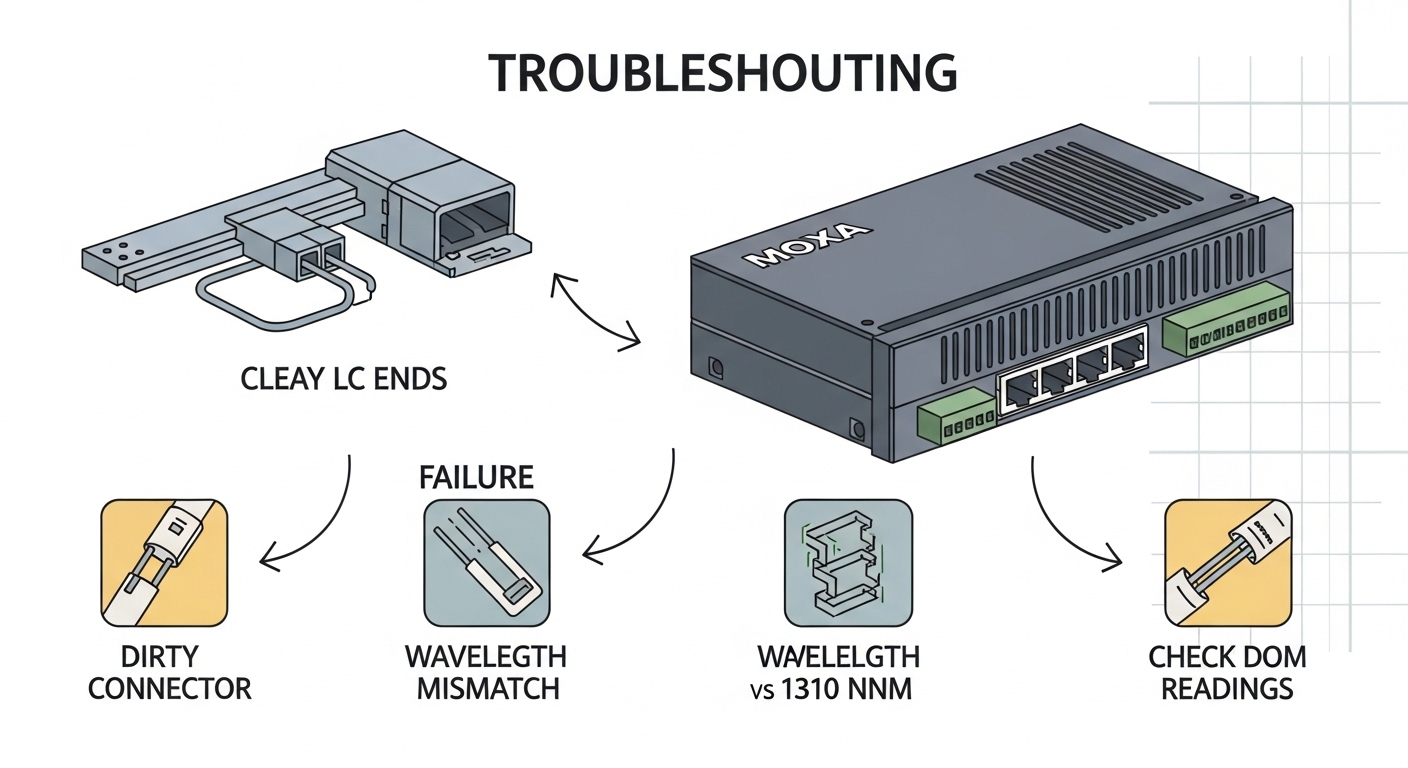
Here are seven field-proven transceiver categories, mapped to the most common 5G connectivity challenges: short-reach switch uplinks, campus aggregation, and long-reach transport. Each item includes key specs, best-fit scenarios, and practical pros and cons.
10G SFP+ SR for fronthaul and ToR-to-aggregation links
Best fit: 5G sites where you terminate at 10G Ethernet switches and want short-reach multimode optics. Typical modules target 850 nm over OM3/OM4, using LC connectors. In practice, we deploy them when the fiber plant is already multimode and you need predictable optics behavior during frequent maintenance windows.
Typical spec targets: 10G, SR-class, LC, and laser safety class aligned with SFP+ optics.
Pros: Lower cost per port; fast swap in the field; widely supported by switches.
Cons: Multimode reach depends heavily on cabling quality (especially OM3); system margin can shrink with aging links.
25G SFP28 SR for 5G aggregation with higher port density
Best fit: You are upgrading 10G to 25G to support increased 5G traffic while keeping the same switching footprint. 25G SR modules at 850 nm work well on OM3/OM4, and many vendors support them with digital diagnostics (DOM). This is a common “middle step” when you can’t yet justify 100G optics.
Pros: Better bandwidth per rack unit; strong ecosystem compatibility; DOM helps operations teams track bias current and temperature.
Cons: Still multimode-limited; budget planning must include fiber verification, not just module purchase.
40G QSFP+ SR for legacy 5G transport segments
Best fit: Facilities with existing 40G line cards or older aggregation layers. At 850 nm with QSFP+ SR optics, you can preserve investments while expanding capacity. In deployments I’ve supported, 40G SR is often used during phased upgrades where 100G is scheduled later.
Pros: Mature availability; good for staged capacity increases; efficient in dense racks.
Cons: Power per bit can be higher than newer 25G/100G designs; multimode reach constraints remain.
100G QSFP28 FR/LR for 5G midhaul and metro transport
Best fit: When you need to move traffic beyond multimode distances or between buildings and aggregation hubs. 100G FR typically uses 1310 nm single-mode fiber with LC connectors; 100G LR extends farther. In 5G midhaul, we choose these to stabilize latency and reduce maintenance by minimizing fiber splice counts.
Pros: Single-mode scalability; longer reach; strong performance for metro rings.
Cons: Higher module cost; careful check for switch vendor compatibility and optics vendor lists.
100G QSFP28 PSM4 for long metro links with capacity efficiency
Best fit: High-bandwidth metro segments where you want long reach while using fewer fibers. PSM4 uses parallel optics concepts over single-mode with multiple lanes; it often improves capacity efficiency compared with some older long-reach approaches. We use it when fiber counts are constrained but the route requires robust transport.
Pros: Higher throughput without expanding fiber count; good for dense metro deployments.
Cons: Requires correct patching and compatibility; connector cleanliness matters more than teams expect.
200G/400G QSFP56 for future 5G aggregation refresh cycles
Best fit: When you are planning a refresh window and want to reduce the number of optics transceiver slots. 200G and 400G QSFP56 optics are increasingly common for aggregation layers that must handle traffic growth from multiple gNodeBs. Field operations teams like them because fewer high-speed ports can simplify cabling and reduce failure points—if the plant is tested.
Pros: Fewer ports; easier scaling; strong alignment to modern switch ASIC roadmaps.
Cons: Higher upfront cost; more stringent link budgets; compatibility testing becomes mandatory.
Coherent DSP optics for extreme long-haul backhaul
Best fit: When “metro” becomes “regional” and you need very long reach with robust performance. Coherent optics use digital signal processing to handle impairments over long distances. In practice, they’re chosen when fiber routes are long and you cannot easily add regeneration sites.
Pros: Long reach; better tolerance to transmission impairments.
Cons: Complexity and cost; requires careful planning for power, dispersion, and vendor-specific configuration.
Quick specs you should verify before you buy
Even when modules share the same “marketing name,” the operational reality depends on wavelength, reach, connector type, DOM behavior, and temperature. Use the table below as a baseline checklist for common 5G optical solutions.
| Transceiver type | Data rate | Wavelength | Typical reach | Fiber / connector | DOM | Operating temperature |
|---|---|---|---|---|---|---|
| SFP+ SR | 10G | 850 nm | Up to ~300 m (OM3) or ~400 m (OM4) | Multimode / LC | Often supported | Commercial or Industrial variants |
| SFP28 SR | 25G | 850 nm | Up to ~100 m (OM3) or ~150 m (OM4) | Multimode / LC | Common | Commercial or Industrial |
| QSFP28 FR/LR | 100G | 1310 nm | FR ~2 km; LR ~10 km class (varies by vendor) | Single-mode / LC | Common | Often -5 to 70 C or wider industrial |
| QSFP56 200G/400G | 200G or 400G | Varies (SR over MM or LR/FR over SM) | Depends on mode and vendor | MM or SM / LC or MPO | Usually supported | Model-dependent |
Selection criteria checklist for 5G connectivity
When 5G transport is under load, “it links up on the bench” is not enough. Engineers weigh the following factors in order:
- Distance and fiber type: confirm OM3 vs OM4 vs SMF, then validate link budget using vendor specs.
- Switch compatibility: verify the transceiver is on the switch vendor’s supported optics list for that exact model.
- DOM and monitoring: ensure DOM alarms integrate with your monitoring stack (thresholds for temperature, bias current, received power).
- Operating temperature: use industrial-rated optics for outdoor cabinets and near-radio equipment where heat soak is common.
- Connector and MPO discipline: enforce cleaning procedures and bend radius rules to prevent intermittent errors.
- Budget and power: compare watts per port and cooling impact, not just module MSRP.
- Vendor lock-in risk: consider multi-source optics that still meet performance and are accepted by the switch.
Common mistakes and troubleshooting tips
Below are failure modes I’ve seen in real 5G rollouts, along with root causes and fixes.
Link flaps after a “successful” install
Root cause: Dirty LC/MPO connectors or insufficient cleaning after repeated moves. Optical power can look acceptable at first, then degrade as dust migrates.
Solution: Re-clean with lint-free wipes and approved cleaning tools; inspect with a fiber scope; re-seat and retest.
Works at room temperature, fails in cabinets
Root cause: Using commercial temperature optics in an environment that exceeds spec during heat soak. Bias current drift can
