
Live Event Fiber Module Choice for SMPTE 2110 Links
In live event production networks, a single fiber link issue can stall switching, break tally, or cause frame drops. This article helps broadcast, live streaming, and OB-van engineers select the right live event fiber module for SMPTE 2110 transport over Ethernet. You will get practical selection criteria, field troubleshooting patterns, and a spec-focused comparison of common SFP options.
How SMPTE 2110 changes the fiber module requirements
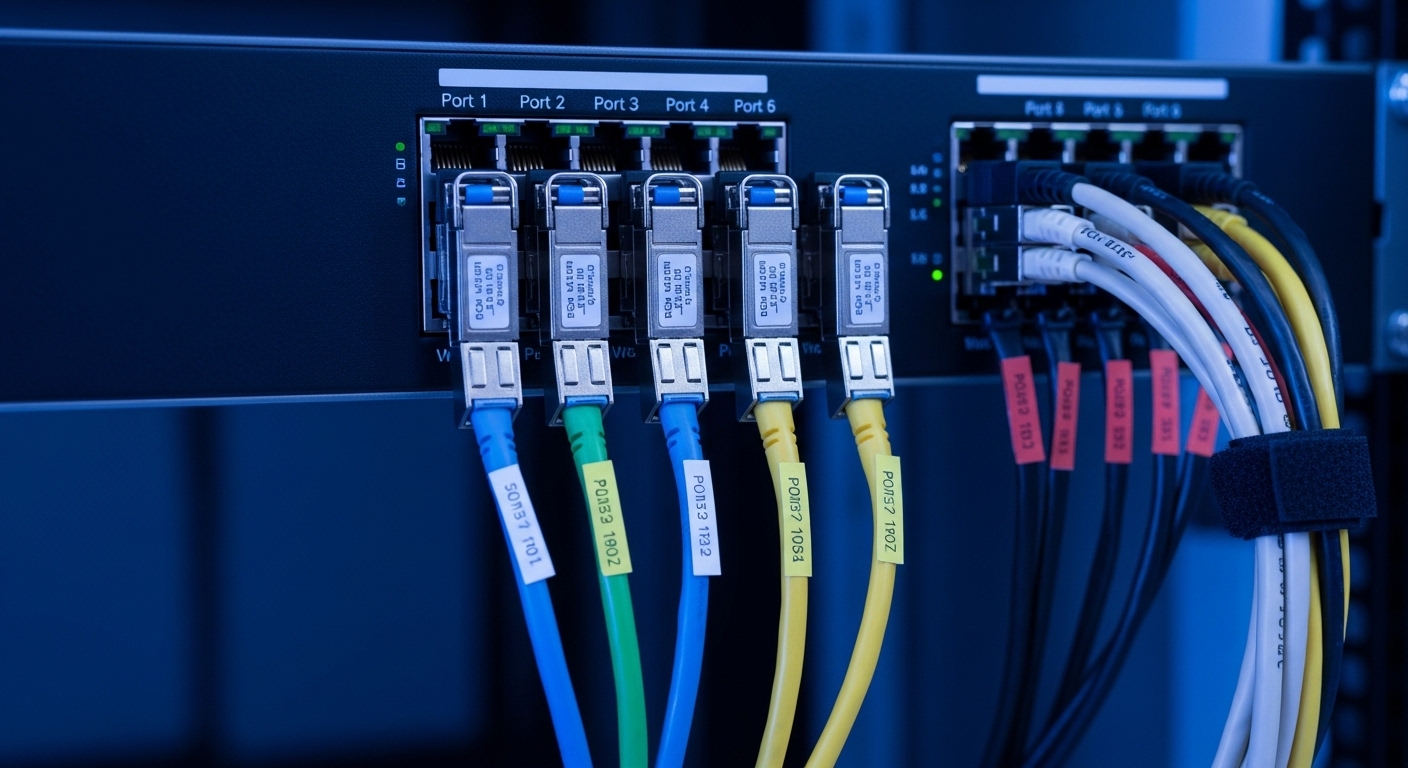
SMPTE 2110 carries video and audio essence as time-aligned IP flows. While it still rides on standard Ethernet physical layers, real deployments are sensitive to link stability, deterministic latency budgets, and monitoring visibility. In practice, a live event fiber module must support the switch or media gateway optics expectations (SFP/SFP+), maintain signal margin over temperature swings, and provide reliable DOM readings for operations. For 2110, engineers also plan for link redundancy and rapid fault isolation, so DOM and consistent optics behavior matter.
What “works in the lab” often fails in the venue
Bench tests sometimes miss connector contamination, cable bend radius violations, or power supply noise from long runs in truss environments. SMPTE 2110 endpoints may continue sending traffic, but the receiver can flap link state when optical power is marginal. That flapping can look like “random” packet loss during switching transitions. Your fiber module choice should therefore be paired with disciplined cleaning and measured optical budget checks.
SFP fiber module specs that matter for 2110 production
Most SMPTE 2110 deployments in OB vans use 1G or 10G Ethernet links, frequently with SFP or SFP+ optics over multimode (MMF) or single-mode (SMF). You should match the data rate, wavelength, and fiber type to your cabling plant, then verify reach using vendor optical budgets. Temperature range is also important because production racks can be warmer than typical office switch rooms.
| Module type (example) | Data rate | Wavelength | Typical fiber | Reach (typical) | Connector | DOM | Operating temp |
|---|---|---|---|---|---|---|---|
| Cisco SFP-10G-SR (10G SR) | 10G Ethernet | 850 nm | OM3/OM4 MMF | ~300 m (OM3), ~400 m (OM4) | LC duplex | Yes (vendor DOM) | ~0 to 70 C |
| Finisar FTLX8571D3BCL (10G SR) | 10G Ethernet | 850 nm | OM3/OM4 MMF | ~300 m (OM3), ~400 m (OM4) | LC duplex | Yes | ~0 to 70 C |
| FS.com SFP-10GSR-85 or equivalent (10G SR) | 10G Ethernet | 850 nm | OM3/OM4 MMF | ~300 m (OM3), ~400 m (OM4) | LC duplex | Often yes | Varies by vendor grade |
| Common 10G LR SFP+ (SMF) | 10G Ethernet | 1310 nm | SMF | ~10 km typical | LC duplex | Yes | ~0 to 70 C |
For SMPTE 2110, the “right” choice is less about marketing reach numbers and more about ensuring your optical budget stays healthy after cleaning, reconnections, and temperature drift. If your venue uses patch panels that get reworked daily, prefer optics with stable receiver sensitivity and predictable DOM behavior.
Selection checklist for a live event fiber module
Engineers typically decide optics in minutes during planning, then validate on site. Use this ordered checklist to avoid last-minute surprises.
- Distance and fiber type: Confirm whether you have OM3/OM4 MMF or SMF, and measure patch lengths including jumpers.
- Data rate compatibility: SFP vs SFP+ must match the switch port capability for 1G/10G.
- Wavelength match: 850 nm optics for MMF; 1310 nm or other wavelengths for SMF.
- Switch compatibility and optics mode: Verify the switch supports the module class and does not restrict optics without approved vendor IDs.
- DOM support for monitoring: Ensure DOM is readable by your network management and that alarms are wired into your monitoring workflow.
- Operating temperature and airflow: OB racks near power distribution can run hot; verify the module’s temperature rating and airflow direction.
- Vendor lock-in risk: OEM modules can reduce troubleshooting time, but third-party modules may work if they match DOM expectations.
Pro Tip: In 2110 live production, the most common “optics failure” is actually a connector cleanliness issue that only shows up under load. If your DOM shows marginal receive power before the show, clean and re-seat LC ends and re-check optical levels; do not assume the module itself is defective.
Real-world SMPTE 2110 deployment example
Consider a 3-tier live streaming setup in a mid-size arena: 48-port 10G ToR switches at the edge, two aggregation switches in a flypack, and a media gateway rack running SMPTE 2110 flows. The leaf-to-spine and leaf-to-gateway links are 10G, with average patch lengths of 120 m inside the venue and occasional longer runs of 700 m to a remote camera control area. The team uses 850 nm 10G SR SFP for OM4 patching inside the main technical bay, then uses 1310 nm 10G LR SFP+ for SMF where cable length and reconnection cycles would otherwise stress the multimode budget.
During rehearsals, they rely on DOM polling to catch drift: a “good” channel stays within a narrow receive power window, while a channel trending downward triggers a cleaning ticket. This approach reduces on-air surprises because 2110 timing sensitivity makes intermittent link instability more visible in monitoring graphs.
Common mistakes and troubleshooting for SMPTE 2110 fiber links
Even experienced teams hit predictable failure modes. Below are common pitfalls with root causes and practical fixes.
- Symptom: Link flaps during showtime; packet loss spikes during switchovers.
Root cause: Dirty LC connectors or oxidized fiber endfaces causing intermittent attenuation, especially when cables move.
Fix: Clean with approved fiber-grade wipes and inspect with a microscope/visual fault locator; re-seat and re-check DOM receive power. - Symptom: “Link up” but SMPTE 2110 streams show sporadic errors.
Root cause: Mismatched optical budget assumptions: too many patch transitions, connectors, or a cable type not truly rated for the wavelength plan (for example, OM2 used where OM3/OM4 was expected).
Fix: Measure with an optical power meter and verify fiber type; reduce patch transitions or switch to SMF optics. - Symptom: Switch refuses to bring the port up with a third-party module.
Root cause: DOM or vendor ID restrictions, or incorrect SFP form factor for the port standard.
Fix: Confirm port supports the SFP/SFP+ class; test the exact module model (for example, Cisco-compatible SR optics) in a spare port before deploying at scale. - Symptom: Receiver shows low power margin at room temperature but fails after the rack warms.
Root cause: Temperature-induced transmitter power drift combined with a tight optical budget and insufficient airflow.
Fix: Improve ventilation, shorten jumpers, or select a module with better characterized margins for your temperature profile.
Cost and ROI reality for live event fiber modules
In typical markets, 10G SR SFP modules often fall into a broad range depending on OEM vs third-party sourcing; OEM optics can cost more per module but reduce compatibility friction. For short-run MMF inside a venue, OEM or well-validated third-party modules both can work, but the operational cost is dominated by spares management, cleaning supplies, and time spent diagnosing “intermittent” faults. From a TCO standpoint, the ROI comes from fewer truck rolls and faster recovery when a link degrades mid-show. Budget for spare pairs (module plus known-good patch cords) and keep a fiber inspection workflow ready.
Also note that failure rates are rarely “module-only.” In field terms, bad connectors and handling dominate; optics selection should be paired with a process that protects endfaces during packing and deployment.
FAQ
What is a live event fiber module used for in SMPTE 2110 systems?
A live event fiber module is the pluggable optical transceiver that converts electrical Ethernet to light over fiber. In SMPTE 2110, it provides the physical link for time-aligned media traffic between switches and media gateways.
Should I choose 850 nm SR or 1310 nm LR for my venue?
If your runs are mostly within OM3/OM4 multimode reach budgets, 850 nm SR is cost-effective and compact. For longer runs, high patch counts, or uncertain cabling, 1310 nm LR over SMF is often more forgiving.
Do I need DOM support for production monitoring?
DOM is strongly recommended because it enables real-time visibility into transmit bias, laser power, and receive power. For live events, that data helps you catch marginal optics before they cause visible stream issues.
Can third-party SFP modules work with managed switches?
Often yes, but compatibility varies by switch vendor and even by firmware. Validate the exact module model in a test port, and confirm DOM alarms integrate
