
Telecom teams are pushing capacity growth while keeping switch ports, power budgets, and operations stable. This article focuses on practical analysis of pluggable optics in telecom, helping engineers decide what to standardize now for 25G through 400G rollouts. You will get selection checklists, compatibility caveats, a specs comparison table, and field troubleshooting patterns.
Why pluggable optics remain the telecom workhorse
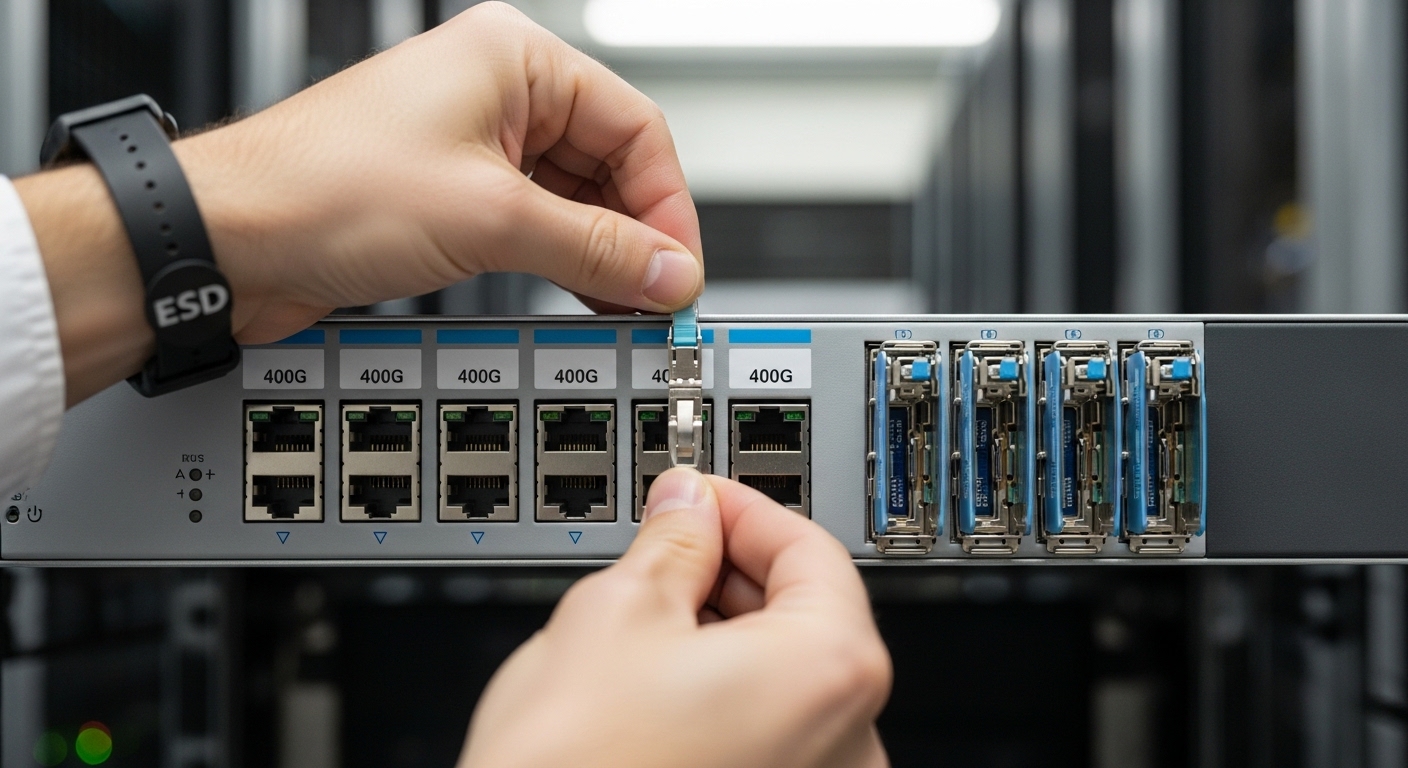
Pluggable optics let operators swap optics without changing the host line card, which reduces truck rolls during maintenance windows. In modern networks, the same chassis often carries multiple distance tiers, so optics choice becomes a routing-and-standards problem as much as a hardware problem. Engineers typically validate compliance against vendor datasheets and IEEE physical-layer expectations, then confirm optics parameters like launch power, receiver sensitivity, and DOM telemetry behavior.
From an operational standpoint, the future depends on two constraints: power and thermal headroom in dense chassis and fleet manageability via digital diagnostics. DOM support is now considered table stakes for most deployments, because it enables automated threshold alarms for laser bias current, supply voltage, and temperature.
For standards context, pluggable optics are aligned to the IEEE 802.3 family for Ethernet PHY behavior and optical link performance classes. For implementation details, always cross-check with vendor product pages and datasheets. [Source: IEEE 802.3] IEEE 802.3
analysis of the near-term roadmap: 25G to 400G optics
In the field, the “future” is usually a staged migration: 25G first for cost-effective upgrades, then 50G/100G, and later 200G/400G where density and power economics justify it. The decision hinges on whether the host switch supports the specific pluggable form factor and whether optics are standardized for reach and safety.
Form factors you will actually encounter
- SFP and SFP+: legacy and still present in edge and brownfield access.
- SFP28 and SFP56: common for 25G/50G in modern access and aggregation.
- QSFP+ and QSFP28: 40G/100G era, often in aggregation.
- QSFP56 and OSFP: higher-speed density options for 200G/400G-class designs.
- CFP2/CFP4: historically used in telecom transport; still relevant in some long lifecycle chassis.
Technical specifications snapshot (example link classes)
Use this table to compare representative optics classes you might standardize. Always validate against the exact switch vendor compatibility list and the optics vendor’s datasheet revision.
| Optics example | Data rate | Wavelength | Typical reach | Connector | Tx/Rx power class (example) | DOM | Operating temp |
|---|---|---|---|---|---|---|---|
| Cisco SFP-10G-SR (example) | 10G | 850 nm | ~300 m (OM3/OM4 varies) | LC | Vendor-specific; check datasheet | Supported | 0 to 70 C (typical) |
| Finisar FTLX8571D3BCL (example) | 10G | 850 nm | ~300 m class (OM3/OM4 varies) | LC | Vendor-specific; check datasheet | Supported | -5 to 70 C (varies by model) |
| FS.com SFP-10GSR-85 (example) | 10G | 850 nm | ~400 m class (OM4 typical) | LC | Vendor-specific; check datasheet | Supported | 0 to 70 C (typical) |
| QSFP28 SR4 (example class) | 100G | 850 nm | ~100 m to ~300 m (OM3/OM4 varies) | LC | Vendor-specific; check datasheet | Supported | 0 to 70 C (typical) |
| QSFP56 DR4/FR4 (example class) | 400G | 1310/1550 nm variants | ~2 km to 10 km (depends) | LC | Vendor-specific; check datasheet | Supported | -5 to 70 C (typical) |
Field takeaway: for 850 nm SR, reach is often limited by fiber grade and patch panel losses, not by the transceiver alone. For long reach single-mode, budget connector cleanliness, splice loss, and aging margins.
Selection criteria checklist for future-proof pluggable optics
Engineers doing real standardization work typically follow an ordered validation flow. Use this checklist to reduce surprises during staged rollouts.
- Distance and fiber type: confirm OM3 vs OM4 vs OS2, and calculate link loss including patch cords and couplers.
- Switch compatibility: verify the optics are explicitly supported on your switch model and firmware release; validate lane mapping for higher speeds.
- Form factor and electrical interface: ensure the host supports the exact pluggable type (SFP28 vs QSFP28 vs OSFP) and speed mode.
- DOM support and telemetry thresholds: confirm the host reads DOM registers and that your monitoring stack can alert on bias current and temperature drift.
- Operating temperature and airflow: validate the module temperature range against your chassis thermal profile and service conditions.
- Launch power and receiver sensitivity: for long reach, verify optical budgets and aging margins; for short reach, verify channel compliance.
- Safety and compliance: ensure laser safety class labeling and regulatory fit for your region.
- Vendor lock-in risk: assess whether third-party optics can be used without triggering port-disable behavior or limiting diagnostics.
- Lifecycle and warranty: check MTBF claims, warranty terms, and RMA logistics for your procurement channel.
Pro Tip: In many telecom deployments, the fastest way to prevent “it works in the lab” failures is to validate DOM telemetry behavior under your monitoring thresholds. If your NMS treats missing or out-of-range DOM fields as “fault,” you can end up with false positives or disabled ports even when the physical link is actually stable.
Common pitfalls and troubleshooting patterns
Below are recurring failure modes seen during rollouts. Each includes a root cause and a concrete fix.
Link flaps after patching, then stabilizes
Root cause: fiber contamination or marginal insertion loss at LC connectors causes intermittent receiver overload or sensitivity issues. Higher-speed optics (like 100G SR4) can be less tolerant of patch panel problems.
Solution: clean both ends with approved lint-free wipes and inspection scope, then re-test with an optical power meter. Re-terminate if bulkhead adapters are worn or misaligned.
Port shows “unsupported module” or stays down
Root cause: optics EEPROM identification mismatch, unsupported DOM page behavior, or firmware incompatibility. This is common when mixing third-party modules with strict host checks.
Solution: confirm the optics are on the vendor compatibility list for the exact switch model and firmware. If allowed, update host firmware and re-test with a controlled A/B module swap.
Diagnostics show rising laser bias and early degradation
Root cause: poor thermal conditions, blocked airflow, or modules installed in the wrong temperature profile. Aging can accelerate when bias current runs high due to temperature or optical mismatch.
Solution: verify airflow path integrity, check for fan faults, and confirm the module operating temperature stays within datasheet limits. Establish a threshold alarm policy using DOM fields and correlate to environmental logs.
Cost and ROI note: what to budget beyond the sticker price
Pricing varies by speed, reach, and vendor, but realistic budget ranges for pluggables often land in a few tiers: short-reach 10G/25G modules are typically the lowest cost per port, while 200G/400G optics with long reach can be several times higher. The total cost of ownership depends on failure rates, RMA handling, spares inventory, and downtime costs during maintenance windows.
OEM modules may cost more but often reduce operational risk through tighter compatibility validation and predictable DOM behavior. Third-party optics can lower direct procurement costs, yet they may introduce higher qualification effort and occasional host-side incompatibility. For ROI, model your expected annual module swaps, average repair time, and the cost of downtime per incident; include labor and fiber test equipment time in your TCO.
When benchmarking vendors, request datasheets with DOM register documentation and warranty terms. Also check whether the optics support the monitoring tools your operations team uses, because that can materially affect incident response time.
FAQ
How do I start analysis for pluggable optics in a telecom upgrade?
Begin with distance and fiber type, then map each link to the exact host form factor and speed mode. Next, validate module DOM behavior against your monitoring system and confirm switch firmware compatibility before scaling deployment.
Are third-party pluggable optics safe to standardize?
They can be, but only after qualification against your switch models and firmware versions. Test for port bring-up reliability and confirm DOM telemetry fields are present and correctly interpreted by your NMS.
What DOM fields should I monitor for early failure prediction?
Focus on temperature, laser bias current, transmitted power, and supply voltage. Correlate trends over time rather than relying on single-event alarms, and set thresholds aligned to your module datasheet.
Why do short-reach 850 nm links sometimes fail even when specs match?
Common causes include connector contamination, patch panel insertion loss, and fiber grade mismatch between OM3 and OM4. Always verify the full channel loss with measurements at installation and after any re-cabling.
What is the biggest compatibility risk when moving toward 400G?
The risk is not only form factor support, but also lane mapping and host firmware expectations for optics identification. Validate with a small pilot using the exact optics part numbers and firmware you plan to run in production.
When should we consider migrating away from older pluggables?
Consider migration when you hit operational friction: limited speed headroom, higher power draw, or frequent compatibility issues with modern monitoring and automation. Align migration timing with your chassis refresh cycles to avoid stranded spares.
In this analysis, the future of pluggable optics in telecom hinges on compatibility discipline, DOM-driven operations, and fiber-loss realism rather than on optics marketing claims. Next, use optics monitoring best practices to tighten telemetry thresholds and reduce avoidable outages during staged upgrades.
Author bio: I deploy and validate pluggable optics in live telecom and data center environments, focusing on optical budgets, DOM telemetry, and failure-mode driven rollouts. I also support procurement standardization by mapping switch compatibility matrices to measurable acceptance test plans.
