

In modern optical network design, bandwidth growth is colliding with fiber-count constraints. Spatial Division Multiplexing (SDM) changes the game by multiplying capacity per fiber bundle, but only if your next-gen transceivers match the SDM optics, lane mapping, and switch expectations. This article helps network architects and field engineers compare coherent and direct-detect SDM-ready transceivers, focusing on deployable parameters, compatibility pitfalls, and operational troubleshooting. It also ties SDM design choices to practical transceiver selection and acceptance testing.
Coherent vs direct-detect next-gen transceivers for SDM capacity
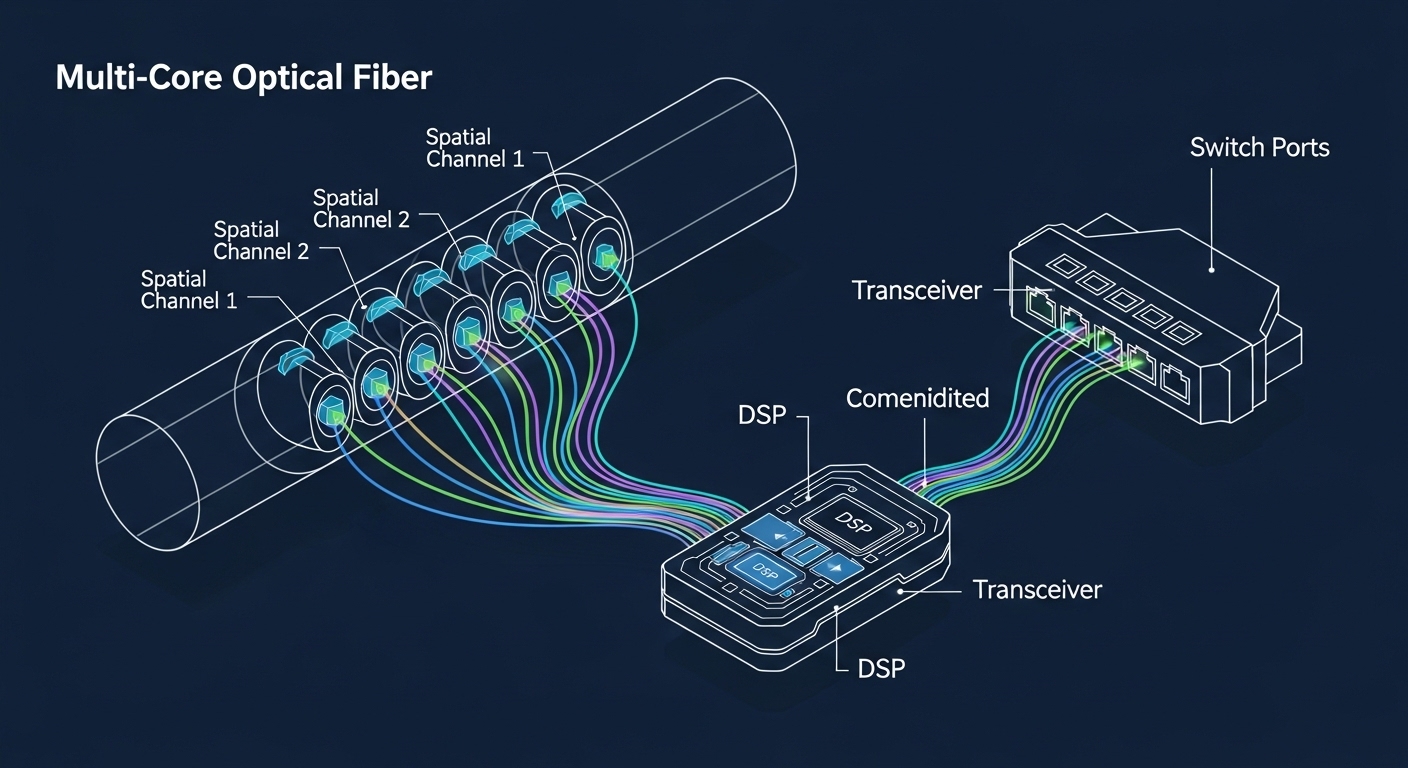
For SDM, the key performance variable is not only reach and bitrate, but also how well the transceiver supports multi-core or multi-mode lane independence. Coherent transceivers typically provide higher tolerance to impairments (chromatic dispersion, polarization effects, and crosstalk) because they recover amplitude and phase digitally. Direct-detect transceivers can be cost-effective for shorter reaches or where channel impairment budgets are relaxed, but they are less forgiving when SDM introduces differential mode coupling and inter-core crosstalk.
In practice, coherent SDM deployments often target multi-core fiber (MCF) or few-mode fiber (FMF) with DSP-heavy transceivers, while direct-detect solutions are common in simpler topologies (e.g., short-reach intra-building links). When you select a next-gen transceiver, you must align its modulation format, FEC mode, and optical interface (fiber type and connectorization) with the SDM system design. If you do not, you can pass basic link tests yet fail at traffic load due to DSP saturation or crosstalk-induced margin collapse.
Minimum SDM-ready parameters to verify
Before procurement, confirm the transceiver can support the SDM lane plan (number of spatial channels), the expected crosstalk tolerance, and the negotiated line rate. Also validate that the host interface (e.g., 100G/200G/400G Ethernet electrical mapping) matches the switch ASIC lane ordering. Many field failures trace back to lane reversal or misconfigured breakout mode, not the optical physics.
| Spec | Coherent SDM-ready (typical) | Direct-detect SDM-friendly (typical) |
|---|---|---|
| Data rate | 100G to 400G per module | 25G to 100G per module |
| Modulation / detection | Coherent with DSP (e.g., QPSK/16QAM) | IM/DD (NRZ/PAM variants depending on vendor) |
| SDM support | Lane- and impairment-aware DSP; supports MCF/FMF system designs | Often limited reach / stricter crosstalk budgets |
| Optical interface | Coherent optics to SDM fiber; connectorization varies | LC/MT-style (multifiber) or vendor-specific interfaces |
| Reach class | Usually metro to long-reach SDM system targets | Commonly short-reach or metro-reach constraints |
| Power / thermal | Higher typical module power; verify host airflow | Lower typical power; easier thermal integration |
| Temperature range | Industrial or extended options depending on model | Often -5 to 70C or 0 to 70C variants |
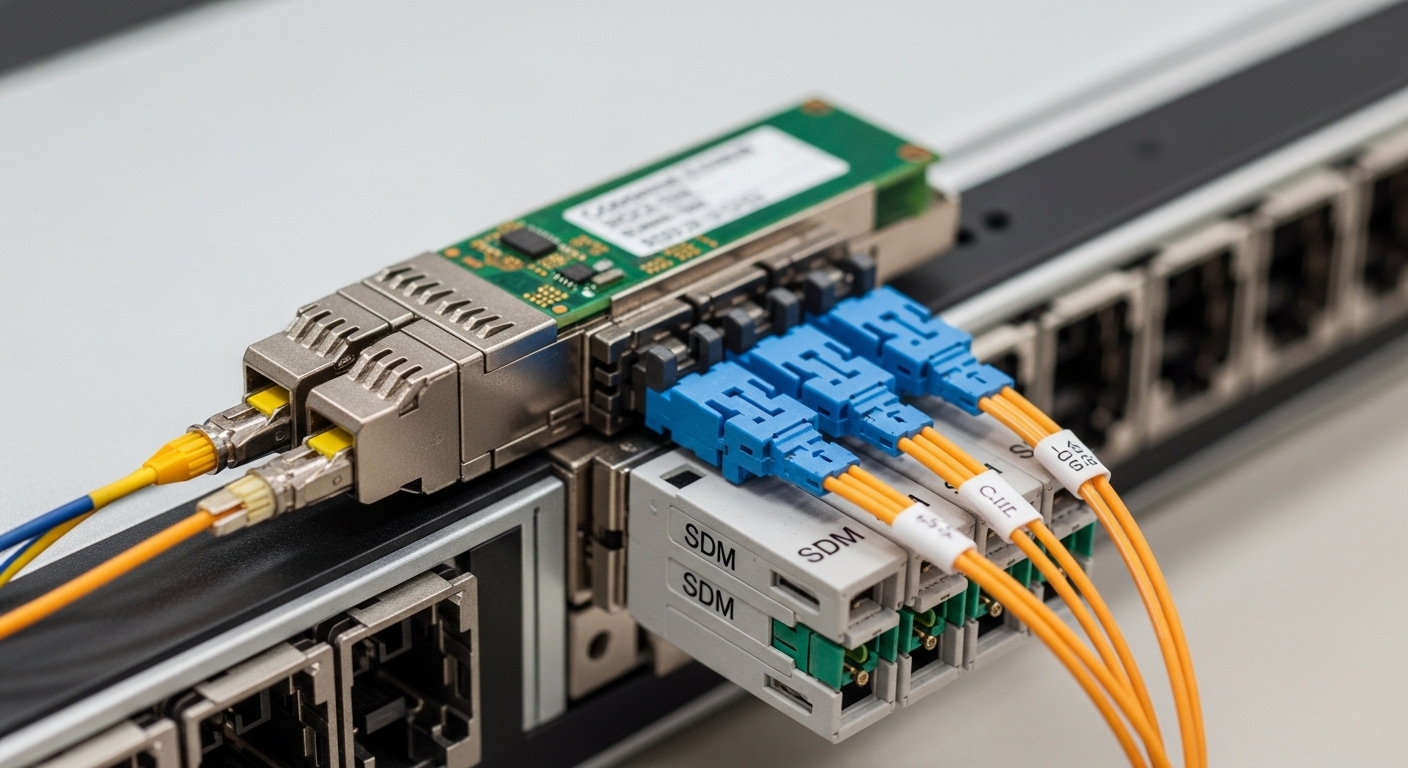
Compatibility reality: switch lane mapping, DOM, and SDM connectorization
SDM systems add an extra layer of complexity: spatial channels must be mapped consistently across transceiver, patch panel, and MCF/MPO harness. Many next-gen transceivers advertise SDM readiness, but the real compatibility depends on host switch optics configuration and DOM parameter support. Verify the module type (QSFP28, QSFP56, CFP2/CFP4, or vendor-specific coherent form factors) matches the switch cage and that the switch firmware supports the specific revision.
DOM (Digital Optical Monitoring) is not optional for acceptance. Confirm that the transceiver exposes the correct diagnostic channels (Tx power, Rx power, bias current, temperature) and that the values are interpreted correctly by the switch. If your SDM link uses a multi-fiber harness, also confirm connector standards for the physical layer: MPO/MT ferrules, polarity keys, and cleaning requirements. A connector polarity mismatch can mimic crosstalk issues and waste commissioning time.
Decision checklist (ordered by field impact)
- Distance and impairment budget: match coherent vs direct-detect capability to SDM crosstalk and dispersion assumptions.
- Fiber type and connectorization: confirm MCF/FMF support and MPO/MT polarity plan end-to-end.
- Switch compatibility: validate form factor support and lane mapping behavior for your exact switch model and firmware.
- DOM and telemetry: ensure diagnostic registers are readable and thresholds align with your monitoring system.
- Operating temperature and airflow: confirm thermal headroom in the rack and verify module power draw under load.
- Vendor lock-in risk: assess whether optics and fiber harnesses are proprietary and whether firmware calibration is required.
Pro Tip: During SDM commissioning, perform a “lane continuity” test before traffic generation. Map each spatial channel end-to-end using low-power optical time-domain checks or vendor diagnostic routines; then confirm switch-side lane ordering. This prevents interpreting a polarity or lane-swapped harness as optical impairment, which can otherwise lead to weeks of false troubleshooting.
Cost and ROI: what changes when you move from single-mode to SDM
From a procurement perspective, coherent SDM-ready next-gen transceivers are typically more expensive per port than direct-detect modules. In many enterprise and metro deployments, the module cost premium is partially offset by reduced fiber count, smaller trenching requirements, and higher link capacity over existing duct space. Typical street pricing varies by region and volume, but engineers commonly see coherent modules in the hundreds to low-thousands USD per unit at scale, while direct-detect optics may fall in the tens to a few hundred USD per unit depending on bitrate and reach.
TCO must include harnesses, cleaning infrastructure, spare strategy, and commissioning time. SDM frequently increases the importance of spares with matching lane/polarity plans; mismatched spares can be functionally unusable even if the optics “work” electrically. For ROI, calculate capacity-per-trench or capacity-per-rack metrics rather than only module price. If your network plan avoids new fiber deployment by using SDM, the ROI can dominate module-level cost.
Example deployment scenario with measurable constraints
In a 3-tier data center leaf-spine topology, a regional operator upgrades 48-port ToR switches to support 400G uplinks using a mix of coherent and direct-detect optics. The facility has limited conduit availability, so the operator selects SDM multi-core cabling for the aggregation layer with an installed reach of 300 m between selected rows and strict rack airflow limits (front-to-back pressure constraints). During acceptance, the team verifies each module under sustained traffic at 95% link utilization for 2 hours while monitoring DOM temperature and Rx power drift. Links that pass BER at commissioning can still degrade if harness polarity is wrong; the operator resolves this by enforcing MPO polarity keys and performing lane mapping validation before enabling full traffic.
Common mistakes and troubleshooting for SDM links
SDM failures often present as “random” packet loss or rising error counters, but root causes are usually deterministic once you isolate the layer. Below are concrete failure modes that field teams encounter when deploying next-gen transceivers for spatial division multiplexing.
Lane mapping mismatch between transceiver and switch breakout
Root cause: electrical lane ordering differs between the module and the host port breakout mode, causing spatial channel swapping. The link may appear “up” but exhibits high FEC corrections or intermittent loss.
Solution: verify switch configuration for breakout mode (e.g., 400G to 4x100G lane maps) and re-run vendor lane mapping tests using DOM and optical loopback where supported.
Connector polarity or MPO key orientation error
Root cause: MPO/MT polarity mismatch reverses or permutes spatial channels, which can look like excessive crosstalk. This is especially common when patch panels are reworked during construction.
Solution: enforce polarity labeling on both ends, clean connectors to spec, and validate with continuity checks per spatial channel before enabling traffic.
Thermal margin violation leading to DSP instability
Root cause: coherent modules can draw more power and generate more heat; insufficient rack airflow raises module temperature, reducing DSP headroom. Symptoms include rising error rates over time rather than immediate failure.
Solution: measure inlet/outlet temperatures and compare against module temperature range; adjust fan trays, airflow baffles, or move modules to lower-thermal zones.
Overlooking DOM interpretation and threshold configuration
Root cause: telemetry is read correctly, but thresholds are not aligned with the monitoring platform’s unit assumptions or baseline calibration.
Solution: calibrate thresholds using commissioning baselines; confirm that Tx bias current and Rx power are within expected ranges for the specific fiber/harness loss.
Decision matrix: coherent vs direct-detect next-gen transceivers
Use the matrix below to quickly align transceiver choice with SDM design intent and operational constraints.
| Requirement | Prefer coherent next-gen transceivers | Prefer direct-detect next-gen transceivers |
|---|---|---|
| High crosstalk tolerance needed | Yes, stronger DSP-based impairment handling | Only if SDM budgets are conservative |
| Longer effective reach in metro/aggregation | Often better suited | May require short-reach constraints |
| Lower power and simpler thermal integration | No (higher power) | Yes |
| Lower initial capex | Typically higher | Typically lower |
| Switch and firmware complexity | More validation steps | Usually simpler |
| Operational monitoring maturity | Best when DOM and DSP telemetry are integrated | Still recommended, but simpler systems can work |
Which Option Should You Choose?
If you are designing SDM links where crosstalk margins, polarization effects, or variable harness losses are expected, choose coherent next-gen transceivers and invest time in lane mapping and DOM calibration. If your SDM deployment is short-reach, carefully engineered, and thermally constrained, direct-detect next-gen transceivers can deliver strong cost-per-port performance with less thermal and commissioning overhead.
For most metro and aggregation SDM rollouts, the pragmatic path is hybrid: coherent for the highest impairment segments and direct-detect where budgets are proven. Start by validating physical connector polarity and lane mapping in a staged pilot, then scale only after sustained utilization testing.
FAQ
Q: Are next-gen transceivers required for SDM, or can older optics work?
A: Older optics may not support the modulation format, DSP tolerance, or SDM-specific lane
