Modern 5G radio access networks live or die by fronthaul reliability. If you are deploying a split architecture and need the right 5G fronthaul SFP for CPRI or eCPRI, this guide helps you pick modules that actually work with your switches, optics budget, and environmental constraints. It is written for field engineers and network owners who need actionable selection steps, not marketing claims.
What your fronthaul split demands: CPRI vs eCPRI optics behavior
Before you compare reach numbers, confirm which functional split you are running. Classic CPRI traffic is typically mapped to deterministic transport with strict timing expectations; eCPRI runs over Ethernet framing and is more flexible, but it still has tight latency and jitter requirements depending on your DU-CU split. In practice, the biggest “gotcha” is not only data rate; it is whether your transport and transceiver support the required line coding, optics budget, and deterministic latency profile.
Most engineering teams standardize on a small set of physical layer profiles, then validate the end-to-end path with loopback and BER tests. For optics, the module must meet the intended wavelength (commonly 1310 nm for longer reach single-mode), output power and receiver sensitivity, and dominate mode behavior (DOM) expectations for monitoring. Always confirm the platform supports the SFP electrical interface and the vendor’s DOM implementation, or you risk “works in lab, alarms in production.”
Key fronthaul requirements you must map to the SFP
- Data rate and line rate: ensure the SFP is designed for the same optics lane speed your system expects.
- Wavelength and fiber type: 1310 nm over single-mode is the common fronthaul approach; multimode is typically shorter reach.
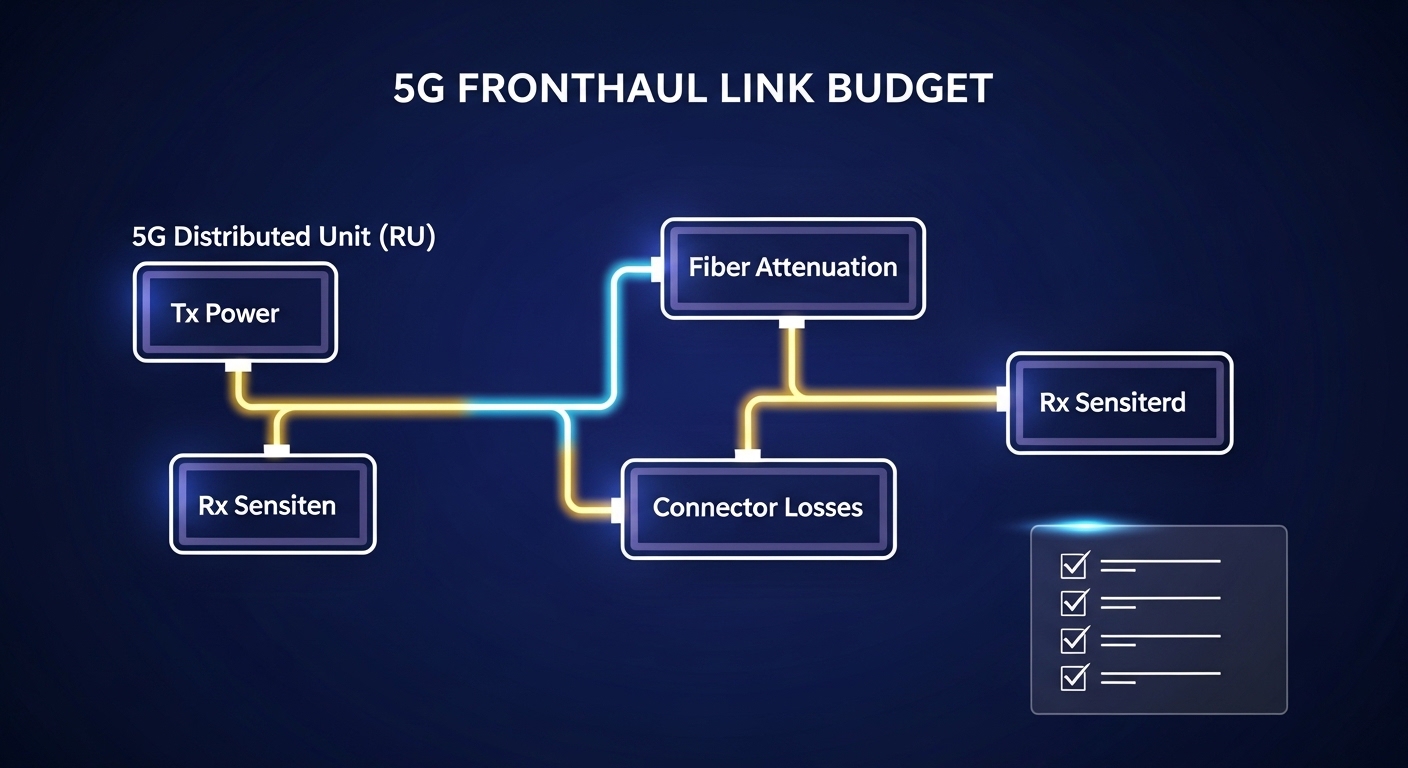
- Optics budget: power at Tx minus sensitivity minus losses (fiber attenuation, connectors, splices).
- Timing sensitivity: eCPRI transport may be more tolerant than strict CPRI, but latency and jitter still matter.
- Monitoring: DOM support must match your NMS polling method and platform thresholds.
Pro Tip: In field deployments, the fastest path to success is to validate the optics budget with your exact patch cord and splice plan. Teams often use generic “0.5 dB per connector” assumptions, but real patch panels plus aging can add 1–2 dB more loss than the spreadsheet. That margin loss shows up as intermittent LOS/LOF alarms under temperature swings, then disappears after swapping fibers—until it returns.
5G fronthaul SFP selection: specs that matter for CPRI and eCPRI
A 5G fronthaul SFP must meet both optical and electrical constraints. SFPs are governed by MSA electrical and mechanical expectations, and optics performance is defined by vendor datasheets. For standards context, check the relevant Ethernet physical layer behavior (where eCPRI uses Ethernet) and the optical safety and link performance assumptions; for optics and link behavior, rely on vendor datasheets and test reports, not “reach marketing.” [Source: IEEE 802.3] [Source: SFP Multi Source Agreement (MSA)]
Below is a practical comparison of commonly deployed single-mode fronthaul SFP profiles. Exact availability varies by OEM and vendor, but the decision logic stays consistent: wavelength, reach, Tx power, Rx sensitivity, DOM, connector type, and temperature range.
| Spec | Typical 5G fronthaul profile | What to verify in datasheet |
|---|---|---|
| Data rate | 1G, 2.5G, 10G-class optics (platform-dependent) | Matches your DU transport lane speed; confirm no oversubscription assumptions |
| Wavelength | 1310 nm (single-mode) | Center wavelength tolerance and vendor-recommended fiber type |
| Reach | Often up to 10 km (profile-dependent) | Declared link budget (Tx power, Rx sensitivity) and supported distance |
| Connector | LC duplex for most deployments | Connector cleanliness and polarity plan (A/B mapping) |
| Tx power | Single-mode SFPs typically offer tens of mW-class output | Min/typ/max output; ensure you have enough margin after losses |
| Rx sensitivity | Vendor-specific, BER-tested | Min sensitivity at the specified BER target |
| DOM | Often supported | DOM version and sensor thresholds; confirm platform reads alarms correctly |
| Temperature range | -5 C to +70 C class or wider | Confirm module class suits cabinet, hut, or outdoor enclosure conditions |
| Standards alignment | MSA compliance + vendor optics tests | Confirm electrical compatibility with your host and optics safety class |
When you shortlist a vendor, compare concrete modules you can actually source and validate. Examples of real-world 10G single-mode SFP families include Cisco-branded optics such as Cisco SFP-10G-SR (note: SR is typically multimode), and third-party single-mode 10G optics such as Finisar FTLX8571D3BCL or FS.com SFP-10GSR-85 (model names vary by reach and wavelength profile). Always verify each model’s wavelength and DOM behavior in the datasheet before committing to a fronthaul bill of materials. [Source: Cisco datasheets] [Source: Finisar optics datasheets] [Source: FS.com product pages]
CPRI vs eCPRI validation workflow: how to test before cutover
Even if the optics spec sheet looks perfect, fronthaul deployments fail when the environment differs from the lab. For CPRI, you will usually emphasize deterministic timing behavior and stable optical link performance under load. For eCPRI, you validate transport behavior under real Ethernet framing, with attention to latency/jitter and link error handling.
Step-by-step pre-deployment checklist
- Confirm optics profile: wavelength, fiber type, and reach class from the host vendor documentation.
- Compute optics budget: fiber attenuation + splice loss + connector loss + safety margin; use measured patch cord lengths.
- Check DOM alarms: verify your NMS reads Rx power, Tx bias, and temperature without false positives.
- Run loopback and BER test: test at the line rate your system uses; log errors for 30–60 minutes per link.
- Stress under temperature: if you can, run during the hottest cabinet window; watch for intermittent LOS.
- Verify polarity: confirm Tx/Rx direction mapping on both ends; many “mystery failures” are reversed polarity.
For CPRI, you should also validate that your transport path does not introduce unexpected buffering behavior. For eCPRI, validate that your switching fabric supports the required QoS treatment and does not collapse latency under congestion. Keep your test logs; they become invaluable when a future firmware update changes behavior and you need a baseline.
Pro Tip: DOM mismatch can mimic a “bad fiber” problem. If your host expects certain DOM thresholds or vendor-specific calibration ranges, you may see frequent warnings even when the optical power is within spec. Compare DOM readings against the module datasheet values and the host platform documentation before you swap optics.
Decision checklist: how engineers pick the right 5G fronthaul SFP
Use this ordered checklist during procurement and engineering sign-off. It is designed to prevent the most expensive failure mode: buying optics that technically match the wavelength but do not match your operational reality.
- Distance and loss budget: measured fiber length, splice count, connector type, and estimated aging margin.
- Data rate and host compatibility: confirm the SFP is supported by the exact host model and software release.
- Wavelength and fiber type: single-mode vs multimode; confirm 1310 nm profile if that is your design standard.
- DOM support and monitoring: verify DOM readout and alarm thresholds match your monitoring stack.
- Operating temperature: ensure the module temperature class fits the cabinet, hut, or outdoor enclosure.
- Vendor lock-in risk: evaluate whether third-party optics are permitted by your operator policy and whether support contracts cover them.
- Spare strategy: carry a small matched spare set for each site type to reduce MTTR.
Compatibility caveat: SFPs may be physically identical yet electrically different in subtle ways (transceiver management interface behavior, DOM calibration, or host firmware expectations). Always validate with the target host before scaling to hundreds of radio units.
Common mistakes and troubleshooting: CPRI/eCPRI fronthaul failures you can fix
Below are field-tested pitfalls. Each includes a likely root cause and a practical fix. If you are troubleshooting alarms, start with the first two items; they resolve the majority of optics-related incidents.
Intermittent LOS under temperature swings
Root cause: insufficient optics margin; higher-than-assumed connector/splice loss; or aged patch cords. Temperature can shift laser output and receiver sensitivity, triggering marginal links. Solution: re-measure end-to-end loss using an OTDR or a calibrated optical power meter, then re-run the budget with a realistic margin (often 2–3 dB extra for field conditions).
Permanent no-link after installation
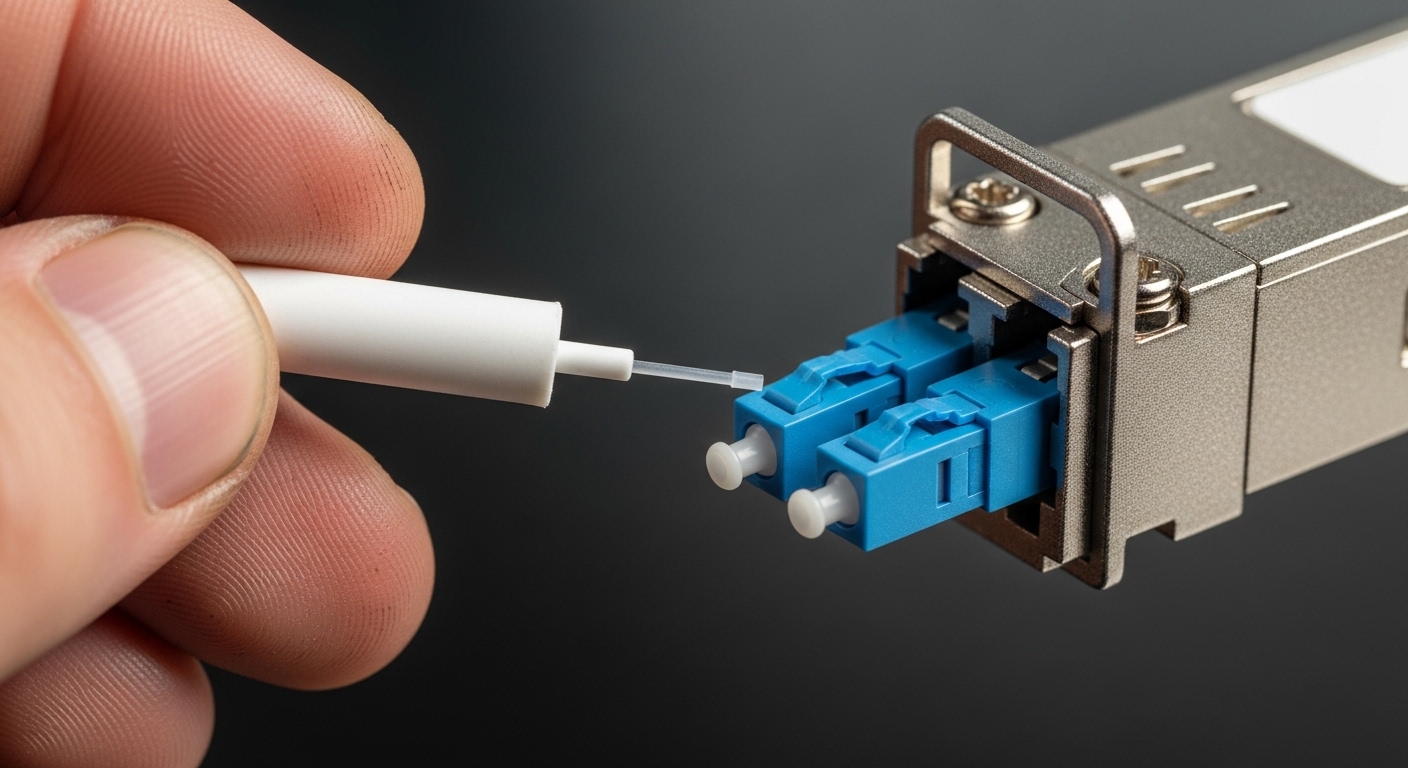
Root cause: reversed fiber polarity, wrong fiber pair, or swapped Tx/Rx on one end. Solution: verify LC duplex polarity mapping with a polarity tester; correct patching and re-test. If the host supports it, check Rx optical power readings immediately after insertion.
DOM warnings that look like optical failure
Root cause: DOM implementation differences or host threshold mismatch causing false alarms. Solution: compare DOM telemetry (Rx power, Tx bias, temperature) to the module datasheet and host documentation. If values are within spec but alarms persist, adjust thresholds or confirm the supported DOM profile for that host.
BER errors that do not correlate with optical power
Root cause: electrical lane rate mismatch, incompatible host firmware, or faulty patch cord cleanliness. Solution: ensure the host is configured for the correct optics profile and line rate; clean connectors with proper inspection and cleaning tools; then rerun BER tests and capture error counters.
Operational tip: always capture screenshots or logs of DOM telemetry and link state at the time of the fault. When escalation is needed, the vendor support team will ask for these exact data points.
Cost and ROI note: what you should budget for
Pricing depends on data rate, reach class, DOM support, and whether you buy OEM-branded or third-party. In many carrier and enterprise projects, OEM optics often cost roughly 1.5x to 3x the price of third-party equivalents, but OEM may reduce integration risk and simplify support. A realistic TCO model includes not only unit price, but also spares, field labor for replacements, and the cost of outages caused by marginal optics budgets.
From a procurement perspective, third-party optics can deliver strong ROI when you enforce strict compatibility validation, including DOM behavior and BER results on the target host. If your operator policy restricts non-OEM optics, treat that as a constraint and negotiate bulk pricing and replacement SLAs. Either way, calculate ROI using your site failure rates and MTTR assumptions rather than relying on “spec-only” comparisons.
FAQ: buying and deploying 5G fronthaul SFP modules
Which wavelength should I standardize on for 5G fronthaul?
Many fronthaul designs standardize on 1310 nm single-mode for longer reach and stable performance. Confirm your system design documents and host vendor guidance; do not assume multimode or 850 nm optics will meet distance once you include patch panels and splices.
Can one 5G fronthaul SFP work for both CPRI and eCPRI?
Often yes at the optics layer, but only if the line rate, electrical compatibility, and host configuration match. CPRI and eCPRI differ in transport framing and timing behavior, so validate end-to-end performance with your actual split and scheduling.
What DOM features should I require?
Require DOM telemetry that your platform can read reliably: Rx power, Tx bias/current, and temperature are common. Also verify alarm behavior and thresholds to prevent false positives that can trigger unnecessary maintenance.
How do I calculate whether my optics budget is safe?
Use vendor-stated Tx power and Rx sensitivity, subtract measured fiber attenuation and real connector/splice losses, then apply a safety margin. If you cannot measure loss, start with conservative connector/splice assumptions and plan for an additional margin during commissioning.
What is the fastest way to troubleshoot a no-link event?
First verify fiber polarity and patching direction. Then check DOM readings and host link state immediately after insertion; if Rx power is near zero, focus on fiber mapping and cleanliness before swapping optics.
Are third-party 5G fronthaul SFP modules safe to deploy at scale?
They can be, but only after compatibility validation on your exact host hardware and software release. Run loopback and BER tests, confirm DOM telemetry stability, and ensure your support process covers optics replacement quickly.
Choosing the right 5G fronthaul SFP is a budget-and-validation exercise: match wavelength and reach, confirm DOM behavior, and test with your real fiber plant. Next, review 5G fronthaul split options and transport planning to align your optics choice with the DU-RU split and latency requirements.
Author bio: I deploy and troubleshoot fronthaul optics in live radio access networks, validating BER, DOM telemetry, and optics budgets under field conditions. I focus on practical compatibility checks with specific host platforms and measured loss, not spec-sheet assumptions.