If your wastewater treatment SCADA link drops during storms or power events, it is usually not “mystery downtime” it is a transceiver and fiber mismatch. This article helps field engineers and utility IT teams choose and deploy water utility fiber transceivers that survive real plant conditions—wet enclosures, temperature swings, and long runs. You will get a step-by-step implementation workflow, a decision checklist, and troubleshooting for the top failure modes.
Prerequisites: what you need before touching the transceiver
Before ordering any optics, gather link data and verify the physical plant constraints. In wastewater sites, the optical path often includes manholes, cable trays, and patch panels that see vibration and moisture ingress, so your “paper design” must match the field reality.
- SCADA network requirement: Ethernet rate (10GBASE-SR, 1GBASE-SX, etc.), latency tolerance, and whether you need redundancy (two fibers per service).
- Fiber plant details: cable type (OM3/OM4/OS2), core size, measured end-to-end length, and splice/patch counts.
- Switch compatibility: model numbers and transceiver support matrix from the vendor.
- Environmental envelope: ambient range near the RTU cabinet (often -10 C to 60 C in unconditioned areas) and whether you have active cooling.
Reference standard targets: Ethernet optical interfaces align with IEEE 802.3 families for fiber physical layers; vendor datasheets define safe operating power, receiver sensitivity, and DOM behavior. Use [Source: IEEE 802.3] and the specific transceiver and switch datasheets for final limits: IEEE 802.3 standards.
Step-by-step implementation: install water utility fiber optics without surprises
Below is the workflow I use when commissioning links to wastewater SCADA RTUs and PLC gateways. It is tuned for reliability: you validate optics first, then deploy in the enclosure, and only then lock the configuration.
Confirm the fiber type and distance with a loss budget
Measure or verify cable plant type and length, then build a simple loss budget. For multimode, remember that OM3/OM4 performance depends on bandwidth modal distribution and connector/splice cleanliness. In mixed environments, I always start from measured attenuation using an OTDR or a calibrated light source and power meter.
Expected outcome: You know whether you need short-reach multimode (SR) or single-mode (LR/ER style) optics, and you have margin for connectors and aging.
Select the transceiver family that matches the SCADA Ethernet rate
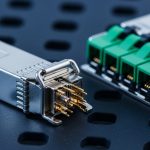
Wastewater SCADA often uses 1G copper historically, but plants increasingly run fiber for noise immunity and longer spans between buildings. Pick optics that match your switch ports and transceiver form factor (SFP, SFP+, SFP28, QSFP+), and ensure the wavelength matches the fiber type.
Example: If your switch supports 10GBASE-SR on SFP+ and your path is within multimode reach, a common choice is a 10G SFP+ SR module like Cisco SFP-10G-SR or FS.com SFP-10GSR-85. For single-mode, you would instead target 10GBASE-LR style optics (typically 1310 nm) with appropriate reach.
Verify DOM and switch diagnostics behavior
Many utilities rely on DOM for preventive maintenance: receive power trends, laser bias, and temperature warnings. Before field deployment, confirm the switch reads DOM correctly and that the vendor does not require “approved” optics lists for monitoring.
Expected outcome: You can see link health in your monitoring system (or at least in switch CLI) and you can alert before failure.
Clean connectors and terminate with wastewater-grade discipline
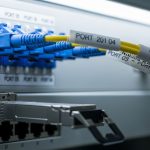
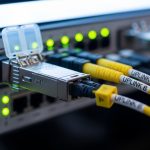
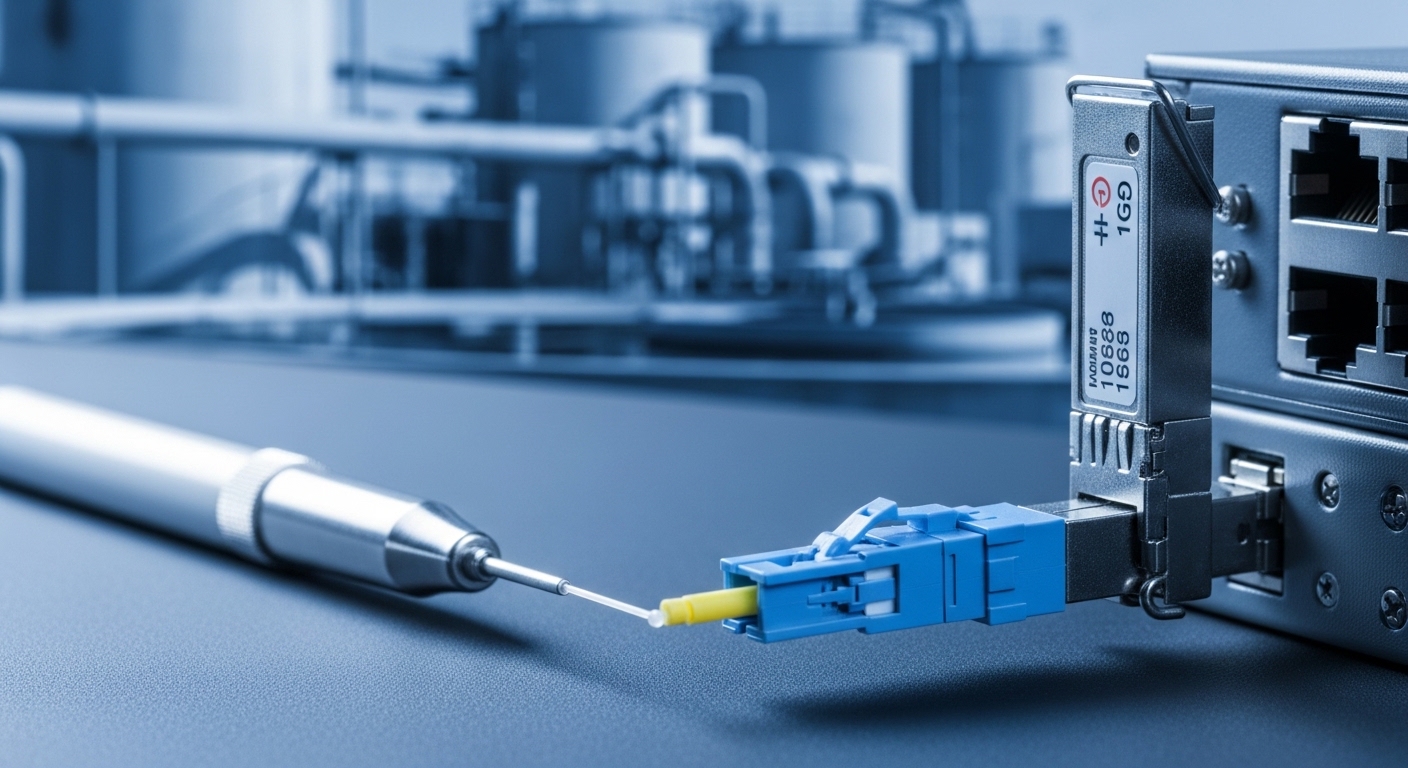
In plant environments, connector contamination is the number one avoidable cause of high BER and intermittent link flaps. Use lint-free wipes and proper cleaning tools, and only open dust caps when ready to mate. If you use LC connectors, verify latch integrity and strain relief; if you use patch cords, label both ends to avoid cross connections.
Expected outcome: Stable optical power and a consistent link-up after enclosure closure.
Install optics, set port parameters, and validate with real traffic
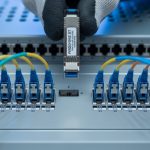
Most fiber optics negotiate automatically at the PHY layer, but you still validate link state and error counters after installation. On Cisco IOS-like switches you can check counters and optics status (DOM fields vary by platform). Run controlled SCADA traffic patterns (polling bursts from the engineering workstation, PLC data bursts, and historian writes) and monitor for CRC errors and interface resets.
Expected outcome: No flaps during stress traffic, no rising error counters, and stable receiver power within the module’s recommended range.
Pro Tip: In wastewater plants, the biggest “gotcha” is not the nominal reach; it is the connector cleanliness and the cumulative impact of additional patch panels added during construction. I have seen a link that passed on day one fail after a cabinet relabeling because two LC ends were re-mated without cleaning. Always re-clean and re-test after any physical handling.
Key optics specs compared for wastewater SCADA fiber runs
Use this table to compare common transceiver options you might deploy for water utility fiber SCADA links. Exact reach depends on link loss, connector quality, and the switch vendor’s optics compatibility rules.
| Spec | 10GBASE-SR (SFP+) | 10GBASE-LR (SFP+) | 1GBASE-SX (SFP) |
|---|---|---|---|
| Typical wavelength | 850 nm | 1310 nm | 850 nm |
| Fiber type | OM3/OM4 multimode | OS2 single-mode | OM2/OM3/OM4 multimode |
| Typical reach | Up to 300 m (multimode) | Up to 10 km (single-mode) | Up to 550 m (OM3) |
| Connector | LC duplex (common) | LC duplex (common) | LC duplex (common) |
| DOM support | Often available (vendor-dependent) | Often available (vendor-dependent) | Often available (vendor-dependent) |
| Operating temperature | Usually 0 C to 70 C (check datasheet) | Usually -5 C to 70 C (check datasheet) | Usually 0 C to 70 C (check datasheet) |
| Form factor | SFP+ module | SFP+ module | SFP module |
If your wastewater utility fiber runs are mixed and uncertain, single-mode (LR) can be a safer “future-proof” choice when you truly need longer distance. However, single-mode optics are typically more expensive than multimode SR options, so you should balance cost against the measured loss budget.
Decision checklist: how engineers pick the right transceiver
In practice, selection is a multi-variable optimization problem. Use this ordered checklist and you will avoid most compatibility and reliability issues.
- Distance and fiber type: confirm OM3/OM4 vs OS2 with records or testing.
- Data rate and port form factor: SFP vs SFP+ vs QSFP+; match the switch port type.
- Budget vs margin: estimate total link loss including splice and connector losses; keep margin for aging.
- Switch compatibility: verify the transceiver is supported on the exact switch model; check vendor interoperability.
- DOM support: ensure your monitoring platform can read DOM fields and that thresholds make sense.
- Operating temperature: choose modules with vendor-rated temperature for the enclosure environment.
- Vendor lock-in risk: if you rely on an optics vendor lock list, budget spares and plan for lifecycle changes.
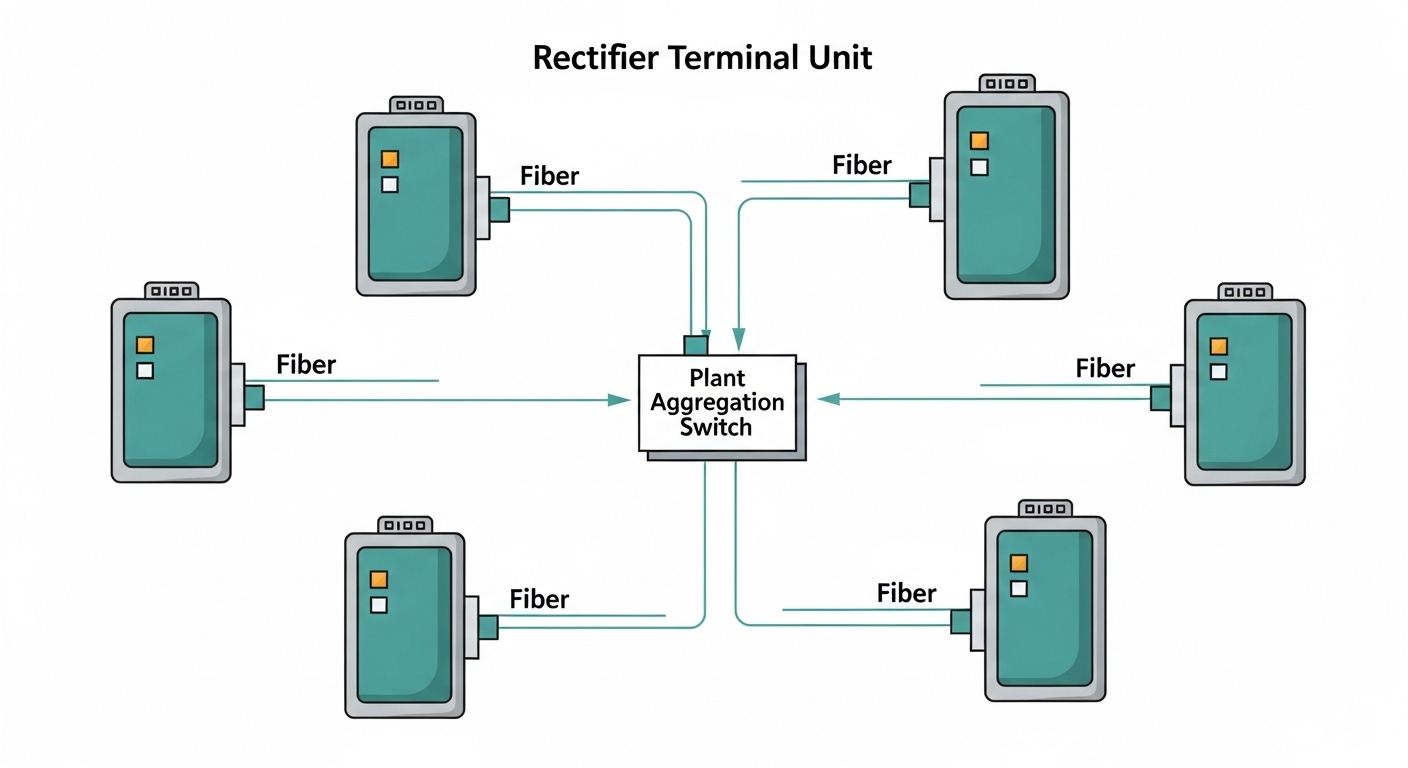
Real-world deployment scenario: In a 3-tier wastewater telemetry network, we connected three pump station RTU cabinets to the plant aggregation switch using 10G SR SFP+ over OM4 for each 120 m run. Each RTU cabinet had an unmanaged media conversion stage replaced by a direct fiber uplink, and we reduced packet retries by tuning the switch to avoid oversubscription during historian sync. After installation, measured receive power stayed within the module’s recommended range, and the interface error counters remained at 0 CRC errors during 24 hours of storm-related polling bursts. The key success factor was re-cleaning LC ends after cabinet re-termination and setting alerts on DOM receive power drop.
Common mistakes and troubleshooting for wastewater SCADA optics
When fiber links misbehave, the fastest path to resolution is to isolate whether the issue is optics, fiber loss, or physical handling. Here are the top field failure modes I see.
Failure point 1: Link flaps after enclosure closure
Root cause: connector micro-bending, poor strain relief, or a connector that was not fully seated. Moisture ingress can also cause corrosion at exposed metal contacts and worsen mating pressure.
Solution: re-seat and clean connectors, verify strain relief, and inspect patch cords for tension. After any cabinet work, re-check link state and DOM receive power.
Failure point 2: High BER symptoms and rising CRC errors
Root cause: contaminated fiber endfaces, damaged ferrules, or exceeding the receiver power margin due to too many splices/patch panels.
Solution: clean both ends with the correct method and verify with a fiber inspection scope. Re-measure optical power or OTDR loss; if margin is tight, move to a lower-loss patch strategy or switch to a different reach optic family.
Failure point 3: “Unsupported transceiver” or missing DOM alarms
Root cause: the switch platform has an optics compatibility policy, or the module’s DOM implementation differs from what the switch expects.
Solution: confirm the exact switch model and firmware version, then use transceivers listed as compatible by the vendor. If you cannot, test in a lab with the same firmware and validate monitoring behavior before scaling.
Cost and ROI note: what to expect in total ownership
Typical module pricing varies by speed and reach. As a rough field range: 10GBASE-SR SFP+ modules often fall in the low to mid tens of dollars for third-party units and can be higher for OEM-branded optics; 10GBASE-LR SFP+ modules can be noticeably more. Your TCO is dominated by spares strategy, truck rolls, and downtime risk, not just the optics purchase price.
Third-party optics can be cost-effective, but you must validate compatibility and DOM behavior to avoid blind spots in monitoring. In utilities, I have seen ROI swing quickly when a single failed link prevents SCADA alarms from reaching the control room; in those cases, paying more for reliable modules and keeping a tested spare kit beats chasing the cheapest option.
FAQ: wastewater SCADA teams ask about water utility fiber optics
What fiber type should I use for water utility fiber SCADA links?
Use multimode (OM3/OM4) for shorter runs within the SR reach envelope, and single-mode (OS2) for longer runs or uncertain future expansions. The best choice is the one that matches your measured loss budget and switch optics support. Always confirm with OTDR or calibrated power measurements.
Can I mix transceiver vendors in the same switch?
Often you can, but it is not guaranteed. Compatibility depends on the switch model, firmware, and the transceiver’s DOM implementation. Test a single port end-to-end in a staging rack before scaling to all RTUs.
How do I know if my link has enough optical margin?
Check receiver power via DOM and compare it against the transceiver datasheet’s recommended operating range. Then verify error counters stay stable under real SCADA traffic. If you are near the edge, plan a move to a different reach optic or reduce connector/splice count.
What temperature issues matter in wastewater RTU cabinets?
Unconditioned cabinets can exceed typical office ranges, especially near heaters or in summer sun. Select modules with a temperature rating appropriate for your site and verify that enclosure airflow does not trap heat around the switch and optics.
Why does cleaning matter even if the link “works”?
Contamination can still pass initial link negotiation while causing higher error rates that show up later under bursts. Clean connectors before installation and after any re-termination, then validate with error counters and inspection scope images. This is one of the highest-leverage reliability steps you can take.
What spare kit should I keep on hand?
Keep at least one tested spare per transceiver type and wavelength used, plus a cleaning kit and inspection scope access. In critical SCADA segments, I also recommend keeping a pre-labeled patch cord set to speed swap testing during outages.
With the right optics selection, disciplined cleaning, and DOM-based validation, water utility fiber links can stay stable through the real conditions that wastewater sites throw at SCADA. Next, review your plant’s fiber path standards and naming scheme using fiber patch panel best practices so every future change stays testable.
Author bio: I am a field-focused network builder who commissions fiber links for industrial telemetry, with an emphasis on optics, monitoring, and failure-proof change control. I write from hands-on deployments and troubleshooting logs to help teams keep SCADA reliable under harsh conditions.