If you are rolling out NG-PON2 TWDM in a fiber access network, the fiber access transceiver you pick determines whether you hit reach targets, optical power budgets, and OLT interoperability on day one. This article helps access engineers and field tech leads evaluate NG-PON2 TWDM optics with the same rigor used in data center uplinks: wavelength plan, reach class, connector and DOM behavior, and failure modes. You will get a practical selection checklist, common troubleshooting patterns, and a ranked comparison table you can use during procurement.
Top 8 NG-PON2 TWDM fiber access transceiver selection criteria
NG-PON2 TWDM transceivers are not interchangeable “any SFP/GBIC-style module.” They must match the TWDM wavelength plan, the reach class required by your ODN design, and the OLT vendor’s optics requirements (including DOM fields and control-plane behavior). In field deployments, engineers often discover issues only after patching dozens of ONUs because the optics vendor’s implementation details differ.
Distance and reach class alignment
Start with your ODN budget: fiber type, split ratio, connector losses, splice losses, and margin. For reach planning, treat optics as a system: transmitter output power minus all ODN loss must land within the receiver sensitivity window, with aging margin. For example, in a suburban deployment with 1:64 splits and an estimated 28 dB total ODN loss budget, you need a transceiver pair whose specified receiver sensitivity and launched power support that budget plus at least 3 dB for aging and patching variance.
- Best-fit: Greenfield ODN builds where you can measure real splice/patch losses.
- Pros: Avoids marginal optical budgets that cause intermittent ranging failures.
- Cons: Requires accurate OTDR and inventory of splitters and patch cords.
TWDM wavelength plan and channel mapping
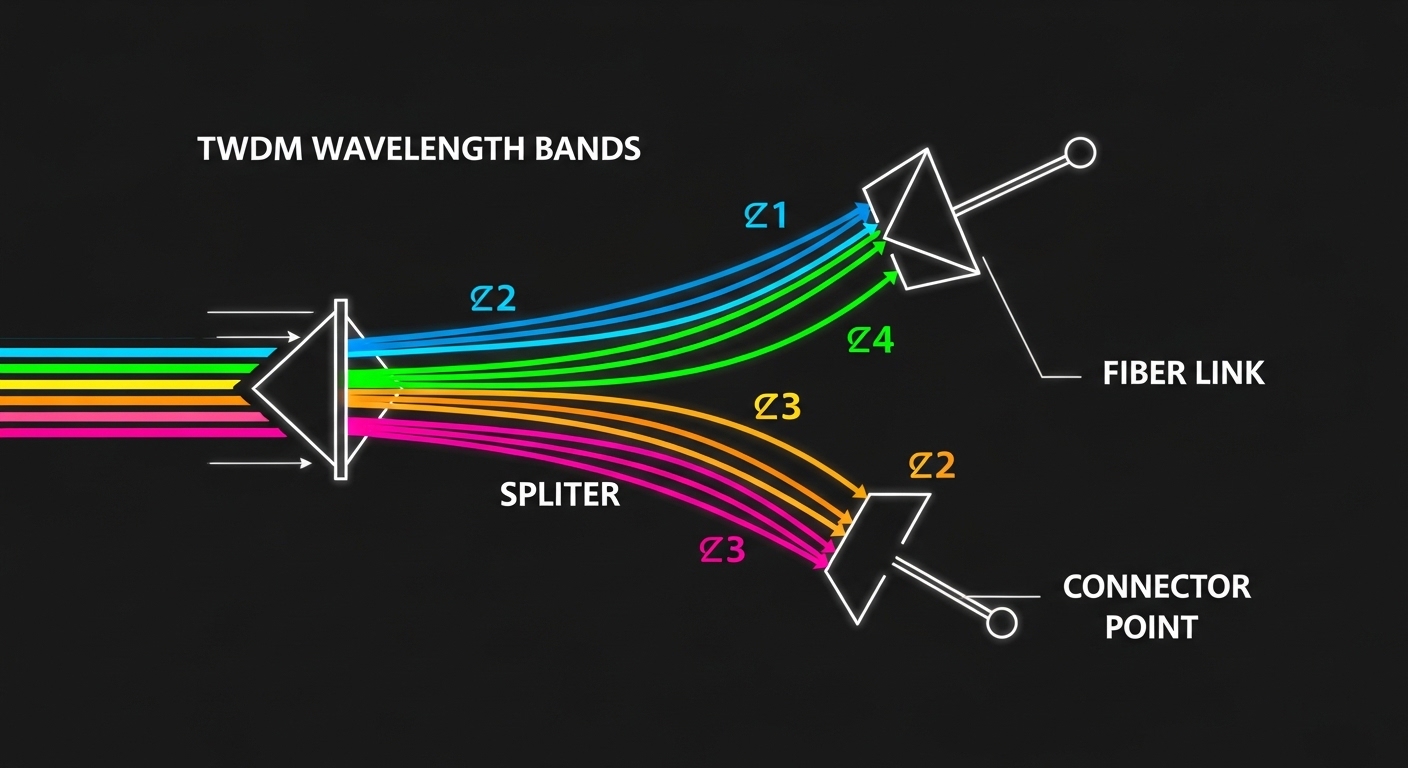
NG-PON2 TWDM uses multiple wavelengths grouped into downstream and upstream bands (exact details depend on vendor implementation and standards alignment). Your transceiver must support the same channel plan the OLT expects; otherwise, you can see “link up” but no stable framing/ranging. Always verify wavelength grid compatibility in the module datasheet and the OLT optics interoperability notes from the vendor.
- Best-fit: Brownfield upgrades where older ODN is reused and patching must preserve channel mapping.
- Pros: Prevents silent failures where optics negotiate but PON control never stabilizes.
- Cons: Increases qualification effort during procurement.
Data rate mode and ONU/OLT optics mode support
NG-PON2 TWDM transceivers are designed for specific PON modes. Confirm whether the module supports the same line rate and framing behavior your OLT configuration uses (including guard times and any vendor-specific parameters). In practice, mismatched mode support can manifest as repeated ranging attempts, high FEC error counts, or traffic shaping failures.
- Best-fit: Multi-tenant environments where you standardize profiles across sites.
- Pros: Reduces operational variance across OLT cards.
- Cons: May limit vendor flexibility if you mix optics brands.
DOM support, management fields, and alarm thresholds
Digital Optical Monitoring (DOM) is essential for operations. Verify that the module exposes expected I2C/MDIO-accessible fields: received power, transmitted power, temperature, and bias current, plus alarm and warning thresholds. In the field, DOM mismatches can break monitoring dashboards or cause false alarms that trigger unnecessary truck rolls. Check whether the OLT reads DOM standard fields consistently across optics vendors.
Pro Tip: During acceptance testing, force a controlled optical power change (for example, by swapping a known attenuator patch cord) and confirm the OLT’s DOM alarms trigger within your documented thresholds. This catches DOM parsing issues that would otherwise appear as “mystery instability” weeks later.
Connector and physical layer compatibility (LC/UPC vs other)
Most NG-PON2 TWDM optics use fiber connectors such as LC. But the key detail is polish and mating standard: UPC vs APC affects reflectance and can influence receiver stability in high-reflectance environments. Verify connector type on the datasheet and match it to your patch panel and jumper stock. In harsh field conditions, inspect and clean connectors with proper lint-free methods; “it fits” is not “it meets spec.”
- Best-fit: Facilities with standardized patch panel hardware and cleaning SOPs.
- Pros: Reduces return-loss problems and intermittent RX saturation.
- Cons: Requires disciplined jumper management.
Temperature range and power consumption
Access networks run in cabinets and rooftops where ambient conditions swing widely. Confirm the transceiver operating temperature range and expected power consumption. Modules that barely meet the spec can drift bias currents under summer heat, leading to higher BER and more FEC corrections. For cabinet installs, I typically demand at least a margin for worst-case ambient plus solar load.
- Best-fit: Outdoor plant and street cabinets.
- Pros: More stable optics performance across seasons.
- Cons: Higher-grade optics can increase unit cost.
Interoperability with your specific OLT line card
Even when the module claims NG-PON2 TWDM compatibility, the OLT vendor may enforce specific optics profiles, including firmware checks and DOM field mapping. Before scaling, validate on one representative OLT card using a controlled set of ONUs and a short ODN. This is where you catch “works on bench, fails in system” scenarios.
- Best-fit: Managed multi-vendor procurement.
- Pros: Avoids expensive rework across hundreds of shelves.
- Cons: Qualification time can delay rollout.
Reliability indicators: MTBF, warranty, and supply chain risk
Ask for reliability metrics and warranty terms, and evaluate lead times. In field operations, “first-year failure” patterns are often tied to manufacturing batches or handling damage during shipping. Treat optics like precision components: keep ESD precautions, avoid uncontrolled temperature swings, and log serial numbers for traceability.
- Best-fit: High-volume deployments with strict SLA targets.
- Pros: Lowers operational downtime and truck-rolls.
- Cons: Some metrics are not disclosed uniformly across vendors.
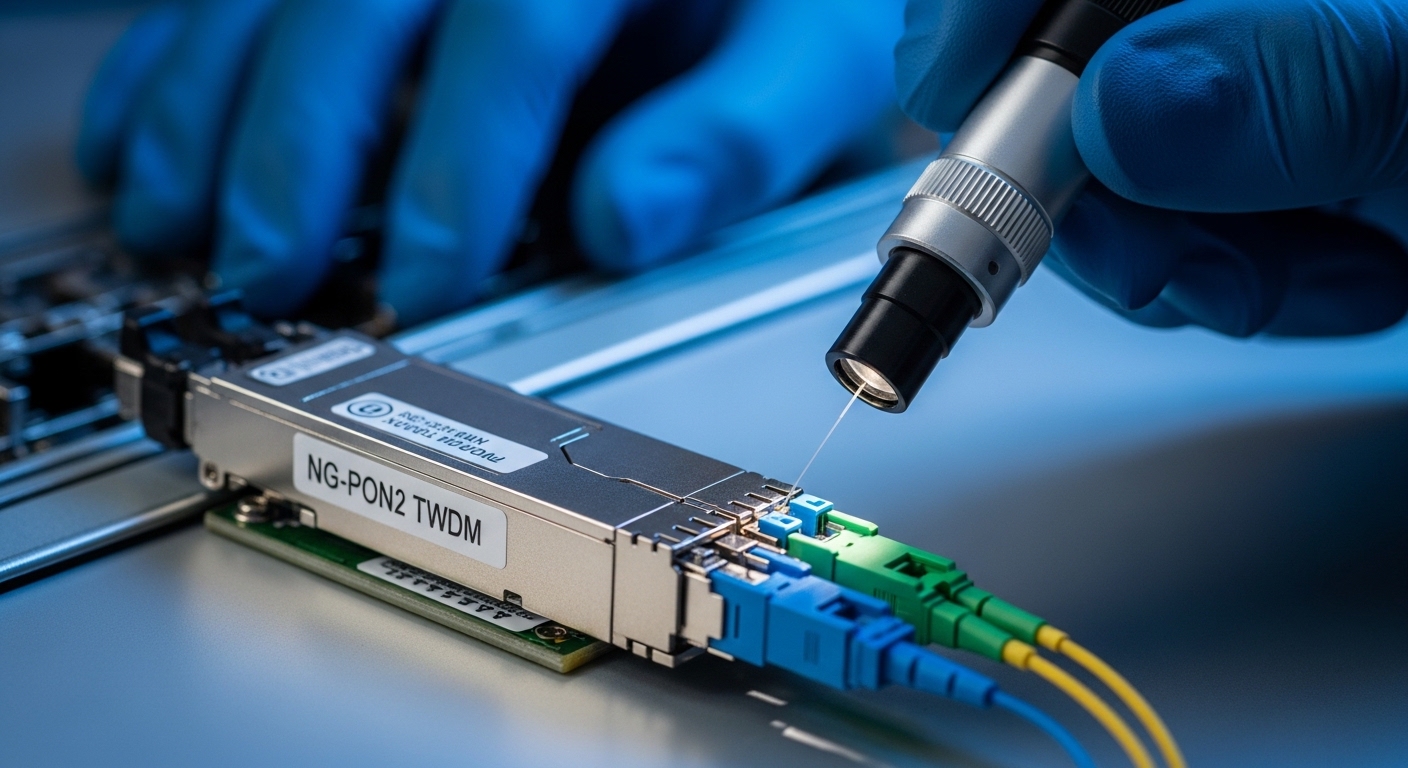
Key NG-PON2 TWDM specs you must validate before purchase
Below is a practical comparison table for the types of parameters you should verify in datasheets and interoperability matrices. Exact values vary by vendor and reach class, so use this as a validation checklist rather than a substitute for official documentation.
| Spec category | What to check | Why it matters in NG-PON2 TWDM | Typical target range (example) |
|---|---|---|---|
| Data rate / PON mode | NG-PON2 TWDM mode support, framing compatibility | Prevents ranging instability and control-plane failures | Configured per OLT profile |
| Wavelength plan | Downstream/upstream wavelength set and grid | Ensures OLT channel mapping matches the module | Vendor-specific wavelength set |
| Reach class | Max reach with split ratios and ODN loss budget | Controls whether RX sensitivity margin exists | Designed for your ODN loss (example 28 dB) |
| Optical power | Tx launch power and Rx sensitivity | Determines margin for aging and patch cord swaps | Within OLT spec window |
| Connector / polish | LC connector type and UPC vs APC polish | Return loss and reflections affect receiver stability | Match your patch panel standard |
| DOM fields | Power, temp, bias, threshold behavior | Enables accurate monitoring and alarm correlation | DOM compatible with OLT parser |
| Operating temp | Module operating temperature range | Prevents bias drift and performance degradation | Cabinet/outdoor grade per site needs |
For standards context, NG-PON2 concepts build on Ethernet PON evolution and coexist with system-level optics requirements described across IEEE Ethernet PON documents and vendor implementations. For baseline Ethernet PON framing concepts and optical interface considerations, review [Source: IEEE 802.3]. For vendor-specific optics and DOM behavior, rely on the OLT and transceiver manufacturer datasheets and interoperability guides. IEEE 802.3 standards page
Real rollout example: NG-PON2 TWDM in a leaf-spine access aggregation
In a regional network rollout, we upgraded an access aggregation layer serving 18,000 homes using a 3-tier design: customer VLANs terminate at access switches, then uplink to an aggregation pair, and finally to NG-PON2 OLT shelves via routed handoff. The ODN design used 1:64 split at the remote nodes and an engineered loss budget of 27 to 30 dB including splices and patching. We qualified two candidate fiber access transceiver options on a single OLT line card, validated DOM alarm thresholds, and confirmed stable ranging across multiple ONU models before scaling to the full 96-port shelf count.
Operationally, the winning optics option was the one that matched the OLT’s DOM expectations and maintained RX power within the OLT’s warning thresholds during seasonal temperature swings. That mattered more than headline reach on the datasheet, because real ODN loss variance came from field patching differences and connector cleanliness outcomes.
Decision checklist: how engineers choose the right fiber access transceiver
- Distance and ODN loss budget: confirm reach class against measured OTDR and splitter/splice/patch losses.
- Wavelength plan compatibility: verify channel mapping in the transceiver datasheet and OLT interoperability matrix.
- Switch/OLT card compatibility: validate the exact line card model and firmware revision, not just “vendor says compatible.”
- DOM support and alarm thresholds: confirm the OLT reads the expected DOM fields and triggers warnings correctly.
- Operating temperature and power: compare site ambient extremes with module operating ranges and confirm thermal margin.
- Budget and total cost of ownership: compare OEM vs third-party pricing, but include qualification labor, failure rates, and warranty terms.
- Vendor lock-in risk: assess how many optics SKUs are required and whether future OLT upgrades will force re-qualification.
Common mistakes and troubleshooting patterns in TWDM optics
Field failures in NG-PON2 TWDM optics are usually not “random.” They cluster into a few repeatable root causes. Below are concrete pitfalls we see during acceptance tests and staged rollouts.
Link up but no stable ranging
Root cause: wavelength plan or TWDM channel mapping mismatch between module and OLT expectations. Sometimes the module is electrically compatible, but the OLT cannot lock to the expected optical set.
Solution: verify the transceiver wavelength set in the datasheet, cross-check OLT interoperability documentation, and run a controlled test with a known-good patch jumper and a minimal ODN segment.
Intermittent packet loss that correlates with temperature
Root cause: module operating temperature margin is too tight for cabinet ambient or solar heating; bias current drift increases BER and triggers more FEC corrections than normal.
Solution: measure cabinet ambient during peak sun, confirm the module operating temperature rating, and validate DOM temperature and optical power trends over time.
High alarm rate after patching or connector changes
Root cause: dirty connector endfaces, wrong polish type (UPC vs APC), or high-reflectance reflections causing receiver instability or saturation.
Solution: enforce connector cleaning SOPs, verify connector polish type matches patch panels, and use a fiber inspection scope to confirm endface cleanliness before re-terminating.
DOM alarms are nonsensical or dashboards show missing fields
Root cause: DOM field mapping differences or unsupported DOM behavior in third-party optics; OLT parser expects specific register layouts.
Solution: confirm DOM compliance with OLT vendor notes, test DOM reads using the OLT CLI/management interface, and standardize on a single optics vendor per OLT generation when possible.

Cost and ROI note: OEM vs third-party optics in access networks
In real procurement, pricing varies widely by reach class, temperature grade, and whether the module is OEM or third-party. As a rough planning figure, OEM NG-PON2 TWDM optics can cost materially more per unit than third-party equivalents, but the ROI often hinges on qualification time and operational risk. Third-party modules may reduce unit price, yet they can increase TCO if DOM behavior is inconsistent or if interoperability qualification requires repeated acceptance cycles.
From a field operations perspective, the biggest hidden cost is truck-roll frequency due to marginal optical budgets or connector-related reflectance issues. A slightly higher upfront cost that comes with strong interoperability documentation and consistent DOM behavior can reduce downtime and improve SLA compliance.
Ranked summary: top fiber access transceiver picks by deployment priority
The ranking below assumes your target is NG-PON2 TWDM in an access network where interoperability, monitoring, and optical stability matter at scale. Replace “Pick A/B/C” with your vendor SKUs after confirming exact wavelength plan and ODN reach class in documentation.
| Rank | Best-fit scenario | What to prioritize | Pros | Limitations |
|---|---|---|---|---|
| 1 |