In high-density switching, a single dirty or poorly polished ferrule can erase an SFP link margin you thought was “plenty.” This article explains how ferrule end face inspection ties directly to polishing and cleaving quality, and how it impacts the optical loss budget for SFP transceivers. It helps field engineers, facilities teams, and datacenter operators reduce intermittent link faults, unexpected CRC bursts, and “mystery” link-down events. You will get practical thresholds, a selection checklist, and troubleshooting actions you can take on site.
Why ferrule end face inspection changes your SFP loss budget
SFP optical budgets are usually modeled around fiber attenuation, connector loss, and sometimes splice loss per the relevant link design rules in IEEE 802.3 for Ethernet PHY optics. In reality, the dominant “surprise” terms are interconnect losses caused by end-face contamination, scratches, chips, and angular mis-polish. Even when the fiber itself is within spec, a ferrule end face with residue or micro-cracks can add several tenths of a dB, which matters when you are near the limit.
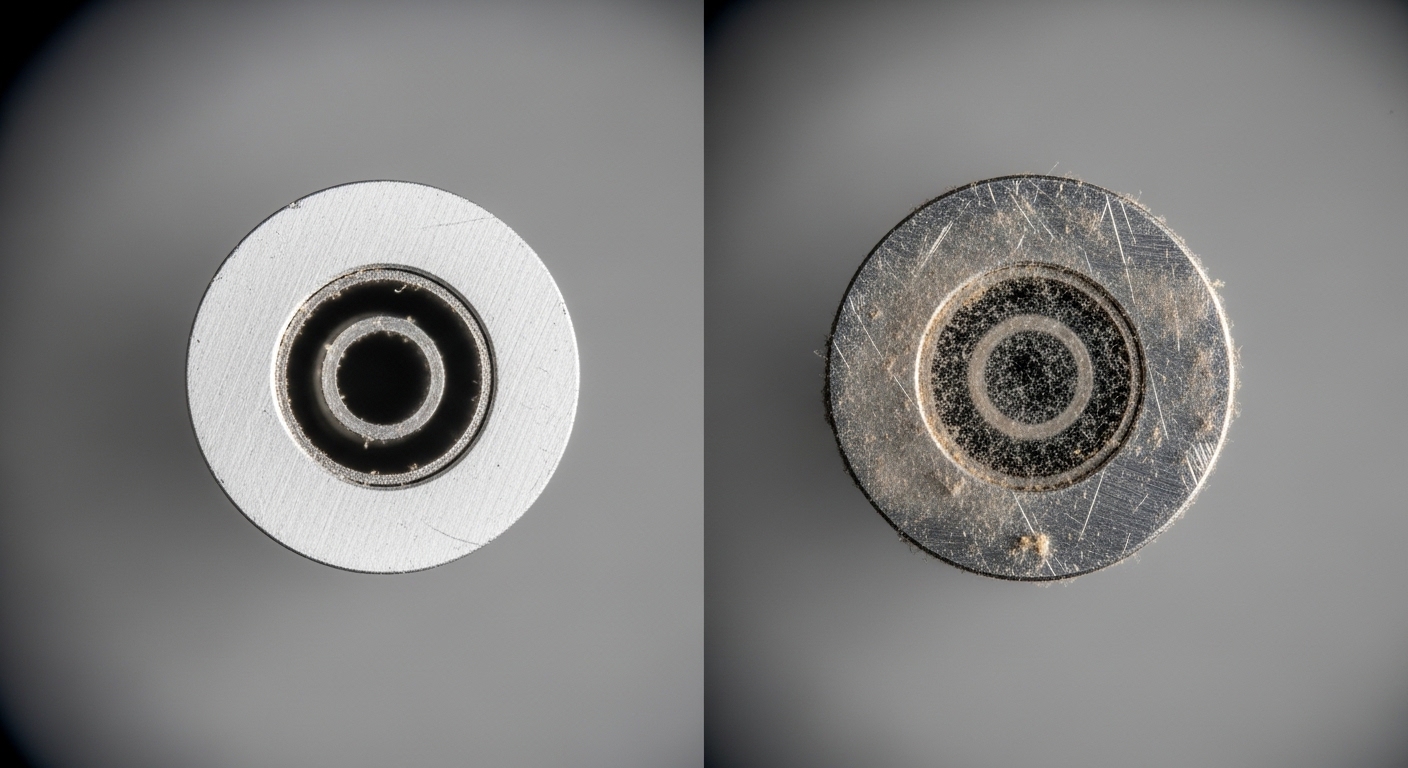
Polishing and cleaving quality strongly shapes the end-face geometry. Poor cleaves leave a jagged fracture line; aggressive polishing can create a convex or concave profile; and insufficient cleaning leaves oils or particulates that scatter light. Ferrule end face inspection is the only way to verify whether the end face is truly “clean and conforming” before you close the panel and bring the link up.
Pro Tip: When you see a link that trains at first but later flaps under vibration or thermal cycling, inspect for hairline chips and polishing scratches. Micro-damage can sit below your initial visual threshold yet still create polarization- and temperature-dependent coupling changes, especially with SMF jumpers and high-launch SFP optics.
Polishing and cleaving defects that inspection can catch
During assembly, the fiber cleave must be perpendicular enough that polishing removes the fracture without leaving a pit. If the cleave angle is off, inspection often shows a dark line, a crescent-shaped damage zone, or edge chips near the ferrule mouth. Under magnification, contamination appears as haze, rainbow oil films, or pinpoint debris that can be invisible at normal room lighting.
For SFP loss budget planning, treat end-face issues as a variable connector loss term. In field measurements, a “visually acceptable” end face can still produce higher insertion loss if there is a thin film or fine scratch that increases backscatter. Vendors specify connector interfaces and typical performance, but inspection is how you confirm the actual workmanship at the exact mating surface.
Key specifications to verify before blaming the SFP
Before you attribute link loss to the SFP transceiver (for example, a Cisco SFP-10G-SR or Finisar/FS.com 10G SR modules), verify that your inspected ferrule end faces meet connector interface expectations. Different connectors use different ferrule geometries and end-face polish styles, and inspection tools must match the connector type to avoid false readings.
| Parameter | What to check with ferrule end face inspection | Typical impact on SFP loss budget |
|---|---|---|
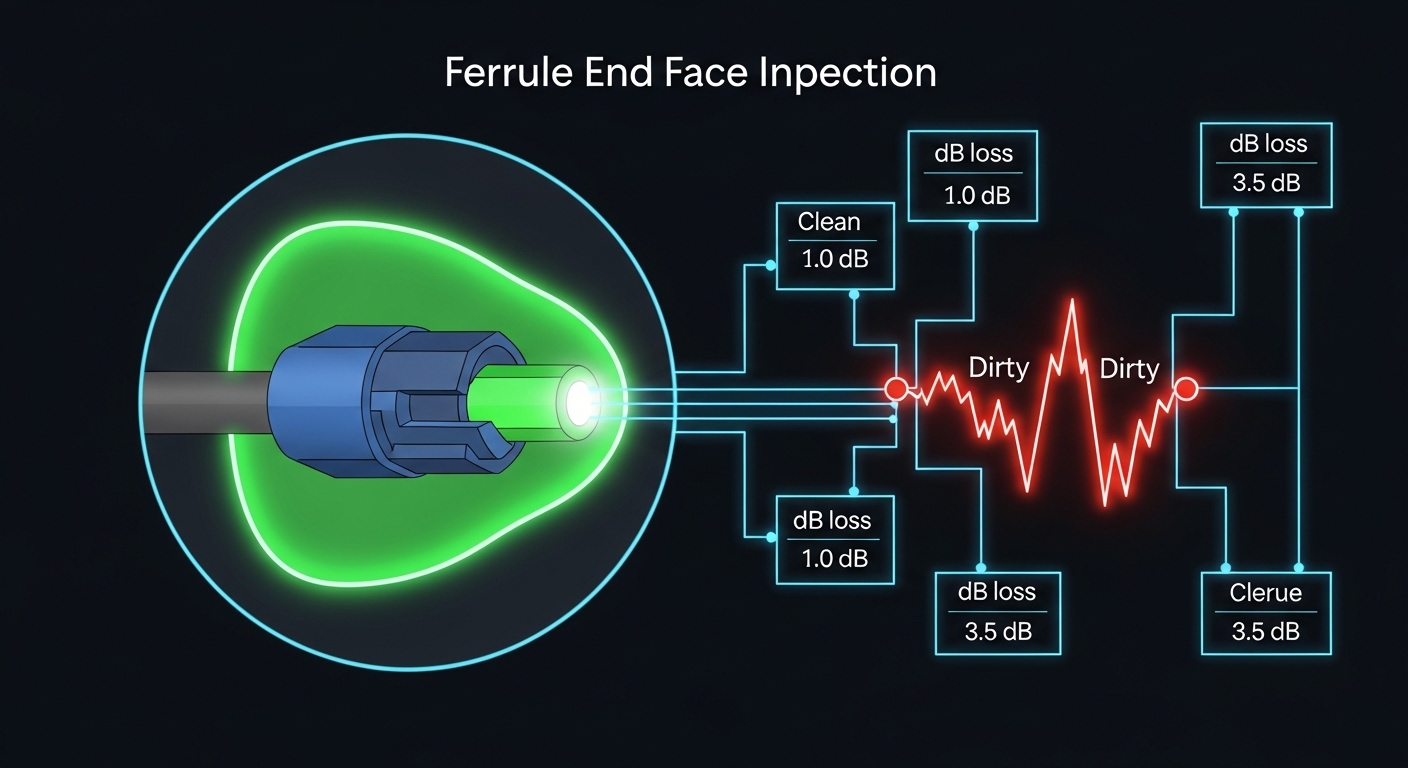
| End-face cleanliness | Oil film, dust, haze, particulate spots | Often +0.2 to +1.0 dB insertion loss; can cause intermittent RX sensitivity |
| Polish geometry | Convex/concave profile, edge over-polish, under-polish | Mismatch can add +0.1 to +0.5 dB and increase reflection-induced penalties |
| Chips and cracks | Edge chips, micro-cracks, fracture pits | Can add +0.3 dB or more; may worsen with thermal cycling |
| Scratch pattern | Fine lines, deep grooves, polishing striations | May add +0.1 to +0.4 dB and raise scattered light |
| Connector standard | UPC vs APC polish style (where applicable) | Wrong polish style increases reflection and can reduce receiver margin |
| Operating environment | Dust exposure, cleaning frequency, handling discipline | Contamination growth over time drives gradual margin erosion |
For authority on link design and optical budget considerations, cross-check your PHY reach targets with IEEE 802.3 requirements and your transceiver datasheet specs (optical power range and receiver sensitivity). For example, SFP SR optics are commonly paired with OM3/OM4 multimode fiber and budgeted around connector and splice losses, but the exact margin depends on your cable plant and patch panel practices. IEEE 802.3 standard
Real-world deployment scenario: where inspection prevents margin collapse
In a 3-tier data center leaf-spine topology with 48-port 10G ToR switches, an operator might run 10G SR SFPs from a leaf to a spine across patch panels using OM4 jumpers. Suppose each hop uses two patch cords plus two connectors per side, and the design assumes 0.5 dB per mated connector pair. After a maintenance window, several links start flapping during peak load; measured optical power is only slightly low, but receiver errors spike.
Field inspection finds one or more ferrules with a thin oil haze and a visible edge chip. Cleaning helps the oil haze, but the chipped ferrule remains problematic; replacing just the affected jumper restores stability. The key takeaway is that the “loss budget” that looked safe on paper was consumed by end-face defects, not by fiber attenuation.
Selection criteria: how engineers choose inspection and cleaning workflows
- Distance and link type: multimode vs singlemode, SFP SR vs SFP LR, and expected connector density per path.
- Connector compatibility: confirm the ferrule type (LC, SC, MPO) and polish style you will inspect; mismatched inspection optics can mislead.
- Inspection method: handheld microscope for fast triage versus higher-magnification inspection for acceptance testing.
- DOM support and optics vendor alignment: while DOM won’t fix dirty ferrules, vendor consistency helps isolate whether loss is connector-related or transceiver-related.
- Operating temperature: choose tools and cleaning supplies rated for your rack-room conditions; cold environments can increase static dust adhesion.
- Vendor lock-in risk: standardize on widely supported connector geometries and inspection documentation formats so you can swap vendors without retraining everywhere.
- Documentation discipline: capture images before and after cleaning to prove workmanship and reduce repeated failures.
Common mistakes and troubleshooting tips
1) Cleaning without inspection. Root cause: technicians clean “blind,” removing only loose dust while leaving a film or micro-chip. Solution: inspect first, clean with appropriate lint-free wipes and isopropyl alcohol where permitted, then inspect again.
2) Using the wrong connector interface procedure. Root cause: LC vs SC vs MPO inspection and cleaning steps differ; using an incompatible cap or cleaning tip can smear residue. Solution: standardize on connector-specific cleaning consumables and verify caps before mating.
3) Replacing the SFP instead of the jumper. Root cause: DOM readings can look “close,” and engineers assume the transceiver is marginal. Solution: validate with a known-good jumper and inspect both ends; if the ferrule end face shows chips or scratches, replace the patch cord, not the SFP.
4) Ignoring mating-side asymmetry. Root cause: only one end is inspected; the other ferrule is contaminated, so your “fixed” side still fails. Solution: inspect both ends of every suspect link, including patch panel cross-connects.
Cost and ROI: inspection pays back quickly
Handheld ferrule inspection microscopes typically fall in the mid to high hundreds of dollars, while replacement SFPs (even when not faulty) can cost thousands at scale when you factor downtime and labor. Third-party optics may be cheaper, but inconsistent connector workmanship and variable cleaning discipline can increase return rates and churn. TCO improves when you treat inspection as a maintenance control: fewer truck rolls, fewer link flaps, and less time spent chasing “transceiver” issues that are actually end-face scattering losses.

FAQ
How does ferrule end face inspection relate to SFP loss budget calculations?
Insertion loss budgets assume connectors and splices are within typical tolerances. Inspection verifies that your actual ferrule end faces are clean, properly polished, and free of chips that increase scattering and connector loss.
What defects are most likely to cause intermittent SFP link flaps?
Hairline chips, fine scratches, and thin oil films are common culprits. They can create temperature- and vibration-dependent coupling changes that show up as RX errors rather than immediate total link failure.
Should I inspect every jumper after