If your leaf-spine network is hitting power density limits, the optics choice becomes an architecture decision, not a line-item purchase. This co-packaged optics comparison breaks down CPO versus near-package optics for modern data centers, helping architects and field engineers choose the right path for performance, thermals, and upgrade cycles. You will see real compatibility checks, operational constraints, and troubleshooting patterns that show up during bring-up.
Architecture tradeoff: what CPO changes vs near-package optics
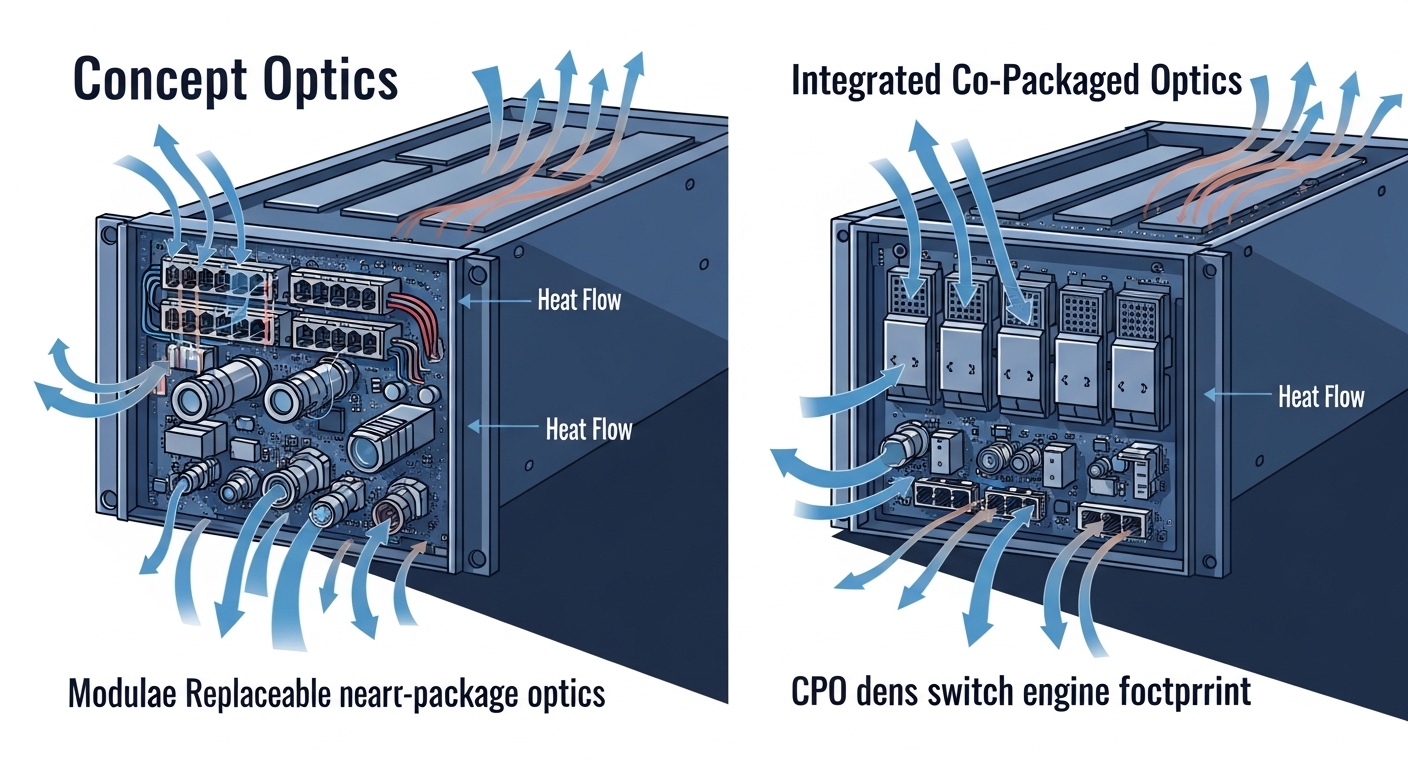
In CPO (co-packaged optics), the optical engine is integrated into or immediately adjacent to the switch ASIC package substrate to reduce electrical trace length and the number of pluggable/connectorized hops. That typically cuts latency and power consumed by high-speed serializer/deserializer and long electrical interconnects. In near-package optics, the optical module sits close to the ASIC but remains a more separable packaging boundary, often using standardized optical/electrical interfaces.
Practically, the biggest difference is not just “where the light starts,” but how much you can simplify the board-level interconnect stack. CPO can allow fewer board layers or shorter high-speed routing, which helps with signal integrity and thermal spreading. Near-package optics usually preserves more modularity, which can reduce risk during phased deployments.
Both approaches target the same bottleneck: in dense racks, the transceiver ecosystem can become the dominant contributor to power, airflow blockage, and maintainability friction. IEEE guidance on Ethernet PHY behavior still matters, but packaging changes how the link budget is engineered at the system level. For standards context, see Source: IEEE 802.3.

Specs that matter: wavelength, reach, power, connectors, temperature
When teams compare co-packaged optics, they often over-index on wavelength and ignore the operational envelope. The table below uses typical ranges you will see across 100G to 400G class deployments; exact values vary by vendor and generation. Always validate with the specific module or optical engine datasheet and confirm compliance with your target Ethernet PHY.
| Parameter | CPO (co-packaged optics) | Near-package optics |
|---|---|---|
| Typical target data rates | 100G to 800G-class per lane ecosystem | 100G to 400G-class per port ecosystem |
| Wavelengths | Commonly 850 nm or 1310 nm depending on design | Commonly 850 nm or 1310 nm depending on design |
| Reach (typical) | Up to ~2 km for some 1310 nm configurations | Up to ~2 km for some 1310 nm configurations |
| Connectorization | Often reduced external connectors, board-integrated optical path | More likely standard optical interface with clearer service boundaries |
| Power and thermal behavior | Often lower link power via shorter electrical paths; higher local hotspot risk | Often slightly higher system power but better thermal spread and service isolation |
| Operating temperature | Commonly 0 to 70 C or vendor-specific extended ranges | Commonly 0 to 70 C or vendor-specific extended ranges |
| Diagnostics/DOM | Varies: may include integrated digital monitoring but depends on switch vendor | More likely to support standard monitoring expectations for service teams |
For concrete, vendor-specific optical module examples in the broader ecosystem, you can reference datasheets for SFP and QSFP families such as Cisco SFP-10G-SR or Finisar/Fiber options like FTLX8571D3BCL, but those are pluggable baselines rather than CPO implementations. For a standards anchor on optical signaling classes, see Source: IEEE 802 project pages and the Ethernet PHY clause references inside IEEE 802.3.
Pro Tip: In co-packaged designs, the “real” margin often comes from board-level thermal equilibrium, not just optical link budget. If your switch vendor specifies a hotspot limit for the optical engine, treat it like a hard constraint during airflow changes, even when the optical temperature sensor reads within range.
Deployment reality: upgrading a leaf-spine fabric with power limits
Consider a 3-tier data center leaf-spine topology with 48-port 400G ToR switches feeding aggregation and core. The site targets 12 kW per rack with strict PUE, and the facility uses inlet air at 24 C with 80/20 hot aisle containment. During a refresh, the team wants to increase port density while keeping switch exhaust temperatures below the platform limit and preserving serviceability windows.
With near-package optics, the team can stage the upgrade: replace optics and verify link training on a subset of ports, using clearer fault isolation when a single optical path fails. With CPO, the optics are more tightly bound to the ASIC package and board design, so initial bring-up may require more careful thermal and signal-integrity validation in the lab. However, once validated, CPO can reduce electrical overhead and improve power per port, which matters when you are counting watts across hundreds of line cards.
Compatibility and change management: what breaks in the field
Engineers usually discover compatibility problems at the intersection of optics type, switch firmware expectations, and optics monitoring interfaces. With CPO, the switch vendor controls more of the optical stack, which can reduce interoperability but also reduces surprises if you stick to the platform’s supported configuration. With near-package optics, there is often more room for standardized optical components, but you still must confirm that the switch supports the intended PHY mode and monitoring interface.
Also watch for how your network management system ingests telemetry. If your operations team relies on DOM-like registers and threshold alarms, confirm whether the co-packaged optics path exposes equivalent metrics. If not, you may need to adjust SRE runbooks, alert thresholds, and replacement workflows.
Cost and ROI: module pricing, power, and failure-rate assumptions
Pricing varies sharply by generation and procurement channel, but a practical way to model ROI is to compare total cost per operational port over the refresh cycle. In many deployments, pluggable or near-package optics carry lower upfront engineering risk because you can replace a failing component without rework of the board-level platform. CPO can reduce recurring power consumption per port, but it tends to front-load validation costs because the integration is less modular.
As a ballpark, teams often see optics-related hardware costs in the range of $50 to $300 per port for mature pluggable generations, while integrated platform components can be higher when you account for platform-specific engineering and procurement bundles. The ROI hinges on whether you can convert those power savings into either reduced power infrastructure spend or capacity expansion at the same power cap. For TCO, include labor for swaps, spares strategy, mean time to repair, and the cost of downtime during maintenance windows.
Selection checklist: how to choose in the next procurement cycle
- Distance and optics class: confirm whether you need 850 nm short reach or 1310 nm longer reach, and validate link budget for your fiber plant.
- Switch and ASIC compatibility: ensure the platform explicitly supports the optics packaging approach and PHY mode you plan to run.
- Power and thermal headroom: check both average power and hotspot constraints; map to your facility’s airflow and inlet temperature profile.
- Service model: decide whether you need field replaceability at the optical path level or can accept more integrated platform swaps.
- Telemetry and monitoring: verify whether your monitoring stack supports the same diagnostics signals you use for alarms and automated remediation.
- Operating temperature and derating: confirm real temperature ranges and any derating curves under high utilization.
- DOM or equivalent digital monitoring support: ensure thresholds and calibration behavior match your operational playbooks.
- Vendor lock-in risk: quantify how much you depend on one platform’s optical integration and what spares can be sourced long-term.

Common mistakes and troubleshooting tips
Mistake 1: Assuming optical link budget alone guarantees success
Root cause: CPO and near-package optics integrate thermals and electrical routing; a marginal hotspot can cause intermittent receiver errors even when optical power looks fine.
Solution: Validate thermal modeling and run traffic tests at sustained utilization; correlate errors with temperature sensor readings and airflow conditions.
Mistake 2: Misaligned PHY mode or optics profile
Root cause: Firmware may expect a specific lane mapping, modulation setting, or reach profile; mismatches can prevent link training or cause high BER.
Solution: Confirm the exact PHY configuration in switch logs, verify the optics profile selection, and compare against the switch vendor’s supported optics list.
Mistake 3: Overlooking monitoring gaps
Root cause: If integrated optics expose different telemetry registers than your standard DOM workflow, automated alerts may miss early degradation or misclassify faults.
Solution: During commissioning, capture telemetry baselines under normal load and intentionally trigger a controlled fault scenario (where safe) to verify alerting behavior.
Mistake 4: Fiber plant variability ignored during staged rollout
Root cause: Near-package or CPO optics may be more sensitive to connector cleanliness, patch panel insertion loss, or modal effects depending on wavelength and encoding.
Solution: Re-test fiber with OTDR and optical power meters for each link class; standardize cleaning procedures and document patch panel loss per route.
Decision matrix: CPO vs near-package optics comparison
| Criteria | CPO fit | Near-package fit |
|---|---|---|
| Power per port at high density | High | Medium to High |
| Serviceability and swap granularity | Lower (more integrated) | Higher (more modular) |
| Bring-up risk in early deployments | Higher upfront validation | Lower deployment risk |
| Telemetry/DOM parity with existing ops | Varies by vendor | Often better |
| Vendor lock-in sensitivity | Higher | Lower |
| Best use case | Capacity expansion under strict power caps | Phased upgrades and mixed-fleet operations |
Which option should you choose?
If you are building a new high-density fabric where power and rack utilization are the primary constraints, CPO is often the better architectural bet once the platform passes lab and thermal validation. If you are doing a phased migration, need fast field replacement, and want to keep operational risk low across mixed fleets, near-package optics is usually the safer procurement path.
Next step: align your choice with your switch vendor’s supported optics list and commissioning test plan using co-packaged optics vs pluggable optics as your baseline for interoperability and service workflow assumptions.
FAQ
Q: Is co-packaged optics comparison mainly about latency