
Railway operators increasingly rely on railway fiber optic links to carry signaling telemetry, platform video, and safety-related status data between wayside cabinets and control rooms. The hard part is not only picking a fiber type, but matching an SFP transceiver to harsh trackside realities: temperature swings, vibration, connector contamination, and strict link budgets. This article helps network and field engineers design resilient trackside connectivity with SFP optics that actually survive deployment and maintenance cycles.
Trackside architecture: where railway fiber optic SFPs fit
In a typical trackside network, fiber runs from a wayside communications cabinet to a nearby aggregation point, then back to a regional control center. You will often see 10G Ethernet or 1G Ethernet carried over short to mid-reach links, with SFPs terminating directly on switch ports in cabinet racks. For wayside equipment, the practical constraints are physical and operational: limited cabinet space, frequent field inspection, and a need for predictable behavior during power cycling.
Most SFP usage in trackside environments targets two patterns. First is “direct attach” style fiber termination in cabinet patch panels using LC connectors, where a service tech swaps the SFP quickly during maintenance. Second is “spine-to-wayside” style aggregation, where the optics must match the switch vendor’s electrical interface expectations and support DOM (Digital Optical Monitoring) for remote diagnostics.
Key SFP optical choices for railway fiber optic links
Selection starts with the link’s physical layer requirement: data rate, wavelength, and reach over multimode or single-mode fiber. For most trackside runs, single-mode is favored when spans exceed typical multimode reach or when you need tighter dispersion tolerance. For short runs inside cabinets or between nearby cabinet clusters, multimode can reduce cost.
Common transceiver families engineers deploy
- SFP (1.25G) with 1310 nm or 1550 nm optics for legacy Ethernet and control networks.
- SFP+ (10G) with 850 nm (multimode) or 1310 nm (single-mode) for modern telemetry and video backhaul.
- Extended temperature variants rated for outdoor cabinet conditions, typically around -40C to +85C or higher depending on vendor.
Technical specifications comparison (what to verify on datasheets)
Use the table below as a baseline for railway fiber optic planning. Exact values vary by vendor and part number, so confirm against the specific SFP datasheet and your switch QSFP/SFP port compatibility list.
| Parameter | Example SFP+ SR (Multimode) | Example SFP+ LR (Single-mode) | Example SFP (Legacy) |
|---|---|---|---|
| Data rate | 10.3125 Gbps | 10.3125 Gbps | 1.25 Gbps |
| Wavelength | 850 nm | 1310 nm | 1310 nm or 1550 nm |
| Fiber type | OM3/OM4 multimode | Single-mode OS2 | Single-mode preferred for longer runs |
| Typical reach | Up to about 300 m (OM3) / 400-500 m (OM4) | Up to about 10 km (budget permitting) | Often 10 km class in OS2 |
| Connector | LC | LC | LC common |
| DOM support | Check switch requirements; commonly available | Check switch requirements; commonly available | Varies by module |
| Operating temperature | Often -10C to +70C or extended variants to +85C | Commonly extended variants available to +85C | Depends on part family |
For real-world examples, you will see many deployments using vendor part numbers such as Cisco SFP-10G-SR and SFP-10G-LR, and third-party compatible optics like Finisar FTLX8571D3BCL (SR class) and FS.com SFP-10GSR-85 (850 nm SR class). Validate both electrical and optical parameters, including transmit power, receiver sensitivity, and connector cleanliness.
References for physical-layer behavior and Ethernet optical link assumptions include IEEE 802.3 (relevant optical interface specifications) and vendor datasheets for each transceiver family. [Source: IEEE 802.3] [Source: Cisco SFP module datasheets] [Source: Finisar/II-VI and FS.com SFP datasheets]
Pro Tip: In trackside cabinets, the most common “mystery outage” after swapping an SFP is not wrong wavelength—it is a dirty LC faceplate. Treat every field swap as a cleaning event: inspect with a fiber scope, clean with lint-free wipes and appropriate solvent, and verify ferrule end-face condition before re-terminating.
Selection criteria checklist for reliable railway fiber optic SFPs
Engineers typically decide in this order to minimize rework during commissioning and maintenance. Use this checklist as an ordered gate process.
- Distance and fiber type: Confirm OS2 vs OM3/OM4 and measure actual span loss with an OTDR or certified test results.
- Budget math: Start with module Tx power and Rx sensitivity; subtract fiber attenuation, connector loss, splice loss, and add a margin for aging and temperature effects.
- Switch compatibility: Confirm the exact transceiver is supported by the switch model and software version; check vendor “supported optics” lists.
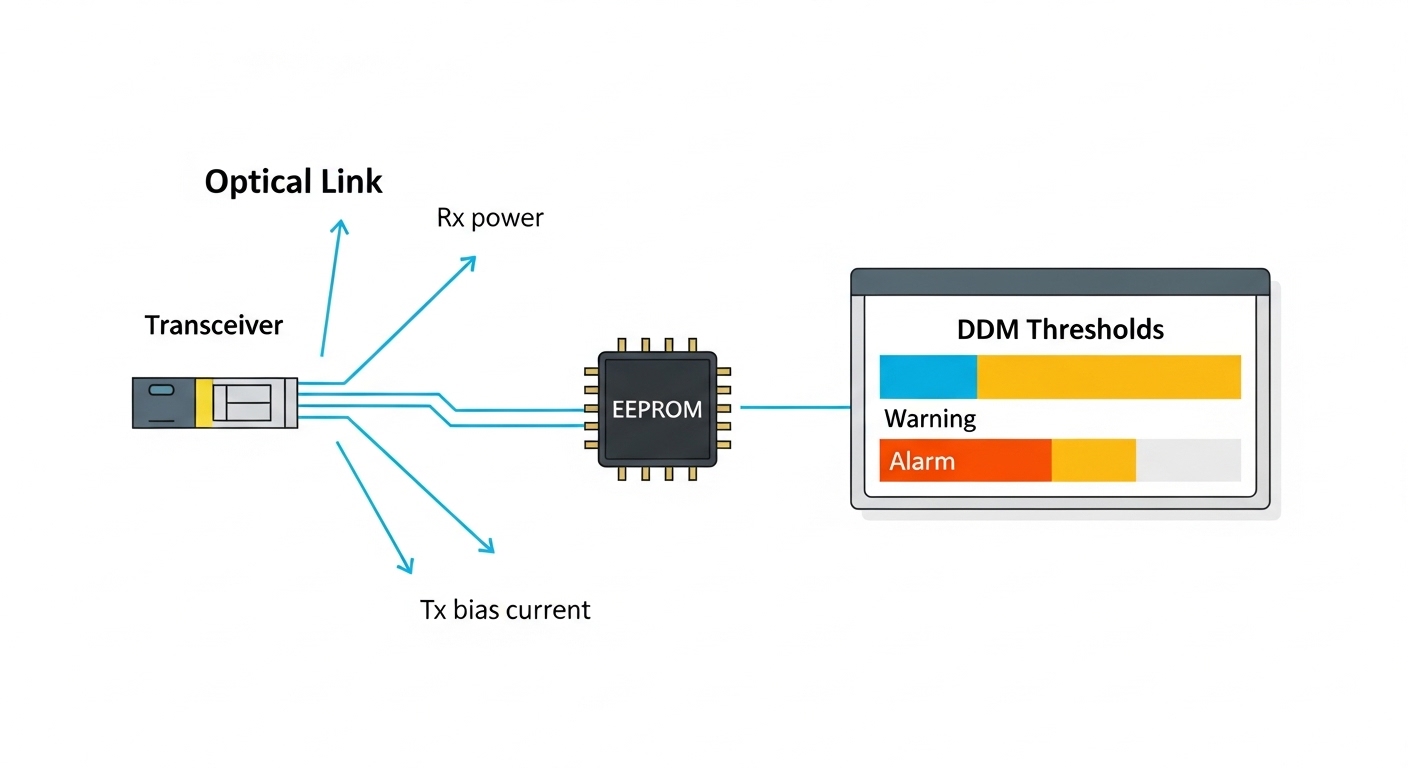
- DOM and monitoring: Ensure the switch can read DOM fields used by your telemetry/alarms; define thresholds for low power and high error rate.
- Operating temperature: Choose extended temperature SFPs for outdoor cabinets; verify that the module spec covers the cabinet’s measured worst-case conditions.
- Vibration and connector strategy: Prefer secure LC patching practices and strain relief; consider pre-terminated pigtails to reduce field handling.
- Vendor lock-in risk: OEM optics can be pricier; third-party optics may reduce capex but require a compatibility and burn-in plan.
Deployment scenario: 10G SFP+ for trackside telemetry and video
Consider a 3-tier railway data network: 48-port 10G ToR switches at a wayside aggregation site, uplinked to a regional aggregation router over single-mode fiber. Each cabinet group uses two redundant 10G SFP+ links to a nearby cabinet, with spans of 4 to 7 km on OS2. Engineers deploy 1310 nm SFP+ LR-class optics with LC connectors, then configure switch port monitoring using DOM alarms to trigger maintenance when receive power drops below a threshold.
During commissioning, field teams run certified fiber tests and record link budgets per circuit. In the first year, the most frequent corrective action is not optic failure but connector rework after planned civil works disturbed patch panels. With pre-defined spares and standardized cleaning kits, mean time to repair drops from days to hours because technicians can swap SFPs confidently and verify link health quickly.
Common mistakes and troubleshooting tips in the field
Even with correct part numbers, trackside conditions create predictable failure modes. Below are common mistakes, their root causes, and concrete fixes.
- Mistake: Wrong fiber type assumption (OM3 vs OS2)
Root cause: Using an 850 nm SR SFP on single-mode fiber, or mixing cabling standards during cabinet refurbishment.
Solution: Verify cable jacket markings and test with a light source or certified OTDR; label circuits by fiber type at both ends. - Mistake: Over-aggressive reach budgeting
Root cause: Ignoring connector count, splice loss, and patch-panel conversions; failing to include a margin for aging and temperature-related power drift.
Solution: Recalculate budget using worst-case Tx power and Rx sensitivity from the datasheet, then add margin (commonly several dB) based on field test results. - Mistake: DOM alarm thresholds left at defaults
Root cause: Defaults may be too sensitive or not aligned to your link budget, causing nuisance tickets or missed degradations.
Solution: Set thresholds based on initial commissioning measurements; integrate alerts into your maintenance workflow. - Mistake: Connector contamination after SFP swap
Root cause: Touching ferrules or using the same cleaning workflow inconsistently across crews.
Solution: Standardize inspection-and-clean procedures; keep caps, fiber scopes, and cleaning consumables at each maintenance depot.
Cost and ROI note: OEM vs third-party optics for trackside
In practice, OEM SFPs are often priced higher than third-party compatible modules. Typical street prices can range from roughly $60 to $200 per SFP depending on data rate, reach class, and temperature rating, while third-party modules may be materially lower but require a compatibility validation plan. TCO should include spares inventory, failure rate history, time-to-repair, and labor cost for cleaning and re-testing.
If your network relies on rapid restoration during service windows, the ROI often favors optics with strong documentation, consistent DOM behavior, and predictable performance under temperature cycling. Build a small acceptance test batch: run link error checks, verify DOM telemetry stability, and perform a burn-in schedule before scaling procurement.
FAQ
What wavelength should I choose for railway fiber optic trackside links?
For short cabinet-to-cabinet runs on multimode, 850 nm SR-class optics are common. For longer spans or when you want more stable reach, 1310 nm single-mode optics are typically preferred, assuming your OS2 link budget supports it.
