
Private 5G campus networks live or die by deterministic transport: low-latency fiber paths, stable optical power, and transceivers that behave predictably across temperature swings. This article helps network and RF engineers select private 5G fiber optic transceivers (SFP/SFP+/QSFP and optical media) for a campus rollout that connects baseband units, CU/DU sites, and edge compute. You will get practical selection criteria, a spec comparison table, and troubleshooting patterns seen in field installs.
Why fiber transceivers are the hidden reliability layer in private 5G
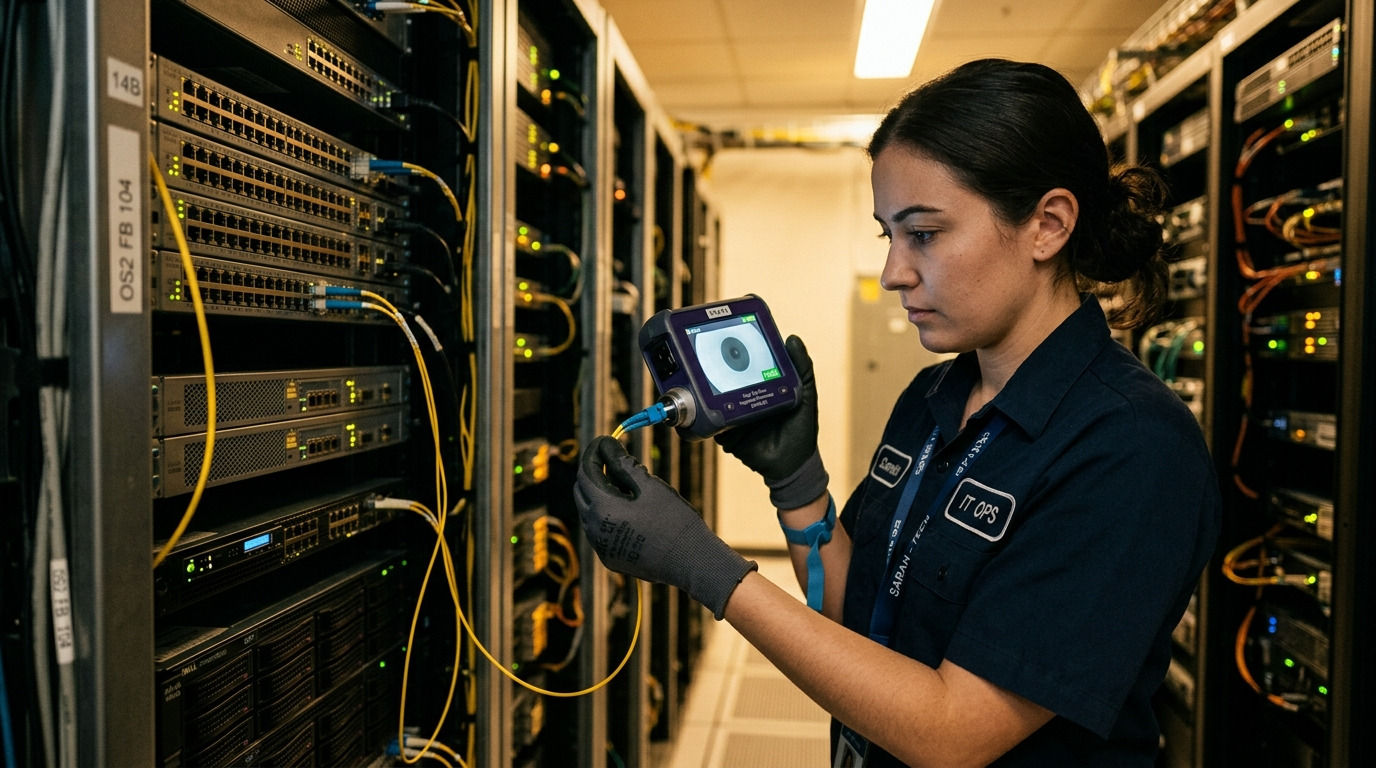
In a private 5G campus, the radio equipment typically terminates into transport gear such as O-RAN fronthaul/midhaul switches, aggregation routers, and edge compute. The transceiver layer controls optical budget, link margin, and interoperability with switch PHYs. If you underestimate module temperature range, DOM behavior, or connector cleanliness, you may see intermittent packet loss that is misattributed to RF interference. Standardization matters: Ethernet transport generally follows IEEE 802.3 link-layer behavior and vendor implementations of digital diagnostics.
For engineers, the goal is to keep the optical link within the vendor’s specified operating envelope while maintaining enough margin for aging and dust. In practice, that means selecting the correct wavelength band (850 nm for short reach MMF, 1310/1550 nm for longer reach SMF), verifying reach against your fiber plant, and validating DOM readings (Tx power, Rx power, bias current) against known-good thresholds.
Transceiver spec map for campus links: MMF vs SMF and reach targets
Most campus deployments start with a leaf-spine or collapsed core topology for aggregation, with ToR switches at wiring closets and edge nodes near the radio sites. Common link distances range from 30 m to 500 m for MMF runs in buildings, and 500 m to 10 km for SMF between buildings or across industrial sites. Your transceiver choice should be driven by measured fiber loss (not just labeling) and by the optical budget of the module and switch.
| Spec | 10G SR (MMF, 850 nm) | 10G LR (SMF, 1310 nm) | 25G SR (MMF, 850 nm) |
|---|---|---|---|
| Typical data rate | 10.3125 Gbps (10G Ethernet) | 10.3125 Gbps (10G Ethernet) | 25.781 Gbps (25G Ethernet) |
| Wavelength | 850 nm | 1310 nm | 850 nm |
| Connector | LC duplex | LC duplex | LC duplex |
| Fiber type | OM3/OM4 multimode | OS2 single-mode | OM3/OM4 multimode |
| Vendor reach (typical) | 300 m (OM3) / 400 m (OM4) | 10 km | 100 m (OM3) / 150 m (OM4) |
| DOM support | Yes (Tx power, Rx power, bias current) | Yes | Yes |
| Operating temperature (typical) | 0 to 70 C (some variants extend) | -40 to 85 C (many enterprise-grade) | 0 to 70 C or extended options |
Concrete examples engineers reference include Cisco SFP-10G-SR, Finisar/LSI optical modules such as FTLX8571D3BCL, and FS.com-style equivalents like SFP-10GSR-85 (verify exact part number and reach spec before purchase). For longer campus spans, LR variants at 1310 nm on OS2 fiber are common, while SMF 1550 nm modules may be justified for higher loss plants or when you need deeper margin for bad splices.
Selection criteria checklist for private 5G fiber optic modules
Use this ordered checklist during procurement and during pre-commissioning validation. It prevents the most expensive failure mode: buying the right “spec” but the wrong behavior for your switch and environment.
- Distance and measured loss: Base it on OTDR or certified link loss in dB at the correct wavelength, then apply connector and splice penalties.
- Budget and optics margin: Ensure Rx power stays within the module’s specified sensitivity range with at least a few dB of headroom for aging and cleaning variance.
- Switch compatibility: Validate against your switch model’s optics matrix (vendor interoperability lists). Some platforms enforce vendor-specific EEPROM checks.
- DOM support and thresholds: Confirm the transceiver exposes Tx/Rx power, temperature, and bias current via digital diagnostics; set alert thresholds for early drift detection.
- Operating temperature and airflow: Campus cabinets can exceed 50 C near power equipment; choose extended-temperature variants when needed.
- Connector ecosystem: Standardize on LC duplex, and mandate shuttered dust caps plus cleaning tools. Mixed polarity and contaminated connectors cause “ghost” outages.
- Vendor lock-in risk: OEM modules may be cheaper in downtime terms, but third-party can reduce capex if you test DOM behavior and link stability first.
Pro Tip: In private 5G rollouts, treat DOM readings as an acceptance test. If Tx bias current or Rx power is already near the module’s comfort zone during commissioning, you will often see link flaps after a few hot-cold cycles, even when the link “still works” on day one.
Common mistakes and troubleshooting patterns in campus installs
Mistake 1: Overestimating MMF reach from transceiver marketing specs. Root cause: marketing reach assumes ideal OM3/OM4 characteristics and controlled connector/splice counts. Solution: use certified link loss numbers and confirm the fiber is truly OM4 if you plan 150 m-class SR operation; otherwise drop to shorter runs or use SMF.
Mistake 2: Ignoring DOM and alerting configuration. Root cause: the module may report Rx power but your monitoring system does not alert on drift, so outages appear as “sporadic packet loss.” Solution: baseline Tx power, Rx power, and temperature at commissioning, then set thresholds and collect time-series during heat events.
Mistake 3: Connector contamination and polarity errors. Root cause: dust on LC faces or swapped Tx/Rx polarity can create intermittent loss that resembles RF problems. Solution: enforce cleaning SOPs (lint-free wipes plus proper cleaner), verify polarity with a polarity tester, and document patch cord mapping.
Mistake 4: Thermal mismatch in cabinets. Root cause: a transceiver rated for 0 to 70 C is installed near high-wattage line cards with poor airflow. Solution: measure actual cabinet temperature profiles; if you exceed safe margins, switch to extended-temperature modules or improve airflow/blanking.
Cost and ROI reality: OEM vs third-party optics for private 5G
In 2025-era enterprise pricing, 10G SR optics often land in the tens of dollars per module (commonly low-to-mid range depending on brand and temperature grade), while 10G LR on SMF is typically higher, and 25G modules generally cost more than 10G for the same reach class. OEM modules can carry premium pricing but may reduce incompatibility risk and shorten troubleshooting time. Third-party modules can be cost-effective when you perform compatibility testing with your exact switch models and validate DOM telemetry.
For ROI, include not only module unit price but also labor and downtime cost. A single campus radio link flap can trigger maintenance windows, truck rolls, and RF desk time. In practice, field teams report that the cheapest module is the one that stays within spec under cabinet thermals and connector conditions; therefore, spending on certified fiber cleaning tools, OTDR verification, and DOM-based monitoring often yields a better TCO than chasing marginal optics cost differences.
Deployment example: private 5G campus with fiber to edge compute
Consider a 3-tier campus in which two buildings each host radio units, and an edge compute room aggregates baseband traffic. Each building has 48-port 10G ToR switches feeding 10G uplinks to a central aggregation switch, with 120 m average intra-building distances from closets to radio termination points. The design uses OM4 MMF for SR links (850 nm) at 10G SR for the 120 m runs, and OS2 SMF for inter-building uplinks at 10G LR across 3.5 km with certified end-to-end loss under 6 dB. During commissioning, the team records DOM Tx/Rx power at 22 C cabinet temperature, then re-checks after a 2-hour thermal soak; any module drifting toward low Rx power thresholds is swapped before cutover.
FAQ
What transceiver types are most common for private 5G fiber optic links inside buildings?
Most engineers start with 10G SR or 25G SR at 850 nm over OM3/OM4 multimode fiber using LC duplex connectors. This typically covers distances from tens to a few hundred meters, depending on your fiber plant and certified loss.
When should we switch from MMF to SMF for a campus network?
Switch to SMF when run lengths exceed the practical OMF reach for your certified loss budget, when you need to traverse building-to-building spans, or when your plant has
