
If you are planning a 400G upgrade, you have probably hit the same wall: ports, optics, power budgets, and vendor support do not line up cleanly between module families. This article helps network and reliability teams compare OSFP vs QSFP-DD specifically for the 400G form factor decision, with deployment-oriented guidance, selection criteria, and troubleshooting. It is written for teams who need predictable reach, measurable thermals, and serviceable optics in production.
Prerequisites for a reliable OSFP vs QSFP-DD 400G rollout
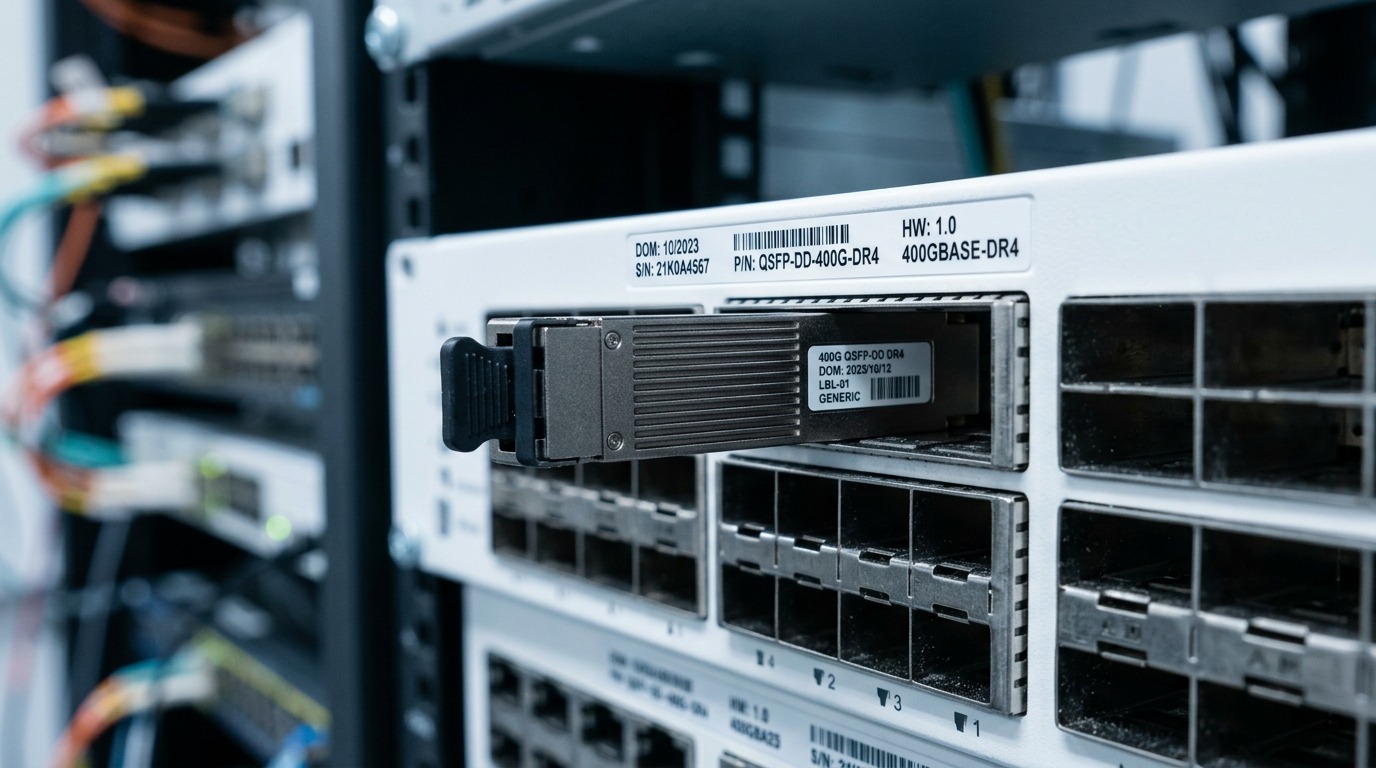
Before you order modules, treat the decision like an ISO 9001 change-control activity: define acceptance criteria, verify compatibility, and log evidence. In the field, I have seen “it should work” assumptions turn into weekend outages when DOM data formats or optics classes do not match what the switch expects. The goal here is to avoid that by setting up a repeatable validation plan.
What you need on hand
- Switch model and port speed: confirm the exact line card SKU and that it supports OSFP or QSFP-DD at 400G.
- Optics choice: determine whether you will use SR4, DR4, LR4, or CWDM4-style optics; ensure you can source matching part numbers.
- Power and airflow data: pull vendor power-per-port figures and your rack inlet temperature targets.
- Environmental limits: note the module operating temperature range and any derating guidance.
- Test plan: include link validation, thermal soak, DOM readout checks, and error-rate measurement.
Expected outcome: You can document compatibility, thermal headroom, and acceptance metrics before any module is installed.
Step-by-step implementation: validate the 400G form factor in your network
This section gives a practical, ordered approach that I have used when migrating leaf-spine fabrics from 100G to 400G. The key is to validate at three layers: optics compatibility (fiber and reach), electrical compatibility (port signaling), and operational compatibility (DOM, alarms, and telemetry).
Confirm switch support at the line-card level
Do not rely on “vendor says 400G supported” statements alone. Verify the exact module family is supported on your switch SKU and software release. For example, some platforms support both families but only on specific port groups, or they require a minimum firmware version for DOM parsing.
Expected outcome: A written compatibility matrix: switch line card SKU, port group, module family (OSFP or QSFP-DD), and required software version.
Choose optics that match the expected reach and fiber plant
For short-reach data centers, engineers often start with SR-class optics. For example, 400G SR4 typically uses four lanes (or lane groups) over multimode fiber; some vendors implement it as 400G using parallel optics inside the module. Your selection must match your fiber type, link budget, and MPO/MTP polarity handling.
Expected outcome: A confirmed optical plan: fiber type (OM4/OM3), connector style (MPO/MTP), expected reach, and polarity method.
Power and thermal verification during a controlled soak
Both OSFP and QSFP-DD modules can be thermally demanding, especially in high-density racks with front-to-back airflow. Validate with your actual airflow and measure inlet temperature and module case temperature if your platform exposes it. If your platform does not expose module temperature directly, use vendor-recommended airflow and verify that you remain within rated inlet conditions.
Expected outcome: Evidence that the 400G form factor will operate within vendor temperature limits under peak load.
DOM and alarm validation (field reliability step)
DOM information is critical for reliability workflows: optical power, bias current, temperature, and threshold alarms. In practice, I have found that some transceivers report different DOM field mappings or require specific transceiver types enabled in switch configuration. Confirm that your monitoring stack ingests the data correctly and that thresholds generate actionable alerts.
Expected outcome: DOM telemetry is readable and alarms trigger as expected in a controlled scenario.
Link quality verification using error-rate measurement
After optics and DOM are validated, confirm actual link health. Use your switch’s built-in counters and, if available, optical diagnostics. For reliability, check that you can achieve stable operation with no rising CRC/FEC errors over a monitoring window.
Expected outcome: Stable error-rate behavior and clean counter baselines for your acceptance record.
OSFP vs QSFP-DD for 400G: what changes in the module and why it matters
The core difference between OSFP and QSFP-DD is form factor and how the ecosystem organizes optics, power, and mechanical fit. That affects procurement flexibility, thermal performance, and operational tooling. In reliability terms, the goal is to ensure the module’s electrical characteristics and monitoring behavior are aligned with your switch.
Key spec comparison (practical engineering view)
Exact values vary by vendor and optic type, so treat this table as a selection framework rather than a promise. Always confirm with the specific vendor datasheet for the part number you plan to deploy.
| Parameter | OSFP (400G class) | QSFP-DD (400G class) |
|---|---|---|
| Target data rate | Up to 400G per module (varies by optic) | Up to 400G per module (varies by optic) |
| Typical optical styles | Commonly SR4/DR4/LR4 variants depending on vendor | Commonly SR4/DR4/LR4 variants depending on vendor |
| Operating temperature range | Often specified around 0 to 70 C or extended options (verify datasheet) | Often specified around 0 to 70 C or extended options (verify datasheet) |
| Power consumption | Varies by optic; plan for higher draw at 400G | Varies by optic; plan for higher draw at 400G |
| Connector and mechanical fit | Large footprint; platform-specific cage design | Smaller footprint; platform-specific cage design |
| DOM and telemetry | Vendor-specific DOM fields; verify switch ingestion | Vendor-specific DOM fields; verify switch ingestion |
| Compatibility caveat | Must match switch supported module family | Must match switch supported module family |
Source notes: Reach and temperature are controlled by the specific transceiver optic family and vendor datasheets. For Ethernet signaling and general PMA/PCS behavior, consult IEEE 802.3 for 400G-related PHY guidance, and vendor documentation for module specifics. [Source: IEEE 802.3] [Source: vendor transceiver datasheets]
Pro Tip: In many production environments, the “real” differentiator between OSFP and QSFP-DD is not raw reach but monitoring reliability. If your switch software release has partial support for DOM field mappings, you can see delayed threshold alarms or missing optical power readings, which then undermines your mean time to detect. Validate DOM ingestion during commissioning, not after the first incident.
Selection checklist: how engineers choose the 400G form factor
When teams choose between OSFP and QSFP-DD, the decision is usually constrained by what the switch platform truly supports, plus thermals and optics availability. Use this ordered checklist to keep the decision evidence-based.
- Distance and optics type: pick SR/DR/LR based on actual link length and fiber type; confirm MPO/MTP polarity strategy.
- Switch compatibility: confirm the exact module family is supported on the port group and software version.
- Optics ecosystem and lead times: confirm you can source the exact part numbers for your chosen reach and wavelength.
- DOM support and telemetry tooling: verify your monitoring system can read the DOM fields and triggers thresholds.
- Operating temperature and derating: ensure your rack inlet stays within vendor limits, especially during high utilization.
- Power budget and airflow: sum worst-case module power across the line card and rack; verify PSU and cooling headroom.
- Vendor lock-in risk: assess whether third-party optics are supported; check for compatibility matrices and firmware requirements.
- Reliability data: look for vendor MTBF claims carefully; prefer documented field performance and warranty terms.
Expected outcome: A decision record that ties module family choice to measurable constraints, not preference.
Real-world deployment scenario: 400G leaf-spine with mixed optics
In a 3-tier data center leaf-spine topology with 48-port 10G ToR switches upgraded to 400G spine uplinks, the team planned a phased migration across 12 spine switches and 96 leaf uplink ports. They used OSFP on the spines where the line card explicitly supported it, while one leaf model required QSFP-DD cages for 400G. For optics, they standardized on SR4 for short runs (about 80 to 120 meters depending on patching) over OM4 with MPO trunks, and they reserved LR4 for longer cross-aisle paths.
During commissioning, they ran a 4-hour thermal soak at elevated inlet temperatures and validated DOM telemetry ingestion into their monitoring stack. The reliability win was that DOM-based optical power thresholds produced early warnings during a single optics aging event, preventing silent degradation from becoming a hard outage. The lesson: the 400G form factor choice was less about “OSFP vs QSFP-DD” and more about how reliably your tooling sees and reacts to DOM data.
Common mistakes and troubleshooting for 400G module issues
Below are the top failure modes I see when teams deploy a new 400G form factor under schedule pressure. Each includes a root cause and a practical fix.
Failure point 1: Port comes up flapping or stays down
Root cause: Switch does not actually support the module family on that port group, or the software release lacks required transceiver support.
Solution: Verify the line card SKU and port group in the vendor compatibility guide; upgrade switch firmware to the minimum supported revision; reseat the module and confirm the cage type matches OSFP or QSFP-DD.
Failure point 2: DOM telemetry missing or alarms not triggering
Root cause: DOM field mapping differences, missing transceiver type enablement, or monitoring collector not updated for the DOM schema.
Solution: Confirm DOM readout via the switch CLI and compare expected fields; update your telemetry ingestion rules; set threshold alarms using the vendor-recommended parameters for that module family.
Failure point 3: High error counters during traffic despite “link up”
Root cause: Fiber polarity mismatch, dirty MPO endfaces, marginal optical power, or using an optics type that does not match the actual reach class.
Solution: Clean MPO/MTP connectors with proper inspection and cleaning tools; verify polarity and patching; check optical power levels from DOM; replace optics with the correct reach grade and confirm lane-level stability if your platform reports it.
Cost and ROI note: budgeting OSFP vs QSFP-DD for 400G
In typical enterprise and mid-market procurement, 400G transceivers often range from roughly USD 300 to USD 1,200 depending on reach and whether you buy OEM or third-party. OEM modules can cost more but may reduce commissioning time, because switch vendors often validate DOM behavior and compatibility more explicitly. For TCO, include the cost of spares, commissioning labor, and the reliability risk of mismatched optics or telemetry gaps.
From a reliability engineering perspective, ROI is strongest when module choice reduces rework during rollouts and improves MTTR through better DOM visibility. If your monitoring stack is already tuned for one module ecosystem, selecting that family can reduce operational overhead even if the unit price is slightly higher.
FAQ
What is the main difference between OSFP and QSFP-DD for the 400G form factor?
The primary difference is mechanical and ecosystem support: each module family is designed for specific switch cage and platform support. Optics reach and lane behavior depend on the optic type and vendor datasheet, so you must validate compatibility on your exact switch line card and software version.
Can I mix OSFP and QSFP-DD modules in the same network fabric?
Yes, you can mix them across different switch ports as long as each switch port supports the corresponding module family. Mixing within a single switch model is only safe when the platform documentation confirms both families are supported on the relevant port groups.
How do I verify DOM support before production?
During commissioning, confirm DOM fields are readable via switch CLI and that your monitoring collector ingests them correctly. Also validate that threshold alarms generate events in your ticketing or alerting system during a controlled test window.
Which 400G form factor is better for thermal reliability in dense racks?
Neither is universally better; thermal behavior depends on module power and your rack airflow. The practical approach is to run a thermal soak in your actual environment and ensure the module stays within the vendor operating range at your measured inlet temperatures.
Are third-party 400G modules safe for OSFP or QSFP-DD?
They can be safe, but only if the vendor provides compatibility guidance for your switch model and software release. For reliability, verify DOM behavior, error counters under load, and warranty terms before scaling beyond a pilot.
What standards should I reference for 400G Ethernet behavior?
For Ethernet PHY and related behavior, consult IEEE 802.3. For module-level details such as optics and DOM expectations, rely on the specific vendor datasheets and your switch vendor’s transceiver compatibility guides. [Source: IEEE 802.3] [Source: vendor transceiver datasheets]
If you want a fast path to confidence, start with the checklist above, run a commissioning soak, and document acceptance criteria for OSFP vs QSFP-DD in your 400G form factor plan. Next, review How to choose 400G optics by reach and fiber type to lock down SR4 vs DR4 vs LR4 decisions for your fiber plant.
Author bio: I am a reliability and QA engineer who has commissioned high-density 100G to 400G Ethernet deployments, focusing on thermal validation, DOM telemetry accuracy, and error-rate acceptance testing.
Author bio: I write from field experience using vendor datasheets, IEEE-aligned PHY expectations, and ISO
