
In many enterprise and metro networks, you quickly hit fiber-count limits even after upgrading switches. This article helps network engineers and field technicians decide between CWDM and DWDM SFP+ optics for wavelength division multiplexing, with practical reach, power, and compatibility details. You will also get a troubleshooting playbook for the most common optical faults that show up during commissioning.
Why wavelength division multiplexing matters for SFP+ links
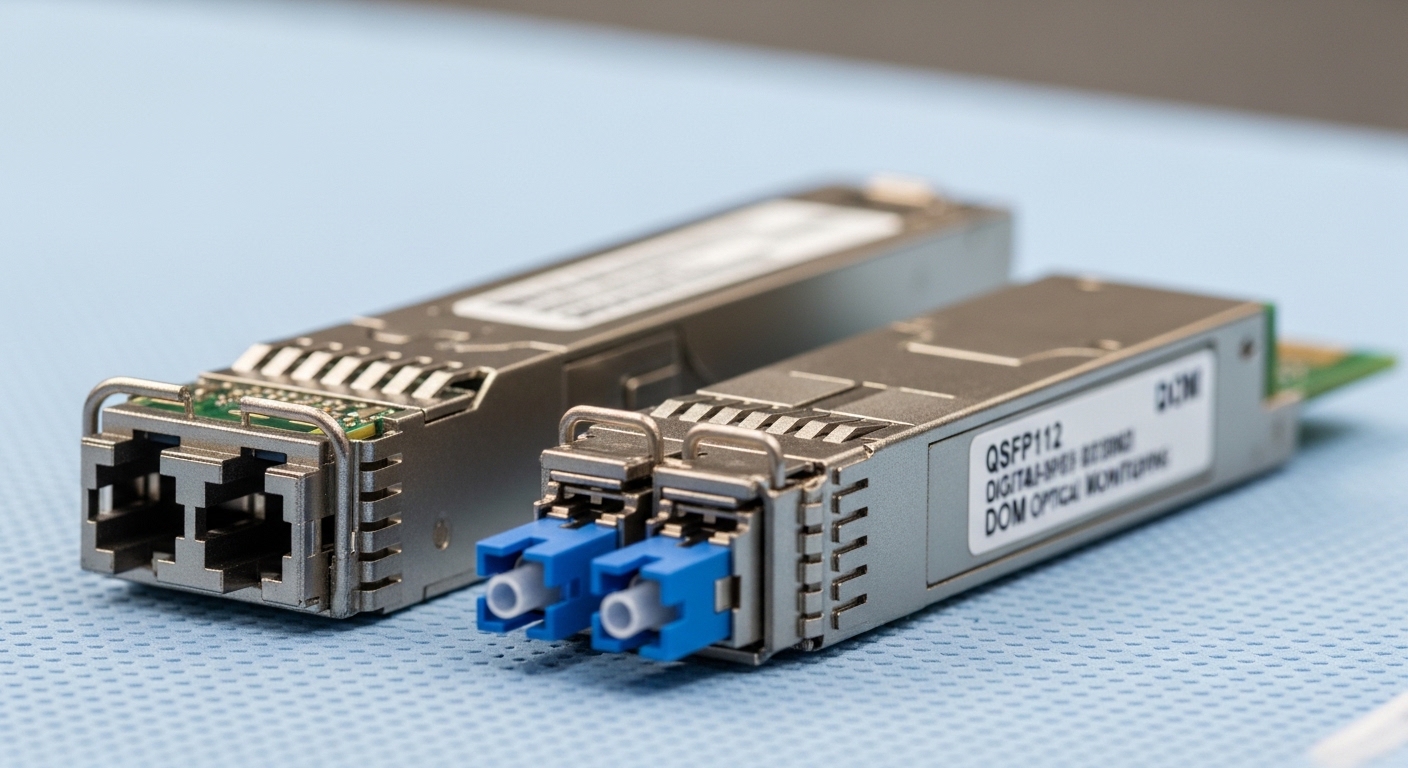
Wavelength division multiplexing (WDM) lets you carry multiple independent optical signals across the same fiber by assigning different wavelengths (colors) to different channels. For SFP+ deployments, the key idea is that the transceiver still presents a single electrical interface (for example, 10GBASE-SR/LR style optics), but the optics and filtering inside the module (or in the mux/demux network gear) determine how the wavelength is selected. In practice, WDM is often used when you need to expand capacity between sites without trenching new fiber.
CWDM and DWDM are two common WDM families. CWDM uses wider channel spacing (fewer channels over a given band), which typically reduces cost and complexity. DWDM uses narrower channel spacing (more channels), enabling much higher aggregate capacity on the same fiber, but it demands tighter optical performance and more careful wavelength planning.
Standards and what to verify
On the Ethernet side, SFP+ optics are commonly aligned to IEEE 802.3 link behavior (for example, 10GBASE-LR and 10GBASE-ER style electrical-to-optical requirements). On the optics and fiber/WDM side, you should verify vendor datasheets for wavelength grids, channel spacing, and optical budgets. For general fiber cabling and optical link loss practices, ANSI/TIA-568 and related cabling guidance are often referenced in engineering packages.
When you design with WDM, also confirm how the network uses multiplexing: either inside an optical module family with integrated filtering, or via external mux/demux components. The “right” architecture depends on whether you are building a point-to-point wavelength plan or a multi-channel hub-and-spoke layout.
Pro Tip: During commissioning, always measure optical receive power at the demarcation point using a calibrated power meter and confirm the channel wavelength with a spectrum analyzer. Even when a transceiver “works,” being off-channel by a small amount can increase adjacent-channel interference and cause intermittent CRC errors under temperature swings.
CWDM vs DWDM SFP+ optics: key differences that affect real installs
For wavelength division multiplexing with SFP+ transceivers, the decision between CWDM and DWDM is primarily about channel spacing, number of wavelengths you can carry, and the tightness of optical tolerances required for stable operation. CWDM SFP+ optics are often deployed when you need a handful of wavelengths between sites and want to keep BOM and installation effort lower. DWDM SFP+ optics are chosen when you need many channels or future headroom, such as scaling from a few 10G links to dozens.
Typical wavelength bands, channel spacing, and reach
Channel spacing drives the grid: CWDM typically uses broader spacing (often 20 nm class grids), while DWDM often uses 100 GHz or 50 GHz class grids. Because the channel spacing is tighter in DWDM, the optics and any mux/demux devices must maintain tighter wavelength accuracy and filter selectivity. Reach depends on the transmitter power, receiver sensitivity, link loss budget (fiber attenuation plus connector/splice losses), and whether you are using dispersion compensation or advanced forward error correction.
| Spec Category | CWDM SFP+ (typical) | DWDM SFP+ (typical) |
|---|---|---|
| Wavelength grid | Wider spacing (often ~20 nm class) | Narrow spacing (often 100 GHz or 50 GHz class) |
| Number of channels on one fiber | Fewer wavelengths per band | Many more wavelengths per band |
| Common use case | Small channel count, metro/enterprise expansions | High-capacity aggregation, scalable metro rings |
| Typical reach classes | Often designed for metro distances; exact reach varies by model | Often designed for longer reach; exact reach varies by model |
| Optical tolerance sensitivity | More tolerant to wavelength drift | More sensitive to wavelength accuracy and filter alignment |
| Connector type | Usually LC | Usually LC |
| Operating temperature | Verify vendor grade (commercial vs industrial) | Verify vendor grade; tight specs matter more in DWDM |
| Power and budget | Lower aggregate complexity; still needs end-to-end budget | Requires careful budget for many channels and mux losses |
Note: The table summarizes typical behavior. Actual CWDM/DWDM SFP+ models vary widely by vendor and by wavelength plan. Always start from the specific transceiver datasheet and the mux/demux insertion loss values from the optical component vendor.
Concrete examples of vendor part types to sanity-check
In real deployments, teams frequently compare like-for-like models: for CWDM, you might see 10G CWDM SFP+ parts offered at specific wavelengths (for example, a family such as FS.com CWDM-10G-SFP+ with defined wavelength options). For DWDM, you might compare a 10G DWDM SFP+ with a specific ITU grid frequency (for example, modules sold under ITU channel numbers with tight tolerances). If you need vendor-neutral planning, verify compatibility with your mux/demux filter set and ensure the module wavelength matches the grid.
When you do cross-vendor comparisons, also check DOM (digital optical monitoring) support. Many enterprise transceivers expose temperature, laser bias current, and received optical power via I2C diagnostics, but the exact mapping and alarm thresholds can differ.
Selection criteria checklist: CWDM or DWDM for your wavelength plan
To choose the right wavelength division multiplexing approach with SFP+ optics, engineers should treat it like an end-to-end optical design problem, not just a “which transceiver is cheaper” question. The checklist below reflects what field teams and optical planners evaluate during BOM and acceptance testing.
- Distance and end-to-end loss budget: Compute fiber attenuation, connector loss, and splice loss. Include mux/demux insertion loss and any patch panel losses. Validate against the transceiver’s specified optical power and receiver sensitivity.
- Channel count and growth timeline: If you need 2 to 8 wavelengths soon, CWDM is often simpler. If you expect 16+ channels or want long-term scaling, DWDM is usually the better structural choice.
- Switch and optics compatibility: Confirm the switch vendor’s transceiver compatibility guidance (some platforms enforce stricter optics behavior). Verify DOM support and whether your monitoring system reads it correctly.
- Wavelength grid and mux/demux filter match: For DWDM, ensure the module is on the correct ITU channel/frequency grid and the mux/demux supports that exact grid. For CWDM, confirm the channel wavelength plan matches the CWDM mux/demux.
- Operating temperature grade: For outdoor runs or unconditioned IDFs, prefer industrial temperature grades and confirm power stability across the full range.
- DOM and maintenance workflow: Check which diagnostics are available (Tx power, Rx power, temperature, laser bias). Confirm alarm thresholds and whether they align with your NOC tooling.
- Vendor lock-in and spares strategy: Evaluate whether you can mix modules from multiple vendors on the same wavelength plan. If not, plan spares procurement and lifecycle replacement.
- Installation and test equipment: DWDM commissioning often benefits from spectrum analysis and stricter acceptance criteria. Make sure your team can measure and document results.
Decision shortcut for many teams
If your requirement is “few channels now, minimal complexity, and we want predictable integration,” CWDM is often the pragmatic start. If your requirement is “many channels and future expansion without adding fibers,” DWDM usually wins despite the higher planning and test discipline.
Pro Tip: In DWDM deployments, don’t assume that “same wavelength number” across vendors means identical optical filtering behavior. Even if the nominal wavelength matches, differences in laser line width and side-mode suppression can affect adjacent channel crosstalk, especially when channels are densely packed.
Real-world deployment: CWDM vs DWDM in a metro aggregation design
Consider a metro environment with a leaf-spine-like aggregation pattern at the edge: 48-port 10G ToR switches in multiple buildings connect to a central aggregation suite. You have one existing fiber pair between two sites, with about 12 dB measured end-to-end loss after accounting for patch panels and measured splices. The team needs to carry six 10G links today and expects to add up to sixteen links over the next 18 months.
In this scenario, CWDM SFP+ optics can be deployed with a mux/demux that supports the required six wavelengths. The acceptance tests are simpler: engineers validate each channel’s Tx and Rx power with standard optical power meters and confirm link layer error rates stay within tolerance. However, when the plan expands beyond the initial channel set, you either need a larger CWDM plan (if available) or a migration strategy that may require re-terminating mux/demux components.
With DWDM SFP+ optics, the same fiber can support a denser channel map, enabling sixteen or more 10G channels without adding fiber. The trade-off is that the optical budget must include mux/demux insertion loss for many channels, and commissioning requires tighter wavelength alignment. Field teams often document spectrum snapshots and per-channel power readings so they can correlate future issues to channel drift or patching errors.
Common mistakes and troubleshooting tips for SFP+ WDM links
Even when the transceiver is correct, WDM failures often come from installation details, budget math, or wavelength plan mismatches. Below are frequent pitfalls with root causes and actionable fixes.
Channel wavelength mismatch between module and mux/demux
Root cause: The transceiver is installed with a nominal wavelength that does not match the mux/demux filter channel assignment (common during manual labeling or when spares are mixed). DWDM is particularly sensitive because narrow spacing reduces margin for adjacent channel interference.
Solution: Verify the module’s wavelength or ITU channel from the vendor label and confirm the mux/demux port mapping. Use a spectrum analyzer or at minimum a wavelength-capable optical test method to confirm center wavelength. Update your rack labeling to include wavelength grid information, not just “port A/B.”
Incomplete optical budget: ignoring mux/demux insertion loss and aging effects
Root cause: Engineers compute budget using only fiber attenuation and connector/splice loss, then forget mux/demux insertion loss, patch cord loss, and worst-case temperature drift. In DWDM, additional penalties can appear due to tighter filtering.
Solution: Recalculate budget using vendor-specified insertion loss and include a margin (commonly several dB) for aging and re-termination. During troubleshooting, measure Rx optical power at the receiver end for each channel and compare to the transceiver sensitivity curve from the datasheet.
Bad patching: wrong fiber direction or swapped LC connectors
Root cause: WDM links can fail silently when transmit and receive fibers are swapped, or when fibers are cross-connected to the wrong channel pair in a patch panel. Because WDM uses multiple wavelengths on one fiber, the symptoms can look like intermittent link flaps or high error rates rather than a total outage.
Solution: Follow a deterministic patch procedure: label both ends of the jumpers, verify continuity, then verify optical power presence on the expected channel before finalizing. For each channel, document whether you see expected Tx power and expected Rx power after patching.
DOM alarm thresholds not integrated into monitoring
Root cause: The module supports DOM, but the monitoring system either does not poll the I2C registers correctly or ignores vendor-specific alarm thresholds. The NOC sees “link up” but misses early warnings like rising laser bias current or falling Tx output.
Solution: Validate DOM readouts on a staging switch. Confirm the monitoring pipeline maps DOM fields correctly and triggers alerts on vendor-defined thresholds. Store historical DOM trends per channel for faster root cause analysis.
Cost and ROI: what to budget for CWDM and DWDM SFP+
Pricing varies by reach class, wavelength grid, and whether the module is OEM-branded or third-party. As a realistic budgeting order of magnitude, many teams see OEM CWDM SFP+ modules priced roughly in the range of $80 to $250 per module, while DWDM SFP+ modules often cost more, commonly around $200 to $600+ per module depending on grid and test/qualification. Mux/demux components and any patch panel redesign can be the larger line item in DWDM projects.
TCO should include installation labor, test equipment time, and spare strategy. DWDM can reduce long-term fiber lease and trenching costs because you can pack more channels onto the same fiber. However, it can increase commissioning time due to stricter acceptance criteria and the need for spectrum validation. If you are operating at high utilization, the ROI often comes from avoiding new fiber buildouts and enabling planned capacity growth without large-scale physical changes.
Reliability is generally strong when optics match the wavelength plan and budgets are correct, but failure modes differ: CWDM issues often show as lower margin problems sooner, while DWDM issues can show as crosstalk-related errors when channel density is high or when patching mistakes occur.
FAQ on wavelength division multiplexing with CWDM and DWDM SFP+
What is the main difference between CWDM and DWDM for SFP+?
CWDM uses wider channel spacing, making it generally easier to integrate for small channel counts. DWDM uses tighter spacing to support many more channels, but it requires tighter wavelength accuracy and careful mux/demux matching.
Can I mix CWDM or DWDM transceivers from different vendors?
Sometimes yes, but you must validate wavelength plan compatibility and optical tolerance behavior. For DWDM, differences in laser line width and filtering can affect crosstalk, so testing on your exact mux/demux hardware is strongly recommended.
How do I confirm the optical budget before installing?
Use the transceiver datasheet for Tx power and Rx sensitivity, then add measured fiber attenuation plus connector and splice losses. Include mux/demux insertion loss and any patch cord losses; for DWDM, ensure you use worst-case values and add a margin.
Do I need a spectrum analyzer for wavelength division multiplexing?
For DWDM dense channel deployments, a spectrum analyzer is often the fastest way to confirm center wavelength and identify channel overlap issues. For simpler CWDM links, teams may rely on power meters plus link error rate checks, but wavelength verification still helps during acceptance.
What are the most common symptoms of a wrong wavelength plan?
You may see link flaps, high CRC or FEC-related errors, or intermittent performance that worsens with temperature changes. A full outage can also occur if the receiver sees too little power due to filter mismatch.
Where can I find authoritative optical and Ethernet requirements?
For Ethernet behavior, reference IEEE 802.3 for 10GBASE characteristics. For cabling practices and loss considerations, consult ANSI/TIA-568 and follow vendor datasheets for the specific transceiver and WDM components. IEEE Standards ANSI Standards Store
If you want your next upgrade to be predictable, start with a clear wavelength plan, build a complete optical budget, and validate compatibility at the switch and mux/demux layer. Next, compare your current transceiver reach and budget assumptions with a practical checklist in optical link budget for SFP+ to reduce commissioning surprises.
Author bio: I have deployed and commissioned 10G and 25G optics in metro and enterprise aggregation networks, including CWDM/DWDM channel planning and acceptance testing with DOM telemetry and optical test gear. I write from field experience to help teams avoid budget math gaps and wavelength-plan mistakes that cause intermittent errors.
