
When a fiber link stays “up” but traffic stalls, the root cause is often not optics performance, but transceiver management details. This article explains how the SFF-8472 standard supports IEEE 802.3 compliance by defining diagnostics, control signals, and safety-relevant behaviors that switch ports expect. It helps network engineers and field teams validate modules in lab burn-in and real deployments.
Why SFF-8472 standard matters for IEEE 802.3 compliance
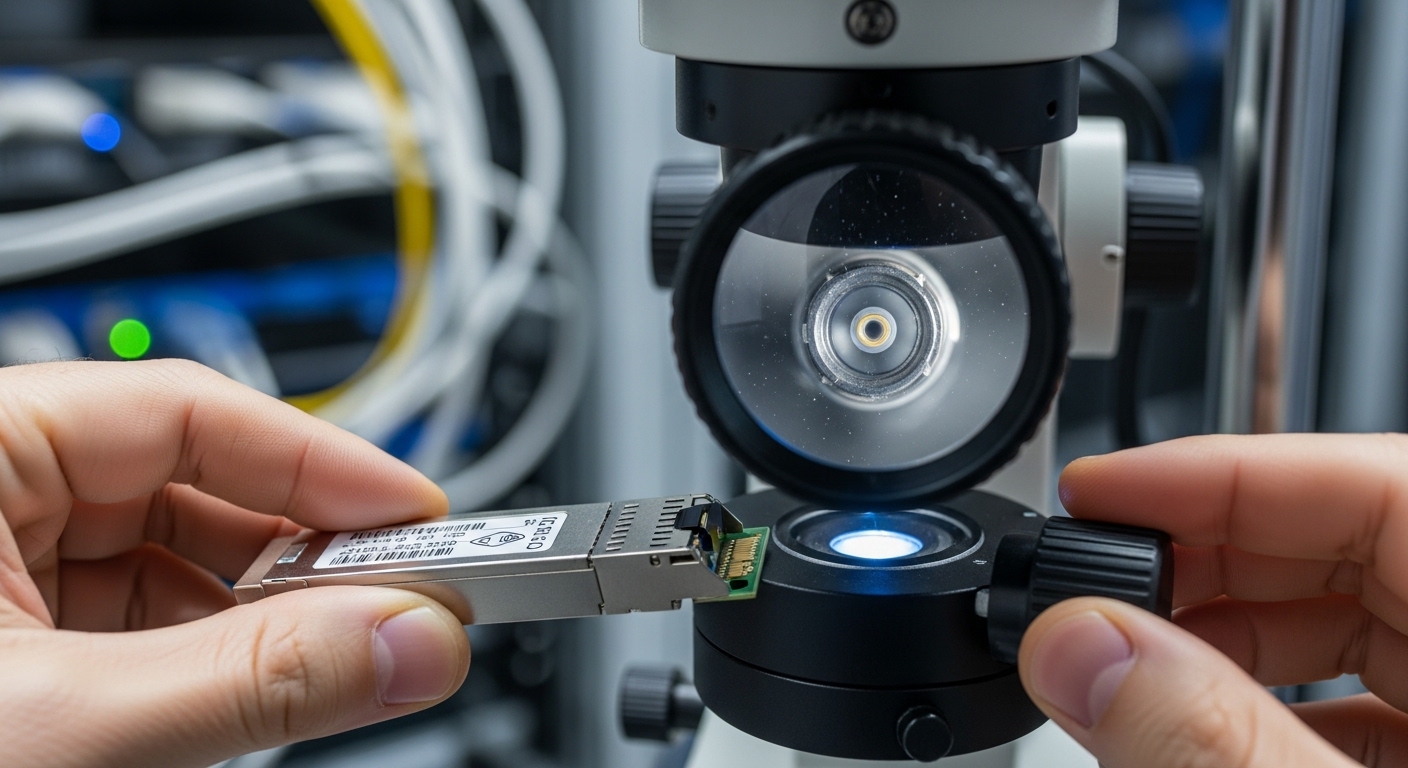
IEEE 802.3 governs Ethernet physical layers and link behavior, but many operational expectations live in the transceiver management plane. The SFF-8472 standard specifies how optical modules expose real-time diagnostics over the management interface so switches can make safe decisions (power, alarms, temperature, and link health). In practice, a switch that supports DOM (Digital Optical Monitoring) will query thresholds and receive calibrated readings; if those readings are missing or nonconformant, automation may mis-handle the port.
From an engineer’s perspective, SFF-8472 compliance reduces “silent failure” modes: for example, it helps ensure the module reports TX/RX power, laser bias/current, and temperature using agreed scaling and alarm registers. Those signals also feed telemetry systems for proactive maintenance, which is critical in leaf-spine data centers and metro aggregation where transceivers are hot-swapped daily.
For authority, see the transceiver management expectations tied to optical modules and monitoring in IEEE 802.3, and the SFF diagnostic interface definitions in the SFF-8472 document set. [Source: IEEE 802.3 Ethernet Working Group] [Source: SFF-8472 standard documentation via SFF committee materials]
Key specifications engineers compare before deployment
Before ordering, verify the module’s DOM behavior and the physical interface mapping your switch expects. Many compatibility issues come from mixing vendor-specific interpretations of threshold values or from modules that advertise DOM but omit required register fields. The table below focuses on the elements that most directly affect SFF-8472 standard usage in IEEE 802.3 environments.
| Parameter | What to verify for SFF-8472 / IEEE 802.3 | Typical examples |
|---|---|---|
| Form factor | Matches switch cage (SFP, SFP+, QSFP, etc.); DOM interface is tied to module type | SFP (e.g., Cisco SFP-10G-SR), QSFP+ (varies) |
| Wavelength | Must align with the fiber plan and link budget for the target Ethernet PHY | 850 nm MMF, 1310/1550 nm SMF |
| Reach | Must meet IEEE 802.3 reach targets under worst-case fiber attenuation and connector loss | 300 m (850 nm MMF typical), 10 km (1310 nm SMF typical) |
| Data rate | PHY must match the port speed (e.g., 10GBASE-SR vs 10GBASE-LR) | 10G, 25G, 40G, 100G depending on module family |
| DOM / diagnostics | Presence and correctness of SFF-8472 diagnostics: temperature, laser bias/current, TX/RX power, alarms | DOM fields expected by common switches |
| Connector | Physical mating and fiber type must match (LC/SC/MPO) | LC for most 10G SR; MPO for higher-density multi-lane |
| Operating temperature | Switches may flag errors if module is out of range; check industrial vs commercial | Commercial commonly 0 to 70 C; extended options vary |
| Power / safety | Laser safety class and power reporting must be consistent with monitoring | Vendor datasheet and interface behavior |
Pro Tip: Field teams often focus on optical power alone, but the fastest way to isolate DOM-related issues is to compare the module’s reported alarm threshold registers against what the switch UI/CLI expects. If the switch never transitions from “warning” to “normal” after calibration, automation can keep throttling or logging false positives.
Real-world verification workflow in an enterprise leaf-spine
In a 3-tier data center leaf-spine topology with 48-port 10G ToR switches (each leaf uplinked to a pair of spines), I’ve seen DOM mismatches trigger excessive alerting during maintenance windows. The rollout plan worked like this: we staged LC 10GBASE-SR modules in a burn-in rack for 24 hours at 25 C ambient, then cross-checked telemetry against baseline modules installed in production. After swapping one module at a time, we validated that the port’s reported TX power and temperature stabilized within vendor tolerances and that alarm registers behaved normally.
Operationally, we used a switch CLI to confirm DOM presence, then compared readings to module datasheet expectations (laser bias/current and optical output). Where a third-party module reported DOM but showed abnormal scaling for TX power, the port still linked under IEEE 802.3, yet the monitoring system flagged “degraded optics,” creating unnecessary ticket volume. This is exactly where the SFF-8472 standard alignment becomes practical: it affects both link health and how automation trusts the module.
Selection criteria checklist for SFF-8472 standard compatibility
Use this ordered checklist before you commit to a procurement batch:
- Distance and fiber type: confirm MMF vs SMF, core diameter, and connector type (LC vs MPO).
- IEEE 802.3 PHY target: ensure the module is intended for the exact Ethernet variant your port supports (SR vs LR vs ER).
- Switch compatibility matrix: verify vendor support for DOM and transceiver management behavior.
- DOM support and SFF-8472 standard behavior: confirm it exposes expected diagnostics and alarm registers.
- DOM calibration and scaling: in lab tests, compare TX/RX power and temperature stability against known-good modules.
- Operating temperature range: choose industrial/extended options if your racks run near upper limits.
- Vendor lock-in risk: evaluate whether monitoring thresholds and telemetry tooling assume a particular vendor’s interpretation.
Common mistakes and troubleshooting tips
These are recurring failure modes I’ve investigated in the field, with root causes and fixes:
- Mistake: Link comes up but monitoring shows constant “low power” warnings. Root cause is often DOM scaling differences or threshold register interpretation. Solution: compare DOM telemetry fields and alarm thresholds; test the module in a known-good port profile before broad rollout.
- Mistake: Frequent alarms after hot-swap during maintenance. Root cause can be transient thermal stabilization or reseating that marginally increases connector loss. Solution: allow stabilization time, inspect fiber cleanliness, and verify connector insertion depth and ferrule condition.
- Mistake: “Incompatible module” messages despite correct form factor. Root cause is typically EEPROM ID mismatch, unsupported DOM features, or switch firmware expecting specific diagnostic fields. Solution: update switch firmware, verify module EEPROM layout support, and use the switch vendor’s compatibility list.
- Mistake: Works on one switch but fails on another. Root cause is differing port optics parameters and management expectations across platforms. Solution: validate on the exact target platform model and firmware revision, not just a similar chassis.
Cost, TCO, and ROI: what usually drives the number
In typical enterprise buying, OEM modules commonly cost more upfront than third-party options. As a practical range, many 10G SR optics land roughly in the $50 to $150 per module band depending on brand, while higher-speed variants can be substantially higher. The ROI often comes from reduced downtime and fewer support tickets: DOM-aligned modules reduce monitoring noise, which lowers operational labor. However, third-party modules can carry higher risk of DOM/threshold mismatches, which increases validation time and may raise failure probability if quality control is inconsistent.
When calculating TCO, include: switch firmware upgrade effort, lab time for telemetry validation, expected failure rate over the warranty period, and the cost of incident response when alarms are noisy or misleading. For reference on interoperability and PHY expectations, consult IEEE 802.3 materials and vendor datasheets. [Source: IEEE 802.3 Ethernet Working Group] [Source: Cisco transceiver datasheets] [Source: Finisar and other vendor DOM datasheets]
FAQ
Q1: Does the SFF-8472 standard affect whether the link comes up under IEEE 802.3?
Not usually for basic link establishment, but it can affect monitoring, alarm thresholds, and automation workflows. A port may link successfully while telemetry-based systems still treat the optics as degraded if diagnostics are inconsistent.
Q2: What DOM signals should I verify during acceptance testing?
Verify temperature, laser bias/current, TX power, RX power, and the presence of alarm registers and threshold behavior. Compare stability after insertion and validate scaling against a known-good baseline module.
Q3: Can third-party transceivers be SFF-8472 standard compliant?
They can be, but compliance is not guaranteed across every vendor and every product revision. Always validate on the target switch model and firmware, because the management interface behavior is what your platform will interpret.
Q4: Why do I see “warnings” but no actual traffic loss?
Warnings can be driven by threshold interpretation, stale readings after hot-swap, or fiber connector loss that still remains within link budget. Check whether RX power is near thresholds and whether alarms clear after thermal stabilization.
Q5: How do I reduce false alarms at scale?
Standardize on a small set of validated module SKUs, enforce burn-in and telemetry baselines, and tune monitoring thresholds only after you confirm consistent SFF-8472 standard diagnostics. Also ensure fiber cleanliness procedures are part of every maintenance playbook.
Q6: Where should I look in documentation for compatibility?
Start with the switch vendor’s optics compatibility guidance and the transceiver datasheet DOM section. Then map the Ethernet PHY requirement to IEEE 802.3 and confirm the module is intended for that exact reach and wavelength band.
Bottom line: the SFF-8472 standard is the practical bridge between optical hardware and switch expectations for IEEE 802.3 management, diagnostics, and safe
