
When a 10G uplink suddenly drops link during a cutover, the culprit is often not the switch port but the 10GBASE SFP+ transceiver standards mismatch: wavelength, reach class, or optics type. This reference helps network engineers and field techs choose the right SR, LR, ER, or ZR SFP+ module for fiber runs, budget constraints, and switch compatibility. You will also get a practical checklist, common failure modes, and a compact spec table tied to what vendors actually ship.
What the SR, LR, ER, and ZR labels really mean in 10GBASE SFP+
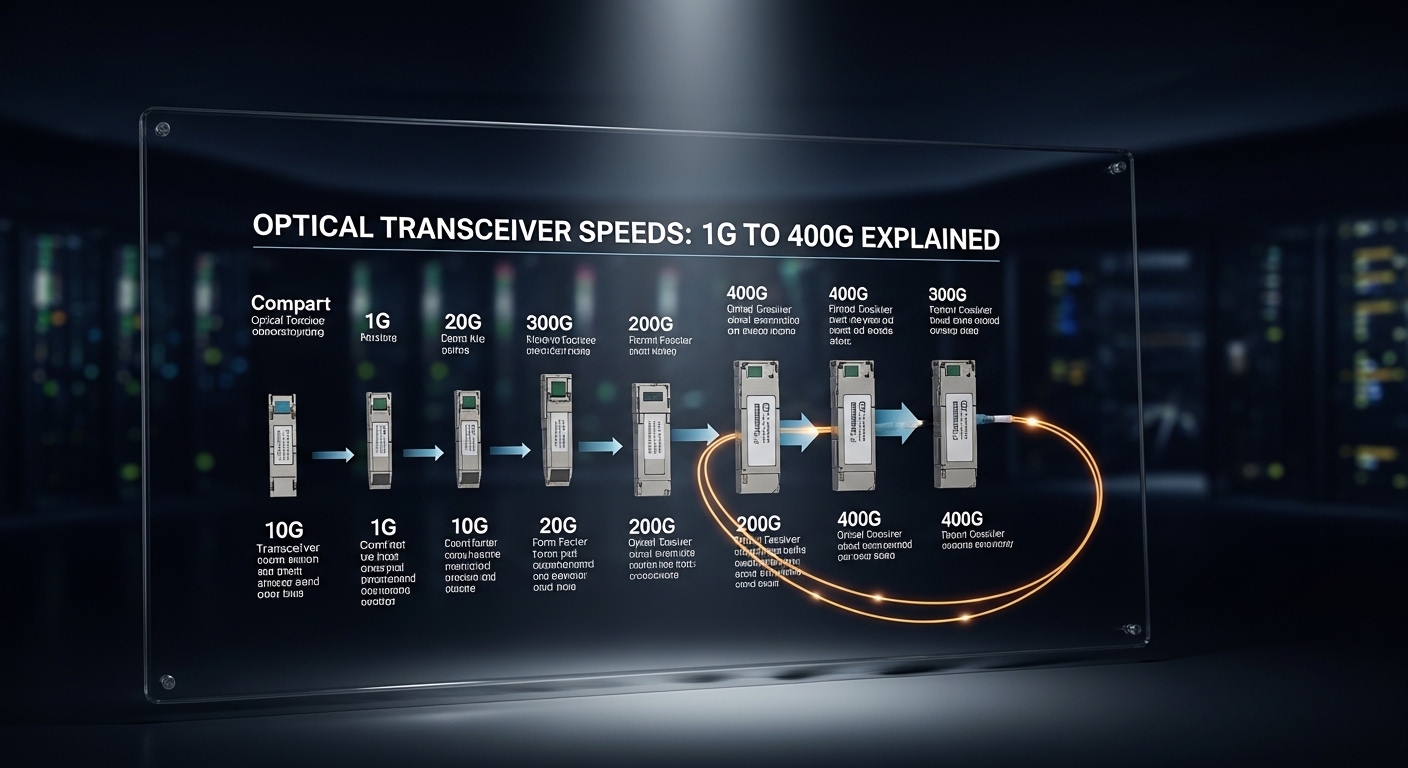
In the 10GBASE family, the “S”/“L”/“E”/“Z” naming is shorthand for optics reach classes and typical operating wavelengths used with SFP+ optics. In practice, the label drives the transceiver’s internal laser wavelength, receiver sensitivity targets, and supported fiber type (multimode versus single-mode). IEEE defines 10GBASE Ethernet physical-layer behavior, while SFP+ vendors publish electrical and optical parameters in datasheets and the modules expose Digital Optical Monitoring (DOM) over the SFP management interface.
SR: short reach over multimode
10GBASE-SR is designed for multimode fiber (MMF) with typical operation around 850 nm. It is the common choice for top-of-rack to aggregation in enterprise and campus networks where fiber runs stay short and switch ports are dense. SR modules often support 300 m or 400 m class reach depending on fiber grade and link budget, so you must validate your plant: OM3 versus OM4 matters.
LR: long reach over single-mode
10GBASE-LR targets single-mode fiber (SMF) with typical wavelength around 1310 nm. LR is frequently used for building-to-building runs, small metro segments, and longer leaf-spine hops when you want compatibility with 10G optics ecosystems without paying for extended reach.
ER: extended reach over single-mode
10GBASE-ER also uses SMF but with a wavelength typically around 1550 nm, trading higher link budget for longer spans. ER is a go-to option when you have longer fiber attenuation, extra connectors, or conservative loss margins that would otherwise break an LR link.
ZR: very long reach over single-mode
10GBASE-ZR is the farthest of the set, commonly associated with 1550 nm optics and long-distance SMF in metro/regional scenarios. The operational reality: ZR modules are costlier, you must be strict about link loss budgets and dispersion/reflectance constraints, and compatibility can hinge on whether your switch optics are validated for ZR use.
Pro Tip: Before you blame the switch, read the module’s DOM values after insertion. If the transceiver reports “TX power low” or “RX power near threshold,” you are likely dealing with a reach-class mismatch or a fiber plant loss issue rather than a defective port. This single check can cut swap-and-retry time dramatically during outages.
Key specs that differ across 10GBASE SFP+ reach standards
Engineers tend to remember “SR is 850 nm, LR is 1310 nm,” but outages happen when other specs diverge: fiber type, nominal optical budget, connector style, DOM presence, power draw, and operating temperature. Use the table below as a baseline, then confirm exact parameters against the module datasheet and your switch’s optics compatibility list.
| 10GBASE SFP+ standard | Typical wavelength | Fiber type | Common reach class | Typical connector | Power (typ.) | Operating temp (typ.) | DOM |
|---|---|---|---|---|---|---|---|
| SR | 850 nm | MMF (OM3/OM4) | ~300 m (OM3) to ~400 m (OM4) | LC duplex | ~0.8 W–1.2 W | 0 to 70 C or -40 to 85 C (varies) | Often supported |
| LR | 1310 nm | SMF | ~10 km | LC duplex | ~0.8 W–1.5 W | -40 to 85 C (varies) | Often supported |
| ER | 1550 nm | SMF | ~40 km | LC duplex | ~1.0 W–2.0 W | -40 to 85 C (varies) | Often supported |
| ZR | 1550 nm | SMF | ~80 km | LC duplex | ~1.5 W–2.5 W | -40 to 85 C (varies) | Often supported |
Exact reach depends on link budget, fiber attenuation, splice and connector losses, and receiver sensitivity. IEEE 802.3 defines the 10GBASE PHY behavior, while vendor datasheets define the practical optical budgets and module specifications. For standards framing, see [Source: IEEE 802.3] and vendor technical documentation such as [Source: Cisco SFP+ transceiver documentation] and optics datasheets from major suppliers.
Examples of real-world module families you may encounter in procurement include Cisco-branded and third-party compatible SFP+ optics such as Cisco SFP-10G-SR and Finisar/FS-style 10GBASE-SR parts (for instance, FS.com SFP-10GSR-85), plus 10GBASE-LR/ER/ZR modules from established optics vendors. Always match the reach class and wavelength, not just the connector and “10G” speed label.
Deployment scenario: choosing the right standard in a leaf-spine fabric
In a 3-tier data center leaf-spine topology with 48-port 10G ToR switches, a common pattern is: ToR to aggregation over short runs and aggregation to spine over longer runs. Suppose you have 120 m average patching between ToR and aggregation across OM4 cabling, and 6 km between aggregation and spine over SMF with about 0.30 dB/km attenuation plus 6 dB total splice/connector loss. For the ToR-aggregation links, SR SFP+ at 850 nm is typically appropriate because it stays within the OM4 reach class. For aggregation-spine, LR at 1310 nm can work for 6 km, but if the fiber plant is older with higher loss or you need more margin, ER at 1550 nm is the safer operational choice.
How DOM changes your acceptance test
On first insertion, poll DOM via your switch CLI or monitoring system and record: TX bias, TX power, RX power, and sometimes temperature. If your link flaps, compare DOM trends between a known-good module and the suspect one. This is especially useful with ER/ZR, where link budgets are tighter and receiver thresholds can be reached after fiber aging or connector contamination.
Selection criteria checklist for 10GBASE SFP+ transceiver standards
Use this ordered checklist the way field teams actually decide under time pressure.
- Distance and fiber type: Confirm MMF versus SMF in the run. SR targets MMF; LR/ER/ZR target SMF.
- Wavelength class alignment: Ensure your module wavelength matches the standard (SR ~850 nm, LR ~1310 nm, ER/ZR ~1550 nm). A wrong wavelength can result in “link up/down” or no link.
- Switch compatibility: Verify the switch model’s optics support matrix. Some platforms restrict non-OEM optics or require specific firmware support.
- DOM and monitoring needs: If you rely on alerting, choose modules with DOM support and confirm the switch can read the DOM fields you need.
- Operating temperature: Compare your cabinet ambient and airflow profile against the module’s temperature range. In hot aisles, choose -40 to 85 C capable optics when available.
- Connector and patching readiness: Confirm LC duplex polarity and cleanliness. Replace jumpers rather than “reusing” contaminated ends.
- Vendor lock-in risk and lifecycle: Evaluate OEM versus third-party. OEM optics often have higher supply predictability but greater unit cost; third-party can reduce cost but may introduce compatibility variance.
- Link budget and safety margin: Use your measured fiber attenuation and include splice/connector loss plus a margin for aging.
Common mistakes and troubleshooting tips
Most “it should work” failures are predictable. Here are the top field failure modes with root cause and a fix.
-
Mistake: Using SR optics on a single-mode run
Root cause: The wavelength and receiver expectations do not match the deployed fiber type and link budget.
Solution: Verify fiber type at the patch panel (MMF vs SMF) and inspect module wavelength. Replace with the correct LR/ER/ZR standard. -
Mistake: Ignoring link budget and connector contamination
Root cause: A “close enough” optical budget fails after adding connectors, dust, or micro-scratches.
Solution: Clean LC ends with appropriate inspection and cleaning tools; re-measure link with a power meter if available. If still marginal, move from LR to ER or add loss margin by shortening the run. -
Mistake: Expecting all “10GBASE-LR” modules to be interchangeable
Root cause: Vendors may implement different optical budgets, DOM behavior, or compliance tuning. Some switches enforce strict optics parameters.
Solution: Match reach class and vendor compatibility; test with a known-good module first, then roll out replacements in small batches. -
Mistake: Overlooking DOM alarms after a swap
Root cause: A module can appear “link up” but operate near receiver threshold, leading to future flaps.
Solution: Capture DOM readings at steady state. If RX power is near minimum spec, address fiber loss/cleanliness or choose a higher-budget standard (ER over LR, for example).
Cost and ROI: OEM vs third-party optics in real budgets
Typical street pricing varies by volume and vendor, but you can expect broad ranges: OEM SR SFP+ modules often cost more than third-party compatible equivalents, while ER/ZR typically carry a larger premium due to higher-performance optics. In many enterprises, OEM can reduce compatibility headaches and accelerate RMA handling, improving operational uptime ROI. Third-party modules often deliver immediate unit-cost savings, but you must budget time for validation against your specific switch models and firmware.
TCO is not just purchase price: consider failure rates, cleaning/inspection labor, and the cost of downtime during rollouts. For high-risk links (ER/ZR in metro segments), the ROI often favors modules with strong DOM quality and proven compatibility. For short-reach SR in controlled data center environments with good fiber hygiene, third-party optics can be cost-effective when validated properly.
FAQ
What are the main 10GBASE SFP+ transceiver standards I should know?
The practical set is SR, LR, ER, and ZR. SR is typically 850 nm over multimode fiber, while LR uses 1310 nm over single-mode. ER and ZR use 1550 nm over single-mode with increasing reach.
Can I use an SR module on single-mode fiber?
Usually no. Even if a connector physically fits, the wavelength and receiver sensitivity are not designed for the deployed fiber type and link budget. You may get no link or unstable link behavior.
How do I confirm whether my switch supports a specific optics standard?
Check the switch’s optics compatibility list and release notes for your firmware version. Some platforms restrict non-OEM optics or require specific transceiver parameter ranges to be accepted.
What should I measure during installation to avoid later link flaps?
Record DOM readings (TX power, RX power, temperature) right after installation and after any subsequent cleaning. If RX power is near threshold, fix the fiber loss or contamination before the link becomes intermittent.
Are DOM values the same across all vendors?
No. DOM fields are standardized in the sense of what is reported, but scaling, thresholds, and interpretation can vary. Use the module datasheet plus your switch’s DOM mapping to interpret readings correctly.
When should I choose ER over LR for a 10G link?
Choose ER when measured loss budget is tight, when you have many splices/connectors, or when you need extra operational margin for fiber aging. If your RX power trends toward the lower end, ER can be the straightforward path to stability.
Update date: 2026-04-29. If you are planning a migration, start by selecting the correct 10GBASE SFP+ transceiver standards for your fiber type, then validate with DOM and a simple link budget before scaling—use fiber optics link budget and DOM troubleshooting as your next step.
Author bio: I have deployed and validated 10G and 25G Ethernet optics in production leaf-spine and campus cores, including DOM-based acceptance testing and fiber loss verification. My work focuses on measurable link stability, switch compatibility, and cost-aware rollout planning.
