In the intricate world of fiber optic networking, the choice between OM3 and OM4 fiber is pivotal for engineers aiming to optimize multimode transceiver performance. This article dissects their technical differences, deployment realities, and selection strategies to guide network architects, data center technicians, and fiber optic specialists toward informed decisions.
Understanding OM3 and OM4 Fiber: Technical Fundamentals
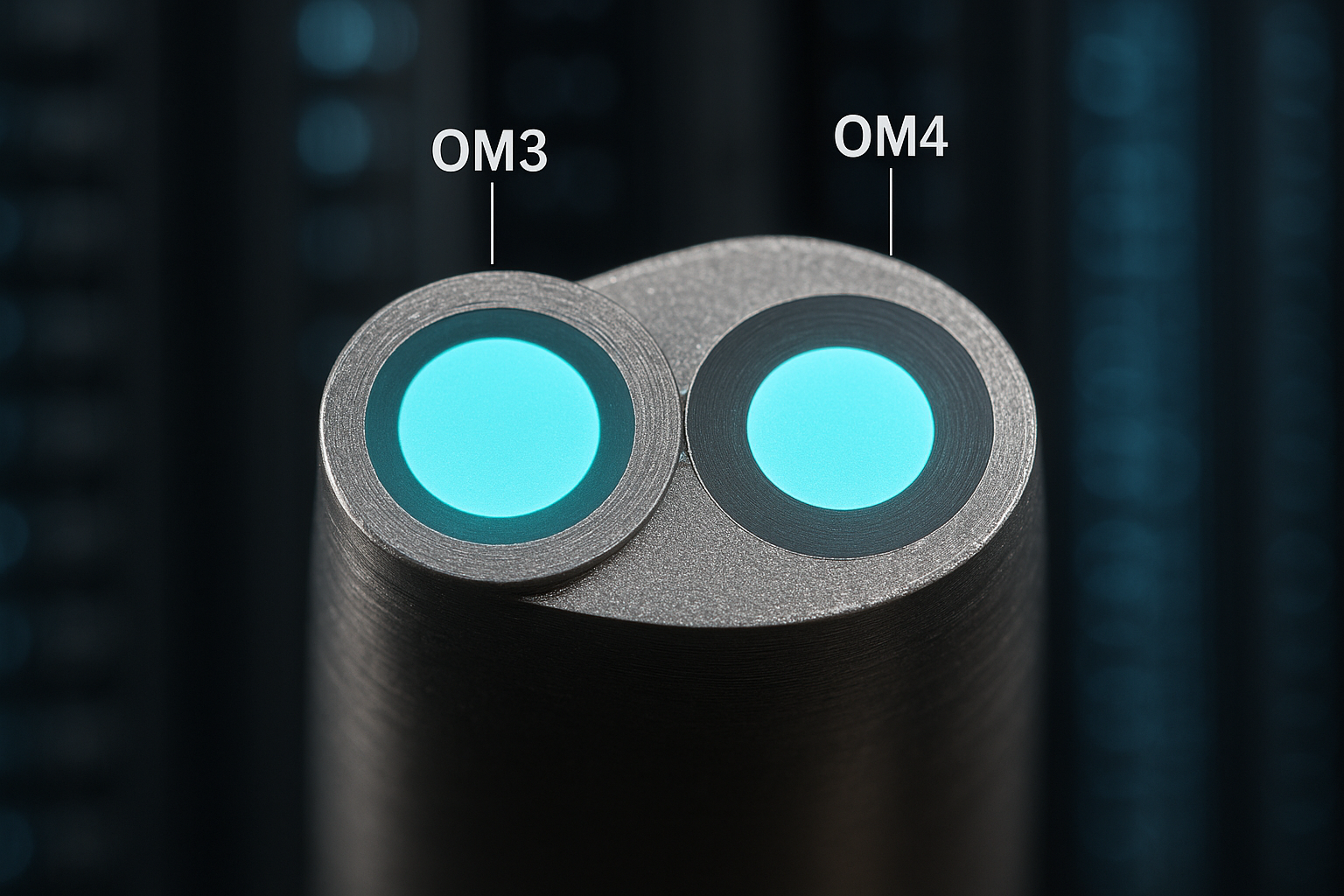
OM3 and OM4 fibers are both laser-optimized multimode fibers (LOMMF) designed to support high-speed data transmission over short to medium distances, primarily in data centers and enterprise LANs. The core distinction lies in their modal bandwidth and reach capabilities when paired with 850nm VCSEL-based transceivers compliant with IEEE 802.3 standards.
| Specification | OM3 Fiber | OM4 Fiber |
|---|---|---|
| Core Diameter | 50 μm | 50 μm |
| Cladding Diameter | 125 μm | 125 μm |
| Modal Bandwidth (850 nm) | 2000 MHz·km | 4700 MHz·km |
| Max Reach @ 10GBASE-SR (IEEE 802.3ae) | 300 meters | 400 meters |
| Max Reach @ 40GBASE-SR4 / 100GBASE-SR10 | 100 meters | 150 meters |
| Connector Type | LC, MPO/MTP | LC, MPO/MTP |
| Operating Temperature | -40°C to +85°C | -40°C to +85°C |
| Typical Attenuation (850 nm) | ~3.5 dB/km | ~3.0 dB/km |
Both fibers support 50/125 μm multimode cabling, but OM4’s higher modal bandwidth translates into extended reach and greater margin for high-data-rate transceivers like 40GBASE-SR4 and 100GBASE-SR10. OM3, while slightly limited in bandwidth, remains a cost-effective choice for shorter reach applications.
Real-World Deployment Scenario: Data Center Leaf-Spine Topology
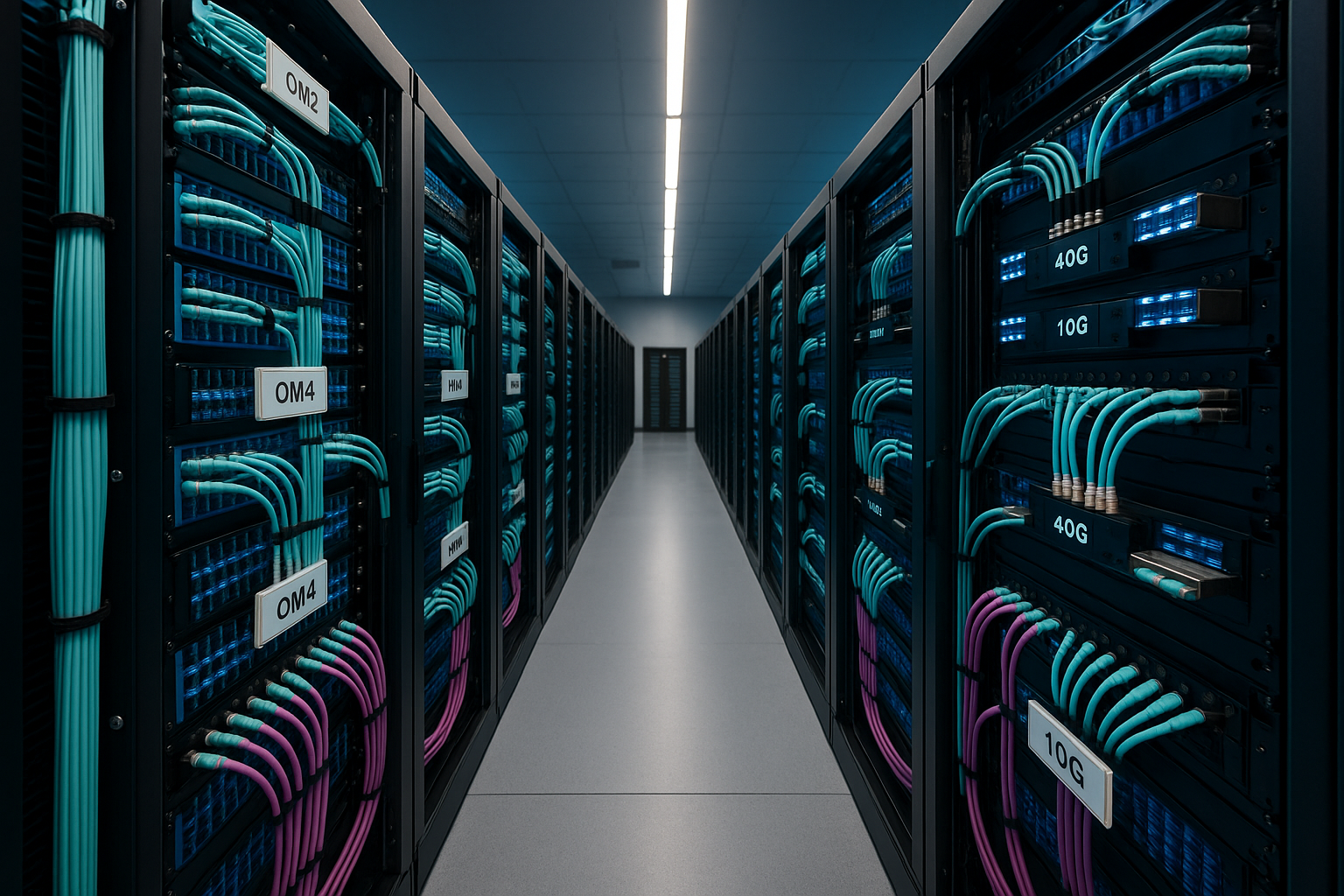
Consider a 3-tier data center with a leaf-spine architecture deploying 48-port 10G ToR (Top of Rack) switches interconnected by 40Gbps uplinks. The environment demands cabling that balances cost, performance, and future scalability.
In this case, OM3 fiber is commonly deployed to connect 10GBASE-SR transceivers across racks, achieving up to 300 meters reach within the same data hall. However, when uplinks scale to 40GBASE-SR4 modules (e.g., Cisco QSFP-40G-SR4 or Finisar FTLF8519P3BNL), OM4 fiber enables links up to 150 meters compared to 100 meters with OM3, providing operational headroom for larger facilities or longer cable runs.
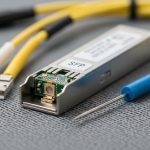
System engineers often pair OM4 cabling with DOM (Digital Optical Monitoring) capable transceivers to monitor real-time parameters like optical power and temperature, enhancing fault isolation in complex deployments. The extended bandwidth of OM4 also helps mitigate modal dispersion, reducing BER (bit error rate) in high-density multiplexed environments.
Selection Criteria for OM3 vs OM4 Fiber
- Distance Requirements: Evaluate the maximum link distance required for your application. OM3 supports up to 300m at 10G, while OM4 extends to 400m, critical for larger campus or data center spreads.
- Data Rate and Transceiver Type: Higher speed standards like 40GBASE-SR4 and 100GBASE-SR10 benefit from OM4’s superior modal bandwidth for reach and reliability.
- Budget Constraints: OM3 fiber and compatible transceivers are typically less expensive upfront. OM4 costs more but may offer better ROI through extended reach and future-proofing.
- Switch Compatibility and DOM Support: Confirm that your network switches and transceivers support the chosen fiber type and offer features like DOM for enhanced monitoring.
- Operating Environment: Consider temperature ranges and mechanical robustness. Both OM3 and OM4 fibers handle typical data center conditions (-40°C to +85°C).
- Vendor Lock-In and Standards Compliance: Prefer fibers and transceivers adhering to ANSI/TIA-492AAAC (OM3) and ANSI/TIA-492AAAD (OM4) standards to ensure interoperability.
Pro Tip: In practice, upgrading an existing OM3 infrastructure to OM4 fiber often yields diminishing returns unless accompanied by a transceiver refresh. Always consider end-to-end system compatibility rather than fiber alone to maximize network performance.
Common Mistakes and Troubleshooting Tips
- Mistake: Mixing OM3 and OM4 fiber in the same channel without proper planning.
Root Cause: Modal bandwidth mismatch can increase insertion loss and degrade signal quality.
Solution: Maintain consistent fiber types end-to-end or use mode conditioning patch cords to mitigate mode coupling issues. - Mistake: Assuming OM4 fiber guarantees longer reach without validating transceiver specs.
Root Cause: Transceiver optical power budget and receiver sensitivity ultimately limit reach.
Solution: Cross-reference IEEE 802.3 transceiver standards (e.g., 10GBASE-SR, 40GBASE-SR4) and vendor datasheets for supported distances on OM3/OM4. - Mistake: Ignoring connector cleanliness and inspection.
Root Cause: Dust or debris causes insertion loss spikes and transient errors.
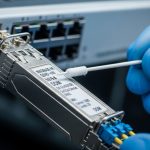
Solution: Employ fiber inspection scopes and cleaning protocols before installation or troubleshooting.
Cost and ROI Considerations
OM3 fiber optic cables typically range from $0.30 to $0.50 per meter, whereas OM4 fibers are priced at approximately $0.50 to $0.75 per meter depending on manufacturer and cable specs. Transceivers compatible with OM4 fiber, such as the Cisco SFP-10G-SR or FS.com SFP-10GSR-85, may carry a premium of 10-15% over OM3 counterparts.
While initial capital expenditure favors OM3 for short-reach applications, OM4’s extended reach and higher modal bandwidth can reduce the need for intermediate switches or repeaters, lowering long-term operational expenses. Additionally, OM4’s reduced insertion loss and superior performance can decrease failure rates, contributing to lower maintenance costs.
Choosing OEM vs third-party fibers and transceivers impacts total cost of ownership (TCO). OEM products guarantee vendor support and compatibility but at a higher price point. Third-party alternatives offer savings but require rigorous qualification testing to ensure standards compliance and network reliability.
FAQ
- Q: Can OM3 fiber support 100G Ethernet?
A: Yes, OM3 can support 100GBASE-SR10 but only up to about 100 meters. For longer distances or better performance, OM4 is preferred due to its higher modal bandwidth. - Q: Are OM3 and OM4 fibers backward compatible?
A: Physically, yes; both use 50/125 μm cores. However, mixing them in a channel can degrade performance unless properly managed. - Q: How do I verify if my existing fiber is OM3 or OM4?
A: Check cable jacket markings or use an OTDR with modal bandwidth measurement capabilities. Manufacturer datasheets or installation documentation can also confirm fiber grades. - Q: Does upgrading to OM4 require new transceivers?
A: Not necessarily. OM4 is backward compatible, but to leverage its extended reach and bandwidth, transceivers optimized for OM4 performance are recommended. - Q: What connector types are commonly used with OM3/OM4 fibers?
A: LC and MPO/MTP connectors are standard for data center multimode applications, offering reliable low-loss connections.
In summary, the OM3 vs OM4 fiber choice hinges on balancing distance requirements, data rates, and budget within your network environment. By understanding their specifications and deployment nuances, engineers can craft robust multimode fiber optic infrastructures that align with evolving enterprise needs.
For further insights on fiber optic transceiver compatibility and deployment best practices, explore our detailed guide on multimode fiber transceiver selection.
Author Bio: Alex Morgan is a fiber optic network engineer with over a decade of experience implementing high-speed data center cabling solutions. Passionate about translating complex telecom standards into actionable strategies, Alex combines hands-on expertise with a deep understanding of optical physics.