Network engineers and IT professionals often face the challenge of selecting the appropriate fiber optic cabling for high-speed data transmission. This article provides an in-depth comparison of OM3 vs OM4 fiber and explores how these multimode fibers relate to single-mode fiber optics in terms of transceiver compatibility and deployment scenarios. Understanding these differences ensures optimal network design, cost efficiency, and future-proofing.
Understanding OM3 and OM4 Fiber Optics

OM3 and OM4 are both categories of multimode fiber (MMF) designed for high-speed communication, especially in data centers and enterprise LANs. The critical difference lies in their bandwidth capacity and maximum transmission distance at given data rates.
Technical Specifications Comparison
| Specification | OM3 Fiber | OM4 Fiber | Single-Mode Fiber (OS2) |
|---|---|---|---|
| Core Diameter | 50 µm | 50 µm | 9 µm |
| Cladding Diameter | 125 µm | 125 µm | 125 µm |
| Bandwidth (850 nm) | 2000 MHz·km | 4700 MHz·km | Not applicable |
| Max Reach @ 10GBASE-SR | 300 meters | 400 meters | Up to 10 km (single-mode) |
| Max Reach @ 40G/100GBASE-SR4 | 100 meters | 150 meters | Not applicable |
| Connector Type | LC, SC | LC, SC | LC, SC |
| Typical Operating Temperature | -40°C to 85°C | -40°C to 85°C | -40°C to 85°C |
| Typical Application | Data centers, LANs | High-performance data centers, longer reach LANs | Long-haul, campus backbone, metro networks |
The table above highlights that OM4 fiber provides more than double the effective modal bandwidth of OM3, allowing longer reach and higher data rates using the same multimode transceivers. Single-mode fiber (OS2) has a much smaller core diameter, enabling transmission over kilometers with laser-based transceivers at a much higher cost and complexity.
Multimode vs Single-Mode Fiber for Transceiver Selection
Choosing between multimode (OM3/OM4) and single-mode fiber depends heavily on the intended network topology, data rates, and budget constraints. The transceiver modules used must be compatible with the fiber type to ensure signal integrity and compliance with IEEE 802.3 standards.
Multimode Fiber Transceivers
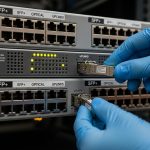
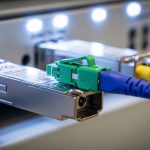
Multimode SFP+ and QSFP+ transceivers (e.g., Cisco SFP-10G-SR for 10G, Finisar FTLX8571D3BCL for 40G SR4) utilize vertical-cavity surface-emitting lasers (VCSELs) operating at 850 nm wavelength. These are optimized for OM3 and OM4 fibers and offer cost-effective solutions for short-reach high-speed links.
However, the maximum reach depends on the fiber grade:
- OM3: up to 300 meters @ 10G, 100 meters @ 40G/100G
- OM4: up to 400 meters @ 10G, 150 meters @ 40G/100G
Single-Mode Fiber Transceivers
Single-mode transceivers (e.g., Cisco SFP-10G-LR) employ laser diodes at 1310 nm or 1550 nm wavelengths and support longer distances—up to 10 km or more. Single-mode fiber is favored for campus backbones, metro networks, and high-reliability environments but comes at a higher price point.
Real-World Deployment Scenario
In a 3-tier data center leaf-spine topology with 48-port 10G Top-of-Rack (ToR) switches, OM4 fiber is often selected for uplinks to spine switches due to its extended reach and higher modal bandwidth. For example, a 10GBASE-SR link running over OM4 fiber can reliably cover up to 400 meters, providing flexibility in rack placement and cable management. Meanwhile, ToR-to-server connections within the same rack or adjacent racks use OM3 fiber, reducing costs.
For future-proofing, some operators opt to install OM4 fiber throughout the facility. This decision supports potential migration to 40G or 100G using SR4 transceivers on the same fiber infrastructure. However, for inter-building links exceeding 500 meters, single-mode fiber with LR or ER transceivers is mandatory.
Selection Criteria for OM3 vs OM4 Fiber and Single-Mode Transceivers
- Distance Requirements: Determine maximum link length; OM3 supports shorter distances than OM4; single-mode for >500 meters.
- Data Rate: Consider current and future speeds (10G, 40G, 100G); OM4 supports longer reach at higher speeds.
- Budget Constraints: OM3 fiber and associated transceivers cost less; OM4 has slightly higher upfront cost but offers better performance.
- Switch Compatibility: Verify transceiver and switch port support for fiber type and speed (e.g., SFP+ SR modules for OM3/OM4).
- Distance Optical Monitoring (DOM) Support: DOM-enabled transceivers provide real-time diagnostics; factor this for maintenance.
- Operating Environment: Ensure fiber and transceivers meet temperature and durability requirements.
- Vendor Lock-In Risk: Evaluate OEM vs third-party compatibility and warranty implications.
Common Mistakes and Troubleshooting Tips
- Mistake: Using OM3 fiber beyond its rated maximum reach for 10G or 40G links.
Root Cause: Signal attenuation and modal dispersion increase, causing bit errors.
Solution: Upgrade to OM4 fiber or switch to single-mode transceivers for longer distances. - Mistake: Mixing fiber types (e.g., OM3 patch cords on OM4 backbone) without verifying attenuation losses.
Root Cause: Mismatched modal bandwidth and increased insertion loss.
Solution: Standardize fiber types or perform thorough link testing after installation. - Mistake: Deploying multimode transceivers on single-mode fiber without mode conditioning.
Root Cause: Coupling loss due to mode field diameter mismatch.
Solution: Use appropriate single-mode transceivers or mode conditioning patch cables.
Cost and Return on Investment Considerations
OM3 fiber cable assemblies typically range from $0.50 to $1.50 per meter, while OM4 fiber may cost approximately 20-30% more. Transceivers for OM3/OM4 multimode fiber (e.g., 10GBASE-SR) are generally priced between $150 to $350 per module, depending on vendor and volume. Single-mode transceivers (10GBASE-LR) can cost upwards of $400 to $600 each.
The total cost of ownership (TCO) must factor in power consumption, failure rates, and future scalability. OM4 fiber’s superior bandwidth and reach reduce the need for costly equipment upgrades and re-cabling, often resulting in a lower TCO for rapidly growing data centers. Third-party transceivers can reduce upfront costs but may introduce compatibility issues or void warranties.
Pro Tip: In the field, engineers often find that installing OM4 fiber from day one, despite its higher initial cost, minimizes future network downtime and upgrade expenses when migrating from 10G to 40G or 100G speeds, making it a strategic investment in scalable multimode infrastructure.
Frequently Asked Questions
- Q: Can OM3 fiber be used with 100GBASE-SR4 transceivers?
- A: Yes, but the maximum reach is limited to approximately 100 meters. For longer distances, OM4 fiber is recommended for up to 150 meters reach.
- Q: What is the main advantage of single-mode fiber over OM4 multimode fiber?
- Single-mode fiber supports much longer distances (up to 10 km or more) and higher bandwidth with laser-based transceivers, suitable for campus and metro networks.
- Q: Are OM3 and OM4 fiber cables interchangeable for patch cords?
- While connectors are compatible, mixing OM3 patch cords on an OM4 backbone can cause slight performance degradation. It is best to match fiber grades end-to-end.
- Q: How do I know if my switch supports OM3 or OM4 fiber transceivers?
- Check the vendor datasheet for supported SFP+ or QSFP+ modules, specifically for 10GBASE-SR, 40GBASE-SR4, or 100GBASE-SR4 standards that list compatible fiber types.
- Q: Is OM4 fiber future-proof for next-generation data rates?
- OM4 provides sufficient bandwidth and reach for current 40G and 100G standards. For beyond 100G or longer links, single-mode fiber may be necessary.
In conclusion, selecting between OM3 vs OM4 fiber depends on your current network requirements and anticipated growth. Multimode fibers offer cost-effective, high-speed connectivity up to 400 meters, with OM4 providing enhanced performance and scalability. Single-mode fiber remains the choice for long-reach and high-bandwidth applications. For detailed guidance on fiber optic transceiver technologies, consider exploring fiber optic transceiver types and selection.
Author Bio: John Miller is a registered network engineer and certified fiber optic specialist with over 10 years of experience designing and deploying enterprise and data center fiber optic networks. He specializes in multimode and single-mode fiber systems and transceiver integration for high-density environments.