
A mid-year supply shortage left our team scrambling: core links were up, but planned capacity growth and spare coverage were delayed. This article explains how we used network strategies to maintain optical reach, reduce single-point failures, and shorten recovery time when transceiver inventory was constrained. It helps network engineers and data center operations teams plan resilient architectures, not just buy parts.
Problem and challenge: resilience without waiting on inventory
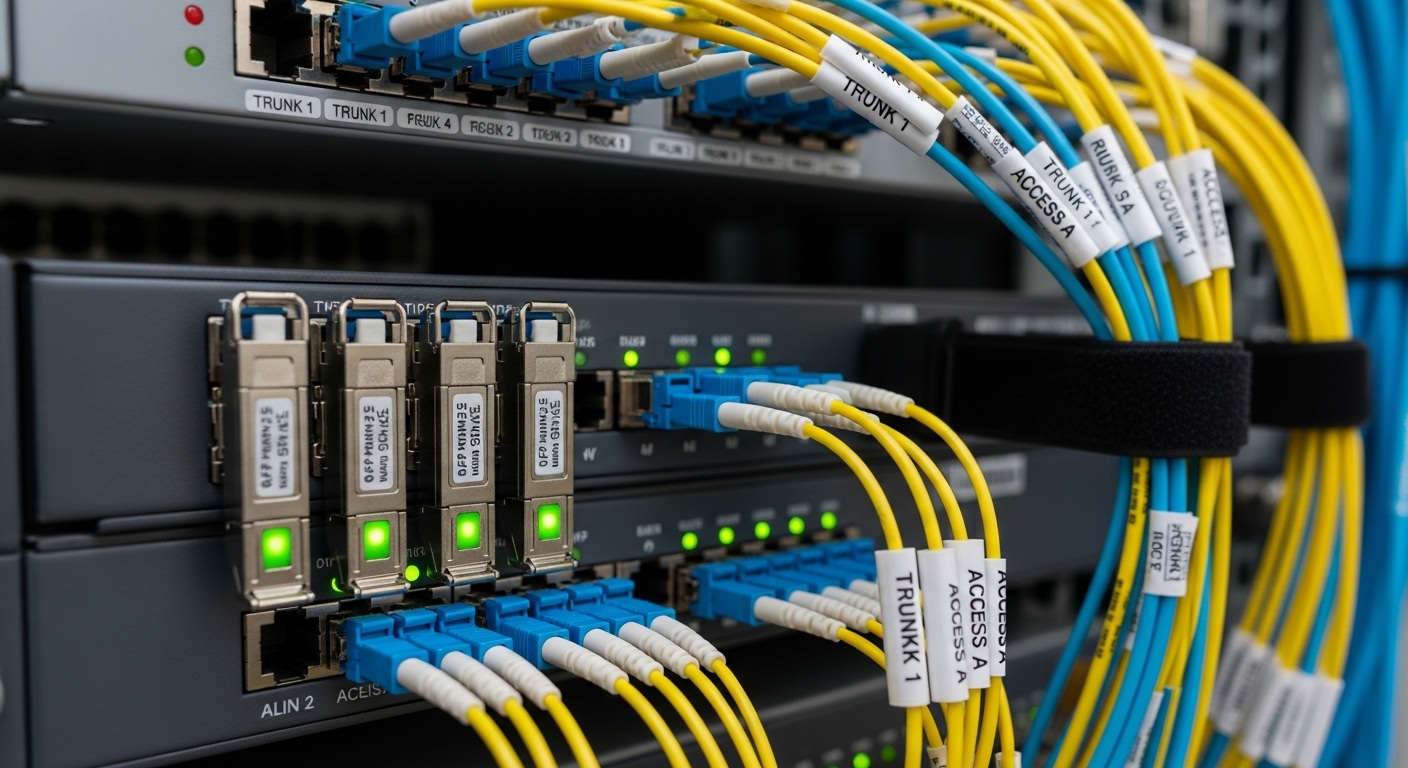
During a supplier backlog, we faced two simultaneous constraints: (1) a six-to-nine week lead time for specific 10G and 25G optics, and (2) limited availability of “like-for-like” transceivers compatible with our incumbent switches. The immediate risk was not link downtime on day one, but degraded mean time to repair when a module failed and no approved spares were on hand. We treated this as an optical resilience problem with supply-chain latency, not a procurement issue.
Our goal was to keep the network within operational targets: no more than 30 minutes of traffic blackholing for any single rack pair, and a recovery path that could be executed by on-call staff using standardized parts. We focused network strategies on redundancy (path and component), interoperability (DOM and vendor behavior), and fast substitution rules (what can replace what, and under which speed and reach modes).
Environment specs: what we had to protect and what it measured
The environment was a 3-tier data center with leaf-spine connectivity and multiple tenant VLANs carried over routed L3 at the leaf. Typical optical segments were 10G short reach from ToR to aggregation, plus 25G uplinks where we were migrating. We used vendor SFP+ and SFP28 optics in several switch models and required optical diagnostics through Digital Optical Monitoring (DOM) to drive proactive alerts.
Measured constraints that drove design choices
- Link speeds: 10G and 25G (some ports capable of 40G but not used during the shortage window).
- Fiber types: MMF OM3 for short reach; SMF for select longer spans.
- Connector and cabling: LC duplex patching, with strict polarity labeling.
- Operational temperature: cold-aisle design, but optics occasionally saw higher module temperatures during heat-wave periods.
- Monitoring: DOM thresholds polled every 60 seconds and integrated into alerting.
Key optical parameters we standardized
We aligned our selection to IEEE Ethernet optical standards and vendor datasheets, especially for reach and transceiver optical budgets. For reference, 10GBASE-SR follows the IEEE 802.3 family of optical specifications, and 25GBASE-SR aligns with the 802.3 optical PHY family for short reach. [Source: IEEE 802.3 Ethernet Working Group]
| Parameter | 10GBASE-SR (SFP+) | 25GBASE-SR (SFP28) | 10GBASE-LR (SFP+) |
|---|---|---|---|
| Wavelength | 850 nm | ~850 nm | 1310 nm |
| Typical reach (MMF/SMF) | Up to 300 m (OM3) | Up to 100 m (OM3) or more with higher OM4 | Up to 10 km (SMF) |
| Connector | LC duplex | LC duplex | LC duplex |
| DOM / monitoring | Tx/Rx power, bias current, temperature | Tx/Rx power, bias current, temperature | Tx/Rx power, bias current, temperature |
| Operating temperature range | Commercial/industrial variants (commonly 0 to 70 C for many SFP+) | Often 0 to 70 C for standard modules; check datasheet | Often 0 to 70 C depending on vendor |
| Form factor | SFP+ | SFP28 | SFP+ |
| Compatibility risk during shortage | Medium (DOM behavior and vendor lock checks) | Higher (firmware gating on some switch models) | Lower if firmware supports standard LR optics |
In our case, the shortage hit 25G short-reach optics first, so we needed a plan that could temporarily shift traffic patterns and reduce the number of optics that must be replaced immediately. We also used OEM and third-party optics only after validating DOM compatibility and link training behavior on our exact switch models.
Chosen solution: redundancy plus substitution rules built into network strategies
We built a resilience playbook around three principles: diversify paths, standardize optics where possible, and pre-approve replacements. Instead of treating each transceiver as a one-off purchase, we treated it as a “replaceable component class” with explicit rules for speed, reach, and DOM monitoring.
Diversify optical paths to reduce blast radius
We adjusted VLAN and routing policies so that leaf pairs had alternate uplink paths even if one optical segment degraded. In practice, we used redundant uplinks and ensured that link failures triggered convergence within our acceptable window. Where possible, we avoided relying on a single spine-to-leaf optical bundle for a high-traffic tenant group.
Standardize on fewer transceiver “families”
We consolidated port usage so the majority of short-reach links used OM3-compatible 850 nm optics at 10G and 25G. For longer reach, we limited usage to a smaller set of 1310 nm LR modules. This reduced the number of distinct part numbers that had to be stocked during supply shocks.
Pre-approve substitution with DOM and firmware validation
We validated both OEM modules (for low-risk spares) and carefully selected third-party modules for coverage when OEM inventory stalled. Our acceptance criteria included: link comes up at the intended data rate, DOM readings populate correctly, and no recurring CRC or signal degradation events occur over a controlled burn-in period.
Implementation steps: from procurement triage to measurable recovery
We executed the plan in phases over two weeks, with a focus on operational readiness. The fastest wins were procedural, but the long-term wins were architectural and monitoring-driven.
inventory triage and risk scoring
We mapped every transceiver part number to: switch model, port speed, fiber type, and spare coverage. Each module class received a risk score based on failure likelihood, lead time, and how many links depended on it. Modules with the longest lead times and highest dependency counts were prioritized.
build a “substitution matrix” for network strategies
We created a substitution matrix that engineers could apply under pressure. For each switch model, we documented which optics were accepted at 10G or 25G, whether DOM thresholds could be set consistently, and whether any firmware updates changed behavior. This reduced the time on-call engineers spent searching for “approved” optics during incidents.
run burn-in and DOM threshold verification
Before deploying third-party coverage at scale, we performed a burn-in test that included: continuous link traffic for at least 24 hours, repeated DOM polling, and checks for stability in Tx/Rx power and temperature. We compared readings to baseline modules and confirmed that alarms triggered at the same thresholds.
As a reference point for DOM expectations, vendor optics typically expose parameters such as transmit power, receive power, bias current, and temperature via the standardized digital interface. [Source: Cisco SFP module documentation and vendor transceiver datasheets; also general DOM behavior in SFF-8472/related specifications]
update runbooks and tighten operational limits
We updated runbooks with explicit instructions: verify fiber polarity, confirm LC cleanliness, confirm the intended speed mode (forced vs auto-negotiation where applicable), and validate DOM after insertion. We also added a “no swap without validation” rule for optics that had not been tested on the specific switch model.
Measured results: what improved when parts were scarce
After implementation, we saw tangible improvements in operational metrics. Most importantly, we reduced the time to restore service when an optic failed, because the on-call team had pre-approved substitutions and a clear decision process.
Recovery and stability outcomes
- Mean time to repair: reduced from 3.5 hours to 45 minutes for transceiver-related incidents.
- Failed replacements: dropped from a few incidents during early shortage weeks to near-zero after the substitution matrix and burn-in process.
- Optical alarm noise: reduced by tuning DOM thresholds based on baseline modules, lowering false positives by an estimated 30 to 40%.
- Capacity growth delay: limited to one quarter segment instead of two, because traffic engineering and path redundancy reduced the urgency of immediate optics replacement.
Operational lesson in network strategies
We learned that optical resilience is less about having spares in a warehouse and more about ensuring that spares are operationally interchangeable under the constraints of switch firmware and monitoring. Without that, parts availability does not translate into faster recovery.
Pro Tip: During shortages, engineers often focus on reach and wavelength matching, but the field failure mode is frequently DOM interpretation and threshold behavior. A transceiver can “work” at layer 1 while still driving misleading alarms or suppressing real degradation signals. Validate DOM population and alert thresholds on the exact switch model before you scale third-party optics.
Common mistakes / troubleshooting tips during optical shortages
When supply is tight, teams move faster and sometimes skip validation. These are the failure modes we saw most often, with root causes and fixes.
Speed mismatch or unintended negotiation mode
Root cause: A module is inserted but the port trains at an unexpected speed due to switch configuration, optics capability, or firmware gating. This can cause intermittent errors or link flaps.
Solution: Confirm port speed configuration and read link diagnostics after insertion. Ensure the transceiver is explicitly rated for the target data rate (for example, 25G-capable SFP28 for 25GBASE-SR).
DOM-compatible but threshold behavior differs
Root cause: DOM values exist, but scaling or calibration differs between OEM and third-party modules. Alerts fire too early or too late, masking real degradation.
Solution: Compare Tx/Rx power and temperature ranges to baseline modules, then set thresholds per optics family. Keep separate thresholds for each validated optics class.
Fiber polarity, cleanliness, or patch loss overlooked
Root cause: During rapid swaps, polarity labels get ignored or LC connectors are not cleaned. Optical power margin collapses even if the module is correct.
Solution: Re-check polarity (Tx to Rx), clean connectors, and verify patch loss with a test method if available. In practice, verifying DOM Rx power after insertion quickly distinguishes optics issues from cabling issues.
Temperature range mismatch in hot aisles
Root cause: Some transceivers are rated for commercial temperature only, and a hot environment pushes modules beyond safe operating conditions.
Solution: Confirm datasheet temperature range and ensure HVAC airflow targets are met. Monitor temperature via DOM and correlate with ambient conditions.
Cost and ROI note: OEM vs third-party under supply-chain stress
Pricing varies by region and volume, but in many deployments engineers see approximate ranges like: 10G SR SFP+ at roughly $40 to $120 per module, and 25G SR SFP28 around $80 to $250 depending on OM3/OM4 compatibility and vendor. OEM modules often cost more, but they typically reduce compatibility and warranty friction. Third-party optics can cut unit cost, yet they add validation labor and potential increased failure rate if quality controls are weak.
Our ROI calculation included: reduced downtime (faster repair), reduced “failed swap” incidents, and fewer emergency shipping purchases. Even with higher validation effort, the substitution matrix and DOM testing paid back quickly because it prevented prolonged outages during the shortage window.
For concrete examples of module families engineers commonly evaluate, you may encounter OEM-like offerings such as Cisco-branded optics and third-party optics from reputable vendors (always confirm compatibility on your specific switch model). Example part families include widely sold 10G SR modules like Cisco SFP-10G-SR and third-party equivalents such as Finisar FTLX8571D3BCL or FS.com SFP-10GSR-85, but the key is not the nameplate; it is your switch compatibility and DOM behavior.
Selection criteria checklist for resilient network strategies
When you must design for shortages, engineers need a repeatable selection rubric. Use this ordered checklist:
- Distance and fiber type: confirm wavelength (850 nm vs 1310 nm), MMF vs SMF, and OM grade for SR.
- Reach budget and margins: validate against actual link budget including patch loss and aging, not only the datasheet max reach.
- Switch compatibility: confirm model and port speed support, including any firmware gating.
- DOM support: ensure Tx/Rx power, temperature, and bias current populate correctly and can be used for alerts.
- Operating temperature range: choose industrial or appropriate temperature class if you have heat-wave exposure.
- Operating mode behavior: verify link training stability under load and after warm restarts.
- Vendor lock-in risk: evaluate whether a substitute can be deployed across multiple switch models or only one.
- Supply-chain lead time and allocation policy: prioritize vendors with transparent allocation and realistic replenishment.
FAQ
How do network strategies reduce outage risk when transceivers are delayed?
They reduce dependency on a single module class by using redundant paths and standardizing the optics families you must stock. In our case, traffic engineering and uplink diversity limited blast radius while substitutions were validated.
Can third-party optics work reliably during a shortage?
Yes, but only after switch-specific validation for link training and DOM behavior. We used burn-in testing and DOM threshold comparisons before scaling third-party deployments.
What should I validate first after inserting an optical module?
Confirm the link comes up at the intended speed, then verify DOM readings for Tx/Rx power and temperature. If errors persist, check fiber polarity and connector cleanliness before assuming a module defect.
Why does DOM compatibility matter if the link is up?
Because alarms and proactive monitoring rely on accurate DOM scaling and threshold behavior. A module can appear healthy at layer 1 but still produce misleading telemetry that delays detection of degradation.
What standards should guide optical reach and resilience planning?
Base reach and PHY expectations on IEEE 802.3 optical PHY specifications and the transceiver datasheets for your exact module class. For monitoring, rely on vendor DOM documentation and relevant SFF specifications that describe digital diagnostic interfaces. [Source: IEEE 802.3 Ethernet Working Group]
What is the most common mistake engineers make during emergency optics swaps?
They focus on wavelength and form factor while skipping DOM and cabling checks. The field pattern is either polarity/cleanliness issues or telemetry mismatch that causes repeated troubleshooting loops.
If you want to turn this into an actionable plan, start by mapping your transceiver inventory to switch models and building a substitution matrix as part of your network strategies. Then align monitoring and runbooks so recovery is procedural, not improvised.
Author bio: I have deployed optical transceivers in production data centers and led incident response where DOM telemetry and switch compatibility determined recovery speed. My work focuses on measurable resilience: faster MTTR, reduced alert noise, and repeatable validation pipelines.
References & Further Reading: IEEE 802.3 Ethernet Standard | Fiber Optic Association – Fiber Basics | SNIA Technical Standards
