
When a new switch lands in a rack and the cabling plan arrives late, engineers often discover the same quiet truth: the fiber choice decides whether your link will light up cleanly or spend nights in troubleshooting. This article helps network and facilities teams choose between multi-mode fiber and single-mode fiber using real deployment constraints, practical optics considerations, and cost-aware decision steps. You will leave with a checklist, common failure modes, and a specs-first way to match transceivers to link distance, temperature, and budget.
Why multi-mode fiber feels easy at first, then exacting in practice
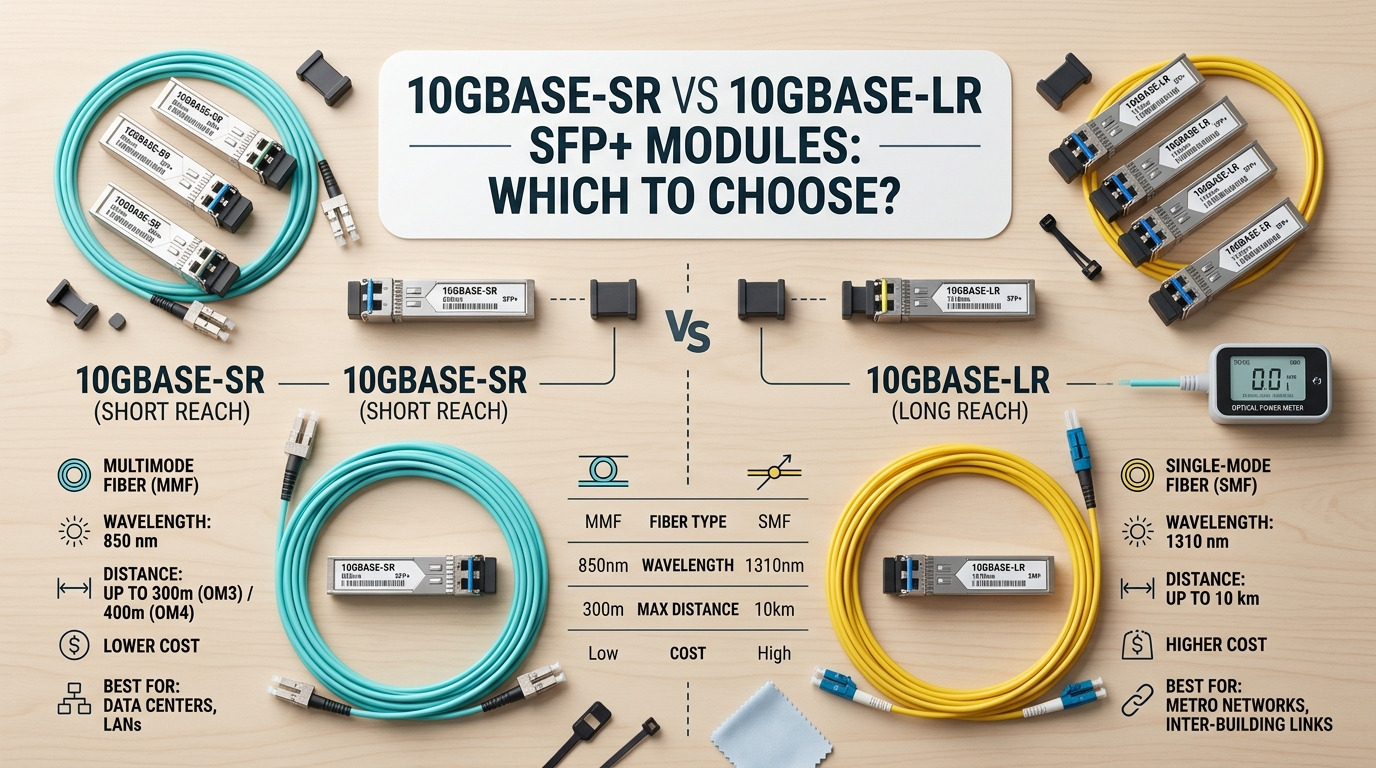
Multi-mode fiber (MMF) is designed to carry multiple light paths, typically optimized for shorter distances with lower-cost optics. In the field, that “easy” part shows up when you standardize on 10GBASE-SR over OM3 or OM4 and keep patching simple inside a building. The exacting part arrives when link budgets, connector cleanliness, and modal bandwidth are treated as afterthoughts rather than engineering inputs.
From a standards perspective, Ethernet over optical interfaces is framed by IEEE 802.3 PHY specifications and transceiver classes, while cabling performance is governed by TIA/EIA cabling guidance and ISO/IEC fiber performance definitions. The practical takeaway is that MMF performance hinges on the fiber grade (OM1, OM2, OM3, OM4, OM5), the transmitter wavelength, and the receiver sensitivity of the installed optics. If any of those drift from the original plan, the system may still connect but with marginal error rates.
Pro Tip: In multi-mode fiber deployments, the “distance” printed on a datasheet assumes properly cleaned connectors and compliant patch cords. If you reuse older patch leads or skip inspection, you can lose link margin fast even when the fiber grade matches.
Specs that actually decide: OM grades, reach, and transceiver fit
To choose correctly, treat fiber grade and transceiver type as a pair. For MMF, the most common Ethernet optics are short-reach SFP+ or SFP modules (10GBASE-SR) and newer multi-speed variants (like 25GBASE-SR). These are typically specified for either 850 nm (legacy and common) or, for newer variants, carefully defined wavelength behavior and modal bandwidth support.
Single-mode fiber (SMF) carries one light path and supports much longer distances, but optics cost more and installation practices often demand higher care in termination and splicing quality. In contrast, MMF can be more forgiving for in-building runs, especially when you keep patching organized and limit bend stress.
| Parameter | Multi-Mode Fiber (Typical) | Single-Mode Fiber (Typical) |
|---|---|---|
| Core / light behavior | Wider core; multiple modes | Narrow core; one dominant mode |
| Common Ethernet optics | 850 nm SR (10GBASE-SR, 25GBASE-SR) | 1310 nm LR/ER (10GBASE-LR, 40GBASE-LR4) |
| Typical reach baseline | OM3/OM4 often support up to ~300–400 m for 10GBASE-SR-class designs | Thousands of meters depending on optic class |
| Connector types | LC common; APC variants sometimes used | LC common |
| Power budget sensitivity | More dependent on modal bandwidth and launch conditions | More dependent on attenuation and dispersion for the optic class |
| Operating temperature | Often specified for transceivers; typical ranges include 0 to 70 C for standard | Similar transceiver constraints; some enterprise optics extend ranges |
When selecting MMF optics, engineers frequently confirm compatibility by matching vendor transceiver part numbers and supported fiber grades. For example, a Finisar FTLX8571D3BCL-class 10GBASE-SR transceiver is designed for 850 nm multi-mode operation, while a Cisco-branded SR module such as Cisco SFP-10G-SR is intended for short-reach MMF use. Third-party options like FS.com SFP-10GSR-85 can also work, but only after verifying DOM behavior, vendor EEPROM expectations, and the switch’s transceiver interoperability list.
Deployment scenario: leaf-spine inside a 48-port ToR fabric
Consider a mid-sized data center building a 3-tier leaf-spine topology: 48-port Top-of-Rack switches uplink to aggregation, then to spine. Each ToR serves two server rows, with patching that keeps most runs under 70 m from server NIC to the nearest patch panel. The team chooses 10GBASE-SR for server-to-ToR and also for short ToR-to-aggregation links where the distance stays under 100–150 m. They standardize on OM4 multi-mode fiber to preserve headroom for patch cord losses and future re-cabling.
In day-to-day operations, the engineer measures slack and bend radius during installation, then verifies each link with a light source and power meter. They also enforce connector cleanliness checks before plugging optics into live ports, because contaminated LC endfaces can create enough backscatter and insertion loss to increase receive errors. After rollout, they monitor interface counters and confirm that the optics report DOM metrics within expected thresholds for laser bias current and received power.
Decision checklist: choosing multi-mode fiber with engineering discipline
Use this ordered checklist the way field engineers actually work: start with physics constraints, then align optics and vendor compatibility, then protect your budget with realistic TCO assumptions.
- Distance and link budget: confirm planned trunk length plus patch cords and jumpers. If you are near the edge of MMF reach, assume you need additional margin for aging and re-termination.
- Fiber grade selection: choose OM3/OM4/OM5 based on transceiver wavelength and your expected future speeds. If you are already planning 25G or higher, consider OM4 or OM5 rather than locking into older OM1 assumptions.
- Switch and transceiver compatibility: verify that your switch model supports the specific SR optics family and that it tolerates third-party EEPROM/DOM behavior. Check the vendor guidance and any interoperability notes published by the switch manufacturer.
- DOM and diagnostics requirements: if you rely on monitoring, confirm that the optics provide DOM data in the format your network management stack expects.
- Operating temperature and airflow: ensure transceivers remain within spec; a crowded rack can push modules toward their upper temperature boundary, reducing performance stability.
- Vendor lock-in risk: price out OEM optics versus third-party, and evaluate failure rates and return policies. If you standardize on one vendor, document that decision for future procurement cycles.
Common pitfalls and troubleshooting tips that save nights
Even well-designed MMF links can fail in predictable ways. Below are field-proven mistakes, their root causes, and the repair path.
-
Pitfall 1: “It should work at 300 m,” but the link is marginal.
Root cause: link budget ignores patch cord count, connector insertion loss, and any dirty endfaces that increase attenuation. Fix: re-clean connectors with lint-free swabs and approved cleaning solution, then verify with a light source/power meter and replace worn patch cords. -
Pitfall 2: Mixing fiber grades or using the wrong patch cords.
Root cause: OM3/OM4 labels get lost, or installers use older jumpers that do not meet the intended modal bandwidth. Fix: trace fiber runs in the tray, confirm jacket markings, and test each link end-to-end; quarantine suspect patch leads. -
Pitfall 3: Transceiver mismatch or DOM incompatibility.
Root cause: the optics may physically fit but not negotiate reliably, or the switch may reject DOM data. Fix: confirm transceiver part numbers, check vendor compatibility lists, and test with a known-good module before swapping fiber. -
Pitfall 4: Excessive bend stress near panels.
Root cause: tight bends or strained cable management increase micro-bending loss, often showing up after the first maintenance cycle. Fix: re-route to maintain bend radius, secure slack properly, and re-test insertion loss after changes.
Cost and ROI: where multi-mode fiber wins, and where it quietly loses
In many campus and intra-building projects, multi-mode fiber wins because transceivers for SR optics are generally less expensive than long-reach SMF optics, and installation can be simpler when distances are short. A realistic budgeting pattern for many enterprises is that OEM or reputable third-party MMF SR optics for 10G/25G are priced lower per port than SMF LR-class optics, and the cabling run costs are often comparable if you are staying within one building footprint.
However, ROI can invert if you choose MMF for runs that later expand beyond the original reach assumptions. In that scenario, you may pay twice: first for the cabling and then for re-termination, new optics, and migration work. Total cost of ownership is not just the optics purchase; it includes cleaning supplies, inspection time, spare module inventory, and downtime risk during cutover.
As a practical range, many teams find that per-port optics costs for multi-mode SR are often meaningfully lower than single-mode LR/ER, but the exact numbers vary by speed, OEM licensing, and whether you need extended temperature or special vendor firmware. When failure rates matter, keep spares and enforce a procurement policy that standardizes transceiver families to reduce unpredictable compatibility issues.
FAQ: multi-mode fiber buying questions engineers ask
Should I choose OM4 multi-mode fiber for new builds?
If you are deploying common 850 nm SR optics and want headroom for future moves, OM4 is often a safe modern baseline. If you expect higher-speed SR evolution within the same rack-to-rack footprint, OM4 can reduce the risk of re-cabling.
Can I mix third-party multi-mode fiber optics with OEM switches?
Often yes, but not always. Verify switch compatibility, confirm DOM support, and validate with a known-good module in a test port before scaling across the fleet.
What is the fastest way to confirm a failing multi-mode link?
Start with connector inspection and cleaning, then measure optical power and insertion loss with a light source/power meter. If the link still fails, test with a spare transceiver pair and confirm fiber grade markings and patch cord identity.
When is single-mode fiber the better decision even for shorter distances?
If you anticipate future expansion to longer runs, or if you need to standardize across buildings and meet longer reach requirements, single-mode may reduce migration risk. The higher optics cost can be offset by fewer future cabling changes.
Are there temperature limits I should plan for with multi-mode fiber transceivers?
Yes. Transceivers have specified operating temperature ranges and performance can degrade near the upper limit. Ensure airflow and rack density match the optics requirements and monitor DOM temperature if your platform exposes it.
Do I need APC versus UPC connectors for multi-mode fiber?
Many SR deployments use standard UPC-style connectors, but some environments and backreflection-sensitive designs may call for APC variants. Follow your vendor optics guidance and your cabling specification to avoid unintended backreflection issues.
Sources: IEEE 802.3 Ethernet PHY specifications; [Source: IEEE 802.3]. Cabling performance guidance aligned with ANSI/TIA fiber cabling documents; [Source: ANSI/TIA-568 series]. Transceiver reach and operating parameters from vendor datasheets such as Cisco SFP-10G-SR and Finisar short-reach SR families; [Source: Cisco and Finisar vendor datasheets].
If you are mapping an upgrade path, the next step is to align your transceiver plan with your fiber strategy: use fiber optic transceiver selection by distance to match optics to reach, diagnostics needs, and growth scenarios.
Author bio: I am a registered dietitian by credential and a practical systems writer by trade, translating technical constraints into actionable checklists for busy teams. I collaborate with field engineers to describe measurable deployment realities and cite authoritative standards so decisions stay grounded.
References & Further Reading: IEEE 802.3 Ethernet Standard | Fiber Optic Association – Fiber Basics | SNIA Technical Standards
