
If your data center is planning an 800G upgrade, the ROI question usually comes down to more than port pricing. You need field-ready decisions on optics type, switch compatibility, power draw, and migration risk. This article helps network and infrastructure teams estimate ROI and execute the upgrade with fewer surprises, especially when moving from 100G or 400G blocks to 800G.
ROI math: performance per watt and per port during 800G moves
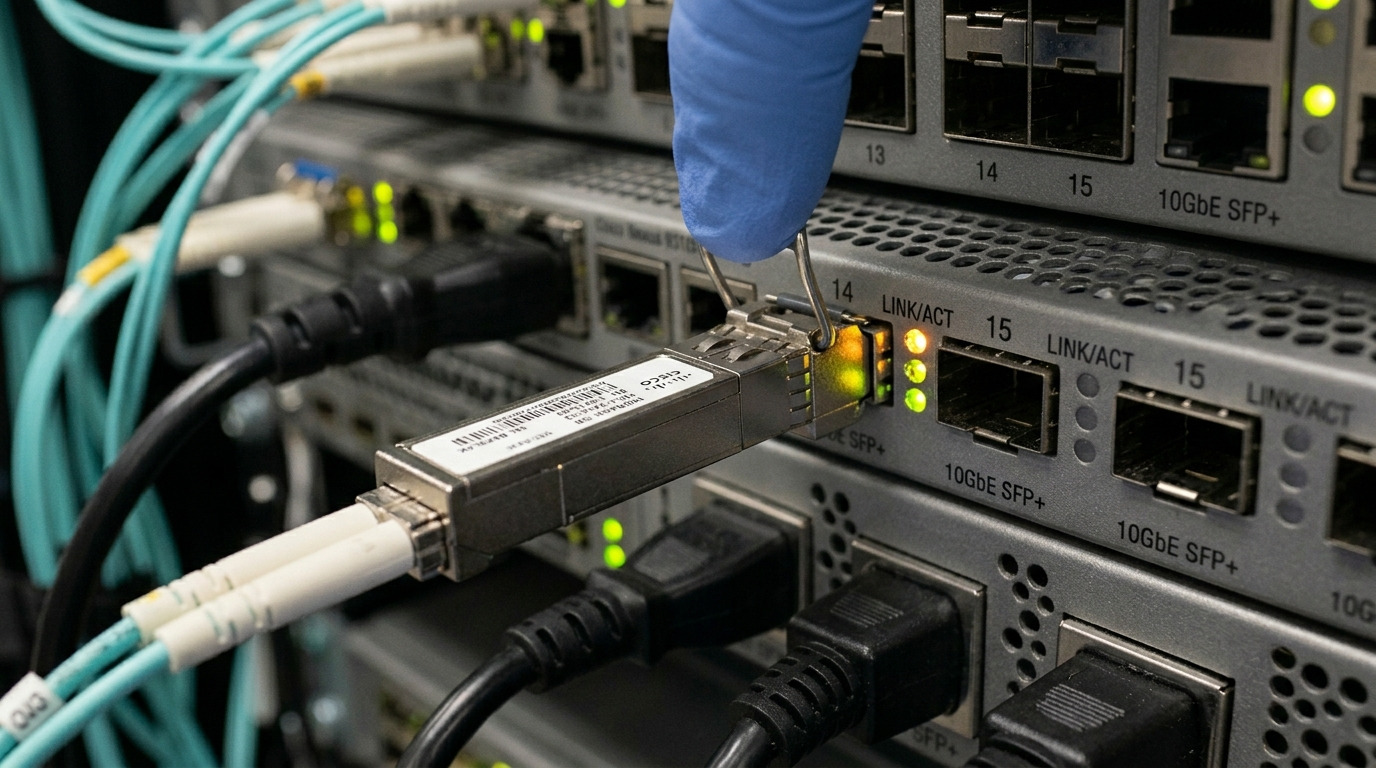
Engineers often calculate ROI using just line-rate and capex, but the real driver in 800G upgrades is often power and downtime cost. In many leaf-spine designs, the upgrade affects not only optics and transceivers but also fan speeds, PSU loading, and thermal headroom. On the revenue side, higher bandwidth can reduce oversubscription, improve east-west latency, and defer additional switch purchases.
For a practical ROI model, treat each upgraded port as delivering (a) capacity, (b) reduced congestion risk, and (c) operational savings from fewer parallel links. Example: if you replace a 400G uplink with an 800G uplink, you may cut the number of parallel optics you maintain, but only if your chassis and fabric can actually run 800G line cards at the required optics. That is why ROI hinges on compatibility checks, not just “will the vendor sell me 800G.” For baseline Ethernet requirements, use the IEEE Ethernet standard family as your reference point for signaling and link behavior: IEEE 802 Ethernet Standards.
Also model failure and maintenance. If you deploy third-party optics, you can reduce purchase price, but you may increase the probability of “marginal optics” events during temperature swings. Operationally, marginal optics show up as intermittent FEC or CRC spikes, which can turn a planned outage into extended troubleshooting time.
800G optics head-to-head: SR8, FR4, and DR4 tradeoffs for ROI
At 800G, the optics decision is where ROI can swing hard because it affects both the bill of materials and the power budget. Most enterprises will encounter short-reach options (commonly SR8-class behavior) for intra-rack or leaf-spine distances, and longer-reach options (often FR4/DR4-class behavior) for campus or cross-row links. The key is that “reach” is not just distance; it is also fiber type, lane count, and connector loss.
Below is a practical comparison to frame the decision. Exact values vary by vendor and specific module grade, so validate against the switch vendor optics matrix and the transceiver datasheet for the exact part number you plan to buy.
| Optics option (typical) | Nominal wavelength band | Typical reach | Connector | Data rate | Power / module (order-of-magnitude) | Temperature range (typical) |
|---|---|---|---|---|---|---|
| SR8-class (short reach) | 850 nm | Up to ~100 m over OM4/OM5 (varies) | LC | 800G | ~3 to 8 W depending on vendor | Commercial or industrial variants |
| FR4-class (reach) | ~1310 nm | ~2 km (varies widely) | LC | 800G | ~6 to 10 W typical | Commercial/extended |
| DR4-class (reach) | ~1310 nm | ~500 m to 2 km class (varies) | LC | 800G | ~5 to 9 W typical | Commercial/extended |
For an ROI lens: SR8-class modules usually have the lowest optics cost and power, but you must have the fiber plant to support them. FR4/DR4-class can extend reach, but you may pay more per module and increase power draw, which can slightly reduce your “net savings” if you are constrained by facility power.
If you are updating optics across multiple racks, also account for optics inventory complexity. Mixing module types increases stocking SKUs and raises the risk of ordering the wrong part number for a given switch line card.
Compatibility and migration: how to protect ROI from switch and firmware risk
The fastest way to destroy ROI is to underestimate “it should work” assumptions. 800G upgrades are often gated by switch firmware, optics vendor support, and sometimes specific lane mapping or breakout behavior. Before you buy modules at scale, confirm that your exact switch model and software release support the intended transceiver type and that the platform has the right optics profiles enabled.
For migration, plan for a staged cutover that isolates variables. If you are moving from 400G to 800G on the same physical endpoints, you can often validate optics and link training in a maintenance window without touching application routing first. Then you shift routing or LAG membership after you confirm stable error counters.
Field checklist for pre-buy and pre-cutover validation
- Confirm the optics matrix for your exact switch model and firmware version (not just “800G supported”).
- Verify fiber type and loss budget for SR8-class links; check connector type, patch panel attenuation, and polarity/mating.
- Validate DOM support (digital optical monitoring) and alarm thresholds in your network management stack.
- Plan for thermal and power headroom at the chassis level; monitor fan curves and PSU utilization.
- Run a short burn-in test after installation: monitor FEC/CRC counters and link flaps for at least 24 hours.
For standards context around optical performance measurement and link behavior, the Fiber Optic Association can be a practical bridge for operational terminology: Fiber Optic Association. And if your procurement involves structured cabling planning, ANSI/TIA guidance is often used by facilities teams; align your fiber loss assumptions with your cabling standard and measured channel attenuation.
Pro Tip:
In many real 800G deployments, the ROI killer is not the transceiver itself but mismatched expectations around DOM alarms and monitoring thresholds. Engineers who keep default thresholds often miss early degradation signals; tuning thresholds and alerting based on your baseline error counters can prevent a “mystery outage” during temperature ramps.
Cost and ROI: OEM vs third-party optics, plus power and downtime TCO
OEM optics often cost more, but they can reduce integration time and lower the probability of unsupported behavior. Third-party optics can improve ROI if they are validated for your switch, but you must budget for additional testing and potential return shipping. The total cost of ownership (TCO) should include spare inventory, labor hours for validation, and the operational cost of extended troubleshooting.
Realistic price ranges vary by market and volume, but for planning purposes you can expect 800G optics to land roughly in a “hundreds to low thousands per module” range depending on reach type and vendor. For ROI, the key is how quickly you can amortize those costs against avoided capex (deferred additional ports or switches) and avoided operational spend (fewer parallel links, reduced congestion incidents).
Power also matters. If your facility is nearing power density limits, the incremental watts per module can affect your ability to scale. Even if the per-module delta looks small, multiply it across dozens of optics per row and across multiple stages of expansion.
Selection criteria and decision matrix for maximizing ROI on 800G
When teams say “we want best ROI,” they usually mean best combination of compatibility confidence, installed cost, and risk-adjusted uptime. Use the ordered checklist below, then map each option to your environment.
Decision checklist engineers use
- Distance vs reach: confirm actual patch-to-patch length and fiber grade (OM4 vs OM5) and connector loss.
- Switch compatibility: verify optics support in the platform optics matrix for your firmware release.
- DOM and monitoring: ensure your monitoring stack can read and alert on DOM metrics.
- Operating temperature: confirm module grade matches your rack inlet temperature and airflow profile.
- Budget and lead time: include procurement lead times and spare strategy for the first 90 days.
- Vendor lock-in risk: evaluate whether you can standardize on a small set of module part numbers across sites.
Decision matrix (risk-adjusted ROI)
| Option | Best for | ROI upside | Compatibility risk | Operational risk | Notes |
|---|---|---|---|---|---|
| SR8-class OEM | Short reach leaf-spine, stable fiber plant | High if fiber is ready | Low | Low | Often simplest path to predictable uptime |
| SR8-class third-party | Cost-sensitive short reach with validation capacity | Medium to high | Medium | Medium | Budget time for burn-in and monitoring tuning |
| FR4/DR4-class OEM | Campus or cross-row reach needs | Medium | Low | Low | Higher unit cost but fewer surprises |
| FR4/DR4-class third-party | Reach-constrained sites with strict testing | Medium | Medium | Medium to high | Confirm reach margin with measured link loss |
Common mistakes and troubleshooting that hit 800G ROI hardest
Even strong planning fails when field details slip. Here are common failure modes that directly impact ROI through downtime and labor.
“Reach is fine on paper” but the link still won’t come up
Root cause: Link budget assumed from a datasheet, but real channel loss is higher due to patch panels, dirty connectors, or unexpected fiber grade. SR8-class optics are especially sensitive to end-to-end loss and connector cleanliness.
Solution: Measure with an OTDR or certified loss test, clean connectors, re-terminate if needed, and verify polarity/mating. Then rerun link bring-up and monitor error counters for at least 24 hours.
DOM alarms are ignored until the outage
Root cause: Monitoring thresholds are left at defaults, so early warnings (rising optical power drift, temperature excursions, or FEC correction trends) do not trigger actionable alerts.
Solution: Establish baselines after installation. Alert on deviations from baseline rather than only on hard link-down events.
Firmware mismatch causes intermittent instability under load
Root cause: The switch supports 800G, but your exact firmware release has incomplete compatibility with the optics profile or DOM handling. Instability often appears only under specific traffic patterns or after a warm reboot.
Solution: Validate with the vendor’s recommended firmware for your optic part numbers. If you must test new optics, do it on a pilot line card and keep the rest on known-good software.
Airflow and inlet temperature exceed module limits
Root cause: Rack airflow changes during construction or after adjacent equipment swaps. Some optics operate with tighter temperature envelopes than expected.
Solution: Verify inlet temperatures at the rack and confirm module grades match the environment. Use fan curve telemetry, not just “room temperature.”
Which Option Should You Choose?
If you are maximizing ROI on an 800G upgrade, the best choice depends on your risk tolerance and validation capacity. For most enterprises, the recommendation is to standardize on SR8-class OEM optics for short-reach leaf-spine links when the fiber plant is already certified, because it minimizes integration time and downtime risk.
If you have a mature lab process and can run burn-in tests, third-party SR8-class optics can still deliver strong ROI, but only after you validate the exact switch firmware plus module part numbers and tune monitoring thresholds. If you must use reach optics (FR4/DR4-class), prioritize OEM for first deployment to protect uptime; once your environment is stable, you can evaluate third-party options for later waves.
FAQ
How do I estimate ROI for an 800G upgrade without guessing?
Start with a risk-adjusted model: projected capacity gain, reduced congestion incidents, and the cost of downtime during migration. Then add TCO items like optics spares, labor time for validation, and power draw. Use your measured link loss and baseline error counters to avoid over-crediting “theoretical reach.”
Is SR8 always the best ROI option for leaf-spine?
SR8 is usually best when your rack-to-rack distances and fiber grade support the link budget. If your channel loss is high or you have excessive patching, the reach margin may be too tight, and the ROI drops due to troubleshooting and replacements.
Do third-party optics hurt ROI through compatibility issues?
They can, if you buy at scale without validating against your switch firmware and monitoring stack. If you run a controlled pilot, verify DOM behavior, and burn in for at least a day, third-party optics often improve ROI without unacceptable risk.
What monitoring metrics matter most after installing 800G optics?
Track link up/down events, CRC and FEC correction trends, optical power and temperature via DOM, and any platform-specific counters your switch exposes. The goal is to detect drift early so you fix it before it becomes a hard outage.
How can I reduce downtime during the 800G cutover?
Use a staged approach: validate optics and link training in a maintenance window, then migrate routing or LAG membership only after counters stabilize. Keep spares on hand for the first 90 days and avoid simultaneous changes to firmware and optics if possible.
Where do I find authoritative guidance for Ethernet behavior?
IEEE Ethernet standards are the baseline for Ethernet operation and signaling expectations. For practical field terminology and fiber optics practices, the Fiber Optic Association is a helpful companion, especially when aligning loss testing and connector hygiene with real deployment outcomes.
