
A 3-tier data center network planning an 800G upgrade often discovers that the biggest expenses are not just the transceivers. Engineers quickly face optics procurement risk, power and cooling impacts, and interoperability constraints with existing switches. This article helps network and telecom teams run a defensible telecom cost analysis for 800G deployment challenges, with real operational numbers, selection criteria, and troubleshooting tactics.
Where 800G costs actually accumulate in telecom networks
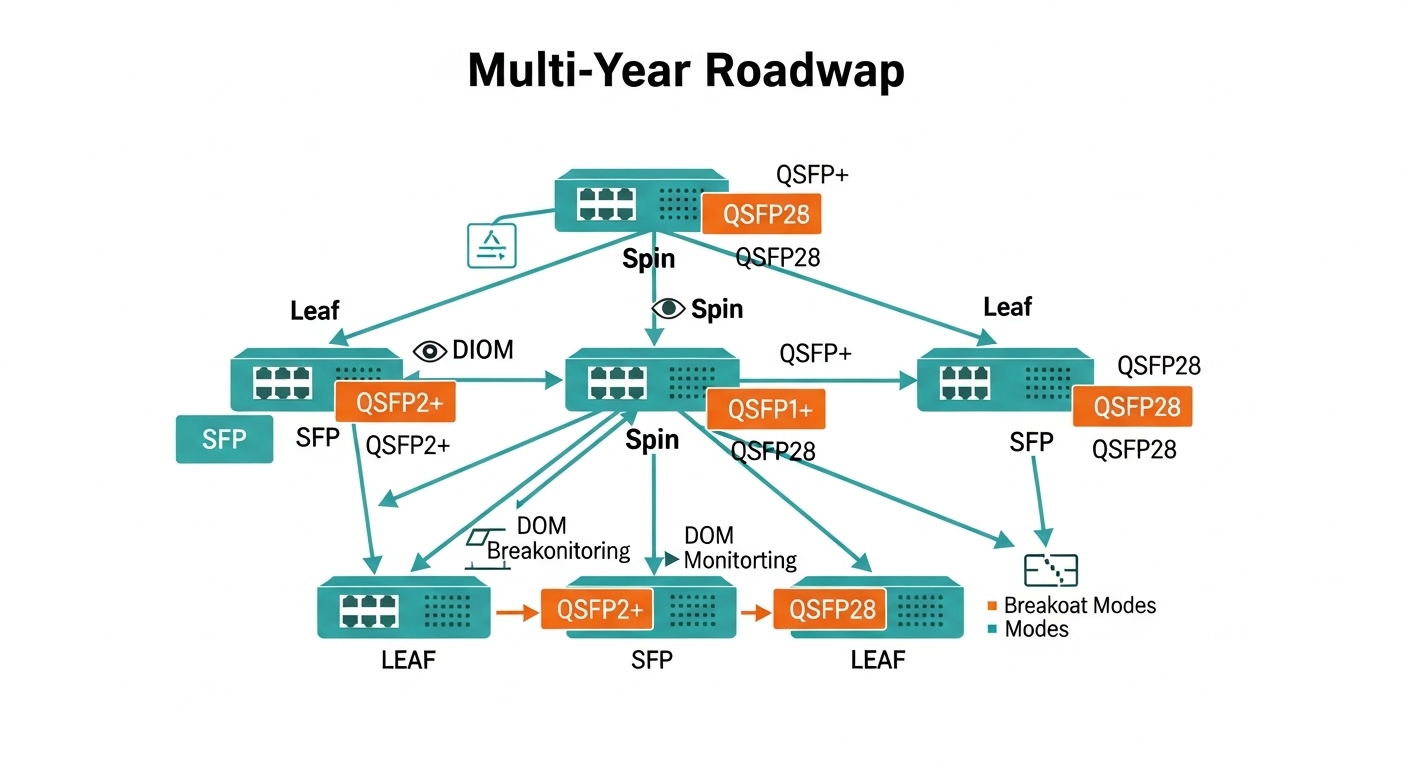
For 800G, cost is a stack: optics and pluggables, switch ports and licensing, cabling and breakouts, power delivery, and cooling. Many budgets underestimate downstream effects like higher fan speeds, additional UPS capacity, and reduced thermal headroom for adjacent line cards. Under IEEE 802.3, 800G Ethernet variants (commonly 800GBASE-R) define electrical and optical interfaces, but vendors implement them with different optics form factors and vendor-specific diagnostics. In a real rollout, you often pay twice: once for procurement and again for rework when optics do not meet switch expectations for DOM, reach, or lane mapping.
From a field perspective, the typical cost drivers map to four buckets. First is optics BOM: QSFP-DD800 or OSFP-class modules, plus any required breakout cables or MPO/MTP harnesses. Second is energy and cooling: every additional watt on the line card and optics becomes a cooling load, often expressed as a PUE-adjusted cost. Third is downtime risk: failed link bring-up can force costly truck rolls and extended maintenance windows. Fourth is compatibility and lifecycle: third-party optics may be cheaper, but they can increase failure rates and trigger returns, spares, and warranty disputes.
Technical constraints that change the telecom cost analysis
Before you price optics, confirm the physical and electrical constraints that determine whether links will train and stay stable. 800G optics commonly use multi-lane architectures with specific wavelength bands and signaling rates; the switch expects particular lane mapping, signal format, and receiver sensitivity. If you select an optics reach class that is marginal for your fiber plant (for example, older OM4 links with higher insertion loss), you may see intermittent CRC errors, which then inflate costs through extended troubleshooting and replacement spares.
In most deployments, engineering teams also track DOM telemetry (Digital Optical Monitoring) availability and behavior. DOM data is not merely a convenience; it is often used by the switch to validate optical health, trigger maintenance thresholds, and enforce optics compatibility. A common procurement mistake is assuming that “DOM supported” means “fully compatible with this switch family,” when in reality vendor-specific thresholds and EEPROM layouts can differ.
| Parameter | Example 800G SR8-class (multimode) | Example 800G LR8-class (single-mode) | Why it matters for cost |
|---|---|---|---|
| Typical wavelength | ~850 nm band | ~1310 nm band | Determines fiber type compatibility and cabling cost |
| Typical reach class | Up to ~100 m over OM4 (varies by vendor) | Up to ~10 km over OS2 (varies by vendor) | Impacts whether you need new fiber runs |
| Form factor | QSFP-DD or OSFP depending on vendor | Often OSFP-class for long reach | Drives switch port and cage compatibility |
| Connector / interface | MPO/MTP (often 8-fiber groups) | MPO/MTP (often 8-fiber groups) | Determines harness cost and spares strategy |
| Power (optics only) | ~8 to 15 W typical range (datasheet dependent) | ~8 to 15 W typical range (datasheet dependent) | Feeds into cooling and PUE-adjusted OPEX |
| Operating temperature | Typically industrial or extended ranges | Typically industrial or extended ranges | Out-of-range modules can raise failure and return costs |
| DOM support | Usually supported | Usually supported | Switch validation and telemetry health checks |
For authority, treat reach and power assumptions as vendor-specific and verify against the actual datasheet for the module you intend to buy. For 10G/25G/100G optics, the industry has long relied on IEEE 802.3 specifications; for 800G, confirm the exact clause aligned to your transceiver type and switch implementation. Relevant reference points include the Ethernet physical layer framework in IEEE 802.3 standards portal.
Deployment scenario: calculating ROI for a leaf-spine 800G refresh
Consider a 48-rack data center with a leaf-spine topology. Each leaf switch has 16 uplink ports used for spine connectivity, and you upgrade from 400G to 800G on the uplinks. In total, you deploy 48 leaves x 16 uplinks = 768 800G links. Suppose you select multimode for intra-row spans with an expected 80 m average cabling distance, and single-mode for longer inter-row spans averaging 2.5 km.
Now translate optics cost and energy into a telecom cost analysis. If an 800G SR8-class module costs roughly $1,500 to $2,500 per pair equivalent (pricing varies heavily by OEM, volume, and availability), and you need 768 links, optics procurement alone can land in the $1.1M to $2.0M range. If your optics and line cards add an incremental 10 W per module over the prior generation (estimate from datasheets and switch power telemetry), then energy cost becomes material: 768 links x 2 modules per link x 10 W = 15.36 kW incremental. With a conservative electricity cost of $0.10 per kWh and uptime of 8,760 hours, annual energy is about $13,400, before PUE multipliers and cooling inefficiency. In practice, cooling and fan curves can push the effective cost higher, and the ROI equation often becomes dominated by power and reliability rather than optics-only price.
Selection criteria checklist for cost control and interoperability
Engineers can reduce telecom cost analysis uncertainty by using an ordered checklist that aligns technical fit with lifecycle risk. Use this sequence during bid evaluation and link validation planning.
- Distance and reach class: Confirm measured fiber loss and connector insertion loss, not just nominal reach. Validate with an OTDR or at least a certified loss report for each MPO/MTP path.
- Switch compatibility: Verify the exact module family is supported in the switch interoperability list, including DOM behavior and alarm thresholds. If you plan third-party optics, run a pilot batch before scaling.
- Optics form factor and port constraints: Confirm whether the switch uses QSFP-DD, OSFP, or a vendor-specific cage. Mismatched form factors are a procurement dead-end.
- DOM and diagnostics: Ensure that DOM telemetry fields used by your network management system (for example, temperature bias, received power, and alarm bits) are exposed and consistent.
- Operating temperature and airflow margin: Match module operating range to your measured inlet temperature at the rack. If you run near upper limits, plan for higher failure rates and proactive spares.
- Power and cooling impact: Pull actual transceiver and port power from switch telemetry where possible. Model PUE and cooling efficiency instead of using optics power alone.
- Vendor lock-in risk: Compare OEM pricing to third-party. Include warranty handling and return logistics in total cost, not just unit price.
- Spare strategy and MTTR: Calculate the operational cost of downtime. A cheap module that increases MTTR can erase savings.
Pro Tip: In many 800G bring-ups, the “it links but it flakes” problem is not reach alone. Field teams often find that marginal fiber cleaning, high return loss on MPO polarity, or uneven lane power cause training to succeed initially but degrade under temperature cycling. Build a test plan that includes repeated link training and receive power monitoring across your expected inlet temperature range, not just a one-time verification.
Common pitfalls and troubleshooting that inflate telecom costs
Even well-engineered plans can fail in ways that multiply cost through rework and downtime. Below are concrete failure modes and practical fixes.
-
Pitfall 1: Assuming “OM4 is OM4” for SR-class 800G
Root cause: Certified loss varies widely by vendor, age, and connector quality; MPO harnesses can add unexpected insertion loss.
Solution: Use certified channel loss and connector specs; inspect and re-terminate or re-clean MPO endfaces. Validate with a link margin test and monitor receive power during temperature ramp. -
Pitfall 2: Third-party optics fail switch alarm thresholds
Root cause: DOM telemetry formatting or alarm threshold semantics differ; the switch can mark modules as degraded even if the link passes traffic.
Solution: Pilot with your exact switch model and firmware version, then confirm that management systems interpret DOM consistently. Align with your network monitoring thresholds and log DOM fields during a controlled soak test. -
Pitfall 3: MPO polarity and mapping errors after cabling changes
Root cause: Polarity rules differ by harness type and vendor lane mapping. A polarity mismatch can cause high error rates or intermittent loss.
Solution: Verify harness type, polarity markings, and lane mapping. Use a repeatable labeling scheme and document polarity orientation before any swap. -
Pitfall 4: Underestimating cooling headroom for high-density port upgrades
Root cause: Higher port density changes airflow patterns; modules near the hottest zone experience thermal stress and higher error rates.
Solution: Measure rack inlet temperature during peak load, then compare to module operating limits. Rebalance airflow baffles and consider targeted fan curve adjustments where allowed.
Cost and ROI notes: how to model TCO without wishful thinking
For telecom cost analysis, unit price is only the starting point. A realistic TCO model includes optics purchase price, installation labor, cabling/harness changes, spares inventory, warranty handling, and the economic cost of downtime. OEM optics can cost more, but they often reduce compatibility risk and shorten troubleshooting cycles. Third-party optics can be cheaper, yet the savings can vanish if you need extra spare modules, multiple truck rolls, or firmware-specific workarounds.
In many deployments, ROI is most sensitive to two variables: failure probability and time-to-repair. If you can reduce MTTR by standardizing optics validation procedures and using consistent harness polarity documentation, you preserve uptime and reduce labor costs. Also include power and cooling in the model: even modest incremental wattage across hundreds of links can compound into meaningful annual OPEX, especially under high PUE environments.
FAQ
What inputs do I need for telecom cost analysis of 800G optics?
Start with the exact switch model and firmware, the number of 800G ports, and the optics form factor required (QSFP-DD or OSFP class). Add certified fiber loss per route, expected ambient rack inlet temperatures, and your electricity plus cooling cost model using PUE. Finally, include spares and warranty return logistics, since those drive operational cost beyond the BOM.
Is third-party optics always cheaper for 800G?
Third-party optics often have lower unit pricing, but the real comparison is TCO. If they create higher failure rates, trigger alarm mismatches, or require extra validation time, the savings can disappear. Run a pilot batch with your exact switch and monitor DOM and link error counters over a soak period.
How do I estimate energy impact for an 800G upgrade?
Use switch telemetry to measure actual incremental power at the port or line card level when possible. If that is not available, use optics datasheet power as a baseline, then apply a cooling multiplier based on your PUE and airflow efficiency. Model the full year and include peak-load conditions, not just average load.
What fiber mistakes most often break 800G links?
The most common issues are excessive insertion loss, dirty or damaged MPO endfaces, and polarity or lane mapping errors after re-cabling. Verify with certified channel loss and perform endface inspection and cleaning using proper MPO procedures before you blame optics reach. Also confirm that harness polarity matches the vendor mapping guidance.
How can I reduce downtime during 800G migration?
Use staged cutovers, pre-stage spares with identical part numbers, and run a pre-validation checklist that includes DOM interrogation and receive power thresholds. Maintain a rollback plan and ensure that maintenance windows are aligned with fiber cleaning and labeling readiness. Standardizing bring-up scripts reduces human error and MTTR.
Which standards and references should I cite in a procurement justification?
Reference IEEE 802.3 for Ethernet physical layer requirements and use vendor datasheets for reach, power, connector type, and DOM behavior. Also cite your switch vendor interoperability guidance and any published optics qualification lists for the specific platform. This combination makes your telecom cost analysis defensible to both engineering and finance stakeholders.
If you want a follow-on angle, review power-and-cooling-optimization-for-high-speed-links to tighten the OPEX side of your model. For procurement teams, the next step is to build a pilot validation plan that proves compatibility and stability before scaling to hundreds of 800G links.
Disclaimer: This article is for informational purposes only and does not constitute legal advice. For regulatory or contracting issues, consult qualified counsel in your jurisdiction.
Author bio: I have deployed high-speed transceiver migrations in production data centers, validating DOM telemetry, link error counters, and thermal margins during cutovers. I also draft procurement justifications that translate technical constraints into measurable telecom cost analysis and TCO outcomes.
