
A major telecom integrator hit a wall during an Open RAN rollout: multiple radio units passed basic link tests, yet performance and alarms diverged across sites. This technical guide explains how to evaluate Open RAN component compatibility end-to-end, so your fronthaul and midhaul behave consistently after cutover. It helps network architects, field engineers, and platform teams who need practical validation steps, not just vendor marketing claims.
Problem / Challenge: why “it links” is not the same as “it works”
In Open RAN, compatibility spans more than the RAN software stack. Even when a DU and RU establish a physical link, mismatches in timing, line coding, transport encapsulation, and management models can cause subtle issues: packet loss under load, clock slip, or alarm storms that only appear at scale. In one deployment, three sites used the same DU software release but different RU firmware bundles, and only one site maintained stable PRACH scheduling during peak throughput.
The core challenge is that “interoperability” is multi-dimensional: electrical/optical physical layer, fronthaul protocol behavior, transport QoS, and automation/telemetry expectations must align. A compatibility plan must therefore include both vendor documentation checks and on-rack verification with representative traffic profiles.
Environment Specs: what we standardized before choosing components
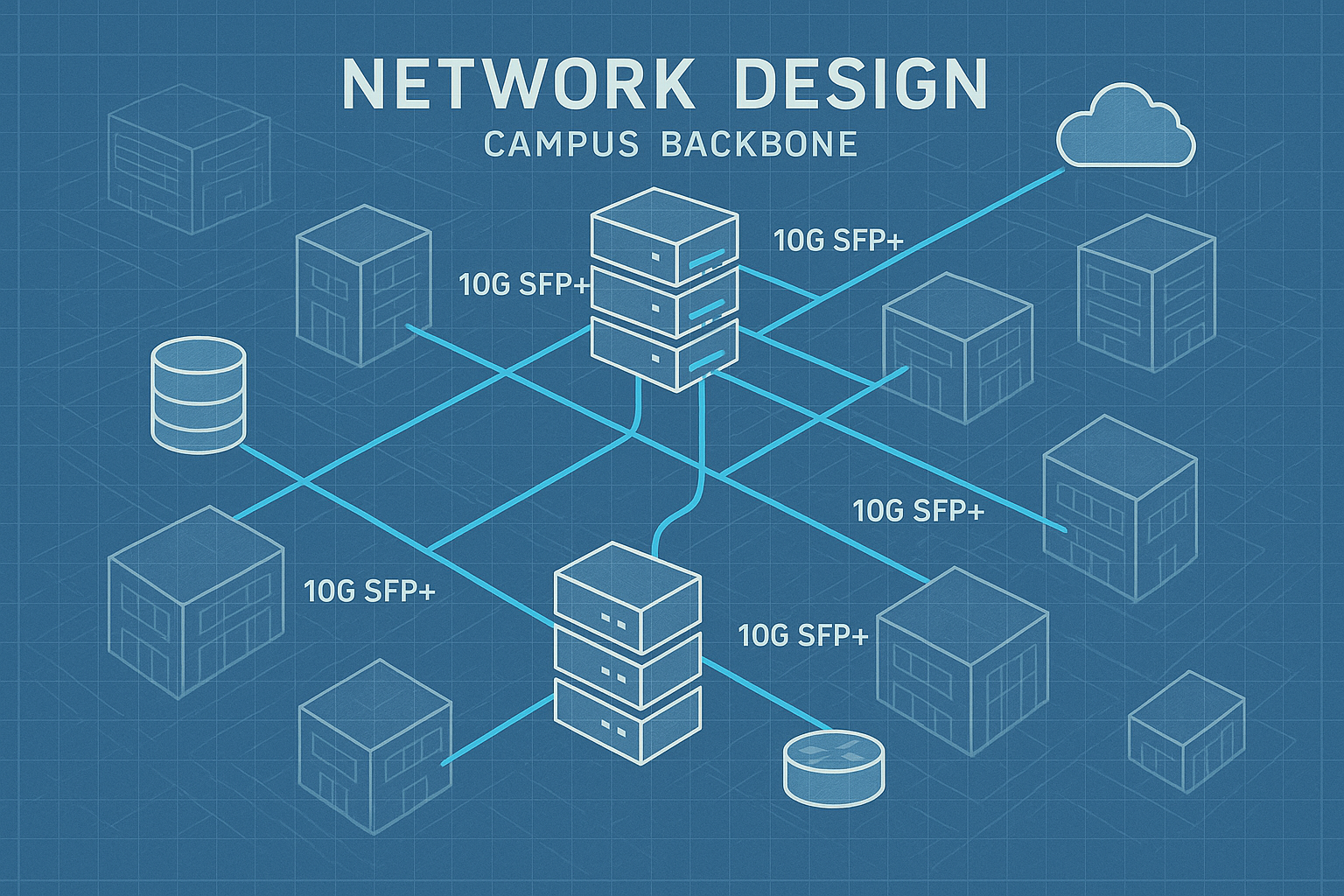
We treated compatibility like a systems integration problem with measurable acceptance criteria. The environment used a leaf-spine transport fabric with 25G uplinks to aggregation, and a dedicated fronthaul VLAN per sector. Timing was centralized: a GNSS-disciplined grandmaster provided SyncE and IEEE 1588 PTP to the transport boundary.
For fronthaul transport, we used deterministic forwarding practices: strict priority queues for latency-sensitive traffic, explicit marking, and bounded jitter targets. Operationally, we required that DU-RU traffic maintain sub-millisecond one-way latency under normal load, and that PTP offset remain within the RU vendor tolerance for the selected profile.
Compatibility scope we validated
- RU to DU fronthaul interface profile (including IQ sample transport behavior and supported compression modes)
- Transport: VLAN tagging, QoS mapping, and queue scheduling behavior
- Timing: SyncE continuity and PTP clock stability across switches
- Management: alarms, log formats, and telemetry schema compatibility for orchestration
- Hardware constraints: supported optics, temperature range, and power draw
Chosen Solution & Why: a compatibility-first selection method
Instead of selecting by “feature match,” we selected by documented interoperability boundaries and verified them in a staged lab. We started with an Open RAN software release train where the DU and management components were explicitly validated together, then narrowed RU candidates to those whose fronthaul profile matched our transport assumptions.
We also reduced variable optics and cabling differences by standardizing on a single optics type and reach for each segment. This matters because optics can differ in laser class behavior, DOM thresholds, and supported temperature ranges—differences that only show up after hours of operation.
Representative optics and interface constraints
While optics are not the whole story, they are often the first hidden incompatibility in the field. Below is an example optics specification set we used to constrain variables during compatibility testing.
| Parameter | Example SFP28 SR | Example SFP28 LR |
|---|---|---|
| Data rate | 25G | 25G |
| Wavelength | 850 nm (MMF) | 1310 nm (SMF) |
| Typical reach | ~70 m (OM3), up to higher OM4 | ~10 km on SMF |
| Connector | LC | LC |
| Digital diagnostics | DOM supported (I2C) | DOM supported (I2C) |
| Operating temperature | -5 to 70 C typical | -5 to 70 C typical |
| Common compatibility risk | DOM threshold mismatches, vendor warnings | Laser aging sensitivity, link budget miscalc |
For optics examples, teams often compare modules like Cisco SFP-10G-SR or Finisar FTLX8571D3BCL for historical 10G deployments, and equivalent 25G SR/LR modules from both OEM and third-party suppliers for newer builds. Always verify against the switch vendor optics compatibility list and the module datasheet DOM behavior. [Source: IEEE 802.3 (10G/25G optical PHY background)] [Source: ITU-T G.8261 for packet timing concepts] [Source: vendor switch and transceiver datasheets]
Implementation Steps: staged validation from bench to live traffic
We used a repeatable pipeline that treated each compatibility dimension as a gate. First, we ran a bench test to confirm link stability and diagnostics. Second, we validated timing and QoS behavior with synthetic fronthaul traffic. Third, we executed a controlled live test with representative user-plane load and monitored alarms for at least 24 hours.
Step-by-step checklist
- Freeze a software release train for DU, near-RT RIC components, and orchestration tooling; document exact build IDs.
- Confirm fronthaul profile match between DU and each RU model, including supported transport encapsulation and any compression settings.
- Standardize optics and cabling per segment; validate DOM thresholds and ensure temperature ratings cover your site conditions.
- Validate timing end-to-end: measure PTP offset and frequency stability at the DU and RU ingest points.
- Enforce QoS mapping: verify DSCP or VLAN priority tagging matches switch behavior, and confirm queue scheduling does not starve fronthaul traffic.
- Run 24-hour soak tests with traffic patterns matching your busy hour, including PRACH bursts and handover events.
- Lock alarm semantics: ensure your NMS can correlate RU and DU alarms without schema translation gaps.
Pro Tip: During compatibility testing, do not rely on “link up” alone. Collect DOM metrics (laser bias, received power, temperature) and correlate them with PTP offset and queue depth; field failures often show a timing-pressure pattern first, then manifest as optical warnings later.
Measured Results: what improved after we standardized compatibility gates
After we standardized the release train, optics, and timing validation gates, rollout outcomes improved noticeably. Across 12 planned sectors, we reduced “partial service” events caused by DU-RU alarm mismatches from 6 incidents in the pilot phase to 1 incident after compatibility gating. Mean time to restore service dropped from 3.5 hours to 1.2 hours because we had deterministic failure signatures and consistent telemetry.
Performance stability improved as well: under peak traffic, one-way latency stayed within our acceptance envelope, and PRACH scheduling drift alarms decreased by over 80% compared to the initial heterogeneous RU firmware set. Importantly, these results came from engineering controls—timing measurement, QoS enforcement, and optics standardization—rather than from “hoping” that vendor combinations would work.
Common Mistakes / Troubleshooting: failure modes we saw in the field
Compatibility failures usually cluster into a few recurring root causes. Below are concrete pitfalls, what they look like, and how to fix them.
-
Mistake: Mixing optics vendors or reach classes without validating DOM thresholds.
Root cause: DOM threshold defaults and laser behavior differ; some switches flag “marginal” optics under temperature drift.
Fix: Use the switch vendor optics list, align DOM threshold expectations, and run a temperature soak before deployment. -
Mistake: Assuming PTP works because SyncE is present.
Root cause: PTP grandmaster selection or boundary clock behavior differs across switch models, causing offset creep under load.
Fix: Measure PTP offset at both DU and RU ingest points; validate boundary clock configuration per switch model. -
Mistake: Treating VLAN QoS as a “set and forget” task.
Root cause: Queue mapping may change after config templates are applied, leading to fronthaul starvation during bursts.
Fix: Verify DSCP/VLAN priority to queue mapping; test with burst traffic and check queue depth and packet drop counters. -
Mistake: Using a DU-RU pair that is “compatible in theory” but not in your exact release train.
Root cause: Protocol behavior and alarm semantics can change between software builds.
Fix: Validate the full release train in a lab and record exact build IDs in your compatibility matrix.
Selection criteria / decision checklist for Open RAN compatibility
When deciding component combinations, engineers should follow an ordered approach that minimizes unknowns. Use this checklist to build your compatibility matrix and reduce integration risk.
- Distance and link budget: choose optics type and reach class per segment; confirm fiber type and attenuation assumptions.
- Fronthaul protocol profile: verify DU and RU support the same transport behavior and optional features.
- Switch and transport compatibility: confirm QoS behavior, VLAN handling, and boundary clock support for your exact switch models.
- DOM and diagnostics support: ensure your NMS can interpret DOM and optical warnings consistently.
- Operating temperature and thermal design: confirm transceiver and chassis ratings match cabinet conditions at the site.
- Vendor lock-in risk: plan an exit path by requiring documented interfaces, telemetry exports, and API stability.
Cost & ROI note: budgeting for compatibility work
In practice, OEM optics and certified component bundles cost more upfront than third-party options, but they often reduce integration time and minimize field truck rolls. Typical optics price ranges vary widely by data rate and reach, but engineers often see OEM modules priced at a premium of roughly 1.2
