
Smart cities depend on reliable backhaul for CCTV, traffic analytics, edge AI, and municipal IoT gateways. In the field, the bottleneck is rarely the application layer; it is the optical link budget, transceiver compatibility, and operational temperature margins. This article helps network and infrastructure engineers design and maintain fiber transport using SFP, SFP+, and QSFP pluggable optics with measurable selection criteria and failure-mode troubleshooting.
Where smart cities actually stress optical links
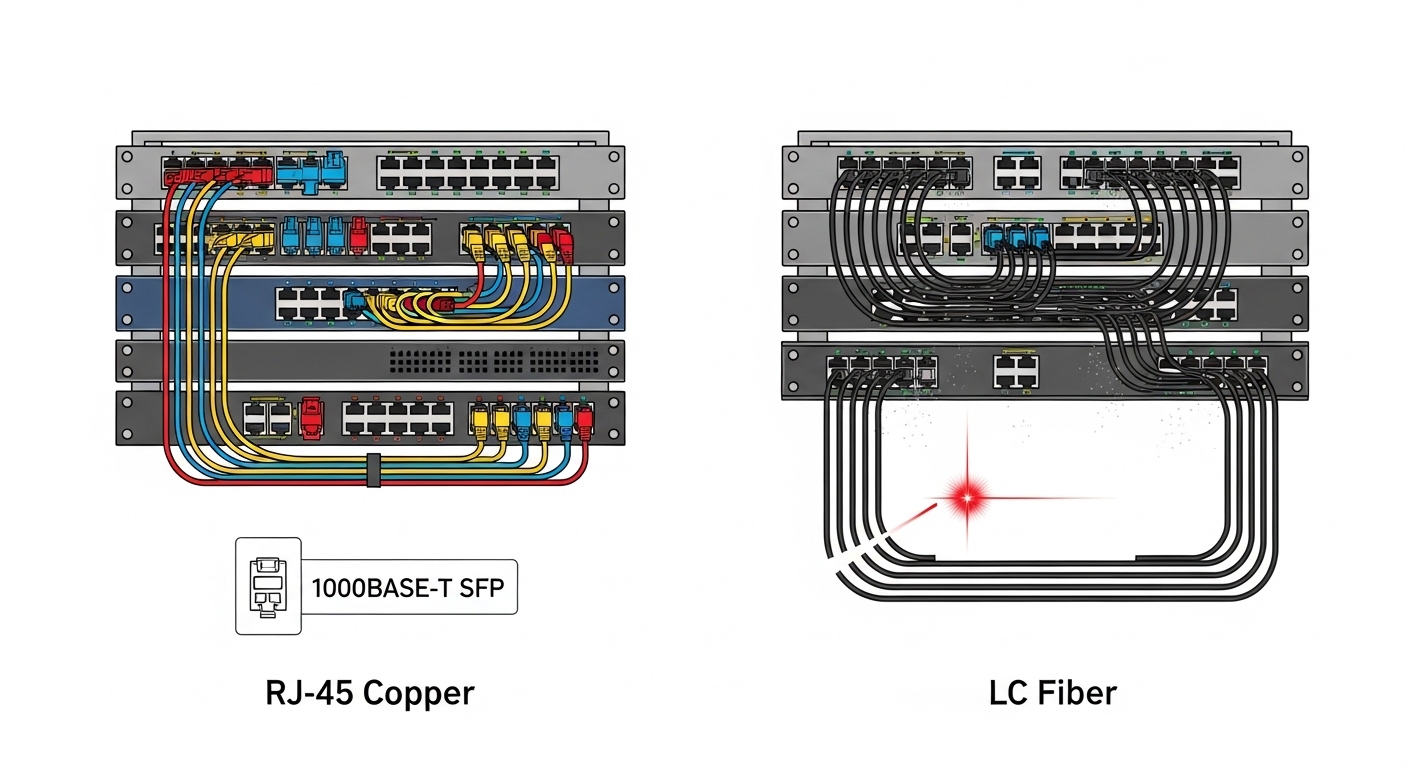
Municipal networks often combine fiber for aggregation with short-reach optics for local rings, then extend to metro or regional transport. A typical pattern is leaf-spine or aggregation switches at a public safety building, then fiber to street cabinets, traffic control rooms, and remote edge compute. Unlike enterprise data centers, smart city environments add thermal cycling, vibration, and occasional connector contamination from field work. As a result, engineers must treat optical modules as safety-critical components, not consumables.
From an IEEE perspective, the physical layer for Ethernet over fiber is defined by IEEE 802.3 (for example, 10GBASE-SR, 25G/50G variants, and their electrical/optical signaling behavior). In parallel, vendors implement industry-standard management interfaces (commonly the SFF-8472 DOM model for SFP/SFP+ and SFF-8636/SFF-8436 for higher-speed pluggables). The practical outcome: you can automate monitoring, but only if your switch supports the module’s DOM and you validate diagnostics thresholds early.
Typical smart city link map
A field-ready design usually includes three optical classes: short reach for street cabinets and nearby aggregation, extended reach for campus-to-substation runs, and metro for backhaul to a regional POP. Example: CCTV and LPR cameras might connect to an edge switch using 10G SR to a nearby aggregation point, while the aggregation uplinks use 40G/100G optics over OM4 or single-mode fiber depending on distance and budget.
Optical module types that fit smart city architectures
Pluggable optics span multiple form factors and wavelengths, but the selection logic is consistent: match data rate and lane encoding, confirm connector and fiber type, and verify reach versus measured link loss. For smart cities, engineers typically use multimode for short reach (often OM3/OM4) and single-mode for longer metro segments. The most common operational risk is assuming “spec reach” equals “installed reach” without accounting for patch panel loss, dirty connectors, and aging.
Core spec comparison engineers should use
The table below summarizes representative modules frequently seen in municipal deployments. Always confirm exact model numbers against your switch vendor compatibility list, because optics can be electrically similar yet behaviorally different under DOM thresholds.
| Module (example model) | Data rate | Wavelength | Reach target | Fiber type | Connector | Typical power / class | Operating temp | DOM |
|---|---|---|---|---|---|---|---|---|
| Cisco SFP-10G-SR | 10G | 850 nm | ~300 m (OM3) | Multimode | LC | Low single-digit W | Commercial / Industrial variants | Supported |
| Finisar FTLX8571D3BCL (10G SR) | 10G | 850 nm | ~400 m (OM4) | Multimode | LC | Low single-digit W | Industrial grade available | Supported |
| FS.com SFP-10GSR-85 (10G SR) | 10G | 850 nm | ~300 m (OM3) / ~400 m (OM4) | Multimode | LC | Low single-digit W | Industrial options available | Supported |
| Common 40G SR4 / 100G SR4 class (varies by vendor) | 40G or 100G | ~850 nm | Hundreds of meters | Multimode (OM4) | LC (multi-fiber) | Higher than 10G | Varies by grade | Supported |
For authority on physical layer behavior and Ethernet over fiber expectations, consult IEEE 802.3 clause mappings for each speed and reach class. For management and pluggable transceiver information models, use SFF documentation referenced by vendor datasheets. Source: IEEE 802.3 Standards Source: SNIA (general fiber and monitoring context). For concrete module electrical/optical specs, rely on vendor datasheets such as Cisco and Finisar (Finisar is now part of publicly documented supplier ecosystems; exact naming varies by product family). Source: Cisco product datasheets.
Choosing multimode vs single-mode in the real world
In smart cities, multimode is attractive for short runs because OM3/OM4 fiber is common in legacy ducts and can reduce cost per port. However, multimode budgets are more sensitive to connector quality and patch panel density because modal dispersion and link margin depend on launch conditions. Single-mode optics, while often more expensive per transceiver, can be more forgiving across longer distances and varied splicing practices. The key is to measure installed link loss and not rely on “fiber distance” alone.
Pro Tip: In street cabinet builds, engineers often discover that the dominant loss term is not the fiber run length but the patching workflow. If you clean and re-terminate LC connectors and re-measure with an OLTS after the final labeling pass, you can recover enough margin to avoid field swaps of 10G SR optics that otherwise fail intermittently.
Selection criteria checklist for smart city optical module procurement
Engineers should treat optics selection as a compatibility and risk-management exercise, not a procurement checkbox. The checklist below is ordered to minimize rework and truck rolls.
- Distance and installed loss: Use OTDR or OLTS results for each segment. Convert measured dB loss into a margin plan that includes splice loss, connector loss, and patch panel loss.
- Fiber type and grade: Confirm OM3 vs OM4 (multimode) or single-mode class. Ensure the connector standard matches (LC is common for pluggables).
- Switch compatibility: Verify the exact switch model and transceiver form factor. Even within “10G SR,” some platforms reject optics due to EEPROM ID interpretation or DOM threshold expectations.
- DOM support and monitoring: Confirm DOM is readable and that your NMS can ingest vendor diagnostic fields (Tx power, Rx power, temperature). Validate alert thresholds in a staging environment.
- Operating temperature and enclosure thermal profile: Smart city cabinets can exceed indoor assumptions. Choose industrial grade optics when ambient extremes are likely; target a verified operational temp range supported by the vendor datasheet.
- Budget and power: Higher-speed optics consume more power; in dense cabinets, that affects airflow and fan duty cycles. Account for power draw in TCO.
- Vendor lock-in risk: Prefer pluggables with broadly compatible EEPROM implementations, or adopt a tested third-party program. Maintain a compatibility matrix and require DOM conformance tests.
Distance math that prevents “works on bench, fails in cabinet”
Bench tests often use a short patch cord and a clean lab environment. In the field, link loss includes additional connectors, splice points, and sometimes unplanned patching. The mitigation is simple: require OLTS/OTDR evidence per segment and set a conservative margin threshold, especially for multimode SR at 850 nm.
Common pitfalls and troubleshooting in smart city optical deployments
Optical failures in smart cities are frequently intermittent and environment-driven. The fastest teams follow a disciplined fault isolation path: validate optics presence, validate physical layer parameters, verify power levels, then inspect fiber cleanliness and re-measure.
Intermittent link flaps after cabinet re-seating
Root cause: Dirty or slightly misaligned LC connectors after maintenance create micro-reflections and variable receive power. DOM may show Rx power drifting near the threshold. Solution: Use fiber inspection with appropriate magnification, clean with certified methods, and re-seat connectors with consistent latch engagement. Re-run OLTS or at least verify Rx power stability for several minutes.
“Link up” but high CRC/FCS errors on 10G/25G
Root cause: Marginal optical power due to excess patch panel loss or fiber grade mismatch (OM3/OM4 confusion) can increase error rates even when the link negotiates. Solution: Compare Tx/Rx power readings against vendor recommended ranges; if Rx is near minimum, reduce loss (fewer patches, re-terminate, replace damaged jumpers) and confirm fiber type documentation.
Switch rejects optics or DOM alarms that mask real issues
Root cause: EEPROM ID interpretation differences can trigger “unsupported transceiver” behavior, or DOM fields may not map cleanly to your monitoring thresholds. Solution: Enforce a compatibility matrix per switch SKU and transceiver family. In monitoring, tune thresholds based on observed baseline in a staging cabinet, not just vendor defaults.
Thermal degradation leading to delayed failures in summer
Root cause: Commercial-grade optics installed in harsh enclosures can drift with temperature, reducing laser output or increasing receiver sensitivity noise. Solution: Select industrial grade transceivers with validated operating temp ranges. Also verify airflow and verify that the cabinet’s internal temperature matches the assumptions used in the design review.
Cost and ROI considerations for smart cities optical modules
Pricing varies by speed, vendor, and temperature grade, but a realistic budgeting approach is to consider not only the transceiver unit price but also the cost of downtime and truck rolls. In many municipal builds, OEM optics can cost roughly 1.5x to 3x compared to third-party alternatives, yet OEMs may offer tighter compatibility guarantees. A practical TCO model should include expected failure rates, annual cleaning/inspection labor, and the mean time to replace (MTTR) given your spares strategy.
Power and thermal effects matter at scale: higher-speed optics increase cabinet power density, which can increase cooling costs and fan wear. Engineers can reduce risk by standardizing on a small number of optics families (e.g., 10G SR for edge-to-aggregation, single-mode for metro uplinks) and maintaining a tested spares pool with known DOM behavior. If you need buy-vs-build logic: you typically buy optics off the shelf, but you build the compatibility and monitoring layer internally.
FAQ: smart cities optical module decisions
Which transceiver types are most common for smart cities?
For edge-to-aggregation links inside a campus or street cabinet radius, SFP/SFP+ 10G SR at 850 nm over OM3/OM4 is common. For longer metro uplinks, operators typically move to single-mode optics (wavelengths vary by speed and vendor). Always match the data rate and connector type to the switch and the installed fiber plant.
How do we verify compatibility without risking production downtime?
Build a staging test bench using the exact switch model and the exact optics SKU(s) you plan to deploy. Validate link stability, DOM telemetry readability, and monitoring alert thresholds for at least 24 hours under expected temperature conditions. Then roll out in a canary cabinet before scaling.
Do third-party optics work in smart city networks?
Often yes, but only if you enforce a compatibility matrix and require DOM conformance testing. Third-party optics can differ in EEPROM ID behavior and diagnostic scaling, which may cause monitoring false positives or even transceiver rejection on stricter platforms. The ROI improves when you reduce unit cost without increasing truck-roll frequency.
What is the fastest troubleshooting path when links go down?
Start with operational state and DOM readings: verify the module is recognized and check Tx/Rx power and temperature. Next, inspect and clean the fiber connectors, then confirm link parameters and error counters. If the problem persists, re-measure the link with OLTS or OTDR to isolate loss anomalies.
Should we prioritize industrial-grade optics?
If enclosures experience thermal extremes beyond commercial assumptions, yes. Industrial-grade optics are designed for wider operating temperature ranges, reducing drift-related failures. The cost increase is usually smaller than the cost of repeated seasonal outages.
How does DOM data improve operations for smart cities?
DOM enables proactive maintenance by tracking Tx power, Rx power, and temperature drift. In practice, teams correlate Rx power trending with connector contamination events and schedule cleaning before a threshold breach. This reduces mean time to recovery during seasonal maintenance cycles.
Smart cities succeed when optical transport is engineered like a reliability system: measured link budgets, validated compatibility, and monitoring that reflects installed conditions. If you are planning the broader fiber plant, start with fiber network design for municipal deployments and align transceiver procurement to the measured loss and operational temperature realities.
Author bio: I build and operate fiber and pluggable-optics transport for high-availability networks, focusing on link-budget engineering and DOM-driven monitoring in production. I have deployed these patterns in cabinet-based field networks where thermal cycling and connector hygiene dominate reliability outcomes.
