
In real QKD deployments, the bottleneck is often not the crypto protocol but the fiber transceiver chain: optics, connector cleanliness, reach budget, and timing stability. This article explains the practical role of a quantum communication SFP in Quantum Key Distribution (QKD) over fiber, helping network and field engineers choose, validate, and troubleshoot modules in production. You will also get a ranked selection table and a decision checklist tuned to engineering constraints like DOM behavior, operating temperature, and switch compatibility.
Top 7 ways a quantum communication SFP directly impacts QKD performance
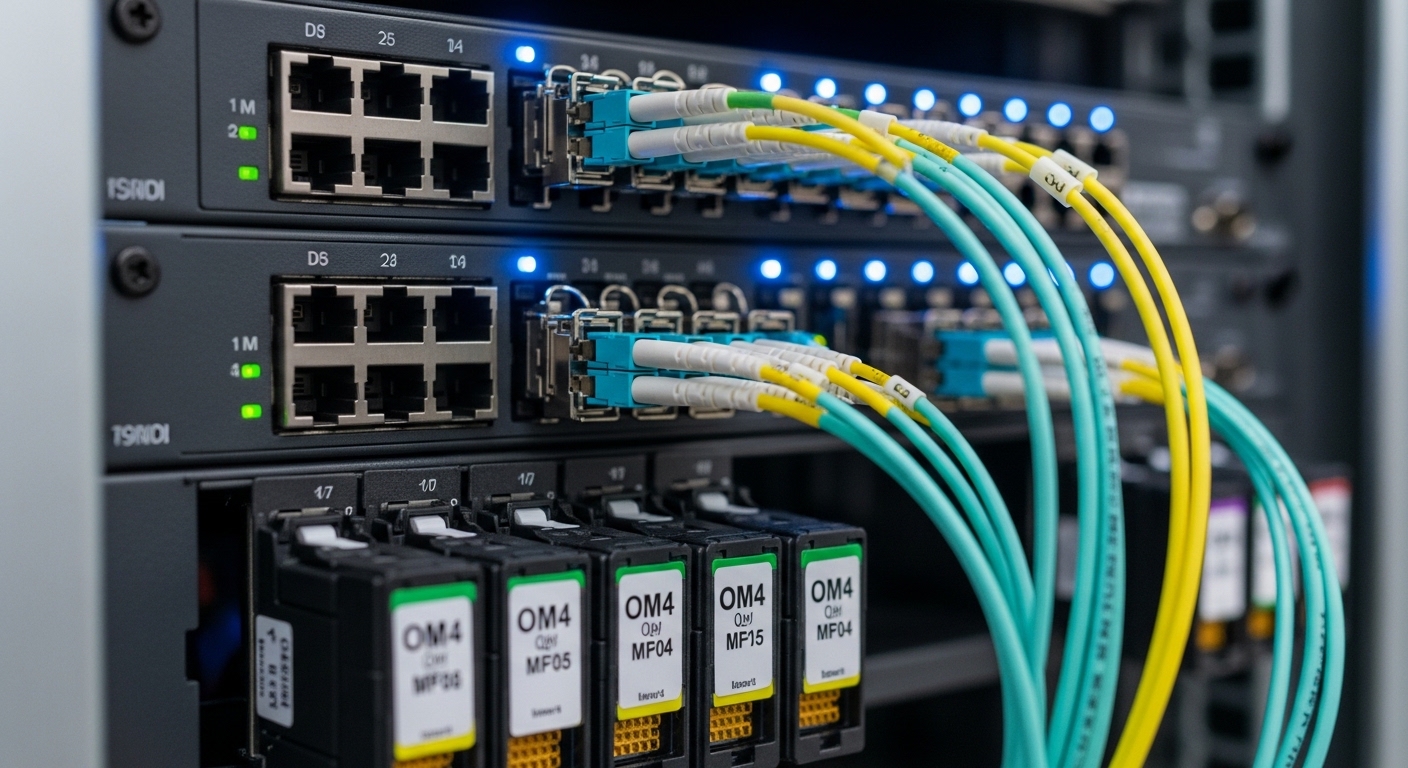
Optical wavelength alignment and spectral fit
A QKD transmitter/receiver pair is extremely sensitive to wavelength plan and channel filtering. A quantum communication SFP must match the system wavelength (commonly around 1310 nm for some QKD links or 1550 nm for longer reach) and maintain spectral stability under temperature drift. In vendor datasheets, look for center wavelength tolerance and side-mode suppression; in practice, I verify with an optical spectrum analyzer (OSA) during acceptance testing.
Best-fit scenario: Your QKD system uses narrow filtering and you are integrating with existing fiber plants where wavelength discipline matters. If your SFP is off by even small tolerances, you can see elevated quantum bit error rate (QBER) after link margin is consumed.
- Pros: Better channel compatibility, lower QBER risk.
- Cons: Higher vendor matching requirements; fewer “drop-in” options.
Link budget: reach, splitter losses, and detector sensitivity
QKD is not “just transport”; the optical power reaching the receiver must stay within a narrow operational window to avoid detector saturation while still supporting single-photon detection. A quantum communication SFP affects link budget through transmitter power, receiver sensitivity, and connector/fiber losses. For field validation, I calculate margin using measured splice loss and connector insertion loss, then confirm with optical power readings at the demarcation.
Best-fit scenario: You run QKD through a campus fiber plant with known splice counts and planned splitters. If you have a 1:16 splitter, budget the splitter insertion loss plus polarization and aging factors.
- Pros: Predictable performance when margin is controlled.
- Cons: Small component losses can collapse the usable key rate.
Timing and jitter behavior that affects sifting rates
QKD systems rely on precise timing for coincidence detection. While SFPs are typically specified for standard data links (IEEE 802.3 style electrical interfaces), QKD transceivers must exhibit low timing jitter, stable modulation characteristics, and predictable startup behavior. I have seen systems fail intermittently when a transceiver’s power-on sequence caused synchronization drift during maintenance windows.
Best-fit scenario: You use QKD with active synchronization over the same transceiver path or share timing references across racks.
- Pros: More stable key generation under real maintenance conditions.
- Cons: Requires careful acceptance testing beyond basic link-up.
Connector and endface cleanliness: the silent killer
A QKD link can be far less forgiving than classical Ethernet because it is operating near the photon-counting threshold. A quantum communication SFP is only as good as the physical interface: dust on an LC/SC endface can introduce micro-reflections and excess attenuation. In deployment work, I treat connector inspection as a procedure: inspect with a fiber microscope, clean with verified cleaning kits, and re-check insertion loss after every re-seat.
Best-fit scenario: You are integrating into an existing MPO/LC patch panel with frequent moves, adds, and cable re-routes.
- Pros: Cleaner optics means lower QBER and fewer “mystery outages.”
- Cons: Requires disciplined field processes and documentation.
DOM and diagnostics: knowing the health before key rate collapses
Digital Optical Monitoring (DOM) information—laser bias current, received optical power, temperature—helps predict degradation. A quantum communication SFP should implement diagnostics reliably and expose readings over the host interface so operators can correlate key rate drops with optical power trends. In practice, I log DOM values at fixed intervals and set alert thresholds based on receiver power and temperature stability.
Best-fit scenario: You need operational visibility for a multi-site QKD network with limited on-site staffing.
- Pros: Faster root cause analysis and proactive maintenance.
- Cons: DOM support varies by switch/host; you must validate telemetry.
Temperature range and thermal stability in real racks
QKD transceivers often run in environments with airflow constraints and thermal gradients. A quantum communication SFP must meet operating temperature requirements and maintain performance within spec across the full range. I have measured cases where a transceiver sat near a hot exhaust zone and drifted enough to push the link outside its acceptable operating window.
Best-fit scenario: You deploy in high-density telco racks, near power supplies, or in outdoor cabinets with varying ambient conditions.
- Pros: Stable performance across seasons.
- Cons: Thermal margins can be tight; airflow design matters.
Compatibility with host systems and electrical interface constraints
Even if the optics are perfect, host compatibility can break the link. Many QKD platforms use custom backplanes or specialized transceiver cages; the quantum communication SFP must match the electrical expectations (including low-speed control signals, laser enable behavior, and any vendor-specific calibration). I recommend checking the transceiver form factor and cage pinout compatibility, and validating with the exact QKD equipment model during lab acceptance.
Best-fit scenario: You integrate transceivers into an existing QKD chassis with strict part numbers and timing requirements.
- Pros: Fewer integration surprises.
- Cons: Vendor lock-in risk is higher than commodity Ethernet optics.
Key quantum communication SFP specifications engineers should compare
When you compare modules, focus on optical wavelength plan, reach assumptions, power levels, connector type, and temperature range. Also confirm that the DOM implementation is supported by your host monitoring stack. Specifications differ by vendor and QKD system design, so treat reach as a budget input, not a guarantee.
| Spec | What to check | Why it matters for QKD |
|---|---|---|
| Wavelength | Center wavelength tolerance (e.g., 1310 nm or 1550 nm) | Filtering and receiver acceptance windows |
| Optical reach | Declared reach under specified loss assumptions | Impacts key rate and QBER margin |
| Tx power / Rx sensitivity | Transmit power range and receiver sensitivity | Single-photon detection window and saturation risk |
| Connector | LC or SC; polish grade; any MPO adaptation | Insertion loss and reflection control |
| Data rate / interface | Host electrical interface expectations | Prevents link-up and timing failures |
| DOM support | Diagnostic availability and telemetry mapping | Enables predictive maintenance and alerts |
| Operating temperature | Specified range (often 0 to 70 C or wider) | Laser drift and performance stability |
Note: For standards context, optical transceiver behavior for classical links often aligns with IEEE 802.3 optics concepts, while QKD systems may apply additional constraints not covered by Ethernet specifications. See [Source: IEEE 802.3].
anchor-text: [Source: IEEE 802.3]
Pro Tip: During field commissioning, log DOM temperature and received optical power at one-minute intervals for the first 24 hours. If you see a slow drift trend that correlates with key rate decay, you can often correct airflow or reseat optics before you ever touch firmware or reconfigure the QKD stack.
Real deployment example: QKD in a leaf-spine campus fiber plant
In a 3-tier campus design with a leaf-spine topology, you may run QKD between two security domains over dedicated dark fiber. For example, the QKD endpoint racks sit 8 km apart with 0.35 dB/km fiber loss, 0.2 dB per splice, and 2.0 dB connector/patch-panel loss per end. After accounting for 18 splices and patch loss, the total loss can approach 8 km × 0.35 = 2.8 dB plus 18 × 0.2 = 3.6 dB plus 4.0 dB connectors, totaling roughly 10.4 dB.
In this scenario, I select a quantum communication SFP whose transmitter output and receiver sensitivity maintain enough margin for the required single-photon detection window. I also validate connector cleanliness at LC interfaces and confirm DOM telemetry works with the host so the operations team can correlate QBER spikes with optical power changes.
Selection checklist: choosing the right quantum communication SFP under constraints
- Distance and loss profile: measure actual fiber attenuation and splice counts; do not rely on cable nameplate alone.
- Wavelength plan: confirm center wavelength tolerance matches your QKD filter bandwidth and acceptance window.
- Budget and availability: compare OEM vs third-party lead times; include warranty and return logistics.
- Switch or cage compatibility: verify that the exact host/QKD chassis supports the transceiver’s electrical and DOM behavior.
- DOM support and telemetry mapping: confirm which parameters are exposed and how thresholds are interpreted.
- Operating temperature: validate against your rack airflow and worst-case ambient conditions.
- Vendor lock-in risk: assess whether you can standardize on a second-sourcing option without protocol requalification.
Common mistakes and troubleshooting tips in the field
Assuming “link-up” equals QKD readiness
Root cause: Classical link tests can pass while QKD-specific timing, filter alignment, or photon budget is out of range. Solution: run QKD-specific acceptance tests (QBER, sift rate, and key rate over a defined stability window), not just optical power or interface link status.
Using the wrong connector polish or dirty endfaces
Root cause: Micro-scratches and contamination increase insertion loss and back-reflections, which can elevate QBER. Solution: inspect with a microscope, clean with validated lint-free methods, and re-test insertion loss after every re-seat.
Ignoring thermal gradients inside dense racks
Root cause: Transceiver temperature drift changes laser output and receiver margins, especially in hot exhaust zones. Solution: measure actual module temperature, adjust airflow baffles, and ensure the transceiver meets its specified operating range.
Misinterpreting DOM readings due to host mapping differences
Root cause: DOM values can be scaled or mapped differently across hosts, causing operators to chase the wrong threshold. Solution: compare DOM readings against bench measurements during commissioning and document the scaling factors.
Cost and ROI note: balancing OEM optics vs third-party transceivers
In 2026 market practice, OEM quantum communication optics can cost materially more than commodity SFPs, often placing per-module pricing in the hundreds to low-thousands USD range depending on wavelength plan and QKD qualification level. Third-party modules may be cheaper, but the ROI can reverse when you factor requalification time, higher integration risk, and potential warranty exclusions. Over a multi-year TCO window, the dominant cost is frequently not purchase price but downtime, troubleshooting labor, and the cost of maintaining
