
Industrial networks now have to carry both deterministic control traffic and high-bandwidth telemetry, often across harsh environments where downtime is expensive. This article maps SFP industrial applications to practical automation use-cases and shows how engineers select, validate, and troubleshoot fiber links using real-world constraints. It is written for automation, OT networking, and field reliability teams deploying Ethernet over fiber in plants, warehouses, and utilities.
Top 8 SFP industrial applications that stabilize OT Ethernet
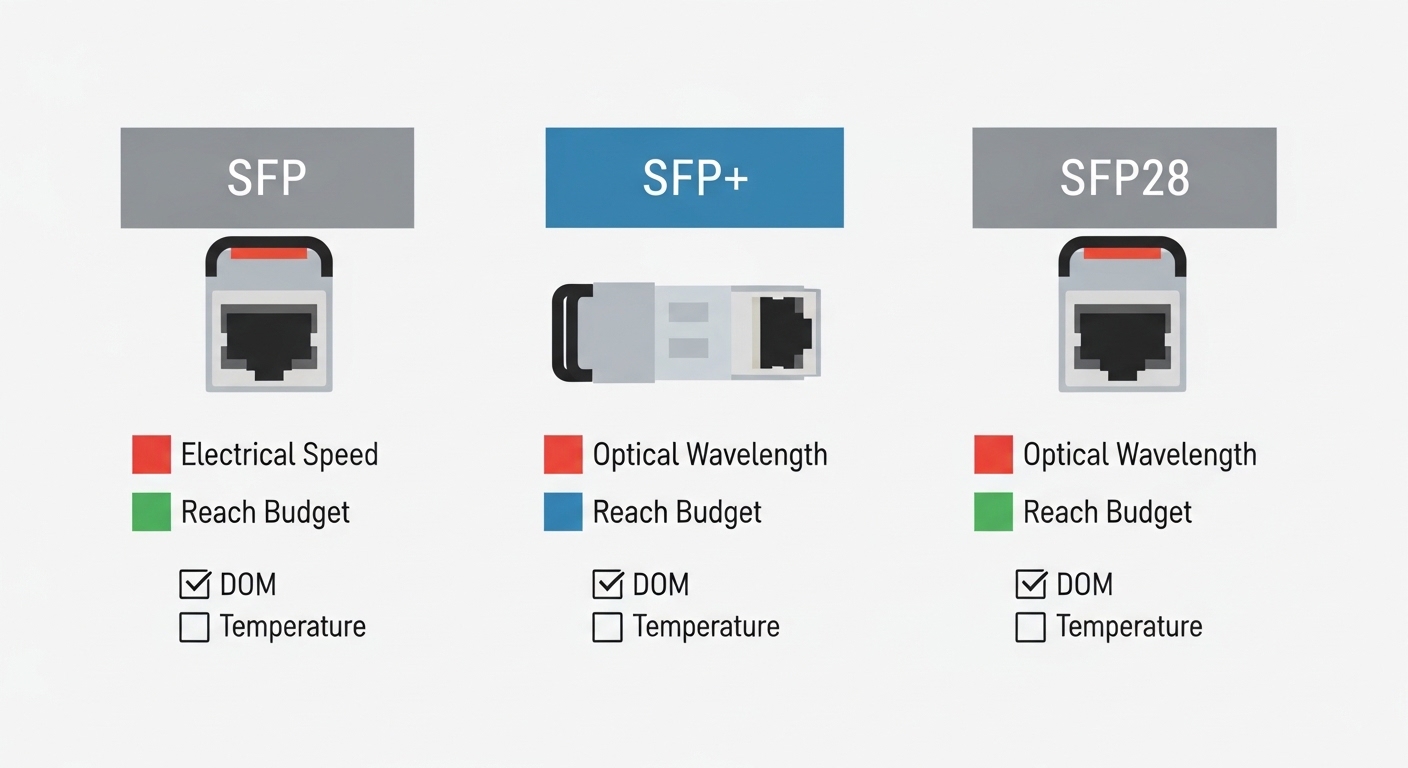
In modern OT, SFP modules act as the physical-layer “interface contract” between switches, media converters, and distributed devices. The most successful deployments pair the right transceiver class (temperature, optical budget, connector type) with switch support and a validation plan that matches the actual cable plant. Below are eight use-cases that I have seen work in brownfield upgrades and greenfield rollouts, along with the key specs that matter.
Fiber uplinks from edge switches to the control room
Many plants use ruggedized managed switches at cell or line level, then aggregate to a control room with fiber uplinks to reduce noise and ground-loop risk. In one deployment, we replaced 1G copper uplinks with 1000BASE-SX or 1000BASE-LX fiber using vendor-qualified SFPs, eliminating intermittent CRC bursts during welding operations. For automation, the key is stable link training under temperature swings and predictable optical power margins after connector cleaning and patch-panel rework.
- Best-fit scenario: Cell/line switch aggregation over 300 m to 2 km with multimode or single-mode fiber.
- Typical data rate: 1G, 10G (often 10G for video and historian replication).
- Operational focus: optical budget, link stability, and repeatable installation practices.
Pros: better EMC immunity, longer reach than copper, easier physical separation. Cons: fiber handling skill required, connector contamination can cause link flaps.
[[IMAGE:Photorealistic scene inside a factory control room at night; a rugged industrial managed Ethernet switch mounted in a metal rack with fiber patch cords; close-up of an SFP transceiver in the switch port with visible LC connector; cool blue lighting, shallow depth of field, high detail, documentary photography style, realistic colors, no logos]
Redundant ring topologies for line control and failover
Industrial Ethernet rings (for example, PRP/HSR style redundancy concepts or vendor-specific ring protection) depend on fast convergence and consistent PHY behavior. Using SFPs for ring segments can improve determinism by keeping the optical path stable while the network layer handles failover. In practice, we validated convergence time by measuring traffic recovery after intentionally pulling one fiber patch cord and verifying that the transceiver remained within spec without repeated reinitialization.
- Best-fit scenario: Line-level rings spanning 200 m to 1.5 km per segment.
- Key specs to confirm: link power class, receiver sensitivity, and supported digital diagnostics (DOM).
- Compatibility check: switch firmware and transceiver DOM mapping.
Pros: resilient topology, less downtime during maintenance. Cons: mis-matched optics across ring members can complicate troubleshooting.
Pro Tip: In ring protection events, many “mystery outages” are not topology issues but transceiver resets caused by marginal optical power after connector rework. Capture DOM readings (Tx bias, Rx power) before and after patching so you can correlate failures with physical-layer degradation rather than higher-layer alarms.
Machine vision and edge analytics with 10G fiber
Machine vision cameras and edge inferencing frequently push beyond 1G, especially when streaming raw frames or multiple ROI streams. Engineers often move to 10G Ethernet over fiber using SFP+ optics to keep latency consistent and avoid copper reach limits. In a pilot cell, we used 10G SR for short multimode runs to aggregate camera traffic into an edge compute rack, then routed to the plant network with a disciplined QoS profile.
- Best-fit scenario: Vision systems requiring 10G throughput over short to medium distances.
- Key specs: reach class (for SR vs LR), fiber type (OM3/OM4 vs OS2), and temperature grade.
- Operational focus: deterministic latency, buffer behavior, and link stability under vibration.
Pros: supports higher camera counts, reduces switch oversubscription. Cons: 10G SR requires correct multimode fiber and connector cleanliness.
[[VIDEO:Short industrial training clip showing a field tech cleaning LC connectors with lint-free wipes and inspecting fiber endfaces under a microscope before inserting an SFP+ module into an industrial switch; overlay callouts on Tx/Rx power and DOM alarms]
Long-distance telemetry for utilities and substations
Utilities and industrial substations often need fiber links that survive extreme temperature and EMI conditions while transporting telemetry and protection-related data. Single-mode optics (for example, 1310 nm or 1550 nm families) are common because reach can scale to multiple kilometers. In the field, the decisive factor is the link power budget after accounting for splice losses, aging, and connector reflection considerations.
- Best-fit scenario: 10G or 1G links spanning 10 km to 40 km.
- Key specs: wavelength, reach class, and receiver sensitivity; verify compliance with IEEE 802.3.
- Validation: OTDR traces and end-to-end loss testing, not just “it lights up.”
Pros: scalable, stable under harsh EMC. Cons: end-to-end loss testing and careful splicing are mandatory.
Harsh-environment I/O backbones in motion and process control
Process and motion control architectures increasingly use fiber to connect distributed I/O, motion controllers, and safety controllers across large machine footprints. When you deploy SFP industrial applications here, temperature range and mechanical durability become as important as optics. We have seen failures where a standard commercial transceiver met reach on paper but drifted under sustained heat soak, causing intermittent link drops during production peaks.
- Best-fit scenario: Machine rooms with ambient temperatures from roughly -20 C to 70 C or higher.
- Key specs: industrial temperature grade, DOM thresholds, and mechanical retention.
- Operational focus: thermal design and cable management to avoid micro-bending.
Pros: better reliability than copper in noisy machine bays. Cons: requires industrial-grade transceivers and robust fiber strain relief.
Remote tank farms and warehouse automation with hardened fiber links
Remote sites like tank farms and distribution centers often run Ethernet across long corridors where lightning exposure, grounding differences, and physical damage risk are real. Fiber with SFP optics decouples the electrical domains and reduces the impact of surges compared with copper. In a warehouse automation rollout, using industrial SFPs and consistent patch-panel labeling reduced mean time to repair after a forklift incident.
- Best-fit scenario: 1G/10G links across 500 m to several kilometers with intermittent physical access.
- Key specs: connector type (LC commonly), wavelength, and guaranteed receiver performance.
- Operational focus: spares strategy and repeatable connector inspection.
Pros: safer electrical separation, easier spares management. Cons: physical labeling and documentation discipline are required.
[[IMAGE:Concept illustration showing a layered OT network diagram overlaid on a warehouse floor plan; fiber routes highlighted in bright cyan, SFP modules represented as small “optical link nodes” with temperature icons; clean vector style, isometric view, high contrast, minimal text, modern industrial design theme]
Data center edge gateways for OT-to-IT historian replication
Even when the control layer stays in OT, historians and event logs often replicate to IT for analytics. SFP industrial applications at the OT edge help bridge managed switches, industrial firewalls, and aggregation routers using predictable optics. In one scenario, we deployed 10G SR for OT aggregation to a DMZ gateway and used DOM to monitor optical health, which helped avoid silent degradation that later manifested as packet loss.
- Best-fit scenario: OT edge to IT DMZ with 10G or 25G/40G depending on platform.
- Key specs: transceiver form factor (SFP vs SFP+), DOM support, and switch interoperability.
- Operational focus: monitoring integration with SNMP/telemetry pipelines.
Pros: improves observability, supports bandwidth growth. Cons: wrong module type can cause link refusal or degraded diagnostics.
Fleet-wide remote maintenance and diagnostics over fiber
Remote maintenance depends on reliable management-plane reach, not just user-plane traffic. Fiber links with SFPs enable stable out-of-band or in-band management across distributed controllers and gateways, supporting firmware updates, log retrieval, and configuration drift checks. We used transceiver telemetry as an early warning system: when Tx/Rx power shifted beyond expected ranges, we scheduled cleaning or patch replacement before a full outage.
- Best-fit scenario: Multi-site deployments where technician visits are costly.
- Key specs: DOM availability, alarm thresholds, and stable optical power over time.
- Operational focus: alarm routing to NOC/SCADA on-call.
Pros: early fault detection, fewer truck rolls. Cons: telemetry requires integration work and disciplined threshold tuning.
[[IMAGE:Lifestyle-style photo of a field engineer in high-visibility PPE in an outdoor industrial yard at dawn, holding a fiber endface inspection scope near a rugged enclosure; a small SFP module is visible in a tool pouch; warm sunrise lighting, shallow depth of field, documentary realism, no brand markings]
Key SFP industrial applications specs to compare before you buy
Selection starts with aligning the transceiver class to the Ethernet PHY standard and the fiber plant. IEEE 802.3 defines optical signaling behaviors, while vendor datasheets define temperature grade, optical budget, and DOM capabilities. Below is a practical comparison of common SFP/SFP+ families that appear in automation networks.
| Parameter | 1G SX (SFP) | 1G LX (SFP) | 10G SR (SFP+) | 10G LR (SFP+) |
|---|---|---|---|---|
| Typical wavelength | 850 nm | 1310 nm | 850 nm | 1310 nm |
| Reach (typical) | Up to 550 m on OM2/OM3 | Up to 10 km on OS2 | Up to 300 m on OM3, 400 m on OM4 | Up to 10 km on OS2 |
| Connector | LC (common) | LC (common) | LC (common) | LC (common) |
| DOM / diagnostics | Often supported | Often supported | Commonly supported | Commonly supported |
| Industrial temperature range | Commonly -40 C to 85 C (verify) | Commonly -40 C to 85 C (verify) | Commonly -40 C to 85 C (verify) | Commonly -40 C to 85 C (verify) |
| Power and form factor | SFP (legacy) | SFP (legacy) | SFP+ (10G) | SFP+ (10G) |
Sources: [Source: IEEE 802.3 Ethernet specifications], [Source: Cisco SFP product documentation], [Source: Finisar and OEM transceiver datasheets]. For concrete part examples often used in industrial spares kits, engineers may consider models like Cisco SFP-10G-SR, Finisar FTLX8571D3BCL, or FS.com SFP-10GSR-85, but always validate against your specific switch and optics budget.
Selection criteria checklist for SFP industrial applications
Field failures usually trace back to one of five mismatch categories: distance, fiber type, switch compatibility, temperature grade, or diagnostics behavior. Use this ordered checklist to reduce rework and speed commissioning.
- Distance and fiber type: verify OM2/OM3/OM4 for SX/SR and OS2 for LX/LR; confirm end-to-end loss with OTDR or certified test results.
- Data rate and form factor: ensure SFP versus SFP+ matches the port; do not assume “same wavelength” implies same electrical interface.
- Switch compatibility: confirm transceiver interoperability with the exact switch model and firmware; check whether the platform enforces vendor IDs.
- DOM support and telemetry mapping: verify that alarms populate correctly in your monitoring stack (SNMP/telemetry) and that thresholds are not overly aggressive.
- Operating temperature and thermal design: choose an industrial grade transceiver and validate cabinet airflow and heat soak conditions.
- Vendor lock-in risk and spares plan: define acceptable cross-vendor optics behavior, test spares in staging, and document approved part numbers.
Pros: fewer commissioning loops, clearer acceptance criteria. Cons: requires upfront testing and documentation discipline.
Common mistakes and troubleshooting tips in industrial fiber links
Below are concrete failure modes I have observed in OT environments, with root causes and fixes that reduce downtime. Many issues look like “bad optics,” but the root cause is often installation practice, mismatch, or thermal stress.
Link flaps after connector work
Root cause: endface contamination, micro-scratches, or insufficient cleaning after patch-panel changes, causing intermittent receiver overload or marginal signal-to-noise ratio. Solution: clean using validated procedures (lint-free wipes and proper inspection), re-terminate if needed, and confirm Rx power via DOM.
“Works in the lab” but fails in summer heat
Root cause: using a commercial temperature transceiver in a cabinet that exceeds its operating range, leading to laser bias instability and link resets. Solution: enforce industrial temperature grade selection (verify datasheet), improve airflow, and run a burn-in test at worst-case ambient.
Wrong fiber type selection (OM vs OS) leading to silent performance loss
Root cause: deploying SX/SR optics on a cable plant that is not the expected multimode grade, or OS2 single-mode on multimode expectations, resulting in excessive attenuation or modal dispersion. Solution: test the fiber type and measure link loss; replace patch cords or optics to match the engineered fiber plant.
Switch refuses non-approved transceivers
Root cause: platform enforcement of transceiver identity, or firmware incompatibility with certain DOM/EEPROM behaviors. Solution: check the switch compatibility list, update firmware if supported, and standardize on approved part numbers for the fleet.
Pros: targeted troubleshooting accelerates restoration. Cons: requires DOM visibility and repeatable inspection tools.
Cost and ROI note for SFP industrial applications
Pricing varies by wavelength, reach, and temperature grade. In many procurement cycles, industrial-grade SFP/SFP+ optics can land in a broad range from roughly $60 to $250 per unit for common 1G/10G modules, with higher costs for longer-reach or tightly specified industrial variants. OEM optics may cost more but can reduce commissioning risk when switch vendors enforce compatibility.
TCO reality: the biggest drivers are labor for commissioning and the cost of downtime, not just the transceiver purchase price. A practical ROI model often assumes that avoiding one “truck roll” and one extended outage can justify multiple spares and better cleaning/inspection processes. For fleet reliability, I recommend budgeting for at least a small pool of verified spare optics plus an endface inspection microscope and fiber cleaning consumables.
Sources: [Source: vendor datasheets and compatibility notes], [Source: ANSI/TIA fiber optic installation and testing guidance].
Summary ranking table: best fit across the top 8 use-cases
This table ranks the eight use-cases by how directly SFP industrial applications typically solve the physical-layer problem, plus how critical optics selection is to success.
| Rank | Use-case | Primary benefit of SFP optics | Selection criticality |
|---|---|---|---|
| 1 | Harsh-environment I/O backbones | Temperature-stable links for motion/process control | Very high |
| 2 | Redundant ring segments | Stable PHY behavior during failover events | High |
| 3 | Long-distance telemetry | Reach and optical power budgeting at scale | High |
| 4 | Edge gateways for OT-to-IT replication | Bandwidth growth with observability via DOM | Medium to high |
| 5 | Fiber uplinks from edge switches | EMC immunity and cleaner aggregation paths | Medium |
| 6 | Machine vision and edge analytics | 10G throughput with consistent latency | Medium |
| 7 | Remote tank farms and warehouses | Electrical isolation and maintainability | Medium |
| 8 | Fleet-wide remote diagnostics | Management-plane reliability | Medium |
FAQ
Which SFP type is most common for industrial automation uplinks?
For many plants, 1G SFP is still common for aggregation, while 10G SFP+ is increasingly used for camera, historian, and edge compute traffic. The best choice depends on your switch port speed, fiber plant (OM vs OS), and the engineered reach with measured loss.
Do I need DOM for SFP industrial applications?
DOM (digital optical monitoring) is not strictly required for link operation, but it is highly valuable for reliability engineering. With DOM, you can track Tx bias and Rx power trends and correlate optical degradation with incidents before users report symptoms.
Can I mix third-party SFP modules across a switch stack?
You can, but you should test in a staging environment because some platforms enforce compatibility rules or have different EEPROM/DOM behaviors. For operational safety, standardize on approved part numbers and validate that monitoring alarms behave consistently across vendors.
What fiber testing matters most after installation?
Measure end-to-end loss and verify connector quality. OTDR traces and certified loss results help you confirm that the actual optical budget matches the transceiver spec, especially after patch-panel changes or cable reroutes.
What is the most common cause of “link up but no traffic”?
Often it is not the transceiver itself but a mismatch in VLAN trunking, speed/duplex negotiation (where applicable), or a miswired patch cord leading to the wrong fiber pair. Still, verify optical health with DOM first because a marginal receiver can create subtle packet loss.
How should I plan spares for SFP industrial applications?
Plan spares by criticality and replacement lead times: keep at least one verified spare per transceiver type used in each cabinet or ring segment. If your sites are remote, stock spares plus inspection and cleaning tools so you can restore service quickly with controlled verification.
If you are building a fiber strategy across automation zones, the next step is to align optics selection with your network design and testing workflow. For more on engineering decisions that reduce commissioning risk, see fiber optic transceiver selection and pair it with your acceptance test plan.
Author bio: I am a field-focused financial and network analyst who supports OT connectivity programs by translating optical specs into measurable uptime and TCO outcomes. I have deployed and audited SFP-based fiber links in industrial environments, emphasizing interoperability, test evidence, and operations-ready documentation.
