
If you are planning 5G deployment and your transport network is the bottleneck, the fix is rarely “more bandwidth.” It is usually optics reach mismatch, DOM/firmware incompatibility, connector cleanliness, or thermal/power oversubscription in the wrong place. This guide helps enterprise network engineers and field teams choose the right fiber, transceivers, and installation practices to scale reliably from aggregation to core.
What scaling optical transport for 5G deployment actually stresses
5G deployment traffic patterns behave like bursty east-west plus steady north-south flows. In practice, you may see sustained utilization near 60 to 80% during peak hours with micro-bursts that trigger link renegotiation edge cases and optics alarms. Your optical layer must also handle rapid site turn-up, meaning you need repeatable transceiver and fiber validation workflows.
At a field level, the biggest stressors are: reach budget margin (fiber loss plus splice/patch loss), optical transmitter power and receiver sensitivity, and thermal behavior inside high-density line cards. Vendor datasheets and IEEE alignment matter, but the real-world failure modes tend to come from physical layer details: dirty connectors, wrong fiber type, and patching errors.
Reach budgets, wavelengths, and transceiver choices that survive the field
Most enterprise 5G transport designs use a mix of 10G, 25G, and 100G optics over singlemode fiber (SMF) with LC or MTP/MPO fanouts. Your selection should start with distance from radios or aggregation to the next grooming point, then subtract realistic losses.
Distance math engineers use (quick)
Use a simple budget approach: Tx power – (fiber attenuation + splice loss + patch loss) >= receiver sensitivity margin. Add a safety margin for aging and future re-patching. If you are not sure of splice counts, assume at least 2 to 6 splices per end-to-end path in enterprise builds.
Common transceiver types you will see
For 5G deployment, you will commonly encounter:
- 10G SR (850 nm, multimode) for short reach inside buildings.
- 10G/25G LR (1310 nm, singlemode) for metro and enterprise campus spans.
- 100G SR4 (850 nm, multimode) for high-density aggregation.
- 100G LR4 (1310 nm, singlemode) for longer aggregation/core hops.
| Transceiver example | Data rate | Wavelength | Typical reach | Connector | DOM | Operating temp (typ.) |
|---|---|---|---|---|---|---|
| Cisco SFP-10G-SR | 10G | 850 nm | ~300 m (OM3) / ~400 m (OM4) | LC | Yes | 0 to 70 C |
| Finisar FTLX8571D3BCL | 10G | 850 nm | ~300 m (OM3) / ~400 m (OM4) | LC | Yes | 0 to 70 C |
| FS.com SFP-10GSR-85 | 10G | 850 nm | ~300 m (OM3) / ~400 m (OM4) | LC | Yes | 0 to 70 C |
| Typical 100G LR4 (vendor-specific) | 100G | 1310 nm | ~10 km class | LC (often duplex per lane mapping) | Yes | -5 to 70 C (varies) |
Note: exact reach depends on fiber grade, link loss, and vendor calibration. Always confirm against the transceiver datasheet and your switch compatibility matrix. For standards context, see IEEE 802.3 for Ethernet optical PHY requirements. [[EXT:https://standards.ieee.org/standard/802_3 IEEE 802.3]]
Pro Tip: In many 5G deployment rollouts, the “real” limiting factor is not the optical spec sheet reach; it is connector hygiene and patch panel loss. If you tighten your field process to clean and verify every LC/MPO termination, you can often reclaim enough margin to avoid swapping optics during site acceptance.
Compatibility, DOM checks, and operational safeguards
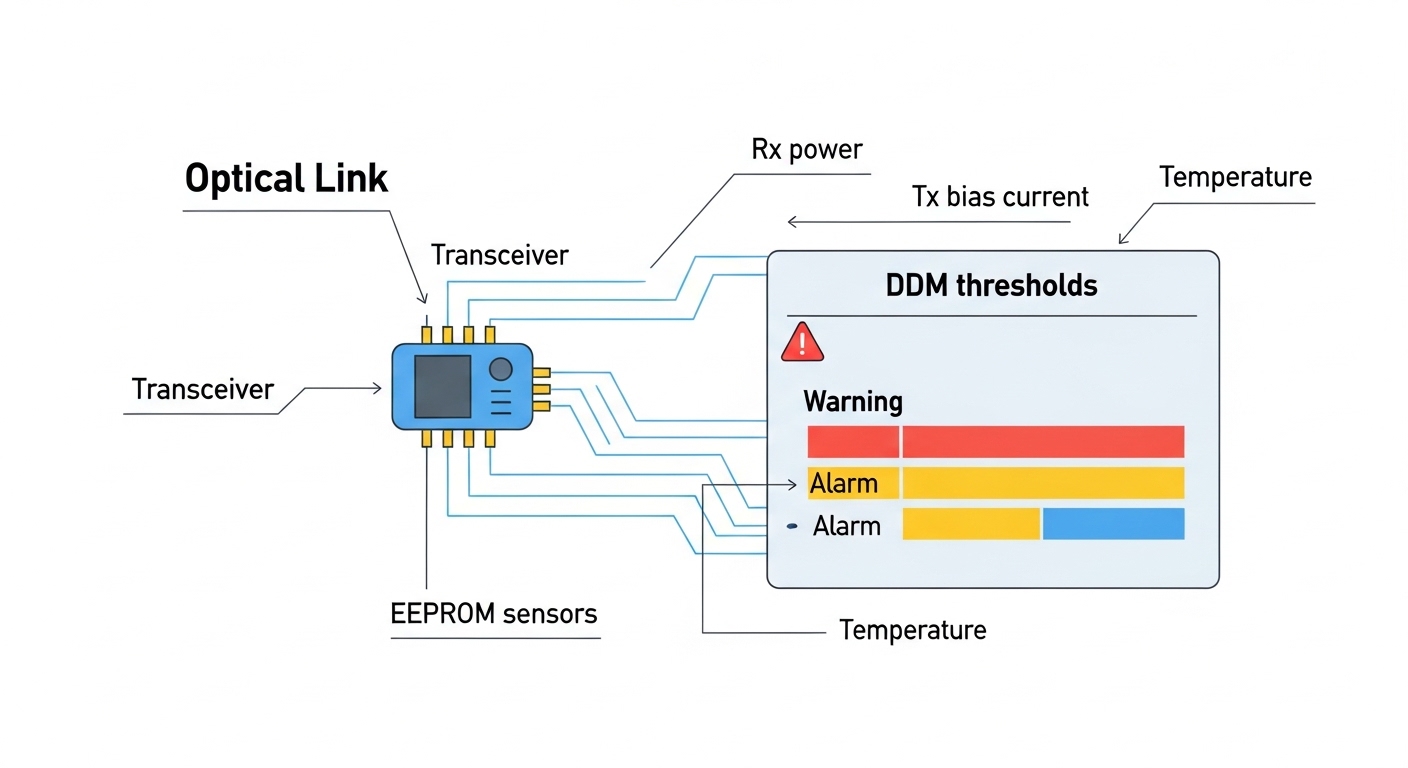
Enterprise scaling often mixes OEM and third-party optics. Many modern switches support Digital Optical Monitoring (DOM), but behavior varies by vendor firmware and platform. You want predictable alarms for optical power, bias current, and temperature—not just “link up.”
What to verify before rollout
- Switch compatibility: confirm the exact transceiver type is supported for your model and software version.
- DOM support: validate that optical diagnostics are readable and thresholds trigger correctly.
- Fiber type: OM3/OM4 for SR, SMF for LR/LR4; do not assume “multimode works anyway.”
- Connector mapping: MPO/MTP polarity and lane mapping for SR4/LR4 variants.
- Thermal plan: ensure airflow and port-side thermal limits are respected in high-density chassis.
If you are using remote monitoring, baseline alarm thresholds during commissioning. For 5G deployment, you typically care about early warning signals like Tx bias drift, Rx power approaching low threshold, and temperature excursions. Those give you time to fix a patch panel or replace a suspect transceiver before customer-impacting outages.
Common mistakes and troubleshooting tips in 5G deployment optical scaling
Below are the failure modes that show up repeatedly during enterprise fiber turn-up. Each includes a root cause and a practical fix.
Link flaps after cleaning, then fails again
Root cause: partial contamination or re-contamination from uncapped fibers during patching; also possible oxidized dust on connector ferrules. Solution: use approved connector cleaning tools, re-clean both ends, and verify with an inspection scope before reconnecting.
“Works on one port, fails on the next” with SR optics
Root cause: patching error (wrong fiber strand pair) or MPO polarity mismatch. Solution: trace the fiber using labeled patch routes, then correct polarity using the vendor-recommended method (including MPO polarity adapters when required).
Reach budget looks fine on paper, but Rx power is low
Root cause: underestimated splice and patch losses, or fiber grade mismatch (OM3 vs OM4 assumptions). Solution: measure end-to-end loss with an OTDR or certified loss tester; replace questionable patch cords and re-terminate if needed.
Alarm “DOM not supported” or threshold behavior is inconsistent
Root cause: optics that are electrically compatible but not fully compatible with the switch’s DOM implementation. Solution: use optics officially supported by the switch vendor or validated by your integrator; confirm software release compatibility before scaling.
Cost and ROI note: how to budget without creating a maintenance trap
Typical field reality: OEM optics cost more upfront but can reduce time spent on compatibility validation and warranty disputes. Third-party optics can be cost-effective for 5G deployment scaling, but you must budget for testing time and spares qualification.
- Price ranges (very approximate, depends on speed and vendor): 10G SR SFPs often land in the mid tens to low hundreds USD each; 100G LR optics are materially higher.
- TCO: include installation labor, cleaning/inspection consumables, spares, and downtime risk from repeated truck rolls.
- Power: modern optics are efficient, but port density drives chassis power. ROI often comes from avoiding failed links and reducing repeat commissioning cycles.
If you standardize on a small set of optics and validate once per switch model and software release, you reduce operational variance and can accelerate 5G deployment timelines.
Selection criteria checklist for optical scaling in 5G deployment
Use this ordered list during design and before procurement.
- Distance & loss budget: calculate worst-case loss, include splices/patch cords, and add margin.
- Data rate alignment: ensure optics match the switch port speed and line card capability.
- Fiber type and connector plan: OM vs SM, LC vs MPO/MTP, polarity strategy.
- Switch compatibility: consult the vendor compatibility guide and test in a pilot.
- DOM support and alerting: confirm diagnostics are visible and thresholds behave as expected.
- Operating temperature: verify transceiver temperature range matches your enclosure airflow.
- Vendor lock-in risk: if using third-party, qualify spares and keep a documented cross-reference.
FAQ
How do I choose between SR and LR for 5G deployment?
Start with distance and fiber type. SR (850 nm) suits shorter spans on multimode; LR (1310 nm) suits longer spans on singlemode. Then validate with the transceiver datasheet reach and your measured link loss, not just the nominal spec.
Do I need DOM for scaling optical networks?
For operational reliability, yes. DOM lets you monitor Rx power, Tx bias, and temperature so you can catch degradation early during 5G deployment. Without DOM visibility, you often discover issues only after a hard outage or severe alarm storm.
Can I mix OEM and third-party optics?
You can, but compatibility varies by switch model and firmware. Run a pilot with the exact optics SKU and software version, confirm DOM behavior, and ensure alarms/thresholds work before scaling across sites.
What is the fastest way to troubleshoot a dead link?
Check fiber type and connector mapping first, then verify link training on the switch. If the link stays down, inspect and clean connectors, confirm polarity for MPO paths, and measure loss if Rx power is low.
How much spare inventory should I keep for 5G deployment optics?
It depends on your rollout size and maintenance window. A common approach is to keep spares for each optics type per switch model plus a small buffer for commissioning failures, then adjust after you see real-world failure rates over the first few sites.
Where should I look in standards and vendor docs?
Use IEEE 802.3 for Ethernet optical PHY expectations and the specific switch and transceiver datasheets for reach, power, and DOM details. For platform-specific behavior, rely on the switch vendor compatibility and release notes. Vendor platform documentation
Scaling optical networks for 5G deployment is mostly about predictable physics and repeatable field execution: correct reach budgets, validated compatibility, and disciplined termination practices. Next step: pick your top two site path types, run a pilot with the exact optics and patch plan, then lock the standard before expanding across the rollout. [[LINK:
