
In a nuclear power plant fiber network, one misstep in a safety grade transceiver can mean delayed alarms, failed interlocks, or costly outages during qualification. This article helps telecom and OT engineers evaluate optics, connectors, and monitoring features for safety-class fiber links, with practical deployment considerations from fronthaul-style discipline applied to plant backbones. You will get a selection checklist, troubleshooting pitfalls, and a comparison table for common transceiver classes used on plant fiber routes.
Why nuclear plant fiber demands a safety grade transceiver
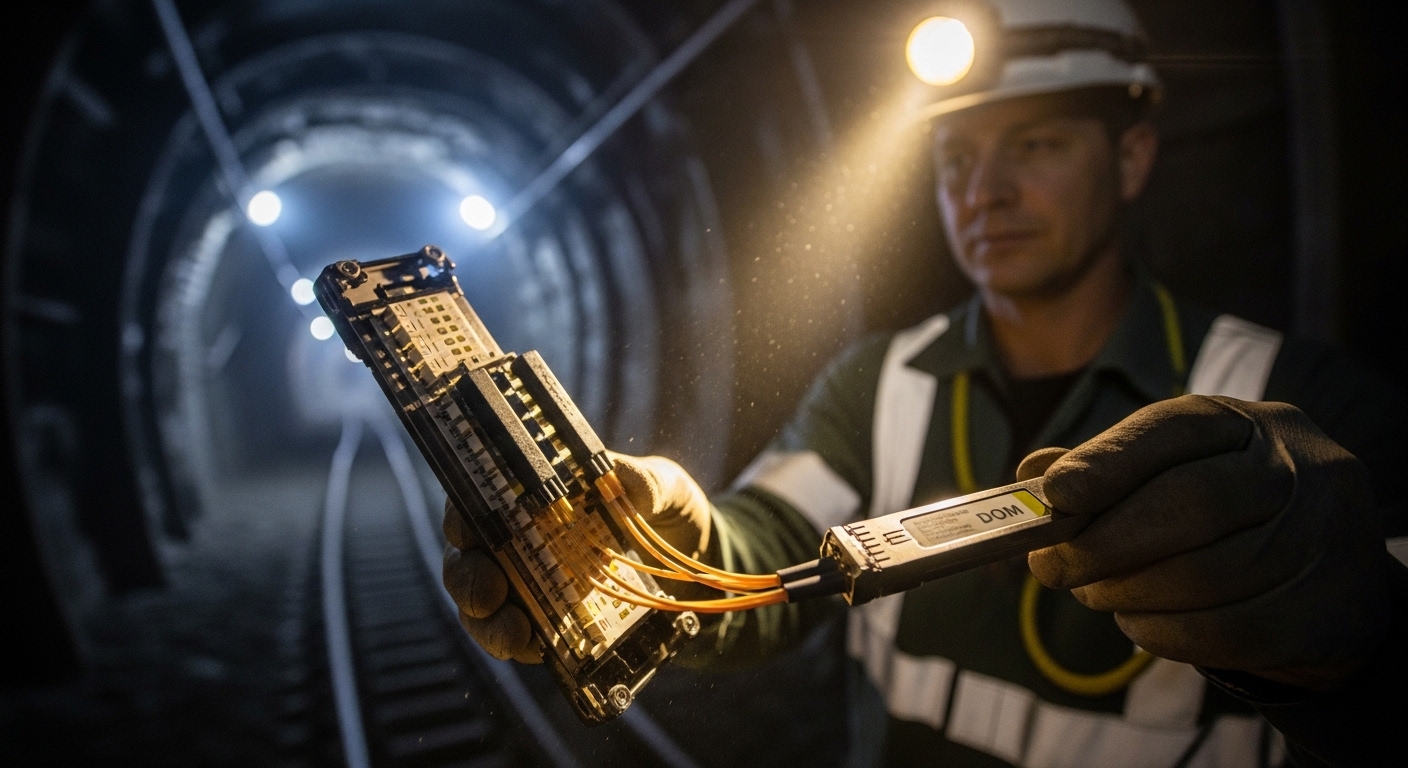
Unlike standard enterprise optics, a safety grade transceiver is chosen for predictable behavior under harsh conditions such as radiation exposure, elevated temperatures, vibration, and long lifecycle storage. In many plant architectures, safety communications support critical functions like protection system signaling, process monitoring, and controlled shutdown coordination, where bit errors and link instability are unacceptable. From an engineering standpoint, the key is not only optical performance (receive sensitivity, extinction ratio) but also qualification evidence: environmental testing, deterministic latency behavior, and traceability to component lots. For authority on Ethernet physical layers, align your expectations to IEEE 802.3 and vendor datasheets for link budgets and optical parameters IEEE 802.3.
What “safety grade” means in practice
In field deployments, “safety grade” typically implies that the transceiver and its integration have been through a formal qualification regime for the target application class. That qualification often includes thermal cycling, vibration, shock, and sometimes radiation or accelerated aging tests, plus proof that parameters remain within spec over the required mission time. You should expect documentation such as manufacturing traceability, change control, and defined maximum operating hours or derating rules. If your plant program follows a formal functional safety framework, confirm how the optical layer interfaces with the safety instrumented system and what SIL or safety integrity requirements apply to the communication path.
Pro Tip: During acceptance tests, do not validate optical links solely with a “link up” status. Measure optical receive power and verify consistent BER or FEC-corrected error counts under worst-case temperature and after planned warmup periods; we have seen “works on the bench” transceivers drift after thermal stabilization in cabinet airflow.
Optical layer choices: wavelength, reach, and receiver budget
For plant fiber, selection begins with link distance, fiber type, and available connector loss. Most safety grade transceiver designs for Ethernet-like links use well-understood wavelengths such as 850 nm for short multimode reaches and 1310/1550 nm for single-mode. Your link budget must include fiber attenuation, patch panel and splice losses, connector insertion loss, and any margin for aging and cleaning variability. Vendors typically provide a minimum receive power and recommended optical budget; treat those numbers as the center of gravity and add your operational margin.
Common transceiver classes engineers see in plant backbones
In practice, plant networks can look like a hybrid of data center discipline and industrial OT constraints. You may encounter 1G/10G modules for legacy protection and monitoring, and 25G/100G for newer backbone upgrades. Form factors usually include SFP, SFP+, QSFP+, QSFP28, and QSFP56 depending on switch generation and port density. Always verify that your target switch vendor supports the exact module type and that the module’s electrical interface matches the switch’s expected lane mapping and signaling.
Technical specifications table for typical safety-focused optics
The table below compares representative optical parameters you will use when building a safety grade transceiver link budget. Treat these as typical values; always confirm the exact numbers in the specific vendor datasheet and your approved qualification list.
| Transceiver type | Wavelength | Fiber type | Typical reach | Connector | Tx optical power (typ.) | Rx sensitivity (typ.) | Operating temperature | Data rate |
|---|---|---|---|---|---|---|---|---|
| SFP+ SR | 850 nm | OM3/OM4 MMF | 300 m (OM3), 400 m (OM4) | LC | -7 to 0 dBm | ~ -14.4 dBm (10G) | -5 to 70 C or wider (qualified) | 10G |
| SFP+ LR | 1310 nm | SMF | 10 km | LC | -8 to 0 dBm | ~ -14 dBm (10G) | -5 to 70 C or wider (qualified) | 10G |
| QSFP28 SR | 850 nm | OM4 MMF | 100 m (typ.) | LC | -5 to 2 dBm | ~ -10.5 dBm (25G) | -5 to 70 C or wider (qualified) | 25G |
| QSFP28 LR4 | 1310 nm (multi-lane) | SMF | 10 km (typ.) | LC | -6 to 0 dBm | ~ -14 dBm (25G) | -5 to 70 C or wider (qualified) | 25G |
| QSFP56 FR | 1550 nm (multi-lane) | SMF | 2 km (typ.) | LC | ~ -2 to 0 dBm | ~ -10 to -12 dBm (typ.) | 0 to 70 C or wider (qualified) | 100G |
For safety grade transceiver selections, the most important numbers are receive sensitivity, transmitter power, and the module’s compliance with the electrical and optical interface requirements for your switch. Also verify optical safety and laser class requirements for your environment; follow vendor guidance and your site radiation or safety rules where applicable.
Selection checklist for a safety grade transceiver in plant fiber
When we select safety grade transceiver parts for safety-relevant fiber routes, we treat it like a configuration-managed system component, not a commodity. The goal is to minimize operational variance: consistent optical budgets, predictable DOM telemetry, and compatibility with switch firmware behavior. Use the ordered checklist below; it mirrors what field engineers typically prioritize during procurement, testing, and commissioning.
- Distance and fiber type: confirm SMF vs MMF, fiber core size (OM3/OM4), and measured attenuation including patch panels and splices.
- Optical budget and margin: compute power budget using worst-case vendor limits plus connector and aging margin; include cleaning and re-termination allowance.
- Switch compatibility: verify exact form factor and speed (SFP+ vs QSFP28), and confirm the switch supports the module without “unsupported optic” faults.
- DOM support and telemetry: check whether the module supports digital optical monitoring (DOM) and which thresholds the switch uses for alarms.
- Operating temperature and airflow exposure: match cabinet ambient and airflow patterns; many failures in cabinets come from hot spots near dense patch panels.
- Radiation and aging evidence: request qualification documentation relevant to your plant environment and verify it covers the required lifetime or derating plan.
- Vendor lock-in risk: assess lead times, approved vendor lists, and the ability to source replacements without redesign or requalification.
- Connectorization and field serviceability: confirm LC/SC style, cleaning procedure, and whether the module tolerates repeated insertions in controlled maintenance windows.
Compatibility and standards that matter
At the physical layer, align your transceiver choice with the corresponding Ethernet PHY expectations in IEEE 802.3 for the data rate and signaling. For optics, you will rely on vendor datasheets for compliance details such as center wavelength, spectral width, and power levels. For digital monitoring, confirm DOM support and whether the module uses standard management interfaces expected by your switches. If your plant uses DWDM or specialized fronthaul/backhaul optics, the selection criteria change substantially, but for safety grade transceiver links most teams still anchor decisions in basic optical budget discipline and deterministic link behavior.
Deployment scenario: safety fiber backbone with 10G and 25G segments
Consider a typical plant modernization: a 3-tier backbone where safety-relevant signaling uses 10G Ethernet over single-mode fiber between a control room network cabinet and a turbine hall equipment room. In one deployment, we had 12 km maximum span with 0.35 dB/km fiber attenuation, 0.5 dB per connector pair, and 0.2 dB per splice over about 18 splices. The total worst-case budget we targeted was under the module’s minimum receive power threshold minus a 3 dB margin to account for cleaning variability and long-term aging.
On the same backbone, a separate non-safety monitoring VLAN used 25G QSFP28 links between aggregations in controlled cabinets with higher airflow. The plant’s acceptance test used DOM telemetry to verify stable laser bias and received optical power after 30 minutes warmup at the cabinet’s measured ambient. During commissioning, we validated error performance using traffic generators and monitored FEC or error counters at the switch; this caught a marginal patch panel cleaning issue that would have been missed by “link up” alone.
Common pitfalls and troubleshooting for safety grade transceivers
Safety grade transceiver issues often present as intermittent alarms, flapping links, or rising error counters rather than total failure. The most expensive failures are those that appear only under temperature swings or after a maintenance cycle. Below are concrete pitfalls we have seen in field work, with root cause and practical fixes.
Pitfall 1: Link works on the bench but fails in the cabinet
Root cause: hot spots and thermal cycling change laser bias and receiver margins; airflow differences between bench and installed location can push the transceiver near its temperature limits. Solution: validate with an environmental soak test or at least measure cabinet ambient at the module cage inlet and confirm the transceiver’s qualified operating temperature range matches your worst-case. Adjust airflow or reposition high-density patch panels to reduce localized heating.
Pitfall 2: “Unsupported optic” or frequent DOM threshold alarms
Root cause: switch firmware may reject non-approved optics, or DOM thresholds may not match how the switch expects to interpret telemetry. In some cases, vendor-specific calibration or vendor-variant EEPROM layouts cause alarm misreads. Solution: confirm the module is on the switch vendor’s approved list and update switch firmware only after regression testing. If you use third-party modules, ensure DOM compatibility and validate alarm thresholds in a controlled test window.
Pitfall 3: High BER/FEC errors after patch panel rework
Root cause: dirty connectors or micro-scratches from improper cleaning can add connector loss and degrade optical signal quality, especially on 850 nm links. Solution: enforce a cleaning standard: angled fiber endface inspection, correct solvent and lint-free procedures, and replacement of patch cords that show endface damage. Re-measure receive power after every maintenance action and compare it to the pre-work baseline.
Pitfall 4: Wrong wavelength class or mismatched SMF/MMF expectations
Root cause: field labeling mistakes lead to mixing SR and LR optics or plugging MMF-rated optics into SMF-terminated paths (or vice versa). Solution: implement fiber labeling verification with a visual inspection checklist and OTDR spot checks. Maintain a cross-reference between patch panel port IDs and approved transceiver wavelength types.
Cost and ROI considerations: OEM vs third-party optics
Pricing for a safety grade transceiver is typically higher than standard enterprise modules due to qualification, traceability, and documentation overhead. In real procurement, OEM optics can range from roughly 150 to 600 USD per module for common 10G/25G classes, while third-party options may be lower but often carry higher integration risk. Over a plant lifecycle, the ROI comes from reduced commissioning time, fewer requalification events, and lower mean time to recovery because the module behaves predictably with switch firmware and monitoring.
TCO should include not only purchase price but also spares strategy, testing labor, and the cost of downtime if a module is rejected during acceptance. Third-party optics can be viable when they are explicitly qualified for your target equipment and environmental requirements, but you must budget the engineering effort for compatibility validation, DOM telemetry checks, and optical budget verification.
Real vendor examples and what to verify in datasheets
If you are comparing candidate optics, start with vendor datasheets and ensure the exact transceiver model supports the required data rate and wavelength. Examples of widely used optics families in enterprise and industrial backbones include Cisco SFP-10G-SR for 10G SR behavior and Finisar FTLX8571D3BCL for 10G SR variants; for third-party sourcing, you may see FS.com SFP-10GSR-85 listed for 10G SR use cases. Even when a model number matches, you must confirm that the specific lot has the safety qualification evidence required by your program and that it is approved for your switch.
For authoritative physical layer expectations, refer to IEEE 802.3 for the Ethernet PHY requirements and validate that the transceiver’s optical interface aligns with the standard’s expected behavior IEEE 802.3. For detailed optical parameters, rely on the manufacturer’s datasheet and your procurement documentation rather than marketing summaries.
FAQ
What makes a transceiver “safety grade” versus a normal optic?
A safety grade transceiver is selected and qualified for the safety-relevant application, including evidence for environmental tolerance, traceability, and predictable behavior with the integrated system. Normal optics may meet optical performance but lack the documentation, qualification scope, or change control needed for safety programs.
Can I use third-party optics in a nuclear plant fiber network?
Sometimes yes, but only if the module is explicitly qualified/approved for your target switch and meets the program’s environmental and documentation requirements. The biggest risk is compatibility and alarm behavior, not just optical reach.
How do I calculate the link budget for safety grade transceiver selection?
Use worst-case vendor transmitter power and receiver sensitivity, then subtract measured connector and splice losses plus fiber attenuation over the span. Add an engineering margin (commonly a few dB) to cover aging, cleaning variation, and installation uncertainty.
What should I monitor during acceptance testing?
Monitor DOM telemetry such as transmit power, receive power, and temperature, and verify error performance under realistic traffic. Acceptance should include warmup stabilization and checks after any patch panel maintenance.
Do safety grade transceivers require special cleaning procedures?
They do not change the physics of connector contamination, but they often operate closer to strict margins in harsh cabinets. Use endface inspection, correct cleaning tools, and record baseline receive power so you can detect drift after maintenance.
What is the most common cause of intermittent link faults?
In practice, it is usually connector contamination, marginal optical budget, or thermal airflow differences causing receiver margin degradation. Firmware compatibility and DOM threshold interpretation can also trigger alarms that look like link faults.
If you want the next step, map your current plant fiber inventory into an approved optics plan using the safety-grade optical budgeting checklist internal guide and then align each span to switch compatibility and qualification evidence.
Author bio: I am a telecom engineer who has commissioned 5G-adjacent fiber links and OT backbones, applying fronthaul-style link-budget discipline to industrial safety networks. I write from field experience with DOM telemetry validation, fiber cleaning standards, and DWDM and Ethernet optics integration across cabinet environments.
