
Upgrading an SMB network toward 800G is exciting, but the optics bill can quietly dominate the budget. This article helps IT managers and network engineers evaluate ROI optics decisions for 800G migration, balancing reach, power, vendor support, and failure risk. You will get a head-to-head comparison of common optics paths, a practical selection checklist, and troubleshooting tips pulled from field-style deployments.
800G optics ROI: performance levers that actually change TCO
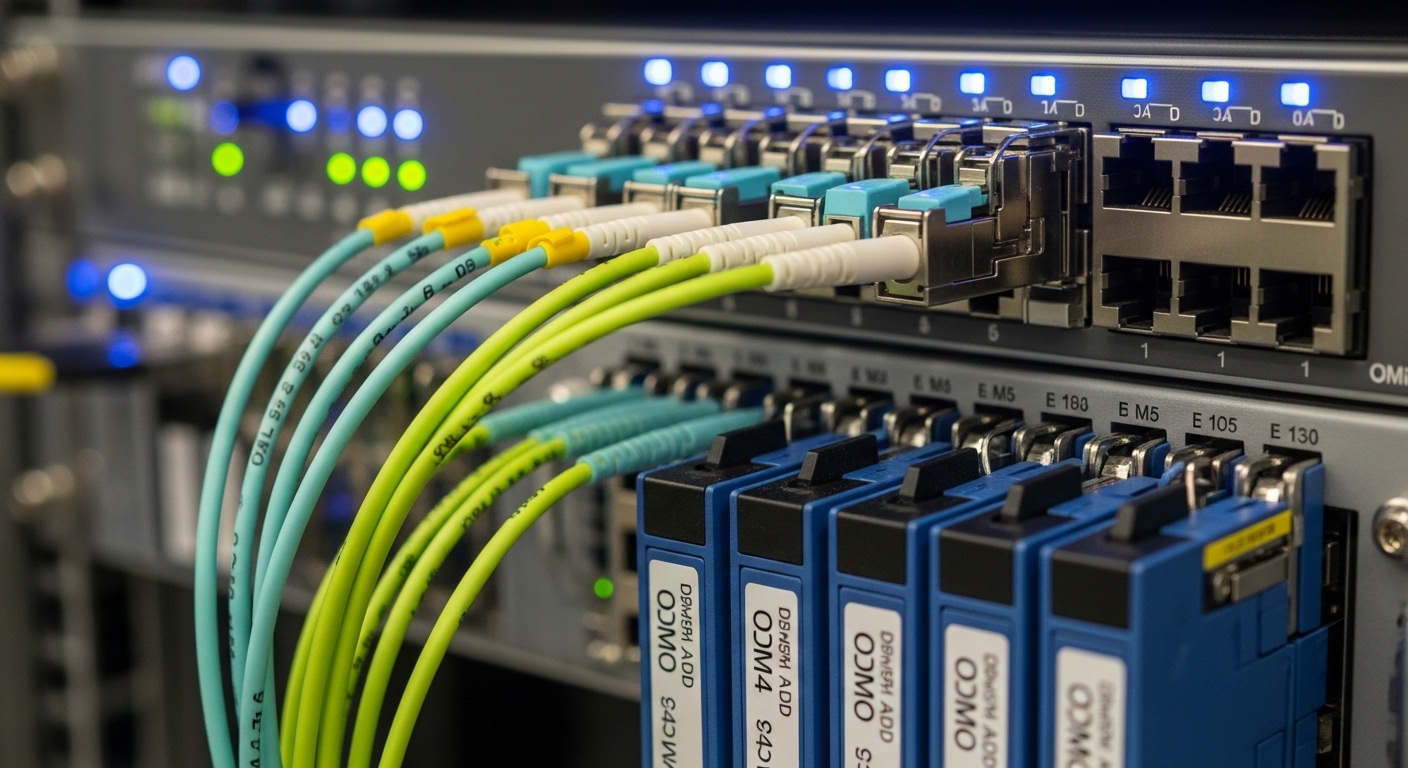
When people calculate “is it worth it,” they often focus on port speed and forget that optics drive both direct costs (module price, spares, replacement labor) and operational costs (power draw, cooling impact, and downtime). For ROI optics, the biggest levers are reach class, connector type, and whether your switches support the optics in a vendor-compliant way (including DOM validation and supported vendor IDs). On 800G, small changes in transmit power and receiver sensitivity can determine whether you can use shorter fiber spans or cheaper cabling runs.
From a standards perspective, the industry aligns high-speed Ethernet optics to IEEE 802.3 families for electrical and optical interfaces (for example, IEEE 802.3bs for 400G Ethernet and the broader 800G/next-gen Ethernet ecosystem that vendors implement). In practice, your switch vendor’s transceiver support matrix matters as much as the IEEE baseline, because optics must meet vendor-specific electrical requirements and firmware expectations. For measurable ROI, you should track port utilization, mean time to repair (MTTR), and failure rates by optics vendor and batch.
What changes at 800G: power, lane geometry, and optics class
At 800G, optics are commonly implemented as multi-lane modules with advanced digital diagnostics and strict timing. That means your “cost per port” is only part of the story: power per module and thermal behavior affect rack temperature and can force higher cooling setpoints. If you are running a 42U rack in an SMB closet with constrained HVAC, even a modest increase in average optical power can raise fan duty cycles.
Pro Tip: In many 800G rollouts, the fastest ROI comes from standardizing optics across the site. When you keep one optics family for leaf-spine links and another for access aggregation, you reduce spare SKUs, speed up swap operations, and cut mean time to recovery during link flaps.
Head-to-head: three 800G optics paths for ROI optics
Below is a practical comparison of the optics options SMB teams typically face. Your best choice depends on distance (meters vs kilometers), existing fiber plant (OM3/OM4/OS2), and switch compatibility (including DOM behavior and supported vendor lists). The table uses representative classes rather than a single SKU because 800G deployments vary by switch platform.
| Optics path (typical for 800G) | Wavelength / media | Reach class | Connector | Data rate | Operating temperature | Power (typical) | Main ROI driver |
|---|---|---|---|---|---|---|---|
| 800G SR8-style (multimode) | 850 nm, MMF | Up to ~100 m (varies by implementation) | LC duplex | 800G Ethernet | 0 to 70 C (vendor-dependent) | ~5 to 12 W | Cheaper fiber plant, fast short-reach deployment |
| 800G FR4-style (short-reach single-mode) | ~1310 nm band, SMF | ~2 km class (varies) | LC duplex | 800G Ethernet | -5 to 70 C (vendor-dependent) | ~6 to 14 W | Use existing SMF for longer runs |
| 800G LR4-style (longer-reach single-mode) | ~1310/1550 nm band, SMF | ~10 km class (varies) | LC duplex | 800G Ethernet | -5 to 70 C (vendor-dependent) | ~7 to 16 W | Avoids rebuilding fiber for distant sites |
For concrete examples, you will see vendor modules such as Cisco branded transceivers and third-party equivalents. If you are shopping, confirm the exact optics type supported by your switch model and software release. For reference on common transceiver families and electrical/optical behavior, consult vendor datasheets and switch transceiver compatibility guides. [Source: IEEE 802.3] [Source: Cisco transceiver compatibility documentation] [Source: Finisar and OEM transceiver datasheets]
SMB cost reality: OEM vs third-party optics
OEM optics can reduce compatibility surprises, but they often carry a premium. Third-party optics can cut upfront spend, yet they introduce an extra validation step: DOM readings, vendor ID checks, and firmware quirks. In ROI optics math, that validation time and the risk of a partial deployment can erase early savings if your team is small.
Operationally, you should budget for spares. If you deploy 32 uplink ports at 800G, you might provision 2 to 4 spare modules depending on your maintenance window and MTTR targets. The ROI optics question becomes: are you optimizing for lowest purchase price, or lowest expected downtime cost?
Compatibility and risk: where ROI optics decisions succeed or fail
At 800G, compatibility is not only “does the module light up.” Many platforms enforce DOM thresholds, lane mapping, and specific vendor support policies. If your switch firmware rejects a module, you may see link flaps, negotiated speeds lower than expected, or diagnostics that look healthy but produce intermittent errors under load. For ROI optics, this is a major hidden cost: engineering time plus downtime during the first traffic cutover.
DOM, diagnostics, and switch behavior
Digital Optical Monitoring (DOM) provides optical power, bias, temperature, and alarms. Switches can read these values and sometimes block optics that fall outside expected ranges. Field teams often discover that “it works in the lab” but fails during peak temperature ramps because the module stays within spec but the switch’s threshold logic is stricter.
Selection criteria / decision checklist
- Distance and fiber type: confirm OM3/OM4 vs OS2, and verify measured link loss with an OTDR or a certified attenuation test.
- Switch compatibility matrix: verify your exact switch model and software version support the optics vendor and part number.
- DOM and alarm thresholds: check whether the platform logs DOM warnings and how it reacts (block, degrade, or ignore).
- Operating temperature class: align optics temperature rating with your rack’s worst-case thermal profile.
- Connector and patching strategy: ensure LC polarity and MPO-to-LC breakout conventions match your patch panels.
- Vendor lock-in risk: estimate replacement lead times and pricing volatility for OEM modules.
- Spare strategy: decide how many spares you can warehouse and how quickly you can swap them during maintenance.
Real-world 800G ROI scenario for SMB networks
Consider a 3-tier SMB data center leaf-spine topology with 48-port 10G ToR switches feeding an aggregation tier and a pair of spine switches. The SMB plans to upgrade the aggregation-to-spine layer from 400G to 800G using 16 uplink ports per spine (total 32 800G links). The existing cabling includes OM4 in the rack rows, but some cross-row runs are near the short-reach limit, with measured loss variation.
In deployment, the team selects SR8-style optics for within-row links and FR-style optics for the longer cross-row paths. They validate DOM alarms under a traffic generator for 48 hours, then schedule a weekend cutover. By standardizing on two optics families instead of five, they keep a spare pool of 3 modules total and cut swap time from about 45 minutes to 20 minutes during the first maintenance window. This is where ROI optics becomes tangible: fewer spares, fewer compatibility surprises, and reduced cooling impact due to selecting the most power-efficient reach class that still meets measured loss.
Common mistakes and troubleshooting for ROI optics
Even skilled teams lose money when optics are treated like interchangeable accessories. Below are common failure modes that directly affect ROI optics outcomes, with root causes and fixes.
Works at idle, fails under load
Root cause: marginal link budget or dirty connectors causing higher bit error rate under higher signal power and temperature. Solution: clean connectors with lint-free wipes and validated cleaning tools, re-terminate if needed, and verify link loss and optical power levels. Use switch counters (CRC, FEC, symbol errors) to confirm the error pattern.
“Module not supported” or link flaps after firmware updates
Root cause: switch software updates can tighten DOM thresholds or change vendor ID validation logic. Solution: re-check the transceiver compatibility list for your exact software release, and stage updates in a pilot pair of ports before scaling.
Wrong reach class chosen for the fiber plant
Root cause: selecting a reach spec based on distance alone while ignoring patch cord quality, bend radius, and connector aging. Solution: perform an end-to-end loss test and confirm you have margin for worst-case conditions. If you are near the edge, choose the next reach class or improve the cabling.
Temperature-driven degradation in constrained racks
Root cause: rack airflow restrictions push optics temperature closer to the upper bound; DOM warnings appear late and errors follow. Solution: measure inlet air temperature at the switch and ensure airflow paths are unobstructed. Consider relocating warm equipment or adjusting fan profiles to stabilize thermal conditions.
Cost and ROI note: realistic pricing and TCO math
Pricing varies heavily by reach class, vendor, and supply cycles. As a practical range, SMB teams often see OEM 800G optics priced roughly in the hundreds to low thousands of dollars per module, while third-party options can be lower but not always by enough to offset compatibility and validation time. Your total cost of ownership should include: optics purchase, spares, cleaning supplies, labor hours, and the cost of downtime during cutovers.
For ROI optics, a simple model is to compute expected replacement cost plus downtime risk. Example: if your maintenance window costs your business $2,000 per hour and your team expects a 2-hour delay due to compatibility checks once per year, that downtime alone can justify a higher upfront optics price. Also factor lead times: if third-party modules become backordered, the “cheap” option can become expensive when you pay for expedited shipping or extend the outage.
For authority and baseline technical alignment, verify module specifications in the manufacturer datasheet and confirm the switch vendor’s supported list. [Source: ANSI/TIA optical fiber performance guidance] [Source: IEEE 802.3] [Source: OEM transceiver datasheets and switch compatibility guides]
Decision matrix: which optics path best matches your constraints?
Use this matrix to pick quickly and defend the choice during procurement and change control.
| Priority | Best-fit optics path | Why it wins for ROI optics | Watch-outs |
|---|---|---|---|
| Lowest upfront cost | Third-party SR or FR within supported matrix | Lower module price, fast deployment when compatibility is confirmed | Validate DOM and firmware behavior before scaling |
| Fastest cutover with least risk | OEM optics matching switch support list | Predictable behavior reduces rollback risk | Higher price and potential vendor lock-in |
| Minimize spare SKUs | Standardize on one reach class per site zone | Fewer spares, quicker swaps, lower labor cost | May require careful fiber planning to preserve margin |
| Longer runs without rebuild | FR or LR class on SMF | Avoids cabling projects and reduces downtime | Higher module power and cost; confirm link budget |
| Thermal stability in constrained racks | Choose optics with favorable power and validated temperature class | Reduces error rates and DOM alarms near upper limits | Needs measured airflow and temperature confirmation |
Which Option Should You Choose?
If you are an SMB doing a cautious migration with limited engineering bandwidth, choose optics that are explicitly supported by your switch vendor and standardize on two reach classes at most. If you are optimizing for ROI optics under a strict budget, you can consider third-party modules, but only after validating DOM behavior and running a load test long enough to cover temperature ramp.
If your fiber plant includes mixed distances or you are avoiding cabling rebuilds, prioritize the reach class that preserves margin based on measured loss, not just “spec sheet reach.” For teams planning multi-year growth, treat optics standardization as a TCO strategy: fewer SKUs and fewer compatibility surprises usually outperform pure per-module discounting.
FAQ
What does ROI optics actually measure for an 800G upgrade?
ROI optics measures the return from transceiver spending across direct costs (module price and spares) and indirect costs (validation labor, downtime risk, power and cooling impact). For most SMBs, the biggest “hidden” variable is compatibility and the effort required to avoid cutover rollback.
Are third-party 800G optics reliable enough to save money?
They can be reliable, but ROI optics depends on your platform’s compatibility enforcement and your validation process. Run a DOM and error-counter test under realistic traffic and temperature conditions before you scale beyond a pilot pair of links.
How do I confirm reach is correct before purchasing optics?
Do not rely on distance alone. Measure end-to-end link loss with certified methods (and account for patch cords, connector aging, and bend radius). Then select the optics reach class that preserves margin for worst-case conditions.
Will optics power affect my cooling costs at SMB scale?
Yes, especially in constrained rack environments where airflow is tight. Optics power contributes to thermal load, which can increase fan duty cycles and raise inlet temperatures, indirectly affecting error rates and reliability.
What DOM alarms should worry me during installation?
Worry about recurring high bias, low received power, or frequent temperature-related warnings that correlate with CRC or FEC events. If alarms appear only at idle, schedule a follow-up test under sustained traffic to confirm stability.
Where can I find authoritative compatibility guidance?
Use your switch vendor’s transceiver compatibility matrix for your exact model and software release. Also cross-check against the optics datasheet for wavelength, reach class, DOM diagnostics support, and temperature range. [Source: switch vendor compatibility guides]
Author bio: I help SMB and mid-market teams translate optics and network standards into measurable ROI optics decisions, using deployment checklists and validation plans that reduce cutover risk. I also work with field-style constraints like spare strategy, thermal limits, and firmware behavior to keep total cost predictable.
Next step: review your upgrade plan using fiber reach and link budget basics so your optics purchase matches your real measured plant.
