
If you are planning an 800G upgrade, you are really asking one question: will the ROI show up in your budget and operations within a predictable window? This quick reference helps data center and network teams evaluate 800G system investments by comparing optics, power, cooling impact, and migration risk. It is aimed at engineers and procurement leads who need measurable justification, not theory.
Where 800G ROI is won or lost in real networks
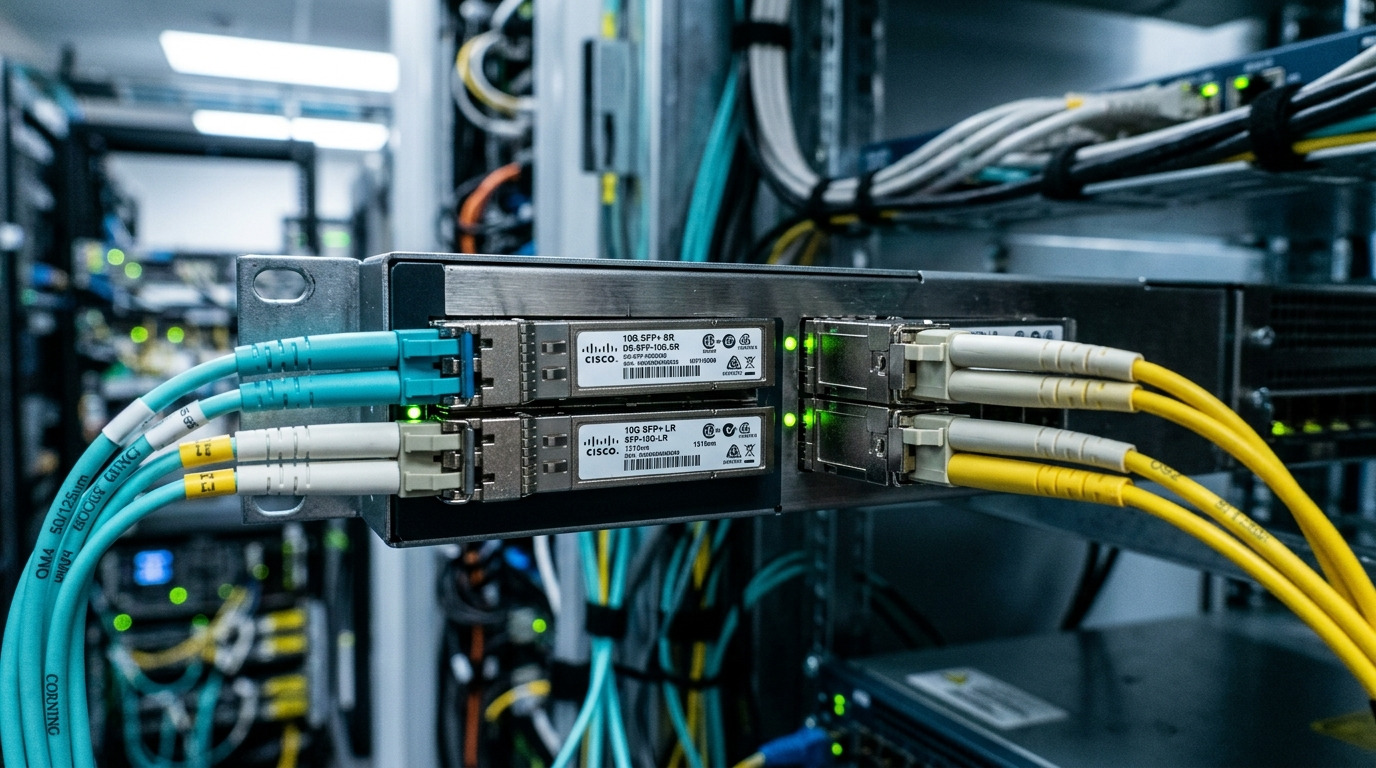
In most leaf-spine and spine-up designs, the ROI of 800G comes from higher throughput per rack position and fewer parallel links, but the cost drivers are optics, host port licensing, and system power. The “gotcha” we see in the field: engineers budget only transceiver and NIC costs, then discover that power and cooling deltas dominate total cost of ownership (TCO). Another common reality is that 800G optics compatibility and DOM behavior can slow rollout, extending downtime windows and delaying payback.
To validate ROI, treat the upgrade like a controlled deployment: pick a representative ToR-to-spine segment, measure baseline utilization and power, then model the delta after swapping optics and enabling the new line rates. For standards context, Ethernet interfaces and optics behavior map to IEEE 802.3 variants for 800G Ethernet, while vendor-specific details like DOM readings and FEC/PCS modes are in transceiver datasheets. For background on Ethernet operation and link behavior, see IEEE 802.3 standards and vendor optics documentation such as Finisar optics datasheets.
ROI model inputs you can measure this week
- Capex: 800G line cards or switch ports, optics (QSFP-DD800/OSFP class depending on vendor), and cabling changes.
- Opex: electricity rate, power supply efficiency, and cooling cost per kW. Even a small power delta per port can matter at scale.
- Operational risk: compatibility issues (DOM, supported reach, FEC modes), plus installation and test time.
- Utilization impact: traffic demand growth; ROI improves when you avoid buying additional racks/links.
800G optics and reach: what you must compare before pricing
800G systems typically rely on coherent or PAM4-based signaling depending on the architecture, with optics options that span short reach and extended reach. The ROI question hinges on whether you can standardize on a small set of optics SKUs that match your distances and budgets. Also, be strict about connector type, wavelength plan, and supported temperature range because mismatches cause link instability or reduced reach.
Below is a practical comparison of common 800G short-reach optics families used in data centers. Exact specs vary by vendor and module generation, so always confirm against the specific transceiver datasheet and the switch vendor compatibility list.
| Module / Example | Typical Data Rate | Wavelength | Reach Class | Connector | Approx. Module Power | Operating Temp | Notes for ROI |
|---|---|---|---|---|---|---|---|
| QSFP-DD800 SR8 (common 800G SR) | 800G (8x100G style) | 850 nm | ~100 m (check exact SKU) | LC | ~5 to 12 W (varies) | 0 to 70 C typical | Best for ToR-spine inside one suite; simplifies standardization. |
| OSFP 800G DR4/ER4 style (vendor dependent) | 800G | ~1310 nm (varies) | ~2 km+ (check SKU) | LC | ~7 to 15 W (varies) | Higher cost per module; reduces need for intermediate switching. | |
| Coherent 800G optics (if applicable) | 800G | 1550 nm band | 10 km to 80 km+ (varies) | LC or custom | ~10 to 30 W+ (varies) | May cost more but can avoid additional network hops. |
When selecting modules, validate with the switch vendor’s “optics compatibility” page and the transceiver datasheet. For example, many 10G/25G/100G module families are published by vendors with explicit DOM and temperature specs; the same rigor applies at 800G. If you are evaluating third-party optics, prioritize those that publish detailed DOM behavior and have documented compatibility results. For optical module spec examples, see vendor catalogs such as FS.com optics product pages and datasheets for known module models like Finisar FTLX8571D3BCL (as a reference point for how datasheets present reach, wavelength, and DOM details at other speeds).
Pro Tip: During ROI validation, do not just compare “module power.” Measure the system-level power at the rack using your PDUs or telemetry, then subtract baseline. In multiple deployments, optics swaps produced a smaller-than-expected rack power delta because airflow and fan curves dominate at high utilization, but link retries and error counters can erase those gains if the optics are marginal for your exact fiber plant.
Decision checklist: how to choose 800G optics that pay back
Use this ordered checklist when you are deciding which 800G path to fund. It is optimized for fast validation and fewer surprises during rollout.
- Distance and plant loss: confirm fiber length, connector type, and estimated link budget. Validate with OTDR or at least measured insertion loss.
- Switch compatibility: verify the exact switch model and port type support the optic SKU and the correct FEC/PCS mode.
- DOM and telemetry: confirm what your management plane reads (temperature, bias current, received power) and whether thresholds match your alerting.
- Operating temperature and airflow: ensure the transceiver’s spec (for example, 0 to 70 C) matches your rack thermal profile and any hot-aisle recirculation risk.
- Reach class fit: prefer standardized optics that cover your majority of links rather than a custom mix that increases inventory and failure troubleshooting time.
- Vendor lock-in risk: assess whether third-party optics are supported and whether future firmware updates might disable unsupported modules.
- Installation and test time: include labor hours, rollback plan, and acceptance testing duration in ROI. Delays can turn a “good” hardware ROI into a schedule loss.
Common pitfalls and troubleshooting that break ROI
If your ROI plan assumes smooth deployment, these are the failure modes that routinely extend timelines and inflate costs. Treat them as pre-mortems.
Pitfall 1: “It links up” but traffic errors kill the economics
Root cause: marginal optical power levels or connector contamination leads to intermittent errors, increasing retransmits and lowering effective throughput. Sometimes the link stays “up,” but the error counters climb.
Solution: run a structured validation: check BER/FEC counters, verify receive power against datasheet thresholds, and clean connectors before swapping modules. Include a traffic soak test that matches your expected packet sizes.
Pitfall 2: DOM mismatch causes alarm storms and delayed rollback
Root cause: the transceiver’s DOM data format or threshold behavior differs from what your monitoring stack expects, triggering false alarms or masking real faults.
Solution: in a pilot, capture DOM telemetry during stable operation and tune alert thresholds. Validate that your monitoring reads temperature, bias, and optical power with correct units and scaling.
Pitfall 3: Temperature overshoot from airflow changes after module density increases
Root cause: 800G optics and higher port density can change airflow requirements. Even if the transceiver spec is “70 C,” the rack hotspots can exceed safe margins, causing performance degradation.
Solution: instrument rack inlet/outlet temperatures, verify fan curve behavior, and confirm that airflow engineering (baffles, blanking panels) is correct before full rollout.
Pitfall 4: Compatibility gaps between switch firmware and optic generation
Root cause: firmware updates can alter supported feature sets (FEC mode negotiation, optics identification rules). A module may work on one firmware level and fail or underperform on another.
Solution: lock a firmware baseline for the pilot window. If you must upgrade, re-validate optics behavior in a controlled batch.
Cost and ROI reality: budgeting beyond the sticker price
Typical 800G optics pricing varies widely by reach class, vendor, and whether you buy OEM-only or consider third-party modules. As a practical range, short-reach 800G optics often land in the hundreds to low thousands of dollars per module, while longer-reach or coherent options can be multiple thousands and may require additional system support. In TCO models, include expected failure rates, replacement lead times, and the cost of downtime during failed link validation.
ROI improves when you reduce the number of parallel links, defer additional rack purchases, and lower power per delivered bit. But be honest: if your network already has spare capacity, 800G may not deliver ROI on throughput alone; the payoff may come later through consolidation or reduced cabling complexity. For measurement discipline, align capex and opex in the same reporting period and include labor hours. If you are comparing OEM vs third-party optics, require documented compatibility results and DOM/telemetry validation; otherwise, your “savings” can be wiped out by extended troubleshooting.
FAQ
What ROI timeline should I expect for an 800G upgrade?
Many teams target a payback window of 12 to 36 months, depending on how urgently they need capacity. If you already have spare capacity, ROI may shift from “throughput now” to “avoid future rack growth.”
Do I need coherent optics to justify ROI?
Not usually. For many leaf-spine and data center interconnect segments, short-reach 800G optics are sufficient to unlock port density and consolidation. Coherent is more ROI-relevant when distance or intermediate hop reduction dominates.
How do I compare power consumption fairly across vendors?
Compare module datasheet power, but validate with your rack telemetry. Measure pre- and post-change rack power at the same utilization level, then normalize for fan curve behavior.
Are third-party 800G optics a safe ROI bet?
They can be, but only if compatibility is proven for your exact switch model and firmware baseline. Require DOM telemetry validation, and confirm that optics are supported by the switch vendor or that you have documented field results.
What fiber issues most often cause 800G link problems?
Dirty connectors, incorrect polarity, and fiber plant loss that exceeds the module’s reach budget are common. Use cleaning SOPs and verify link budgets with measured loss rather than assuming “it should work.”
How should I run a pilot to reduce ROI risk?
Pick a representative set of links across the full distance and temperature range you plan to deploy. Include a traffic soak test, monitor DOM and error counters, and define rollback triggers before you start.
Bottom line: 800G ROI is real, but it is earned through measurable power and utilization gains plus a compatibility-safe rollout plan. If you want a related next step, use how to run an optics pilot and acceptance testing|how to run an optics pilot and acceptance testing to structure your validation and protect your payback window.
Author bio: I build and validate data center network upgrades end-to-end, from optics DOM telemetry to rack-level power measurements, with a bias toward fast PMF-style learning cycles. I help teams quantify ROI using pilots, acceptance criteria, and operational safeguards rather than assumptions.
