
If you run an SMB network and you are weighing an 800G upgrade, the real question is not “can it work,” but “will it pay back.” This article helps IT managers, network engineers, and MSPs perform ROI analysis that includes optics and fiber costs, switch licensing, power, and migration downtime risk. You will get a step-by-step implementation plan with measurable assumptions, a spec comparison table, and troubleshooting for the failure modes that usually destroy projected payback.
Prerequisites: what you must measure before starting ROI analysis
Before you price transceivers or schedule change windows, capture baseline utilization and physical-layer constraints. In SMB environments, the biggest ROI killers are often hidden: oversubscribed uplinks, aging MPO trunks, and licensing that arrives later than the hardware.
Focus on three datasets: traffic growth, physical plant capacity, and operational risk. For physical plant, include fiber type, connector style, and existing lane utilization; for operations, include mean time to repair (MTTR) and your outage tolerance.
Build a 24-month traffic and utilization model
Expected outcome: a forecast that turns into a usable cost-per-Mbps number for ROI analysis.
- Export 95th percentile utilization for each uplink and inter-switch link for the last 30 to 90 days.
- Estimate growth using application pipeline metrics: VM density, VDI seats, backup targets, and any planned AI inference workloads.
- Pick two scenarios: “conservative” and “accelerated.” Example: 20% vs 45% annual growth in east-west traffic.
- Calculate needed throughput headroom as 1.3x your projected 95th percentile to avoid chronic congestion.
Inventory the fiber plant and switch ports down to lane count
Expected outcome: a hard yes/no on whether existing cabling can support 800G optics without a re-pull.
- Identify your current transceiver form factors (QSFP56, OSFP, QSFP112, or vendor-specific) and link speeds (e.g., 100G, 200G, 400G).
- List fiber type: OM4/OM5 multimode versus OS2 single-mode. Record link distance and connector type (LC vs MPO/MTP).
- For MPO/MTP trunks, record polarity method and ribbon/fiber mapping requirements (do not assume “works like the last one”).
- Measure optical budget margins if you have OTDR data; otherwise, plan conservative margins for aging and patch-panel losses.
Quantify operational risk as outage hours and MTTR
Expected outcome: a risk-adjusted ROI analysis that includes downtime cost and repair likelihood.
- Define your maintenance window size (e.g., 2 hours after-hours) and your acceptable rollback time.
- Estimate MTTR based on your team’s experience with optics swaps and break/fix on MPO patching.
- Include probability of “first-time success” for migration steps (especially polarity and lane mapping).
- Assign a business cost per outage hour (even a rough figure like $500 to $2,500 per hour helps compare options).
800G in SMBs: what changes at the physical layer and why it matters for ROI
At 800G, the physical layer becomes less forgiving. You are moving from relatively straightforward optics economics at 100G/400G to higher aggregate bandwidth where the wrong fiber class, insufficient polarity handling, or a marginal optical budget can force costly re-cabling.
Most SMB upgrades aim for 800G uplinks or spine-to-leaf links in a small leaf-spine fabric, but the ROI analysis must separate three cost buckets: (1) transceivers and optics, (2) cabling and patching labor, and (3) switch licensing and operational overhead.
How 800G typically maps to optics choices
Expected outcome: you can compare short-reach vs long-reach designs using vendor datasheets and IEEE-compliant optics behavior.
- Short reach usually targets multimode fiber (OM4/OM5) for intra-rack or short inter-rack distances.
- Long reach uses single-mode (OS2) for campus or extended fabric coverage.
- Connector and polarity matters: MPO/MTP is common for high-density deployments and requires correct polarity alignment.
Technical specifications to compare (the table you should actually use)
Expected outcome: a grounded comparison that feeds ROI analysis inputs for reach, optics type, and operating conditions.
| Optics / Module Example | Data Rate | Target Fiber Type | Typical Wavelength | Reach (Typical) | Connector | Operating Temp | Common Use Case |
|---|---|---|---|---|---|---|---|
| Cisco 800G SR8 (example family) / vendor SR8 equivalent | 800G | OM4/OM5 multimode | 850 nm class | Short reach (tens to ~100m class depending on OM and budget) | MPO-16/MTP (8-lane groups) | 0C to 70C class (check exact datasheet) | Leaf-spine, top-of-rack, or short inter-rack |
| Finisar / FS / OEM 800G LR8 (example family) / vendor LR8 equivalent | 800G | OS2 single-mode | 1310 nm class | Long reach (hundreds of meters to several km class depending on spec) | LC (often) or duplex LC | -5C to 70C class (check exact datasheet) | Campus extensions or longer spine links |
| Cisco 800G FR4/DR4 style (example family) / vendor FR4 equivalent | 800G | OS2 single-mode | 1310/1550 multi-wavelength class | Extended reach (km class depending on budget) | LC (often) | 0C to 70C class (check exact datasheet) | Extended campus or longer fabric segments |
Note: Exact reach depends on optics generation, lane count, fiber grade, patch loss, and vendor optical budget. Always validate against the specific transceiver datasheet and your channel loss assumptions. [Source: IEEE 802.3 Ethernet specifications overview via IEEE 802.3 working group pages] IEEE 802.3
ROI analysis framework: short-term payback vs long-term business value
ROI analysis is not only about “how much bandwidth did we buy.” In SMBs, long-term value often comes from reduced operational friction: fewer congestion incidents, fewer emergency upgrades, and better headroom for new services.
To keep ROI analysis honest, compute both short-term and long-term components. Short-term includes immediate CapEx and migration labor; long-term includes avoided network incidents and reduced upgrade frequency.
Calculate CapEx for optics, cabling, and licensing
Expected outcome: a realistic bill of materials and labor estimate for your 800G plan.
- Transceivers: price the exact reach class you need (SR vs LR vs FR/DR). Include spares at 10% to 15% of the deployed quantity.
- Cabling: include MPO/MTP trunks, patch panels, and any polarity accessories. If you have to re-pull, labor dominates.
- Switch licensing: confirm whether the platform needs feature licenses for the higher-speed mode or specific port breakout behavior.
- Installation: include change window labor, validation time, and rollback contingency.
In many SMB deployments, licensing and labor can rival optics cost. Vendor and partner quotes vary widely, so request line-item estimates.
Calculate OpEx changes (power, cooling, and support)
Expected outcome: an OpEx delta that does not ignore power draw at the chassis and optics level.
- Estimate chassis and line-card power at your expected utilization. If you cannot measure, use vendor power tables and apply a utilization factor.
- Include optical power consumption differences between multimode and single-mode variants and between vendors.
- Add support cost: OEM support often costs more but reduces lead-time risk on failed optics.
- Cooling: verify whether your power/thermal budget is already near limits. A small network room might not have headroom.
Convert network outcomes into avoided cost
Expected outcome: a defensible avoided-cost model for ROI analysis.
- Congestion incidents: estimate business impact of degraded performance (ticket volume, SLA penalties, user downtime).
- Upgrade frequency: compare “upgrade again in 18 months” versus “hold for 3 to 5 years.” Avoided emergency projects are real money.
- Operational time: count hours spent during maintenance and troubleshooting. At 800G, optics and polarity mistakes cost more.
- Risk adjustment: multiply avoided cost by confidence level derived from your MTTR and migration success probability.
Pro Tip: In field deployments, the biggest ROI surprise is not the transceiver price; it is the patching and polarity time. If your current MPO patching scheme is loosely documented, the first 800G migration often adds 2 to 6 hours of labor for verification and lane mapping, which can erase the “short-term savings” you expected from cheaper optics.
Selection criteria checklist: choosing optics and cabling for the best ROI analysis
Engineers often start with reach and ignore compatibility details. For 800G ROI analysis, selection must include switch compatibility, DOM handling, and environmental constraints.
Use this ordered checklist to avoid late-stage rework.
- Distance and fiber grade: match SR vs LR vs FR/DR to OM4/OM5 vs OS2 and your measured channel loss.
- Switch and port compatibility: verify the platform supports the module type and mode at 800G without breakout constraints.
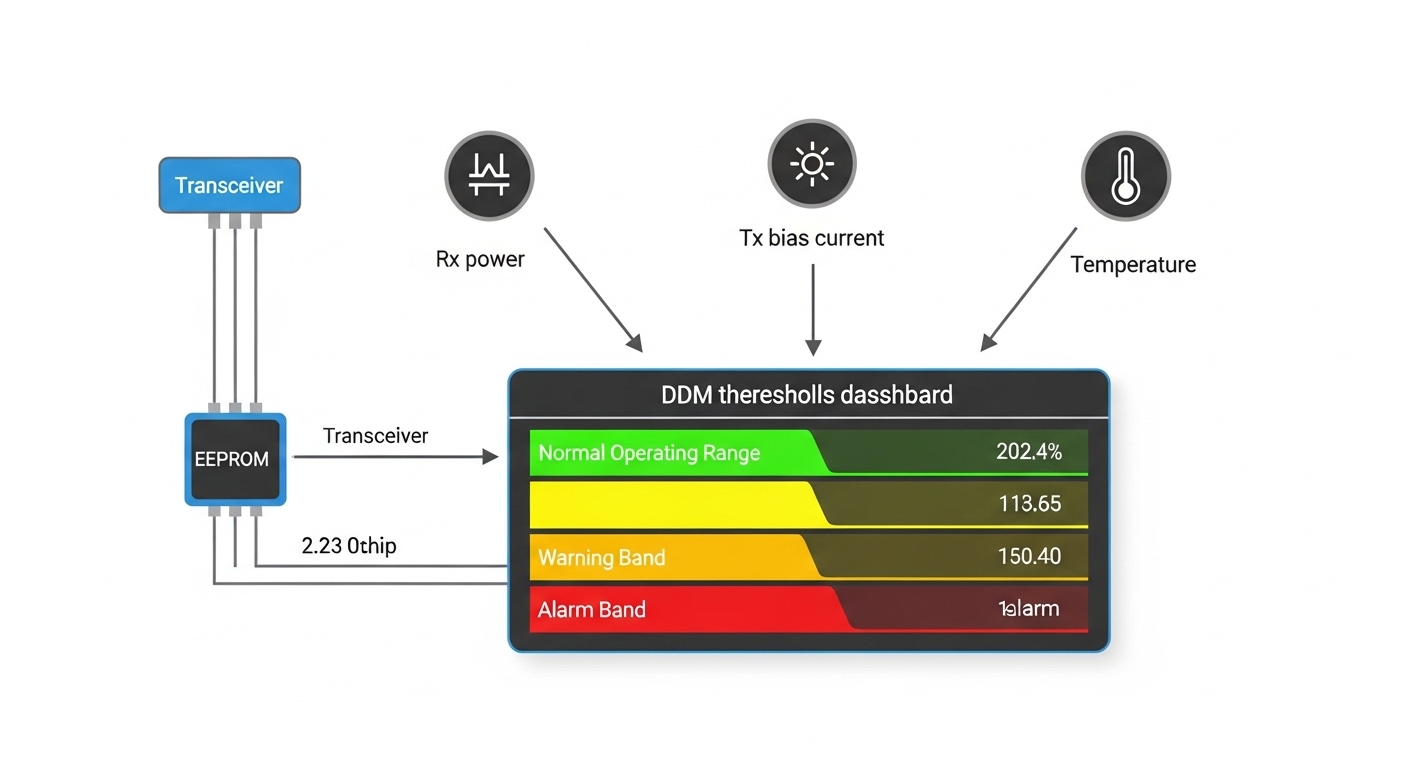
- DOM support and telemetry: confirm Digital Optical Monitoring support (DOM) and whether your switch reads thresholds correctly.
- Operating temperature: ensure the optics meet the actual ambient range in your rack; small server rooms can exceed assumptions.
- Power and thermal budget: check optics power draw and line-card power at your utilization profile.
- Vendor lock-in risk: evaluate whether the switch enforces OEM-only optics, or whether third-party modules pass diagnostics and link negotiation.
- Connector and polarity strategy: for MPO/MTP, document polarity mapping and labeling before ordering cables.
- Spare strategy: plan which optics are hot-spare vs cold-spare based on lead times and support contracts.
Step-by-step 800G upgrade plan for SMBs (implementation with measurable outcomes)
This section turns ROI analysis into an execution plan. The objective is a successful migration with minimal downtime and validated optics performance so that the ROI you calculated is actually realized.
Pilot on one link and validate optical health
Expected outcome: you confirm compatibility, polarity, and link stability before scaling.
- Select one representative link: similar distance, same patch panel type, and same fiber grade as the majority of links.
- Install the optics and apply your documented polarity scheme.
- Bring up the interface and verify link state, error counters, and optic telemetry.
- Verify FEC and BER/PCS health indicators if your platform exposes them. If not, use error counter trends as a proxy.
Implement VLAN and routing validation for traffic classes
Expected outcome: you confirm that higher bandwidth does not mask policy problems.
- Validate that VLAN tagging and trunking remain consistent. High-speed upgrades sometimes coincide with configuration drift.
- Confirm QoS mappings for latency-sensitive traffic (VoIP, virtualization storage, backup traffic windows).
- Run controlled traffic tests: iperf-like throughput is useful, but also validate application-level performance.
- Monitor for microbursts and queue drops during peak periods.
Scale out with a repeatable cabling workflow
Expected outcome: consistent lane mapping and reduced labor time per link.
- Pre-stage optics with serial numbers recorded. Track by port and link ID.
- Use a standardized labeling approach: patch panel ID, polarity orientation, and trunk segment ID.
- Have a second set of eyes verify polarity direction before closing patch panels.
- After each link, confirm stable telemetry and error counters over a defined interval (e.g., 30 to 60 minutes).
Post-upgrade measurement to close the ROI loop
Expected outcome: you compare predicted ROI to actual outcomes and update your model.
- Recompute 95th percentile utilization and congestion indicators from the new baseline.
- Record actual labor hours spent on migration and troubleshooting.
- Track incidents: interface flaps, optic alarms, CRC/FCS errors, and any packet drops.
- Update your ROI analysis: if labor exceeded estimates, adjust your future upgrade planning assumptions.
Common mistakes and troubleshooting tips (top failure points)
Even when ROI analysis looks strong on paper, execution failures can erase it. Below are three common issues I have seen during high-speed optics migrations, with root causes and fixes.
Failure point 1: Polarity or MPO mapping error
Root cause: MPO/MTP polarity mismatch (reversed or wrong mapping) causing link not to come up or intermittent errors after link negotiation.
Solution: verify polarity method end-to-end using your patching documentation; re-seat connectors carefully, and swap patch cords rather than reordering optics randomly. Use consistent labeling and mark “A/B” ends on trunks and patch cords before the next attempt.
Failure point 2: DOM or compatibility mismatch with third-party optics
Root cause: optics that technically negotiate but fail DOM telemetry thresholds, or the switch platform rejects certain module identifiers.
Solution: check switch vendor compatibility lists and confirm DOM behavior. If you use third-party optics, validate in the pilot link first and confirm alarms/telemetry readings match your operational expectations.
Failure point 3: Optical budget too tight due to patch loss and aging
Root cause: excessive loss from dirty connectors, older patch panels, too many mated pairs, or unaccounted attenuation in long patch routes.
Solution: clean connectors with proper procedures, inspect with an optical scope if available, and reduce patch count. If needed, re-route through lower-loss panels or upgrade to approved low-loss trunks.
Cost and ROI note: realistic ranges and total cost of ownership
Pricing for 800G optics varies by reach, vendor, and volume commitments. In many SMB bids, optics are only part of TCO; the true cost includes labor, downtime risk, and the cost of rework when compatibility or cabling assumptions are wrong.
As a practical budgeting approach, model three cost drivers: (1) optics purchase plus spares, (2) cabling/patching labor, and (3) support and lead-time risk. OEM optics are often higher per unit but can reduce failure and lead-time uncertainty; third-party optics can reduce unit cost but increase validation time and compatibility risk. For ROI analysis, treat third-party savings as conditional on passing your pilot validation and meeting your error/telemetry acceptance criteria.
If you want external reference points for optical module categories and Ethernet physical-layer concepts, start with vendor datasheets and authoritative Ethernet standards materials. [Source: ANSI/TIA-568 and IEC connector cleanliness and cabling best practices via TIA and IEC resources] TIA IEC Webstore
FAQ for SMB buyers doing ROI analysis on 800G upgrades
How do I start ROI analysis if I do not know exact traffic growth?
Use 95th percentile utilization trends and build two scenarios: conservative and accelerated growth. Then apply a headroom factor like 1.3x projected 95th percentile to prevent chronic congestion. The goal is not perfect forecasting; it is comparing upgrade options under realistic ranges.
Is multimode (OM4/OM5) always cheaper than single-mode for 800G?
Often, short-reach multimode can reduce optics cost and speed up deployment for nearby links. However, if your patching path is long or already near loss limits, single-mode with a different reach class may reduce rework. ROI analysis should include cabling labor and re-pull risk, not only optics price.
What is the biggest technical risk that breaks ROI projections?
In practice, polarity and MPO lane mapping errors are the most common cause of delayed rollouts. They increase labor hours and can force additional optics or cabling purchases. Build a pilot step and require optical health validation before scaling.
Can I use third-party 800G optics to improve ROI analysis?
You can, but only if your switch platform supports them in practice, including DOM telemetry and link negotiation. Validate on a pilot link, confirm alarms behave as expected, and ensure operating temperature ratings match your rack environment. Treat third-party savings as conditional on passing your acceptance tests.
Should I upgrade VLANs or routing at the same time as 800G?
Do not combine too many changes if your outage tolerance is low. You can validate VLAN trunking and QoS during the upgrade, but keep routing changes staged to reduce variables. ROI analysis assumes you can execute without extended troubleshooting loops.
How long should I measure results after the upgrade?
At minimum, monitor telemetry and error counters for 30 to 60 minutes per link, then re-check after one or two peak cycles. For ROI validation, compare 95th percentile utilization and incident frequency over several weeks to account for traffic seasonality.
Bottom line: strong ROI analysis for SMB 800G upgrades comes from combining optics and cabling costs with migration risk, power/thermal impacts, and measurable post-upgrade outcomes. If you want the next step, review network cabling polarity best practices to reduce the failure modes that most often erase projected payback.
Author bio: I have deployed and troubleshot high-density Ethernet fabrics, including 400G/800G optics, MPO/MTP polarity workflows, and migration playbooks across SMB and mid-market data closets. I focus on measurable validation, optical health telemetry, and routing/switching change control to protect uptime and ROI.
