
If your AI framework is hitting GPU-to-GPU bandwidth limits, the wrong uplink transceiver choice can quietly cap throughput. This article helps network engineers and platform teams decide between QSFP28 and SFP+ for AI cluster fabrics, with concrete optics examples and migration steps. You will also get troubleshooting guidance for the most common link failures and a checklist you can use in procurement reviews.
Prerequisites: audit your AI fabric before swapping optics
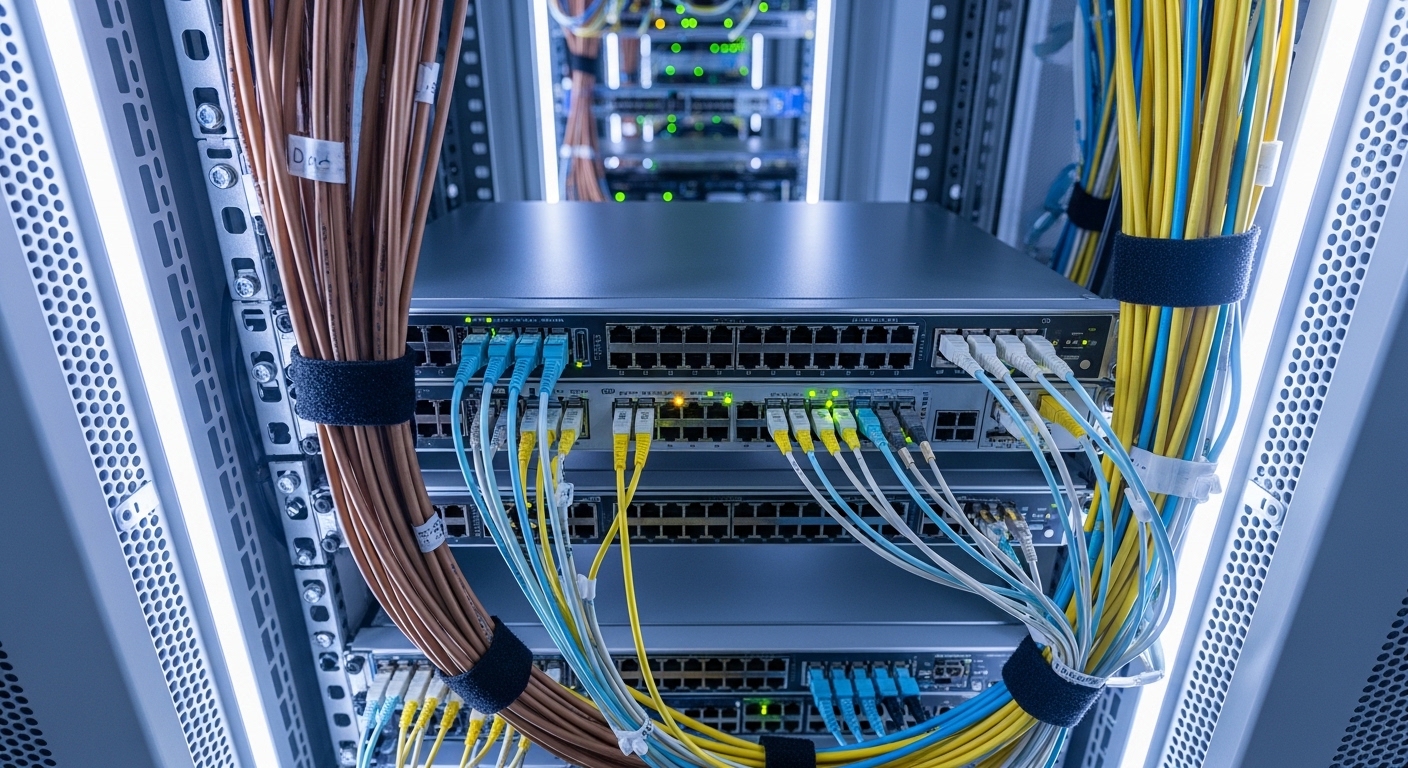
Before choosing QSFP28 or SFP+, confirm the bottleneck is actually transport bandwidth and not oversubscription, congestion, or CPU bottlenecks. In real deployments, teams often discover that the switch ASIC can forward line rate, but the end-to-end path is constrained by oversubscribed leaf uplinks or misconfigured ECMP. You should also verify that your switch ports support the exact electrical lane mode required by the transceiver.
Measure current traffic and link utilization
On the switches, collect interface counters for at least a full training cycle window. Look for sustained utilization above 70% on SFP+ uplinks during all-reduce phases, and correlate to GPU job timelines from your scheduler. If you cannot measure end-to-end, use flow telemetry (NetFlow/IPFIX) and compare top talkers during training epochs.
Expected outcome: You can name the exact links and time windows where the fabric saturates, rather than guessing.
Confirm switch transceiver compatibility and port speed modes
Check the vendor hardware compatibility list for the switch model and firmware. For example, many modern AI switches support QSFP28 at 25G per port, while SFP+ typically tops out at 10G and may require a different optics selection. Also confirm whether the port is configured as 10G, 25G, or breakout mode (for example, 100G QSFP28 breaking into 4x25G).
Expected outcome: You know which ports can physically and electrically run QSFP28 and at what speed.
Gather optical distance requirements and fiber type
Record link distances and fiber plant details: OM3/OM4 multimode versus OS2 single-mode. AI clusters are frequently built with OM4 for short reach, but some pods stretch across buildings and require OS2. Your optics choice depends on wavelength, reach class, and connector type (LC is common for QSFP28 SR).
Expected outcome: A table of each link: distance, fiber type, and connector, ready for optics mapping.
Pro Tip: In many AI fabrics, the biggest “QSFP28 vs SFP+” surprise is not the transceiver itself but the switch port profile. If the port is left in a default 10G mode, QSFP28 may negotiate down or fail DOM validation, causing intermittent link flaps that look like a transceiver defect.
QSFP28 and SFP+ in AI frameworks: what changes at 25G vs 10G
QSFP28 is the form factor that enables higher per-lane throughput, commonly 25Gbps (and also used in higher-rate breakout architectures). SFP+ is older and typically used for 10Gbps Ethernet. For AI frameworks using all-reduce (for example, NCCL-based collectives), the networking layer must move large gradient tensors efficiently; higher link speeds reduce time spent waiting for synchronization.
That said, the real performance impact depends on the topology and oversubscription ratio. In a fat-tree or leaf-spine design with adequate uplinks, moving from SFP+ to QSFP28 can reduce queueing and improve tail latency during synchronization bursts. In an already under-provisioned oversubscribed fabric, faster transceivers alone may not fix congestion.
Map your framework communication pattern to network limits
During training, run a controlled job and observe whether the cluster experiences increased step time at the all-reduce boundaries. If step time spikes correlate with uplink queue buildup, bandwidth is likely the limiting factor. If step time is stable but throughput is low, the issue may be compute pipeline, dataloader throughput, or CPU-side networking.
Expected outcome: You can justify the transceiver upgrade with evidence tied to AI synchronization behavior.
Optics comparison: QSFP28 SR vs SFP+ SR and typical part choices
Most AI clusters prefer short-reach optics within a rack or pod. For QSFP28, the common short-reach multimode option is 25G SR (often specified around 100m on OM4). For SFP+, short-reach is typically 10G SR (often around 300m on OM3 and 400m on OM4 depending on vendor). You must also consider power draw, thermal behavior, and DOM support.
| Spec | QSFP28 (typical 25G SR) | SFP+ (typical 10G SR) |
|---|---|---|
| Data rate | 25Gbps per port | 10Gbps per port |
| Common wavelength | 850nm (MMF) | 850nm (MMF) |
| Typical reach on OM4 | ~100m (vendor-dependent) | ~400m (vendor-dependent) |
| Connector | LC duplex (common) | LC duplex (common) |
| Temperature range | Often 0 to 70 C (commercial) or extended variants | Often 0 to 70 C (commercial) or extended variants |
| DOM support | Usually supported via I2C/MDIO vendor implementation | Usually supported via I2C/MDIO vendor implementation |
For real part examples you may encounter in procurement: Cisco SFP-10G-SR is a common SFP+ reference, while Finisar and FS.com have multiple QSFP28 SR SKUs such as Finisar FTLX8571D3BCL and FS.com variants like SFP-10GSR-85 for SFP+ and FS.com QSFP28 25G SR modules for QSFP28. Always validate the exact model number in the switch vendor’s optics compatibility list.
On the standards side, link behavior and electrical signaling are governed by Ethernet and transceiver specifications and are aligned with IEEE Ethernet operation. For Ethernet requirements, refer to [Source: IEEE 802.3]. For vendor-specific optics behavior, refer to the module datasheets and the switch platform’s transceiver documentation.
anchor-text: IEEE 802.3 Ethernet standard
Step-by-step migration plan: when to upgrade to QSFP28
Use a staged migration to avoid training downtime and to isolate whether the upgrade changes throughput or only shifts bottlenecks. A typical approach is to upgrade one leaf pair or one pod at a time, then run a controlled training workload and compare step time and link utilization.
Choose the right target links (not every port)
Start with uplinks that carry the majority of all-reduce traffic. In many AI clusters, ToR-to-spine and inter-pod links dominate synchronization overhead. If your SFP+ uplinks are the limiting segment, replacing them with QSFP28 at 25G can reduce congestion during gradient exchange.
Expected outcome: Measurable improvement with minimal risk.
Select optics by reach, budget, and vendor policy
For each link, confirm reach on the actual fiber type and end-to-end loss budget. Practical engineers account for connector loss, patch-cord loss, and any splices; if the calculated budget is tight, choose a conservative reach grade or add margin. Also verify DOM compatibility, since some platforms reject non-conforming modules and log “DOM not supported” or “unsupported transceiver” events.
Expected outcome: Fewer field failures and stable link negotiation.
Deploy and validate with deterministic test steps
After installing optics, check link status, speed negotiation, and error counters. Engineers commonly validate with interface counters (CRC errors, input errors), transceiver diagnostics (Tx/Rx power), and a short synthetic traffic test prior to full training. If your switch supports it, enable link-level telemetry and confirm ECMP hashing is distributing flows across member links.
Expected outcome: You can prove the upgrade is healthy before running long jobs.
Selection criteria checklist: QSFP28 vs SFP+ for AI fabrics
When procurement or architecture review asks “which one should we standardize,” use this ordered checklist. It reflects what engineers actually get burned by in the field.
- Distance and fiber type: verify OM3/OM4/OS2 reach margins and connector loss budget.
- Switch compatibility: confirm exact port speed profile and optics compatibility list.
- Data rate alignment: ensure the uplink speed matches the fabric’s oversubscription design.
- DOM and diagnostics: confirm your platform supports the module’s DOM implementation and thresholds.
- Operating temperature: validate module temperature range versus ambient in switch bays and cable trays.
- Vendor lock-in risk: compare OEM-only support versus third-party availability and warranty terms.
- Power and thermal impact: estimate additional heat in dense bays; plan airflow verification.
Common mistakes and troubleshooting: top failure modes
Even experienced teams hit predictable transceiver issues. Below are the most common failure modes with root cause and fixes.
Link flaps after insertion
Root cause: port profile mismatch or optics not fully compatible with the switch’s transceiver requirements (often seen with third-party modules). DOM negotiation can also fail if the module does not meet expected I2C behavior.
Solution: confirm the port is set to the correct speed (for example, 25G mode for QSFP28), reseat the module, and check switch logs for “unsupported transceiver” or DOM errors. Try a known-good OEM module to isolate optics versus port configuration.
High CRC or input errors despite “link up”
Root cause: fiber plant loss too high for the reach class, dirty connectors, or marginal Tx/Rx power. This is especially common when OM4 patch cords are mixed with older OM3 jumpers or when connectors are not cleaned during swaps.
Solution: clean LC connectors with approved cleaning tools, inspect with a fiber scope, and re-verify the link loss budget. Replace patch cords and confirm module diagnostics (Tx power, Rx power, bias current) fall within datasheet thresholds.
Performance gains do not appear after upgrading to QSFP28
Root cause: congestion is elsewhere (for example, storage-to-GPU traffic, CPU bottlenecks, or oversubscription downstream). Sometimes the faster uplink simply moves the bottleneck to another hop.
Solution: repeat the measurement after each migration stage: compare utilization and queueing on the new uplinks and on the next-hop links. Also verify ECMP configuration and that hashing includes the expected header fields for your traffic pattern.
Cost and ROI note: what to budget for QSFP28 vs SFP+
Pricing varies by vendor, region, and compatibility constraints. In many markets, QSFP28 25G SR optics cost more per unit than SFP+ 10G SR, but the ROI often comes from fewer congested links and reduced training step time. For example, teams may replace a set of SFP+ uplinks with fewer higher-capacity QSFP28 links to improve effective bandwidth, even if the per-module cost is higher.
In TCO terms, include transceiver failure rates, warranty length, and the time engineers spend on troubleshooting incompatible optics. OEM optics can be more expensive but often reduce field risk; third-party optics can be cost-effective if they are validated on your specific switch platform and if DOM and thresholds are known to work.
FAQ
Is QSFP28 always better than SFP+ for AI workloads?
No. QSFP28 offers higher per-port bandwidth (commonly 25G), but if your fabric is oversubscribed elsewhere, you may not see step-time improvement. Validate utilization and congestion points before changing optics standards.
What fiber reach should I assume for QSFP28 SR?
Many QSFP28 SR modules are specified for around 100m on OM4 at 850nm, but always use the exact datasheet and confirm your loss budget. If you have longer runs, you may need different reach grades or single-mode optics.
Will third-party QSFP28 modules work in enterprise switches?
Often yes, but compatibility depends on the switch model, firmware, and DOM expectations. Use the vendor compatibility list and test with a known-good module before rolling out at scale.
How do I verify DOM health in the field?
Check switch transceiver diagnostics for vendor-specific DOM fields such as Tx/Rx power, temperature, and alarm thresholds. If you see DOM failures, treat it as a compatibility issue first, not a fiber issue.
What is the most common cause of “link down” after upgrading?
Port speed/profile mismatch or optics not supported for that port mode. Confirm the port is configured for the required speed (for QSFP28, typically 25G) and re-check the platform’s optics support list.
Should I migrate leaf uplinks or every server port first?
Start with the uplinks that carry the dominant all-reduce traffic and are most likely to saturate. A staged approach reduces risk and makes it easier to attribute performance changes to the network upgrade.
If you want the fastest path to a stable AI fabric, pair QSFP28 selection with a measured migration plan and fiber-plant validation. Next, review fiber-optic-transceiver-compatibility-checklist to tighten your transceiver testing workflow before procurement.
Author bio: I have
