
In modern telecom infrastructure networks, engineers are under pressure to raise per-port capacity without destabilizing optics, power budgets, or optics-management workflows. This guide focuses on leveraging QSFP-DD transceivers for high-speed links across metro, data center interconnect, and access aggregation. You will get a practical selection checklist, a specs comparison table, and field troubleshooting patterns you can apply during commissioning.
Why QSFP-DD is showing up in high-speed telecom infrastructure
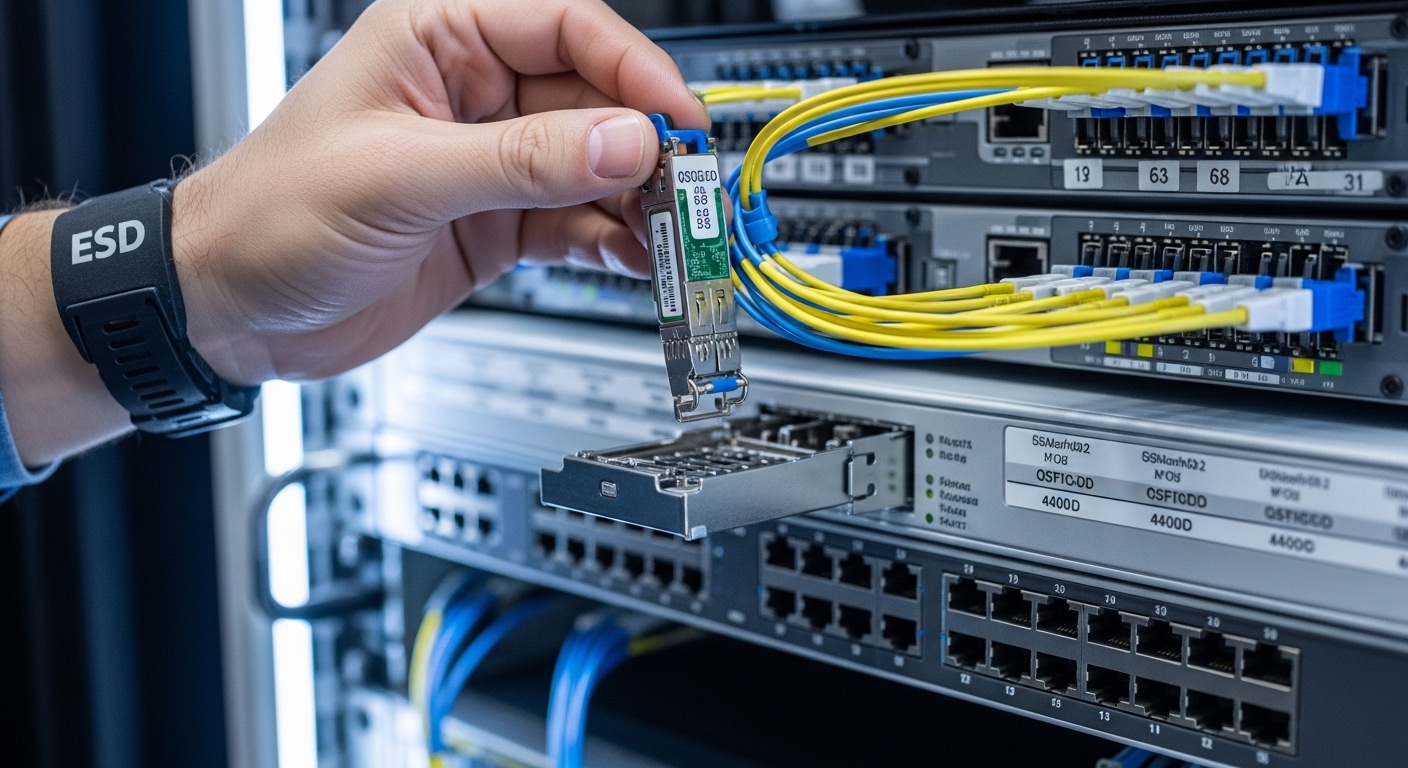
QSFP-DD (Double Density) was designed to increase port density and throughput per slot while maintaining a familiar hot-pluggable operational model. In practice, QSFP-DD modules commonly target 400G class links (often 4x100G electrical lanes) and are used where switch line cards and optical front-ends provide tight power and thermal envelopes. For telecom infrastructure, the key advantage is operational: the same physical form factor can support multiple optics types (SR, DR, LR, ER) depending on the optical engine and transceiver programming.
From a deployment perspective, the module choice impacts transceiver power draw, link margin, and manageability. Engineers typically validate with vendor link budgets, then confirm with live optical telemetry (DOM) and switch counters after installation. If your network uses automation, QSFP-DD also fits into standardized inventory and monitoring pipelines (for example, vendor APIs pulling DOM fields and alarms).
QSFP-DD optics types and key specifications (what to verify)
Before selecting a QSFP-DD, confirm both the optical reach class and the electrical/management expectations of your host switch. Many field failures come from assuming “form factor compatibility” equals “feature compatibility,” especially around DOM support, lane mapping, and supported optics tables.
Spec comparison table: common QSFP-DD variants
The table below compares typical QSFP-DD optics characteristics you will evaluate for telecom infrastructure planning. Exact values vary by vendor and part number; always validate against the specific datasheet.
| Parameter | 400G QSFP-DD SR4 | 400G QSFP-DD DR4 | 400G QSFP-DD LR4 | 400G QSFP-DD ER4 |
|---|---|---|---|---|
| Nominal data rate | 400G (4 lanes x 100G) | 400G (4 lanes x 100G) | 400G (4 lanes x 100G) | 400G (4 lanes x 100G) |
| Wavelength | 850 nm (MMF) | ~500–550 nm band (MMF, variant-dependent) | 1310 nm (SMF) | 1550 nm (SMF) |
| Typical reach | ~100 m over OM4 (vendor dependent) | ~500 m over OM4 (vendor dependent) | ~10 km over SMF (vendor dependent) | ~40 km over SMF (vendor dependent) |
| Fiber type | OM4/OM5 MMF | OM4/OM5 MMF | G.652 SMF | G.652 SMF (often with span design) |
| Connector | LC (duplex or multi-fiber breakout) | LC | LC | LC |
| Power class (typical) | ~7–12 W class (depends on vendor) | ~7–12 W class (depends on vendor) | ~8–14 W class (depends on vendor) | ~8–16 W class (depends on vendor) |
| Operating temperature | Commercial or industrial variants; often -5 to 70 C or wider | Commercial/industrial depending on SKU | Commercial/industrial depending on SKU | Commercial/industrial depending on SKU |
| DOM / telemetry | Typically supported (I2C/SFF-8636 class) | Typically supported | Typically supported | Typically supported |
For compliance context, QSFP-DD module behaviors align with widely used optical transceiver management frameworks (including I2C access patterns used by SFF families) and are implemented in vendor firmware. For baseline Ethernet line-rate expectations, refer to IEEE 802.3 specifications for optical Ethernet PHY behavior and FEC modes where applicable. IEEE 802.3 standards
Real-world deployment scenario: QSFP-DD in a metro aggregation build
In a metro aggregation site with a three-stage topology, we deployed QSFP-DD for leaf aggregation where 40G/100G footprints were being consolidated into 400G uplinks. The environment used 48-port leaf switches feeding 12 uplink ports per aggregation chassis; each uplink carried 400G over SMF to a core router. The design used LR4 optics for roughly 6 km spans and kept a separate spares bin with ER4 for longer rainy-season margin cases. After installation, engineers validated optics telemetry and corrected a staged fiber polarity mapping issue that would have otherwise caused high CRC counts.
Operationally, the commissioning runbook required: verify switch optics compatibility list, confirm DOM reads for laser bias and received power, then check interface counters for FEC mode and errors. We also monitored power draw at the line card level because QSFP-DD modules can shift total rack consumption when multiple ports are simultaneously active. In one field window, a batch of third-party modules showed higher thermal drift under industrial ambient conditions until we confirmed the specified temperature class matched the site.
Selection criteria checklist for QSFP-DD in telecom infrastructure
Use the following ordered checklist to reduce rework and avoid incompatible optics. This is the same sequence field teams typically follow during pre-install validation and acceptance testing.
- Distance and fiber type: select SR4 for short MMF, LR4 for typical metro SMF, ER4 for extended reach; confirm OM4 vs OM5 and SMF grade.
- Host switch compatibility: verify the exact QSFP-DD part number is supported by your switch vendor optics matrix; confirm lane mapping and breakout expectations.
- Power and thermal budget: check line card max module power and chassis thermal derating curves; ensure the site ambient temperature aligns with the module temperature class.
- DOM/telemetry requirements: confirm DOM fields are exposed and alarms are integrated into your monitoring system; test I2C access and threshold behavior.
- FEC and optical power requirements: confirm expected FEC mode and link margin based on vendor link budget; validate receiver sensitivity using measured receive power.
- Connector and fiber harness: ensure LC polarity and multi-fiber breakout harnessing match the planned patching standard; verify labeling and harness routing.
- Operating temperature and reliability target: choose commercial vs industrial grade based on site conditions; confirm expected MTBF class if provided.
- Vendor lock-in risk: plan OEM vs third-party strategy; test a small pilot batch and validate DOM and alarm compatibility before scaling.
Pro Tip: In QSFP-DD deployments, teams often focus on reach but miss that host optics tables can reject or misconfigure modules that report slightly different identifier fields. A quick pre-check using the switch CLI to read module vendor IDs and DOM capability flags can prevent “link down” incidents that look like fiber faults.
Common pitfalls and troubleshooting patterns
Below are frequent failure modes seen during QSFP-DD rollouts in telecom infrastructure projects, with root cause and a practical fix. Treat these as first-response hypotheses before replacing hardware.
Link comes up intermittently, then enters high error state
Root cause: marginal optical power due to excess connector loss, dirty endfaces, or over-attenuated patch channels. QSFP-DD receivers can be sensitive to small margin changes, especially when multiple splices are present.
Solution: clean all LC connectors with approved lint-free methods, inspect with a fiber microscope, then measure receive optical power at the host. Re-run link budget calculations using measured loss per patch cord and confirm the module is within vendor receive power operating range.
“Module not supported” or PHY negotiation failure after swap
Root cause: switch optics compatibility mismatch caused by DOM identifier differences, lane map incompatibility, or host firmware expectations for that transceiver generation.
Solution: check the host vendor supported optics list for the exact SKU; confirm switch firmware version and optics profile. If you must use third-party modules, run a staged pilot while monitoring DOM alarms and interface error counters before full rollout.
High CRC/FCS errors with correct physical link state
Root cause: FEC mismatch or incorrect configuration of the interface for the expected optical mode (for example, the host expects a specific FEC scheme for the module type). Another common cause is incorrect fiber polarity or swapped transmit/receive pairs.
Solution: verify interface configuration: check FEC mode, line rate settings, and any optics-specific profiles. Then perform a polarity verification using known-good patching and confirm TX connects to RX across the link. Use measured optical receive power to ensure you are not simultaneously fighting both polarity and margin issues.
Thermal throttling symptoms and repeated flaps under high load
Root cause: insufficient airflow or mismatch between module temperature class and site ambient conditions. QSFP-DD modules can increase power draw under specific operating states, raising local temperature.
Solution: validate fan tray operation, confirm front-to-back airflow paths are unobstructed, and check chassis thermal telemetry. Replace modules with the correct industrial-grade temperature SKU if the site exceeds the commercial range.
Cost and ROI considerations for telecom infrastructure optics
In budgeting, treat QSFP-DD optics as a combination of optics cost plus operational risk. Typical street pricing varies widely by OEM vs third-party sourcing and by reach class; as a planning range, 400G QSFP-DD LR4/ER4 optics often cost multiple times more than SR4 due to the SMF engine complexity and laser components. In many deployments, OEM modules carry higher unit cost but reduce acceptance-test time because DOM behaviors and alarms are known to work with the host firmware.
ROI typically comes from reduced downtime, faster commissioning, and improved port density that lowers required line cards. TCO should include: cleaning and inspection labor, spares inventory, failure replacement logistics, and monitoring integration effort for DOM telemetry. A pragmatic strategy is to qualify one third-party vendor for each reach class via a pilot (for example, 4 to 8 modules) and only then scale to full spares coverage.
FAQ: QSFP-DD decisions for telecom infrastructure buyers
Which QSFP-DD reach class should I start with for telecom infrastructure metro links?
Start with the reach class that matches your measured span and fiber type. For typical metro distances around a few kilometers, LR4 is often the first choice; for longer links or higher-loss routes, consider ER4. Always compute margin using measured patch loss and verify with vendor link budget guidance.
Do I need to worry about DOM support when selecting QSFP-DD optics?
Yes. Many operational workflows rely on DOM fields for laser bias, received power, and threshold alarms. If your monitoring system expects specific DOM behavior, validate it during a pilot to avoid “silent failures” where the interface looks up but alarms are missing.
Will third-party QSFP-DD modules work in telecom infrastructure environments?
Often they do, but compatibility is not guaranteed. Hosts may enforce optics tables and reject modules with mismatched identifier fields or unexpected telemetry formats. Use a staged rollout with interface counter monitoring and DOM alarm verification before scaling.
What is the fastest troubleshooting path when a QSFP-DD link stays down?
First verify host compatibility with the exact SKU and confirm switch firmware version. Then check fiber polarity and cleanliness, and validate DOM reads for both transmit and receive power. Only after those checks should you replace optics, because many “link down” events are configuration or physical-layer faults.
How should I handle power and thermal constraints for dense QSFP-DD deployments?
Check the line card maximum module power and confirm chassis airflow design meets the module temperature class. During commissioning, monitor thermal telemetry and interface stability under full load. If you see flaps under peak traffic, treat airflow and temperature as first-class variables, not afterthoughts.
Are there standards references I should cite in telecom infrastructure documentation?
Yes. For Ethernet PHY and optical Ethernet behavior, cite IEEE 802.3 where relevant and reference vendor datasheets for module-specific optical and DOM characteristics. For transceiver management patterns, cite applicable SFF management frameworks referenced by the vendor implementation. IEEE 802.3 standards
QSFP-DD can significantly improve port density and throughput for telecom infrastructure when you select the correct reach class, validate host compatibility, and operationalize DOM telemetry. Next, review fiber polarity and cleaning best practices to reduce link margin loss and commissioning delays.
About the author: Field-focused optical network researcher specializing in QSFP-DD and high-speed Ethernet acceptance testing, with hands-on commissioning experience across metro aggregation and data center interconnect links. Published guidance emphasizes measurable link budgets, DOM telemetry validation, and failure-mode driven troubleshooting playbooks.
