
Autonomous vehicle networks live and die by link stability: temperature swings, vibration, and tight latency budgets turn small cabling mistakes into system-wide failures. This article helps field engineers and network designers choose optical transceivers for in-vehicle and roadside compute links, from 10G short-reach to 100G long-reach. You will get practical selection criteria, common failure modes, and a ranked checklist for real deployments in mixed fiber and Ethernet fabrics.
SFP+ SR (10G over multimode) for short, rugged hops
When you need dependable bandwidth inside a vehicle or across a nearby cabinet, 10G SFP+ SR over multimode fiber is often the fastest path to a stable link. Typical parts target 850 nm with reach up to about 300 m on OM3/OM4 (exact reach depends on fiber grade and link budget). In practice, I’ve used this for camera aggregation to an edge switch where runs were under 50 m and connectorization was consistent.
Key specs to verify: data rate 10.3125 Gb/s (10G Ethernet), wavelength 850 nm, typical connector LC, and operating temperature often -40 to +85 C for industrial-grade modules. Ensure your switch supports SFP+ and that the module DOM (Digital Optical Monitoring) is enabled or at least readable by your management plane.
Best-fit scenario: Vehicle-to-vehicle relay rack with 10G uplinks, multimode backbone, and short patch cords.
Pros: low cost, easy to terminate OM4, widely supported. Cons: multimode distance limits; sensitive to poor polishing and dust.
SFP28 SR (25G over multimode) for denser sensor fusion
Sensor fusion workloads are growing faster than chassis power budgets, and 25G SFP28 SR is a common upgrade step. It uses 850 nm optics similar in concept to SR, but with higher throughput and tighter timing. In a fleet lab, we replaced multiple 10G links with 25G to reduce oversubscription when eight cameras per lane streamed simultaneously.
Key specs: data rate 25.78125 Gb/s, wavelength 850 nm, reach often 100 m on OM3 and up to 150 m on OM4 for typical implementations. Confirm the switch port supports SFP28, and check whether your platform enforces specific optical power ranges.
Best-fit scenario: Aggregation switch inside a roadside unit with OM4 cabling and frequent hardware swaps.
Pros: higher per-port bandwidth, good economics. Cons: still limited by multimode reach; poor fiber handling causes elevated BER.
QSFP+ LR4 (10G over single-mode) for longer roadside spans
For distances beyond multimode limits, single-mode links are the practical choice. QSFP+ LR4 typically carries 10G using four wavelengths around 1310 nm (often listed as ~1295 to 1320 nm bands depending on vendor). This is useful when you must span between a curbside compute box and a pole-mounted switch.
Key specs: data rate 10.3125 Gb/s, connector LC, reach commonly 10 km (verify with your specific vendor datasheet and fiber type). Check that your optics are compatible with your network’s dispersion and power budgeting approach.
Best-fit scenario: Campus edge where you route fiber across outdoor conduits and want stable 10G long-haul.
Pros: longer reach, better tolerance to distance. Cons: higher module and installation cost; outdoor fiber requires careful termination and testing.
QSFP28 SR4 (100G over multimode) for high-density compute racks
When you need big fan-in from multiple sensor processing blades, QSFP28 SR4 can deliver 100G over multimode using four lanes. Typical center wavelength is still ~850 nm but the optics are lane-based, so you must match the expected fiber grade and ensure the switch supports QSFP28.
Key specs: data rate 103.125 Gb/s, connector LC, reach often around 100 m on OM4 for many common SR4 implementations. If you’re building a compact edge cluster, this can reduce the number of switch ports required for camera and LiDAR aggregation.
Best-fit scenario: Top-of-rack switching in an edge compute chassis with OM4 patching.
Pros: fewer ports for the same aggregate bandwidth. Cons: multimode reach and connector quality matter more at higher speeds.
QSFP28 LR4 (100G over single-mode) for backbone and inter-rack links
QSFP28 LR4 is a workhorse for single-mode 100G where you want predictable reach without moving to extremely long-haul optics. It uses four wavelengths around ~1310 nm similar to LR4 concepts in other form factors, with 10 km reach frequently quoted for many deployments.
Key specs: data rate 103.125 Gb/s, connector LC, operating temperature often -40 to +85 C depending on industrial grade. For autonomous vehicle networks, this is a strong fit for links between roadside compute and a central aggregation point.
Pros: strong reach for single-mode, mature ecosystem. Cons: requires careful fiber characterization; mismatch can cause link flaps.
CXP and high-speed pluggables for compute backplanes
Some autonomous stacks use specialized compute interconnects where you need very high bandwidth inside a chassis. High-speed pluggables (for example, CXP-style) can reduce latency and simplify cabling, but they are less standardized across vendors than SFP/SFP+/QSFP families. In my experience, the biggest constraint is not the optics itself but the backplane pinout and vendor-specific electrical compatibility.
Key specs to confirm: exact form factor support, lane mapping, and whether the host uses IEEE 802.3 clause support for the target rate. If you go this route, buy from vendors that publish full compatibility matrices and support DOM alarms.
Pros: can fit tight backplane architectures. Cons: higher integration risk; compatibility caveats across OEM platforms.
Thermal and vibration-aware modules for in-vehicle reliability
Autonomous vehicle environments challenge optics with temperature gradients and mechanical stress. Many industrial-grade optical transceivers maintain performance across wide ranges, but you still must manage airflow, cable strain relief, and connector cleanliness. I’ve seen “mystery” link resets traced not to the transceiver but to micro-movement at an LC latch under vibration.
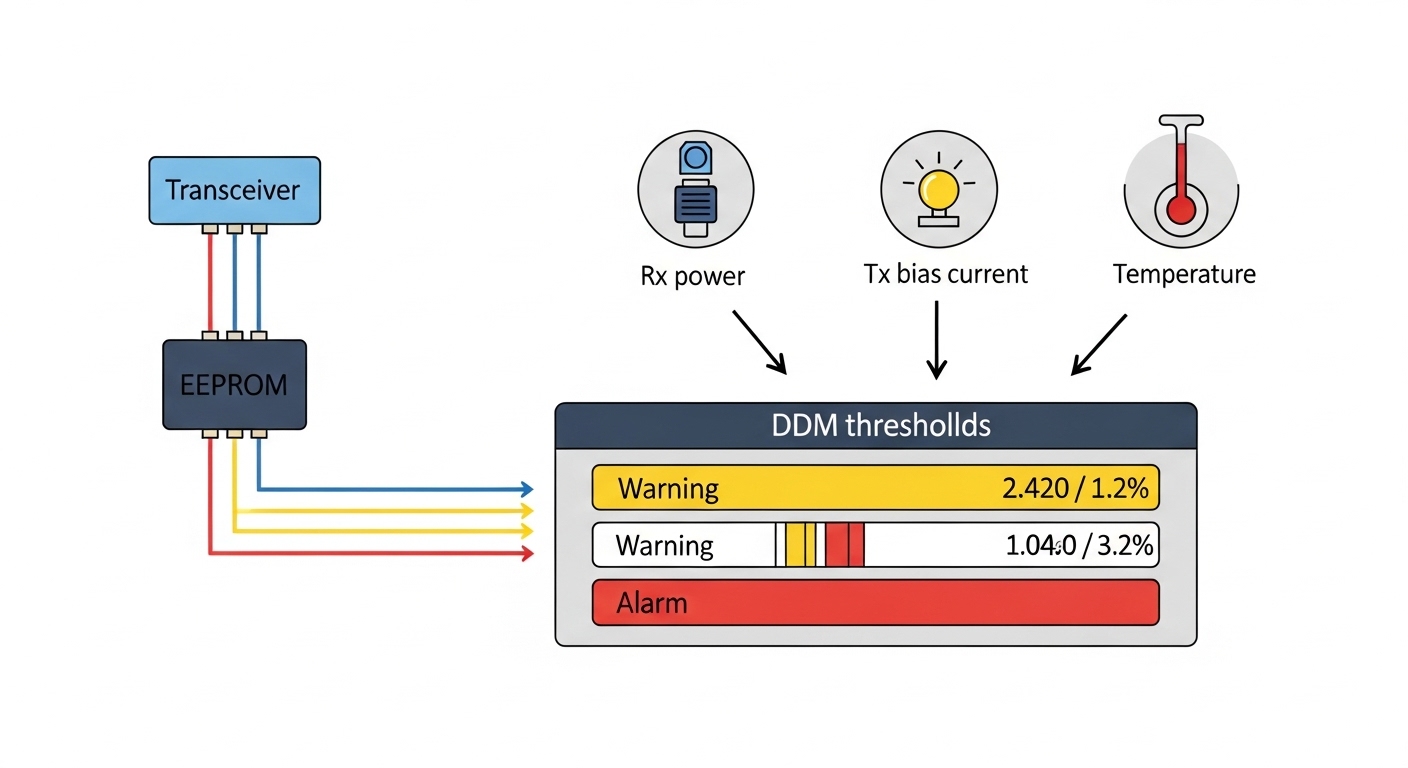
What to check: operating temperature, optical output power stability, and whether your transceiver supports DOM thresholds. Also verify that your installation uses proper strain relief and that fiber endfaces are cleaned before first power-up.
Pros: fewer field failures when you engineer the physical layer. Cons: higher installation discipline and potentially higher module cost.
Decision-grade comparison table (what to choose for AV networks)
Use the table below as a starting point, then validate with your switch datasheet and vendor DOM behavior. The main variables for optical transceivers in autonomous vehicle networks are distance, fiber type, temperature range, and link budget margin under worst-case conditions.
| Transceiver type | Typical wavelength | Common reach | Fiber type | Connector | Data rate | Temperature range (typ.) |
|---|---|---|---|---|---|---|
| SFP+ SR | 850 nm | Up to ~300 m (OM3/OM4) | Multimode | LC | 10G | -40 to +85 C |
| SFP28 SR | 850 nm | ~100 m (OM3), ~150 m (OM4) | Multimode | LC | 25G | -40 to +85 C |
| QSFP+ LR4 | ~1310 nm (4 wavelengths) | ~10 km (typ.) | Single-mode | LC | 10G | -40 to +85 C |
| QSFP28 SR4 | ~850 nm | ~100 m (OM4 typical) | Multimode | LC | 100G | -40 to +85 C |
| QSFP28 LR4 | ~1310 nm (4 wavelengths) | ~10 km (typ.) | Single-mode | LC | 100G | -40 to +85 C |
Pro Tip: In vehicle and roadside deployments, link failures often correlate with connector contamination and micro-movement, not optical power. Build a habit of cleaning with lint-free wipes and endface inspection before swapping optics, then log DOM values over time to spot gradual power drift before the link drops.
Selection checklist for optical transceivers in AV systems
- Distance and fiber type: choose multimode for short hops and single-mode for long runs; confirm reach with your fiber grade (OM3 vs OM4, OS2 vs others).
- Switch compatibility: verify form factor (SFP+, SFP28, QSFP+, QSFP28) and supported IEEE 802.3 clause rates on the exact switch model.
- DOM and alarm behavior: confirm you can read laser bias current, received power, and temperature; set thresholds for early warnings.
- Operating temperature: match the module temperature range to the enclosure airflow profile; validate worst-case soak tests.
- Link budget margin: account for splice loss, connector loss, and aging; keep a margin for future retesting and repairs.
- Vendor lock-in risk: test third-party modules in a pilot; some OEM platforms enforce optics identification or power ranges.
- Installation practicality: LC vs other connector types, dust caps, and whether you can inspect endfaces in the field.
Common mistakes and troubleshooting in optical transceivers
1) Link flaps after vibration
Root cause: strain or micro-movement at the LC latch causing intermittent contact.
Solution: add proper strain relief, verify latch seating, and re-test under controlled vibration while monitoring link state and DOM.
2) High error rates on SR multimode
Root cause: dirty endfaces or mismatched patch cords (OM3 vs OM4 expectations) leading to elevated BER.
Solution: clean and inspect with an endface microscope, re-terminate if needed, and validate fiber grade and total loss with OTDR.
3) “Compatible” optics that fail on DOM thresholds
Root cause: third-party modules report different calibration constants; some switches have strict power/diagnostic ranges.
Solution: run a compatibility
