
AI training and inference are reshaping optical networking from “just connectivity” into a performance-critical system component. If you run leaf-spine fabrics, GPU clusters, or high-throughput WAN backbones, you need to choose transceivers and fiber paths that hit latency, bandwidth, and power targets under real operating constraints. This article explains how the technology is evolving, what engineers should measure, and how to avoid common deployment failures.
Why AI workloads changed the optical networking requirements
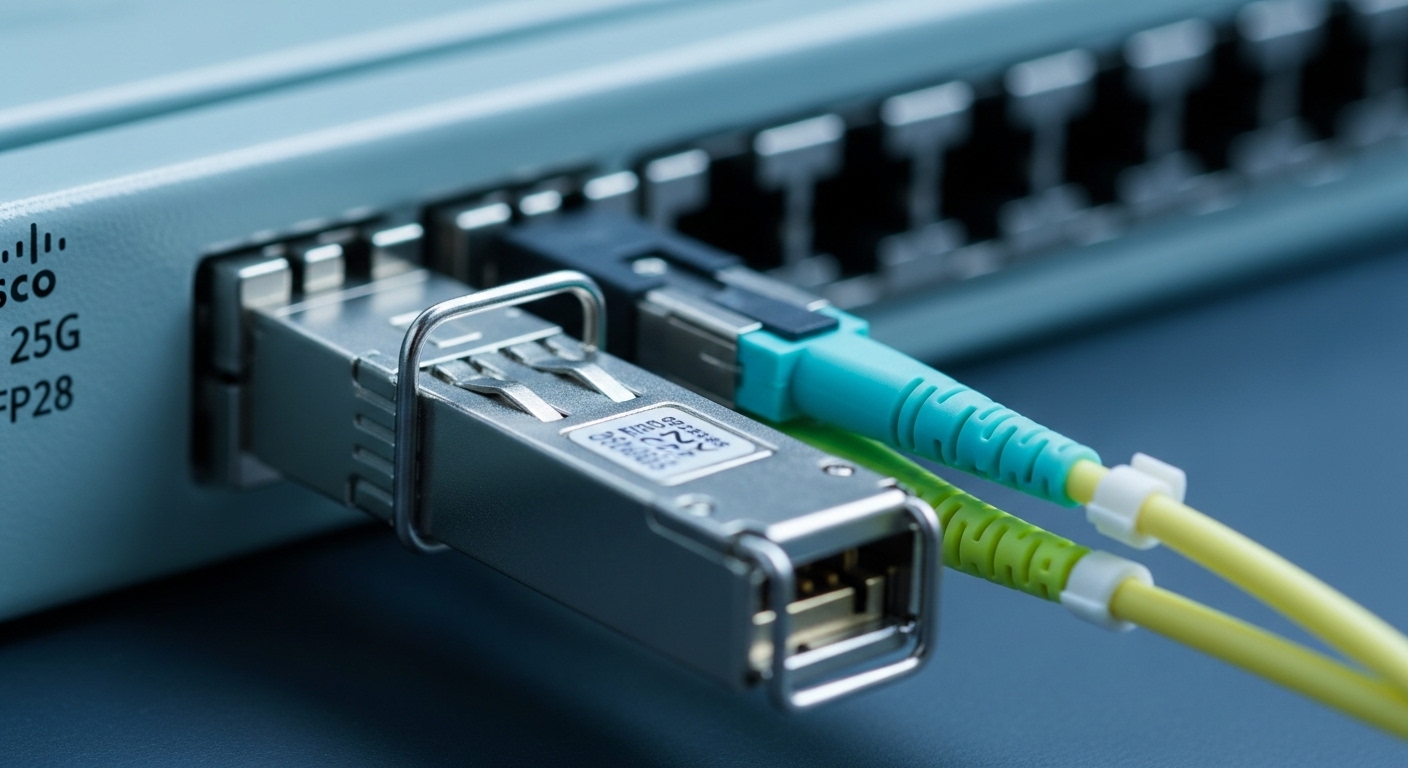
Traditional data center traffic often fit well within the bandwidth granularity of 10G and 25G links. AI clusters push traffic patterns toward east-west bursts between GPUs, plus continuous replication of model checkpoints and parameter updates. As utilization rises, optical networking has to deliver higher line rates with predictable latency, low bit error rates, and manageable power draw at scale.
At the same time, AI increases the sensitivity to physical layer impairments. Faster modulation and higher baud rates mean that fiber attenuation, dispersion, and connector cleanliness have a bigger impact on link stability. Engineers also face new operational goals: tighter thermal envelopes, higher port density, and faster turnaround when a link degrades during production burn-in.
Finally, AI clusters frequently scale in phases. That makes interoperability and upgrade paths critical: you might start with direct-detect optics for short reaches, then migrate to coherent optics for longer hops or higher aggregate bandwidth per fiber pair. The evolution is less about replacing everything and more about matching optics to each distance and cost point.
Direct-detect vs coherent: the practical selection split for AI fabrics
In optical networking, the most visible fork in the road is whether you use direct-detect (DD) transceivers or coherent optics. Direct-detect modules (common in QSFP and OSFP form factors) typically use intensity modulation with direct detection and are optimized for short to medium reaches. Coherent systems use local oscillators and support advanced digital signal processing, which helps them handle larger bandwidth-distance products.
What changes with AI traffic engineering
AI fabrics often rely on dense ToR and aggregation layers where reach is constrained by rack layout and optical patching. In those zones, direct-detect is usually the cost-effective choice because it can deliver high throughput with lower complexity and simpler commissioning. For inter-pod or campus extensions, coherent optics become more attractive when you need to carry more capacity without multiplying fiber count.
Technical specifications comparison (typical module families)
| Spec | Direct-Detect Example | Coherent Example |
|---|---|---|
| Typical use case | Leaf-spine and ToR aggregation (short reach) | Inter-rack, inter-pod, metro, or high-capacity long reach |
| Data rate | 10G/25G/40G/100G per lane depending on form factor | 100G per wavelength up to 400G+ with aggregation |
| Wavelength | 850 nm (MMF) or 1310/1550 nm (SMF variants) | 1550 nm band (common coherent operating region) |
| Reach (typical) | Up to ~400 m on OM4 with 100G-class optics; longer on SMF variants | Often kilometers on SMF, depending on modulation and line rates |
| Connector | LC duplex (most common) | LC duplex (common) with coherent-specific optical alignment needs |
| Power draw (relative) | Lower per link; generally simpler DSP | Higher per transceiver due to coherent receiver and DSP |
| Operating temperature | Commercial or industrial options vary; check vendor datasheet | Check coherent module class; performance depends on temperature stability |
| Standards alignment | IEEE 802.3 and vendor implementation | ITU-T/IEEE implementation plus vendor DSP and FEC profiles |
For concrete deployments, engineers often start with vendor-compatible direct-detect optics such as Cisco SFP-10G-SR for legacy tiers, Finisar FTLX8571D3BCL for specific 100G-class needs, or FS.com SFP-10GSR-85 style parts when budgeting and procurement require third-party sourcing. For coherent, the exact model selection depends heavily on the switch vendor’s supported optics list and the coherent “reach class” they validate.
Pro Tip: In AI cluster rollouts, treat optical networking as an “optics plus optics management” project. If your switches support only specific transceiver vendors or FEC profiles, a technically compatible coherent module can still fail link bring-up due to mismatched DSP/FEC negotiation. Validate against the switch’s optic compatibility matrix before you buy inventory.
Link budgets, reach math, and the hidden contributors to AI link failures
AI changes the operational reality: links must stay stable under higher aggregate traffic and more frequent link state changes during maintenance windows. For optical networking, “reach” is not just a marketing number; it is the result of an end-to-end link budget that includes fiber attenuation, connector loss, splice loss, and margin for aging and temperature effects. Direct-detect modules are especially sensitive to fiber type (OM3 vs OM4 vs OM5), patch cord quality, and bend radius.
Direct-detect fiber considerations
For multi-mode fiber, OM4 and OM5 support higher bandwidth than older OM1/OM2. But AI deployments often add cabling during iterative expansions, and patch cords become a major variable. A single contaminated connector can create intermittent CRC errors and trigger link resets, which can look like “network congestion” at the application layer even though the root cause is physical.
Coherent link considerations
Coherent systems depend on a stable optical environment and good fiber plant quality. Dispersion and polarization effects are handled via digital signal processing, but extreme impairments can still exceed the module’s equalization range. In practical terms, you should plan for consistent end-to-end channel provisioning, careful MPO/LC handling, and verified optical power levels at commissioning.
Operational metrics engineers should monitor
- Optical receive power (Rx) against module thresholds to spot margin collapse early.
- FEC counters for coherent and supported direct-detect profiles to detect rising error rates before outages.
- CRC or symbol error rates to distinguish congestion vs physical degradation.
- DOM telemetry trends (temperature, voltage, bias current) to catch failing optics.
Selection criteria checklist for AI-ready optical networking
When architects evaluate optical networking for AI, they are balancing performance targets with procurement and operational risk. The best outcomes usually come from a disciplined checklist rather than a last-minute optics swap. Use the ordered factors below the way field engineers run pre-deployment reviews.
- Distance and fiber type: Measure actual patch panel lengths, count connectors, and confirm OM4/OM5 vs SMF type. Do not rely on “as-built” drawings alone.
- Switch and platform compatibility: Verify the exact transceiver part numbers validated by the switch vendor. Compatibility often includes FEC mode and DOM behavior, not just form factor.
- Reach and margin: Build a conservative link budget with worst-case connector degradation, not only nominal attenuation.
- DOM and telemetry support: Confirm the module supports DOM/QSFP-DD diagnostics your network OS expects, so monitoring and alarms work during incidents.
- Operating temperature and airflow: In AI racks, hot spots are common. Validate whether commercial temperature optics meet your thermal profile.
- Vendor lock-in risk: Decide whether OEM optics are worth the premium. If you use third-party optics, require a qualification test plan and keep spares from the same vendor batch.
- Power and cooling impact: Higher line rates and coherent optics can increase per-port power. Include cooling overhead in TCO, not just transceiver wattage.
- Maintenance and failure handling: Ensure you have a fast replacement workflow, cleaning tools, and a standardized labeling scheme for patch cords.
As you compare options, also consider the evolution path. Many operators deploy direct-detect for initial AI phases and reserve coherent for later expansions where fiber conservation and higher capacity per wavelength become decisive.
Common mistakes and troubleshooting tips in optical networking for AI
Even well-designed optical networking can fail during commissioning or later under load. Below are concrete pitfalls engineers see, with root causes and practical solutions.
Intermittent link flaps caused by contaminated connectors
Symptom: CRC errors rise, then ports flap during high traffic or after maintenance. Root cause: Dust or micro-scratches on LC or MPO interfaces, often from repeated insertions or improper caps removal. Solution: Implement a strict cleaning SOP (inspection microscope plus correct cleaning method), clean both ends, and re-check optical receive power after reconnection.
“Compatible” transceivers that do not negotiate the right settings
Symptom: Port comes up in a degraded mode or fails to come up at all. Root cause: Mismatch in FEC mode, vendor-specific initialization, or DOM expectations. Solution: Use the switch vendor’s compatibility list for exact part numbers, and run a controlled bring-up test with your intended FEC profile before scaling procurement.
Reach miscalculation due to underestimated patch cord and splice loss
Symptom: Works at first, then degrades over weeks. Root cause: Link budget used only nominal fiber attenuation and ignored additional patch cords, number of connectors, and real-world loss variation. Solution: Recompute the budget using measured loss where possible, add margin, and replace high-loss patch cords with known-good inventory.
Thermal throttling and elevated bias current in dense AI racks
Symptom: DOM shows high temperature or bias current; error counters creep upward. Root cause: Insufficient airflow or blocked vents around transceiver cages. Solution: Validate airflow paths, add baffles where needed, and ensure the rack meets vendor thermal requirements. Monitor DOM trends continuously.
Cost and ROI: how to budget optical networking for AI growth
Optical networking costs are not just the transceiver purchase price. They include installation labor, spares, cleaning and testing equipment, and potential downtime costs when links fail. OEM optics can cost more per module, but they often reduce commissioning time and compatibility risk, which matters when you are deploying hundreds or thousands of ports.
In practical budgeting, direct-detect 10G and 25G optics are typically cheaper per port than coherent modules, and they keep power draw lower in short-reach zones. Coherent optics often carry a higher BOM cost and higher per-link power, but they can reduce the number of fibers needed for higher capacity paths and can extend reach without repeating intermediate active gear.
For TCO, include: expected failure rates based on your qualification results, replacement lead times, and the operational time to validate optics. A realistic approach is to pilot two or three optics families in a representative rack and measure error rates, DOM telemetry stability, and mean time to repair during burn-in. If third-party optics pass qualification and you control inventory consistency, they can reduce capex meaningfully while maintaining availability.
FAQ: Optical networking decisions for AI architects
What is the biggest optical networking difference for AI compared to traditional traffic?
AI increases east-west traffic bursts and raises the importance of physical layer stability under higher utilization. Engineers must also account for thermal density, more frequent maintenance events, and tighter monitoring requirements using DOM telemetry and error counters. This makes link margin and connector hygiene more critical than in many legacy rollouts.
When should we choose coherent optics instead of direct-detect?
Choose coherent when you need longer reach, higher capacity per fiber pair, or you are crossing metro or inter-pod distances where direct-detect becomes expensive or fiber-intensive. Coherent is also useful when you need advanced DSP handling for challenging plant conditions, but it costs more and requires careful compatibility validation with the switch.
How can we verify optical networking compatibility before scaling purchases?
Start by matching exact part numbers to the switch vendor’s validated optics list. Then run a staged bring-up test: confirm link initialization, FEC mode behavior, DOM telemetry fields, and error counter baselines under load. Only after the pilot passes should you expand procurement.
What should we monitor in production to prevent AI cluster outages?
Monitor DOM temperature, bias current, and Rx optical power, plus FEC and CRC or symbol error counters. Set alert thresholds that detect gradual margin loss, not just total link down events. This reduces the chance that a physical issue gets misdiagnosed as congestion or application instability.
Are third-party optics safe for AI clusters?
They can be safe if you qualify them rigorously for your exact platforms and operating conditions. The risk is not only optical performance; it is also DOM compatibility and vendor-specific initialization behavior. Treat qualification as a repeatable process and keep spares from the same qualified vendor batch.
How do we reduce troubleshooting time during optical networking incidents?
Standardize labeling and patch cord management, and keep a pre-approved cleaning and inspection workflow. During incidents, capture Rx power and error counters immediately, then isolate whether the failure correlates with specific patch channels or specific optics units. This approach typically shortens mean time to repair by preventing random module swapping.
Optical networking is evolving for AI by shifting the selection balance between direct-detect and coherent technologies, tightening the link-budget discipline, and raising the importance of optics telemetry and operational hygiene. If you want the next step, review your platform’s validated optics list and build a small pilot that measures DOM stability and error-rate headroom under your real traffic patterns using optical transceiver compatibility.
Author bio: I have deployed and validated high-density optical networking in GPU cluster environments, including link-budget commissioning and DOM telemetry monitoring. I write from field experience to help teams choose optics that meet uptime and ROI targets, not just datasheet specs.
