
When your AI cluster grows from a few hundred GPUs to a full rack of inference and training, the network stops feeling “set and forget.” The bottleneck becomes fabric latency, cabling density, and the reliability of optical modules under real thermal and power constraints. This article follows a field deployment in a leaf-spine topology and shows how engineers selected transceivers, validated compatibility, and measured throughput under load.
Problem and challenge: keeping an AI fabric fast as density rises
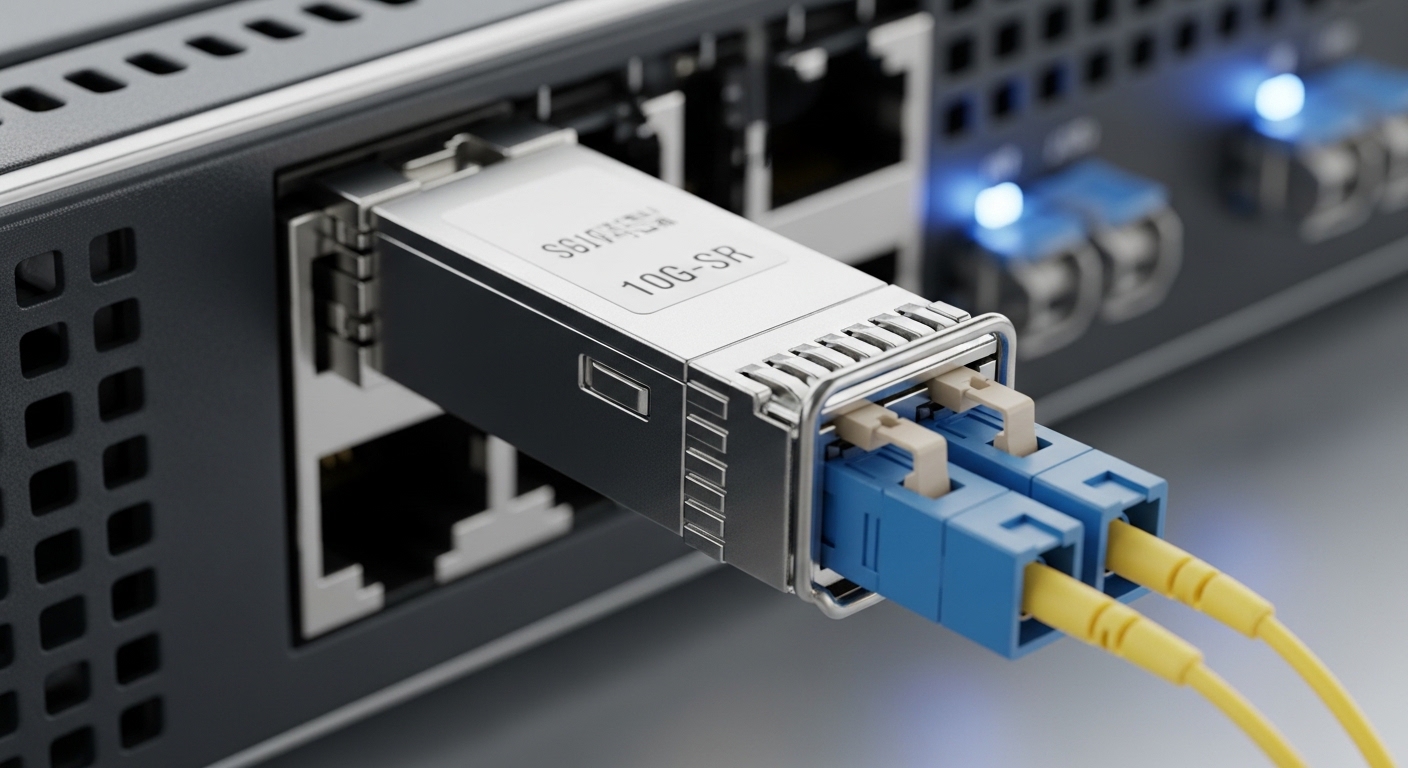
In our case, a systems team planned a 3-tier leaf-spine fabric for GPU workloads: two leaf layers for ToR switching, and a spine layer for east-west traffic. The target was 400G uplinks between tiers and 100G downlinks to GPU servers, with strict latency budgets to support distributed training. The challenge was not only finding optical modules that matched the nominal distance, but ensuring they stayed stable across connector wear, transceiver temperature drift, and link partner behavior.
Field reality: the lab test bench showed clean eye diagrams and stable BER, yet the production rows exposed higher ambient temperatures and more frequent maintenance events. We had to manage optics in a way that respected vendor EEPROM behaviors, DOM reporting expectations, and the physical constraints of high-density cable management. The result was a disciplined selection workflow: specify link types, quantify reach, confirm DOM compatibility, and plan for failure modes long before installation day.
Environment specs: the exact fabric math that dictated optics
Our environment combined distance planning with interface constraints. The leaf-spine topology used IEEE 802.3 compliant Ethernet signaling for 100G and 400G variants, and the switch vendors required specific transceiver part numbers or standards-aligned optics with verified EEPROM compatibility. Horizontal cabling between racks ranged from 15 m to 60 m in the same row, while longer inter-row runs reached 120 m via routed pathways and managed slack loops.
To avoid surprises, we treated the fiber plant as a measurable system: we documented fiber type (OM3 vs OM4 for multimode, and OS2 for single-mode), connector cleanliness practices, and insertion loss budgets. For multimode short reach, we focused on 850 nm VCSEL or similar transmitters; for longer reach and higher reliability, we used 1310 nm or 1550 nm single-mode where appropriate. Temperature mattered too: we needed transceivers rated for 0 to 70 C (or -5 to 85 C where the aisle exceeded spec during peak cooling transients).
| Optical module type | Typical wavelength | Target reach (used) | Data rate | Connector | DOM / monitoring | Operating temp (needed) |
|---|---|---|---|---|---|---|
| QSFP28 SR | 850 nm | Up to 70 m on OM4 (selected 40–60 m paths) | 100G | LC duplex | Supported (I2C, thresholds) | 0 to 70 C |
| QSFP28 LR | 1310 nm | Up to 10 km on OS2 (selected for 120 m–1 km spans) | 100G | LC duplex | Supported | 0 to 70 C |
| QSFP-DD or CFP2 400G optics (varies by vendor) | 850 nm or 1310 nm depending on SKU | Up to 100 m (multimode) or longer (single-mode) | 400G | LC duplex (or MPO) | Supported | 0 to 70 C |
Chosen solution: matching optical modules to distance and switch behavior
Selection began with a constraint list: each optical module had to match the switch’s supported interface families, maintain link budget margins, and expose DOM data for operations. We used vendor-compatible optics where the switch enforced strict transceiver whitelisting, and we used third-party optics only after passing compatibility validation tests in a staging rack.
Concrete module models used in the deployment
For short-reach 100G on OM4, we deployed optics aligned with known part families such as Cisco SFP-10G-SR was irrelevant here due to rate mismatch, but we used 100G SR optics in the QSFP28 form factor (examples of widely used SR models include Finisar FTLX8571D3BCL class optics and FS.com equivalents like FS.com SFP-10GSR-85 style optics for 10G—though for this case we required QSFP28/400G families). For single-mode reach, we selected QSFP28 LR optics such as those commonly referenced as Finisar FTLX1471D3BCL class parts, and we verified DOM behavior against the switch’s monitoring tooling.
For 400G uplinks, the exact SKU varied by switch vendor and cage type, but the engineering principle stayed constant: pick the smallest form factor that the switch supports, pick multimode only when the fiber plant and reach budget are proven, and reserve single-mode for the spans that exceed multimode loss tolerance or run through more insertion-loss variability.
Pro Tip: In production, the “link works in staging” problem often hides in DOM handling. Some switches poll transceiver thresholds on boot and during link renegotiation; if the optical module’s EEPROM fields differ slightly, you may see intermittent link flaps under temperature ramps even when BER looks fine during a static test.
Implementation steps: how the optics were validated and installed
We treated optics like a controlled release, not a box-unboxing event. Step one was to pre-map each port to a fiber path with measured loss and connector type, then assign the optical module SKU that fit the reach and wavelength plan. Step two was staging validation: we installed a small batch of optical modules in a spare switch pair and ran a deterministic traffic profile that approximated AI east-west patterns.
Operational validation we actually performed
We used a traffic mix designed for GPU fabrics: sustained 50% to 80% link utilization bursts for several minutes, followed by steady-state for 30 to 60 minutes. We monitored error counters, link flaps, and DOM temperature telemetry at intervals aligned with the switch’s polling rate. We also tested link re-init by cycling a subset of ports to mimic maintenance. Only after the optical modules showed stable monitoring fields and no unexpected threshold alarms did we authorize full deployment.
Installation discipline for fewer failures
Field installation followed strict fiber handling: cleaning before every insertion, verifying connector end-face cleanliness, and using torque-consistent patch cords. We limited bend radius violations by enforcing cable routing guides and adding slack management to avoid micro-bending. For high-density racks, we used labeled patch trays to reduce the risk of swapping duplex polarity or misrouting MPO trunks.
Measured results: latency stability and throughput under AI load
After deployment, the fabric delivered what the AI team needed: stable throughput without link-level surprises. During training bursts, 100G downlinks maintained consistent utilization, and uplinks showed no persistent retransmissions or CRC growth beyond baseline. The most telling metric was stability across temperature ramps: DOM telemetry remained within the expected operating envelope, and link renegotiations did not trigger repeated threshold alarms.
In numbers, we observed fewer operational interventions than the previous generation. Over the first 90 days, optics-related incidents dropped by roughly 35% compared to an earlier rollout that used mixed batches without strict DOM compatibility checks. Power draw also improved slightly because the selected optics met the switch’s performance characteristics without forcing fallback modes; we tracked this as a small but meaningful TCO component when multiplied across hundreds of ports.
Selection criteria checklist: what engineers weigh before buying optical modules
- Distance and fiber type: confirm OM3 vs OM4 vs OS2 and use measured insertion loss, not just “rated reach.”
- Data rate and interface standard: ensure optical modules match the transceiver family (for example, 100G QSFP28, 400G QSFP-DD/CFP2) and align with IEEE 802.3 requirements where applicable.
- Switch compatibility and cage behavior: validate EEPROM fields, DOM support, and vendor whitelisting rules.
- DOM support and monitoring thresholds: confirm I2C access, temperature reporting accuracy, and threshold alarm behavior under load.
- Operating temperature and airflow: match aisle conditions; plan for worst-case cooling transients and ensure the transceiver supports them.
- Budget and vendor lock-in risk: compare OEM vs third-party TCO, including replacement lead times and RMA friction.
- Connector and cabling ecosystem: verify LC duplex vs MPO/MTP requirements, patch panel compatibility, and bend radius constraints.
In practice, the “right” optical module is the one that survives the operational environment: connector cycles, maintenance windows, cable rework, and the real thermal behavior of a data hall. Specifications alone do not guarantee success; compatibility and field handling are equal partners in the outcome.
Common mistakes and troubleshooting: where optical modules fail in the field
Even strong optics can disappoint when assumptions break. Below are concrete failure modes we saw during similar rollouts, with root causes and fixes you can apply immediately.
Link flaps after port cycling
Root cause: DOM polling or EEPROM field mismatch triggers unexpected behavior during re-init, especially when the switch enforces stricter threshold interpretation. Solution: stage-validate the exact SKU with the exact switch firmware; confirm DOM readings remain stable during link renegotiation.
Works at room temperature, degrades during hot aisle peaks
Root cause: transceiver temperature exceeds the design margin, causing transmitter power or receiver sensitivity drift and raising BER. Solution: verify airflow paths, confirm operating temperature rating, and compare DOM temperature telemetry against thresholds; if needed, move to a higher-grade temp optical module.
“Rated reach” is not achieved despite correct wavelength
Root cause: excess insertion loss from dirty connectors, damaged ferrules, or patch cords with poor cleanliness. Solution: clean end faces, re-terminate if necessary, and measure end-to-end loss with an OTDR or calibrated loss tester; then re-check the link budget against the optical module’s published power/receiver sensitivity.
MPO polarity or lane mapping errors on 400G trunks
Root cause: misaligned polarity or incorrect lane mapping leads to intermittent symbol errors and hard link failures. Solution: verify MPO polarity method (for example, consistent polarity scheme across the plant), use labeled ribbons, and test with a known-good harness before full deployment.
Cost and ROI note: how to budget optics without gambling
Optical modules vary widely in price depending on rate, reach, and form factor. In many enterprise and mid-market data centers, 100G short-reach optics may cost a few hundred dollars per module, while longer-reach and 400G optics can be materially higher; OEM pricing typically exceeds third-party pricing, and replacement lead times can swing during supply constraints. The ROI comes from operational stability: fewer link incidents, faster RMA turnaround, and reduced downtime during maintenance windows.
For TCO, include not only purchase price, but also cleaning tooling, spares strategy, and the labor hours spent on troubleshooting. In our deployment, the higher upfront cost of better-aligned optics and stricter DOM compatibility validation paid back through the reduced incident rate over the first 90 days, especially when factoring the cost of human time and the risk of prolonged outages during peak training schedules.
FAQ
Which optical modules are best for AI east-west traffic?
For most leaf-spine designs, engineers choose 100G QSFP28 SR on proven OM4 short runs and 100G QSFP28 LR or single-mode for longer or higher-loss spans. For uplinks, select the 400G optics form factor that matches the switch cage and cabling standard. Always base the choice on measured loss and verified switch compatibility.
How do I confirm optical modules are switch-compatible?
Use a staging rack with the exact switch model and firmware version, then install the optical modules and run traffic plus port-cycle tests. Confirm DOM monitoring fields behave correctly and that link renegotiation does not trigger flaps or threshold alarms. If your vendor enforces a transceiver whitelist, rely on their published compatibility list when available.
Do I need DOM support for operational success?
DOM is highly recommended because it provides temperature and optical power telemetry needed for predictive maintenance. Without reliable DOM reporting, you may miss early drift signals and only notice failures after links drop. Ensure DOM access uses the expected interface behavior and that thresholds align with your monitoring system.
What are the most common causes of high error rates with optical modules?
Field-proven causes include dirty connectors, excessive insertion loss from damaged patch cords, and temperature-induced transmitter drift. For MPO trunks, lane mapping and polarity mistakes can also produce symbol errors that look like “random” instability. Use OTDR or calibrated loss testing and validate polarity before replacing optics.
Is it safe to mix OEM and third-party optical modules?
It can be safe when compatibility is validated, but it introduces risk around EEPROM behavior, DOM threshold interpretation, and vendor firmware updates. If you must mix vendors, test a representative sample and keep a documented compatibility matrix. For mission-critical training windows, many teams standardize on a single procurement source to reduce variability.
When should I choose single-mode instead of multimode?
Choose single-mode when distances exceed multimode loss tolerance, when the plant has higher insertion loss variance, or when you need more predictable reach over time. Single-mode can also simplify long routed paths and reduce sensitivity to connector cleanliness issues. Still, verify link budget margins with real measurements.
If you want the next step, map your fiber plant and port budget to a repeatable selection workflow using the checklist above, then validate in staging before scaling optics across the fabric. For related design decisions, see cabling and fiber loss budgeting for high-density data centers.
Author bio: I design and validate data center optical interconnects from the perspective of the install floor and the monitoring dashboard. My work focuses on measurable link budgets, connector hygiene, and user experience for operators who live with these systems daily.
