
When optical links based on Active Optical Cables (AOC) start acting haunted, your first instinct is usually to blame the fiber. Fair. But in the real world, the gremlins are often in the transceiver module, lane mapping, power levels, or switch optics compatibility. This article helps data center engineers and field techs isolate AOC issues quickly, protect uptime, and avoid replacing perfectly fine optics.
How AOC optical links fail in practice (and what to measure first)
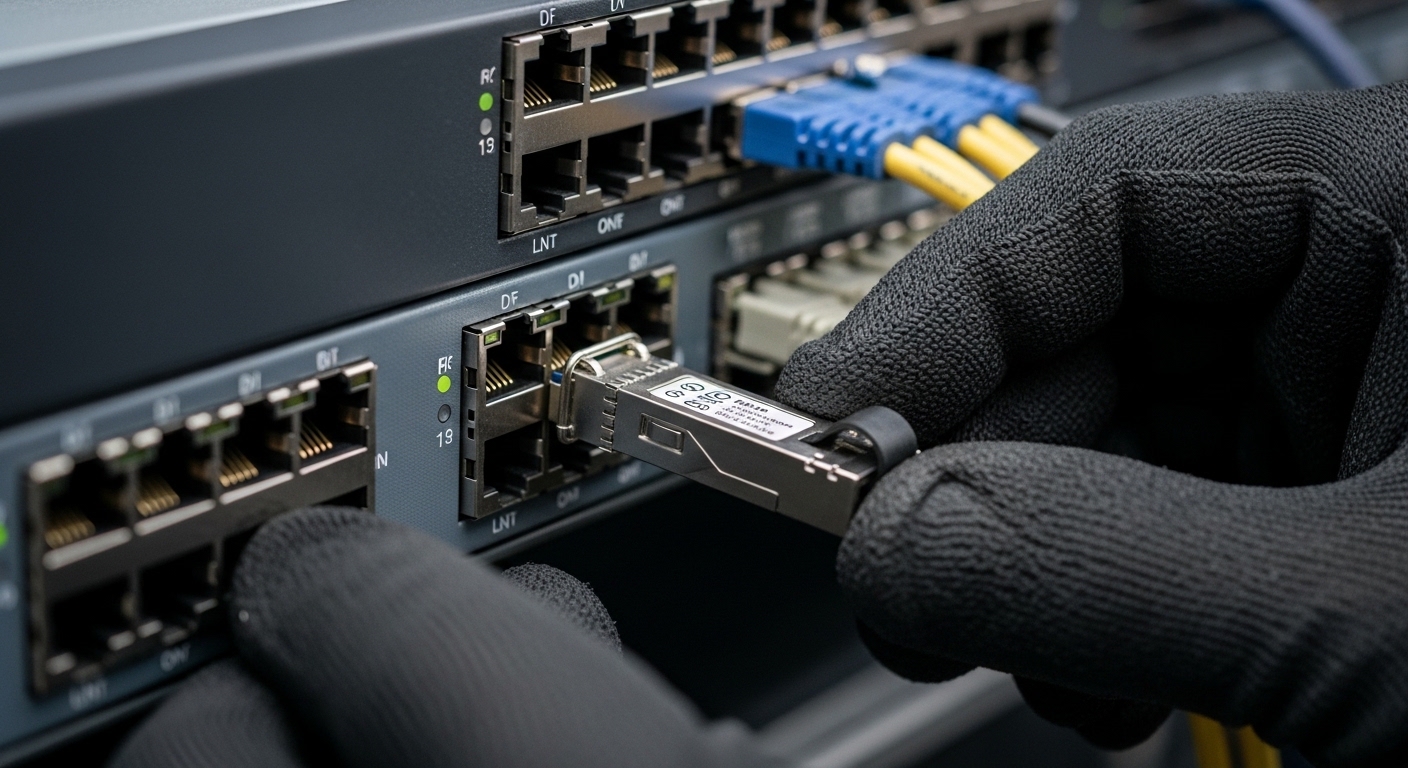
AOC modules combine an electro-absorption transmitter, driver circuitry, and a receiver in one cable assembly, so failures tend to show up as signal loss, CRC errors, or link flaps rather than “nothing is connected.” Start with the boring-but-effective checks: confirm the port is administratively up, verify transceiver presence, and read DOM (Digital Optical Monitoring) values if your switch supports them. Then measure optical power (if available), or infer it from link error counters.
For Ethernet over optical, the IEEE 802.3 family defines the physical layer behavior, while vendors define DOM thresholds and alarm behavior. On the AOC side, you typically see symptoms like high CRC, FEC uncorrectable, link down/up cycles, or intermittent packet loss. The trick is to correlate symptoms with the most likely layer: electrical interface, optical budget, or module health.
Pro Tip: If your switch shows DOM “temperature OK” but you still see rising CRC/FEC errors, suspect marginal optical power due to connector contamination or an AOC that got bent too tightly during routing. Temperature can look innocent while the optical lane power quietly drifts.
Key specs to verify before you swap anything (wavelength, reach, power)
Before troubleshooting gets expensive, confirm the AOC matches the optical links requirements of the port. Engineers often pull a module that “fits the connector” but not the wavelength or reach class. Most AOC assemblies are designed for a specific data rate and reach target, commonly aligned to QSFP+/QSFP28/OSFP or SFP-DD ecosystems.
Use the table below as a quick sanity check. Your exact part numbers matter, but these ranges reflect common deployment patterns in modern 10G and 25G/40G/100G data centers. For standards and baseline behavior, see IEEE 802.3, and for module-specific limits, rely on vendor datasheets. anchor text: IEEE 802.3 overview [Source: IEEE].
| Parameter | Common AOC example | Why it matters for optical links |
|---|---|---|
| Data rate | 10G (XENPAK/SFP+), 25G (SFP28/QSFP28), 40G/100G (QSFP+/QSFP28/OSFP) | Mismatched speed can cause link refusal or auto-negotiation chaos. |
| Wavelength | SR typically around 850 nm for multimode | Wrong wavelength class can look “connected” but fail consistently. |
| Reach | SR-class AOCs often target ~70 m to 100 m class depending on generation | AOC budget is fixed; exceeding the designed length can increase BER. |
| Connector | QSFP28, QSFP+, OSFP, SFP+ (module-specific) | Switch port compatibility depends on form factor and vendor expectations. |
| DOM support | Temperature, bias current, RX power (varies) | DOM alarms help isolate “module degraded” vs “system problem.” |
| Operating temperature | Often 0°C to 70°C for many transceivers | Thermal stress accelerates failures and lane drift. |
Step-by-step troubleshooting workflow for AOC optical links
Use a consistent workflow so you do not end up swapping modules like you are playing transceiver roulette. The goal is to determine whether the issue is localized to one port/module, one switch, or the whole path.
Confirm port and optics state
Check the interface counters and logs immediately after link events. Look for patterns: CRC spikes, link flaps, or FEC uncorrectables. If your platform exposes transceiver status, record DOM readings (temperature, laser bias, and RX power if present).
Validate lane mapping and speed profile
In 25G and 100G optics, lane ordering and breakout profiles can trigger weirdness when the switch config expects a different breakout mode. Ensure the port is configured for the correct speed (for example, 25G vs 10G breakout) and that the cabling matches the expected interface type.
Rule out mechanical stress and cable routing issues
AOC assemblies are sensitive to bend radius and strain. Inspect the cable route: look for sharp corners, tension, or repeated flex near the connector. If the link works when you reposition the cable, you likely have a mechanical stress or internal solder/connector issue.
Swap intelligently: module-to-module comparison
If possible, test the same AOC in a known-good port, and test a known-good AOC in the affected port. This isolates whether the fault follows the module or the port. If the fault follows the module, treat it as a failing optical link assembly; if it follows the port, suspect the switch PHY/retimer path.
Common AOC optical link pitfalls (root cause and fixes)
Here are real-world failure modes that show up in data centers, along with what to do about them. If you only remember one thing: correlate error counters with DOM and mechanics before you order replacements.
- Pitfall: Link flaps only under cable movement
Root cause: connector strain, internal break, or marginal solder joint.
Fix: reseat carefully, remove cable tension, route with bend radius discipline, and test with a different AOC to confirm module failure. - Pitfall: High CRC/FEC uncorrectables after “it was working yesterday”
Root cause: optical power degradation due to handling damage, thermal exposure, or a damaged internal optical component.
Fix: check DOM (especially temperature and RX power trends), compare with a healthy module, and replace if DOM indicates out-of-range behavior. - Pitfall: “Transceiver not supported” or intermittent link at boot
Root cause: switch compatibility mismatch, incorrect EEPROM programming, or wrong speed profile for the port.
Fix: verify exact module type, ensure the switch supports the transceiver vendor/model, and confirm the port configuration aligns with the module data rate. - Pitfall: Works at low utilization, fails under load
Root cause: marginal optical budget or electrical overshoot/undershoot on the module interface.
Fix: test in a controlled environment with known-good traffic patterns, check for excessive congestion-induced error visibility, and consider replacing with a module rated for your exact length class.
Cost and ROI: when to replace vs when to troubleshoot longer
Third-party and OEM AOC modules can vary widely in price, often landing in a range like $80 to $250 for shorter 10G/25G classes and $300 to $900 for higher-speed or longer assemblies, depending on brand, length, and warranty. A field replacement is tempting, but TCO improves when you accurately isolate whether the switch port is the problem.
Consider power and cooling impacts: a failing module that flaps can increase CPU and PHY retries, and it can degrade application performance. Also factor failure rates: if you see repeated faults from a specific batch, it is cheaper to quarantine that lot than to keep swapping in circles. For compatibility caveats, vendor datasheets are your best friend, and the IEEE physical layer expectations help you understand what “should” happen under error conditions. anchor text: Finisar optical components resources [Source: Finisar].
Selection criteria checklist for robust optical links with AOC
Engineers choose AOC modules based on more than “does it light up.” Use this ordered checklist during procurement or during incident response:
- Distance vs reach class: confirm the designed length target and routing realities.
- Data rate and speed profile: match the port’s configured speed and breakout mode.
- Switch compatibility: confirm the module is supported by the switch model and software version.
- DOM and alarm behavior: ensure your platform can read the DOM you need for isolation.
- Operating temperature and airflow: verify the rack and cable bundle stay within spec.
- Vendor lock-in risk: evaluate OEM vs third-party warranties and RMA turnaround times.
FAQ
How can I tell if an AOC optical link issue is the module or the port?
Swap the AOC into a known-good port and swap a known-good AOC into the affected port. If the problem follows the module, it is the optical link assembly; if it follows the port, suspect the switch PHY/retimer path.
What DOM readings are most useful during troubleshooting?
Look for temperature and any available RX power or bias current trends. If the switch reports alarms or “out of range” thresholds, capture those values at the moment errors spike.
Can bend radius really cause optical links to fail without visible damage?
Yes. AOC internal components can degrade under repeated flexing near the connector, causing intermittent optical power and rising CRC/FEC errors before the cable fully fails.
Are AOC modules compatible across different switch vendors?
Sometimes, but not reliably. Compatibility depends on EEPROM expectations, supported transceiver profiles, and switch software behavior, so always validate with the specific switch model and firmware version.
Why does the link seem fine at idle but breaks under load?
Under load, BER sensitivity increases and error correction limits get tested. A marginal optical budget or electrical signal integrity issue may not show up until traffic induces higher error visibility.
Should I clean fiber connectors with AOC?
With true AOC assemblies, there are often no user-cleanable fiber connectors. If you have an AOC that includes patchable interfaces, inspect and clean any exposed connectors, but do not assume contamination is the root cause.
If you apply the workflow above, you will usually isolate optical links AOC problems faster than your ticket queue can grow. Next step: review troubleshooting fiber optic transceivers to tighten your root-cause accuracy across both AOC and traditional pluggable optics.
Author bio: I troubleshoot live data center optical links by correlating switch counters, DOM telemetry, and physical routing constraints during on-site incidents. I also write
