
Open RAN rollouts often stall on a simple question: what do optical deployment costs really look like when you include optics, fiber, power, spares, and field labor? This guide helps radio, transport, and procurement teams build a practical ROI model for common Open RAN optical architectures, so you can plan capex and reduce avoidable downtime. You will get selection checklists, a spec comparison table, and field troubleshooting patterns that directly affect total cost of ownership. Updated: 2026-05-03.
ROI model for Open RAN optical deployments: where costs actually move
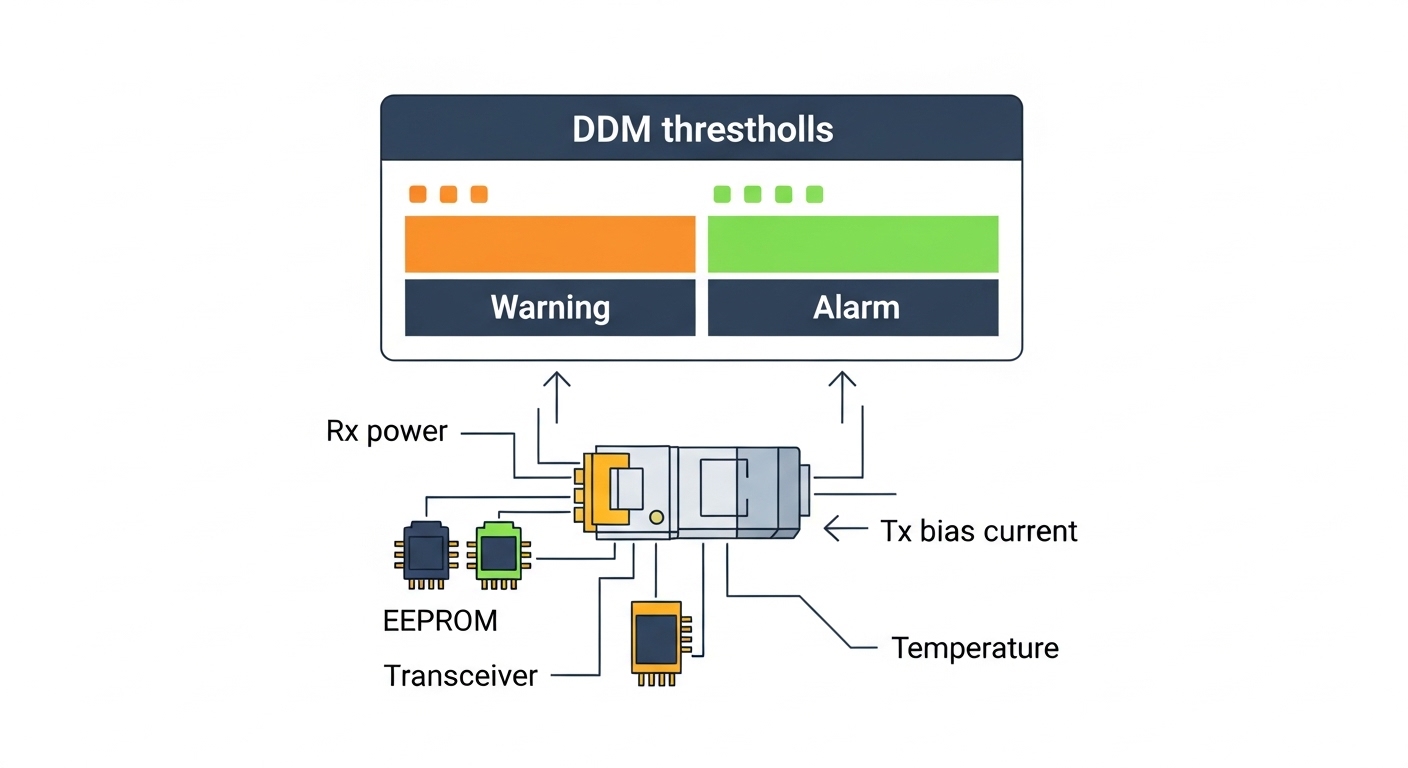
In Open RAN, optics are not just “part numbers”; they shape installation time, rework rate, and failure recovery. A realistic ROI analysis for optical deployment costs usually breaks into five buckets: transceiver unit cost, fiber and connectorization, installation labor (splice/terminate/testing), power and cooling impact, and operational costs (churn, RMA logistics, downtime). For ROI, the key is to quantify both capex timing and risk-adjusted opex from field incidents.
Cost levers that change ROI fastest
- Reach and optics class: picking too-short reach increases the number of intermediate distribution points and patching labor.
- Connector strategy: MPO/MTP fanouts can reduce density footprint but raise termination complexity versus LC.
- DOM and telemetry: enabling digital optical monitoring can reduce mean time to repair (MTTR) during marginal-link events.
- Temperature margin: outside-rated optics can pass initial tests and then fail under sustained enclosure heat.
- Spare strategy: stocking the right SKU reduces truck rolls and site downtime, but too many spares increases working capital.
Pro Tip: In field audits, the biggest “hidden cost” is not the transceiver price; it is the time lost to link bring-up failures caused by patching polarity errors or mismatched optics/wavelength pairs. Instrumenting every link with verified receive power and DOM thresholds can cut rework cycles by more than one truck roll per site in dense deployments.
Optical building blocks for Open RAN: specs that drive both performance and cost
Open RAN optical transport commonly uses Ethernet over fiber with short-reach multimode for intra-building or campus links and single-mode for longer spans. The ROI impact comes from the transceiver reach class, wavelength, and connector type, because those determine fiber type selection, installation effort, and spare compatibility. For standards alignment, Ethernet optical links follow IEEE 802.3 requirements for the chosen rate and optics class; check vendor datasheets for compliance claims and DOM behavior. See [Source: IEEE 802.3] [[EXT:https://standards.ieee.org/standard/]] and vendor spec sheets like [Source: Cisco SFP/SFP+ optics datasheets] [[EXT:https://www.cisco.com/c/en/us/support/index.html]].
Practical transceiver comparison for ROI planning
Below is a decision-oriented comparison for common 10G short-reach and long-reach options. Even if your Open RAN design targets different rates (25G/40G/100G), the cost logic is similar: reach class drives fiber type and installation complexity.
| Parameter | 10G SR (MMF) | 10G LR (SMF) | 10G ER (SMF) |
|---|---|---|---|
| Typical wavelength | 850 nm | 1310 nm | 1550 nm |
| Reach target | Up to 300 m (typical OM3/OM4) | Up to 10 km | Up to 40 km |
| Connector type | LC or MPO/MTP (design dependent) | LC | LC |
| DOM support | Often available (check vendor SKU) | Often available (check vendor SKU) | Often available (check vendor SKU) |
| Operating temp | Typically 0 to 70 C or extended variants | Typically -5 to 70 C or extended variants | Typically -5 to 70 C or extended variants |
| Power draw (typical) | ~0.6 to 1.0 W | ~1.0 to 2.0 W | ~1.2 to 2.5 W |
| Example optics (illustrative) | Cisco SFP-10G-SR, Finisar FTLX8571D3BCL | Cisco SFP-10G-LR | Finisar FTLX1471D3BCL (example ER class) |
When you model optical deployment costs, treat MMF vs SMF as an installation variable, not only a material variable. MMF can reduce transceiver cost, but longer reach requirements may force additional fiber runs, more patching, and more termination labor. Conversely, SMF can reduce splicing density across campus routes, but transceivers may cost more and require careful receive power budgeting.
Decision checklist: how engineers choose optics under optical deployment cost constraints
Use this ordered checklist to prevent design choices that look cheaper at procurement but cost more after field time, retries, and spares. The goal is to minimize risk-adjusted lifecycle cost while meeting Open RAN performance targets.
- Distance and attenuation budget: confirm link length and fiber type (OM3/OM4 vs SMF) plus connector/splice loss and safety margin.
- Rate and optics class alignment: match transceiver family to switch/OLT port type and expected Ethernet PHY mode.
- Switch compatibility and optics vendor lock-in risk: verify vendor supported optics list and whether “compatible” modules trigger diagnostics or port disable events.
- DOM requirement: decide if you need temperature/bias/rx power telemetry for proactive maintenance and alarms.
- Operating temperature and enclosure heat: validate worst-case ambient near the radio transport cabinet; choose extended temp SKUs if needed.
- Connectorization strategy: LC for simplicity and troubleshooting; MPO/MTP for density but higher termination discipline.
- Spare strategy: define minimum spares per site (often 1 per critical link type) and standardize SKU across sites.
- Acceptance test plan: specify OTDR or at least end-to-end loss testing and receive power verification before cutover.
ROI math that field teams can actually execute
- Capex estimate: multiply optics SKU cost by port count plus spares (for example, 5 to 10 percent extra for critical paths).
- Installation labor: estimate termination minutes per connector type, then add testing time per link. MPO/MTP typically increases termination time and rework likelihood if polishing discipline slips.
- Downtime cost: quantify truck-roll hours and mean recovery time; a single prolonged outage can outweigh tens of transceiver dollars.
- Power and cooling: include optics power draw difference across rate and reach classes, then convert to site electricity cost using your local $/kWh.
Common pitfalls and troubleshooting patterns that inflate optical deployment costs
Below are failure modes that repeatedly show up in Open RAN optical rollouts. Each item lists the root cause pattern and a solution that reduces rework and repeat outages.
Polarity and fiber mapping errors during patching
- Root cause: reversed Tx/Rx pairs, incorrect patch panel labeling, or swapped fibers in MPO fanouts.
- Symptoms: link stays down or negotiates erratically; port counters show no valid optical receive.
- Solution: enforce a fiber mapping checklist, validate with a visual tracer before powering, and use receive power checks at the switch.
Mismatched optics reach class or wavelength assumptions
- Root cause: using SR modules on links exceeding MMF budget, or mixing LR/ER optics intended for different budgets.
- Symptoms: intermittent CRC errors, rising BER, or sudden drops after temperature changes.
- Solution: recalculate attenuation with real measured loss, confirm OM3/OM4 compliance, and set thresholds for rx power alarms using DOM.
Operating temperature outside transceiver rating
- Root cause: installing standard temp optics in hot cabinets without airflow modeling.
- Symptoms: works initially, then degrades after weeks; DOM shows bias drift and rising temperature.
- Solution: use extended temperature SKUs where needed, verify airflow, and set proactive maintenance triggers based on DOM trends.
“Compatible” modules failing diagnostics or vendor interoperability
- Root cause: optics not fully compatible with the switch vendor’s expectations for DOM fields, thresholds, or vendor-specific alarms.
- Symptoms: port flaps, “unsupported module” warnings, or management-plane errors.
- Solution: validate modules in a lab with the exact switch model and firmware; standardize on approved third-party SKUs with documented DOM behavior.
Cost and ROI note: OEM vs third-party optics in the real world
Optical deployment costs vary widely by vendor, rate, and reach class. In many enterprise and RAN transport projects, OEM optics may carry a premium of roughly 20 to 60 percent over third-party equivalents, but the real ROI hinges on failure rate, RMA turnaround time, and compatibility risk. Third-party modules can reduce unit cost, yet they can increase rework if diagnostics and DOM behavior are not consistent with your switch platform and monitoring system.
TCO factors to include beyond purchase price
- Failure and RMA handling: estimate warranty replacement time and logistics friction for remote sites.
- Spare inventory carrying cost: higher working capital for extra spares.
- Power consumption differences: small per-port watt deltas can become meaningful at scale.
- Testing overhead: third-party optics sometimes require additional acceptance steps to confirm DOM thresholds and stable signal quality.
For ROI, model sensitivity: if downtime cost per day is high, prioritize optics with stable DOM telemetry and proven compatibility, even if unit price is higher. If downtime tolerance is low, the “cheapest module” can become the most expensive once truck rolls and cutover delays are counted.
FAQ
How do I estimate optical deployment costs for an Open RAN site?
Start with port count and add spares (often 5 to 10 percent for critical links). Then include fiber work (termination plus testing time), acceptance testing labor, and risk-adjusted downtime cost. Use measured loss and receive power as inputs rather than only design estimates.
Is MMF always cheaper than SMF for Open RAN?
Not necessarily. MMF can reduce transceiver cost, but if your distances exceed the practical MMF budget, you will spend more on additional patching, fiber runs, and rework. SMF can improve installation efficiency when the route favors fewer intermediate distribution points.
Do I need DOM support to improve ROI?
DOM is often a major ROI lever because it enables proactive maintenance and faster troubleshooting. If you can integrate rx power and temperature telemetry into your monitoring workflow, you reduce MTTR during marginal-link events.
What is the biggest cause of rework that drives optical deployment costs up?
In many deployments, rework is driven by polarity or mapping errors during patching and connectorization. A disciplined fiber mapping process plus receive power verification before cutover usually prevents most of these failures.
Can third-party optics reduce total cost without increasing risk?
Yes, if you validate them with the exact switch model and firmware and confirm DOM behavior and thresholds. Treat compatibility testing as a gating step; skipping it is a common reason third-party optics increase downtime and rework.
Where should I focus if I need to cut optical deployment costs quickly?
Focus on reducing installation retries and acceptance failures: improve labeling, standardize connector types, and enforce end-to-end testing. Also rationalize SKUs so spares are consistent across sites, which lowers inventory complexity and replacement turnaround time.
Practical ROI for Open RAN optics comes from combining measured link performance with disciplined field processes, not from chasing the lowest transceiver price. Next step: align your design with the selection checklist in optical transceiver selection checklist and update your acceptance tests to match your real deployment environment.
Expert author bio: I have led optical transport deployments for telecom and enterprise networks, including link bring-up, DOM telemetry integration, and acceptance testing. My work focuses on turning optical specs into measurable operational outcomes that reduce optical deployment costs and downtime.
