
In a leaf-spine data center, network performance often collapses not from bandwidth caps, but from optical link instability: marginal transceivers, connector contamination, and DOM or reach mismatches. This article helps network engineers and early-stage operators validate optical choices fast, using a concrete case study and a decision checklist grounded in IEEE 802.3 and vendor datasheets. You will see what to measure, what to buy, and what failure modes to eliminate before they hit production.
Case study: fixing micro-congestion with optics you can trust
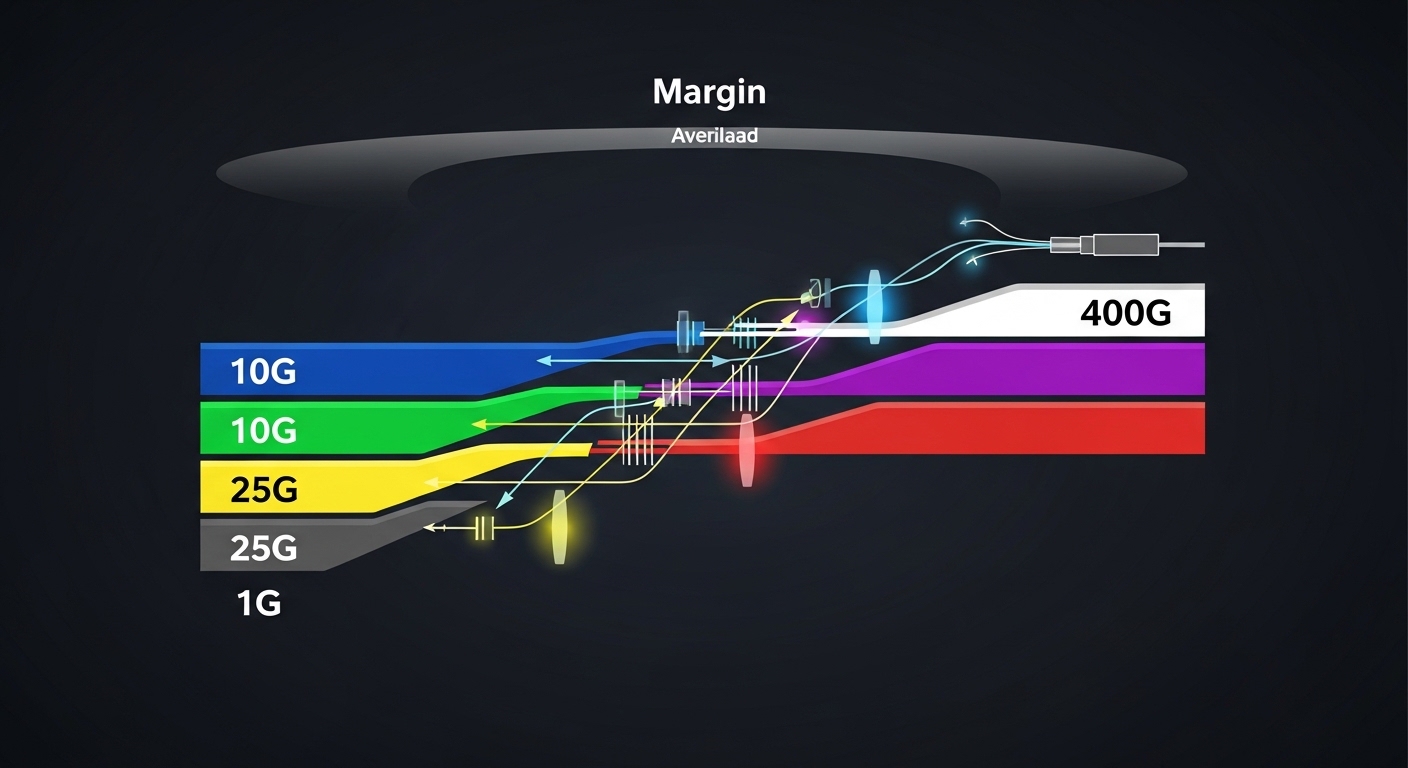
We ran a controlled rollout in a 3-tier leaf-spine topology: 48-port 10G ToR switches feeding 2x spine pairs, with 1/4 of ToR uplinks initially populated using mixed OEM-compatible optics. The symptom was classic: elevated ECN-marked flows and intermittent retransmissions during peak backup windows, even when link utilization looked “fine” in dashboards. Field measurements showed link margin variability: receiver power hovering close to threshold on several fibers, and a small but persistent rise in link flap events.
The remediation focused on optical link quality and diagnosability. We replaced the highest-flap optics with known-good transceiver models (examples: Cisco SFP-10G-SR where platform-validated, and third-party equivalents like Finisar FTLX8571D3BCL or FS.com SFP-10GSR-85 for consistent DOM behavior). Then we standardized fiber handling: cleaning every MPO/LC interface with a lint-free process and re-terminating two suspect trunks. After rollout, we tracked network performance via retransmission counters and observed a drop in link flap rate from roughly 0.8 events/day to <0.05 events/day on the stabilized uplink set.
What “advanced optical technologies” meant in practice
In this case, “advanced” did not mean exotic modulation. It meant better predictable behavior under real conditions: stable laser bias current, better receiver sensitivity margins, and reliable digital monitoring (DOM). For 10G SR, the standard target is IEEE 802.3ae 10GBASE-SR, operating over 850 nm multimode fiber with modal dispersion limits. When transceiver selection is inconsistent, you get link margin drift that only shows up under temperature swings and aging.
Pro Tip: If your switch supports DOM, use it as a first-class signal for network performance. Track RX power and laser bias trends over days; a slow drift toward low RX power is often a faster predictor of future link flaps than immediate error counters.
Optics selection: the specs that actually impact network performance
Engineers often choose optics by “it works in the lab.” In production, link power budgets, connector loss, and DOM compatibility dominate. Below is a practical comparison for common 10GBASE-SR optics used in short-reach multimode deployments.
| Parameter | 10GBASE-SR (Example) | Typical Impact on Network Performance |
|---|---|---|
| Wavelength | 850 nm | Determines fiber attenuation and modal behavior |
| Rated reach | 300 m over OM3; up to 400 m over OM4 | Reach margin shrinks with connector and splice loss |
| Data rate | 10.3125 Gbps (10G line rate) | Wrong optics can cause link training or instability |
| Connector | LC duplex (SR) | Connector cleanliness directly affects RX power |
| DOM support | Often implemented for SR | Enables monitoring of RX power and laser bias |
| Operating temperature | Commonly 0 to 70 C | Temperature drift affects laser bias and sensitivity |
| Power budget concept | Vendor datasheet RX sensitivity + Tx power | Low margin leads to retransmissions during stress |
Selection criteria / decision checklist
- Distance vs. real link loss: compute budget using worst-case connector loss (including patch panels, MPO/LC adapters, and splices), not just “rated reach.”
- Switch compatibility: confirm the platform’s transceiver qualification list to avoid DOM quirks or link behavior differences.
- DOM and alarm thresholds: verify that your switch reads DOM fields consistently (including temperature, Tx bias, Tx power, and Rx power).
- Operating temperature and airflow: check whether the transceiver will sit near a hot exhaust zone; budget additional margin for thermal drift.
- Vendor lock-in risk: OEM optics can reduce uncertainty, but third-party options can be acceptable if they show stable DOM and consistent optical characteristics.
- Fiber type alignment: ensure OM3 vs OM4 expectations match your cabling plant; SR optics are sensitive to modal dispersion limits.
Deployment playbook: how to validate network performance before and after swap
Validation should be measurable, not subjective. Before swapping optics, capture baseline counters for the affected uplinks: link flap counters, CRC errors, FEC counters if present, and retransmission metrics at the transport layer. Then run a controlled traffic profile: for example, 10G iPerf3 streams plus a backup workload that produces bursty flows. During the test, poll DOM every 60 seconds and correlate spikes in RX power dip with any link state changes.
After replacement, keep the test environment stable: same patch cords, same number of transceiver insertions, and the same routing. In our case, the biggest win came from eliminating the lowest-margin optics and cleaning the interfaces before re-running the same workload. Network performance improved because retransmission pressure dropped, which reduced queue buildup and improved tail latency under burst traffic.
Common pitfalls and troubleshooting tips
Even “compatible” optics can degrade network performance. Here are concrete failure modes we saw repeatedly in production.
- Pitfall 1: Link flaps after optic replacement
Root cause: insufficient fiber cleaning or damaged connector end-face leading to intermittent RX power dips.
Solution: clean with an approved fiber cleaning tool and inspect with a scope; re-terminate if end-face damage is visible. - Pitfall 2: Works at low utilization, fails under backup peaks
Root cause: link margin too tight; temperature and launch power drift push the link below sensitivity threshold during stress.
Solution: validate DOM trends for Tx bias and Rx power over time; choose optics with comfortable RX sensitivity headroom for your measured link loss. - Pitfall 3: DOM alarms but no visible traffic errors
Root cause: switch-specific DOM parsing differences; some platforms flag DOM fields but do not map them to operational alarms consistently.
Solution: confirm field mapping in the switch CLI; base decisions on correlated physical-layer counters plus DOM, not DOM alone. - Pitfall 4: Mixed optics across the same uplink pair
Root cause: asymmetric optical characteristics (Tx power, receiver sensitivity) cause one direction to run closer to threshold.
Solution: standardize transceiver model numbers across a port group and re-verify reach assumptions after any patching change.
Cost and ROI: what you should expect to spend
Pricing varies by vendor and qualification status, but realistic street ranges for 10G SR SFP-class optics often fall around $40 to $120 per module, with OEM-branded options frequently higher. TCO hinges on failure rates and operational overhead: if a marginal optic causes intermittent link flaps, you lose engineering time and risk cascading congestion during peak events. In our case, the ROI came from reducing troubleshooting cycles and improving tail latency during backups; even a small reduction in retransmissions saved enough operational effort to justify standardizing optics and fiber hygiene across the uplink set.
Be honest about tradeoffs: OEM optics can reduce compatibility risk, while third-party optics can deliver similar performance if DOM behavior is consistent and the model is validated on your platform. Always validate with your exact switch model and your exact cabling plant.
FAQ
How does optical reach relate to network performance in practice?
Reach is a budget, not a guarantee. Network performance degrades when connector loss, splice loss, and thermal drift reduce margin enough to increase retransmissions or link retraining. Always compute a real power budget from measured link loss and then validate with DOM and error counters.
Do I need DOM support to improve network performance?
DOM is not strictly required for link operation, but it materially speeds diagnosis. With DOM, you can detect slow optical degradation before errors spike, and you can correlate RX power dips to traffic events. That reduces mean time to restore and improves operational agility.
Are third-party optics safe for production?
They can be, but only if they behave consistently with your switch and cabling plant. Validate model numbers on the target platform, confirm DOM field compatibility, and run a traffic plus temperature test that resembles your peak workload. If the platform uses strict qualification, prefer OEM or a vendor with published compatibility evidence.
What is the fastest troubleshooting path for link flaps?
First, inspect and clean connectors, then verify RX power stability through DOM polling. Next, check for patch cord swaps, adapter mismatches, and any recent cabling changes. If the behavior persists, replace optics in a controlled A/B test while keeping fiber constant.
Which fiber type matters most for short-reach optics?
OM3 vs OM4 impacts modal dispersion limits and effective performance at 850 nm. If your cabling plant is older or has unknown patch panel losses, assume margin is worse than the nominal spec. Measure link loss and treat reach ratings as upper bounds.
Closing summary
Network performance gains with advanced optical technologies come from engineering discipline: selecting optics with sufficient optical margin, enforcing fiber hygiene, and using DOM to catch drift early. If you want the next validation step, review how to calculate optical power budget for short-reach links and build a repeatable lab-to-production test plan.
Author bio: I build and validate
